1. What Tolantongo actually is
Grutas de Tolantongo is not a spa resort. It is a canyon-floor park operated by the local Hñähñu (Otomí) indigenous community in the municipality of Cardonal, deep in Hidalgo's Mezquital Valley. The name Tolantongo comes from Nahuatl roots most likely tied to tule reeds and the warmth of the thermal springs — a reference to the hot water that has defined this place for centuries.
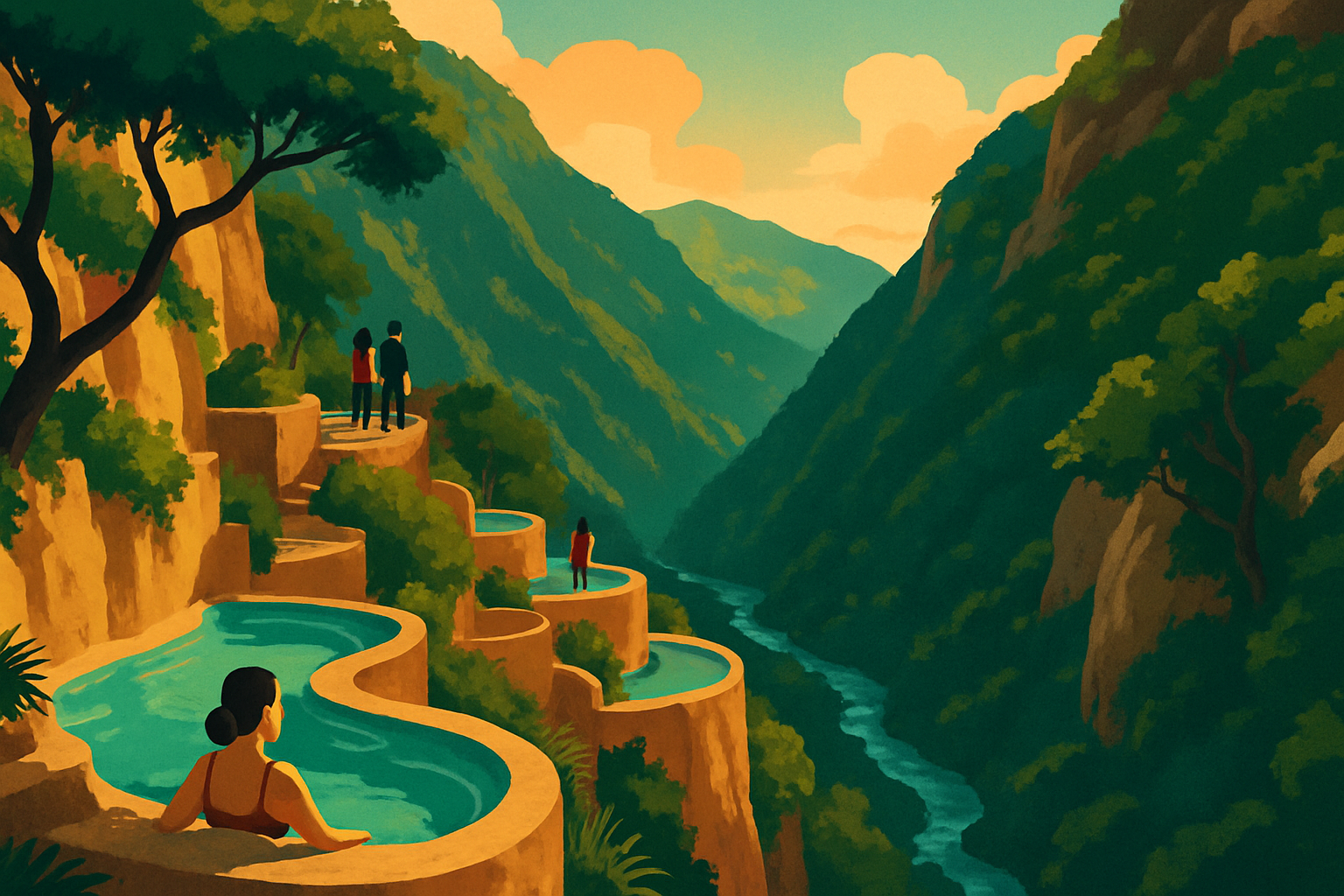
The visual anchor is the cliff pools (pozas): a series of man-made concrete pools terraced into a near-vertical rock face above the Tolantongo River, fed by springs that emerge directly from the canyon wall at 36–38°C. The water is loaded with calcium carbonate, which gives it a luminous turquoise color that looks improbable in photographs and somehow more improbable in person. The pools cascade from level to level, each slightly cooler than the one above, spilling into the gorge below while you sit neck-deep with canyon walls on three sides and open sky on the fourth.
Beyond the cliff pools, the site has a gruta — a natural cave with a thermal river running through it that you wade in near-darkness — a lower outdoor pool complex at the canyon floor with water slides for families, a zipline, and camping grounds. Most visitors stay 4–6 hours, though sleeping in the canyon overnight changes everything.
2. Getting there from Mexico City by bus
The bus route starts at Terminal Central de Autobuses del Norte — Mexico City's northern terminal, reached via Metro Line 5 (yellow line) to the Autobuses del Norte station. Multiple operators including Herradura de Plata and Autobuses Estrella de Oro run frequent service to Ixmiquilpan, the main city of the Mezquital Valley and your transfer hub. The trip takes approximately 2 to 2.5 hours and costs around 150–200 MXN one way. Buses depart starting around 5 AM.
From Ixmiquilpan, you have two options. You can take a shared colectivo van toward Cardonal (30–40 minutes, roughly 30–50 MXN) and then a second colectivo or taxi for the final descent into the canyon (another 20–30 minutes). Or you can hire a taxi directly from Ixmiquilpan all the way to the park entrance for approximately 200–300 MXN for the vehicle — simpler, faster, and worth considering on the return when you are wet and tired.
Total travel time from CDMX: roughly 3 to 3.5 hours. Build extra buffer for transfers; colectivos run when they fill, not on fixed schedules. Leaving Mexico City before 6 AM gives you the best chance of reaching the park when the cliff pools are still lightly occupied.
•Terminal Norte → Ixmiquilpan: Herradura de Plata or Estrella de Oro, ~2–2.5 hours, 150–200 MXN — Metro Line 5 to Autobuses del Norte to get there
•Ixmiquilpan → Cardonal: shared colectivo, ~35 min, 30–50 MXN; then local taxi to park, ~25 min
•Or: taxi Ixmiquilpan → Tolantongo direct, ~200–300 MXN per vehicle — faster, worth it on the way back
3. Getting there by car — and why the last kilometers matter
By car, Tolantongo is approximately 170–180 km from Mexico City and takes 2.5 to 3 hours depending on traffic leaving the city. Take the Autopista 57D north (the Queretaro highway), exit toward Actopan in Hidalgo, then follow Federal Highway 9 east through the Mezquital Valley through Ixmiquilpan and on to Cardonal. From Cardonal, follow signs to Grutas de Tolantongo — the final 13–15 km descends steeply into the canyon on an unpaved road. In the dry season it is passable in a regular sedan; in heavy rain, a higher-clearance vehicle is safer.
The descent into the canyon on that final stretch is part of the experience: dramatic exposed cliffs, the temperature rising as you drop below the mesa, the subtropical vegetation thickening as the canyon floor appears. Paid parking is available at the park entrance. Leave Mexico City before 7 AM on weekdays to clear CDMX traffic and avoid midday arrival.
4. The cliff pools, the cave, and what to expect
The cliff pools are the reason most people make the trip, and they deliver. A path from the entrance climbs along the canyon wall to reach the terraced pool system built directly into the rock face. There are multiple pools at different heights; the uppermost ones are the smallest and hottest — fed directly by the spring — and each successive pool is slightly larger and slightly cooler as the water descends. At non-peak times you can claim a pool that is genuinely secluded: walled by rock on three sides, open to the gorge and sky on the fourth. The calcium carbonate in the water is most vivid in direct sunlight, which hits the upper cliff face from mid-morning through early afternoon.
The gruta (cave) is a separate attraction. You wade from the canyon floor into a natural cave entrance and follow the thermal river through it for roughly 150 meters, the rock ceiling low in places, the water warm and knee-to-waist deep depending on the season. It is more atmospheric than athletic — a sensory contrast to the open air above, and genuinely dark. Bring a waterproof flashlight or rent one at the park entrance.
At the canyon floor, a larger outdoor pool complex with multiple pools and water slides serves families and tends to get the most crowded. If the pozas and the cave are your priority, go there first before the crowds build and finish the lower complex at the end of the day when the cliff pools are cooling.
•Upper cliff pools: hottest and most private — arrive early and claim one before 11 AM
•Cave (gruta): ~150 m of wading through a warm thermal river in near-darkness — waterproof flashlight essential
•Lower complex: water slides and larger pools, good for families, fills up on weekends
5. Timing: weekdays, seasons, and what June looks like
The single most important timing decision is weekday versus weekend. On Saturdays and Sundays — especially during summer and school holidays — the park draws large crowds from Mexico City and surrounding cities in Hidalgo and Queretaro. Parking fills by mid-morning, the cliff pools develop queues, and the canyon feels like a public pool rather than a hidden gem. On a Tuesday or Wednesday, even in summer, the park has a completely different quality: you can sit alone in a cliff pool for an hour, walk through the cave with no one in front of you, and get food at the stalls without waiting.
In terms of season, Tolantongo operates year-round. June through October is Hidalgo's rainy season, which brings afternoon rains that typically clear within an hour and turn the canyon dramatically green. The thermal pools are warm regardless of rainfall. November through February is when the contrast between the cool canyon air and the 36–38°C water is sharpest, which many visitors find more pleasurable than summer. June and July are busy months overall, but the greenery of the canyon in the rainy season is worth seeing if a weekday visit is possible.
6. What it costs, what to bring, and where to eat inside the park
Admission runs approximately 150–250 MXN per person, with separate fees for parking, the cave, and activities like the zipline. Prices have increased gradually over the years as the park has expanded — check for current rates before going, as they vary by season. Bring cash only: there are no ATMs inside the canyon. The nearest bank machines are in Ixmiquilpan; withdraw enough for entry, food, return taxi, and tips before the final colectivo leg.
Water shoes are not optional. The cave floor is rocky and slippery, the thermal river crosses uneven stone, and the cliff paths between pools are perpetually wet. Flip-flops work for some; closed-toe water shoes with grip are better and save you from at least one awkward slip in the cave. Biodegradable sunscreen is required by the park — regular chemical sunscreens are turned back at the entrance. Standard reef-safe or mineral sunscreen qualifies.
Food stalls and small restaurants inside the park serve barbacoa, tacos, quesadillas, and fresh juices at reasonable prices. The corn from the Mezquital Valley makes genuinely good tortillas and the green salsa at most stalls uses a local chile variety you won't find in Mexico City. Eat lunch here rather than packing in your own — the stalls give you a reason to leave the water.
•Entry: ~150–250 MXN per person (check current rates; varies by season and updates regularly)
•No ATMs at the park — withdraw pesos in Ixmiquilpan before the last leg
•Pack: water shoes, biodegradable sunscreen, dry bag for your phone, change of clothes
7. Can you do it as a day trip? And is it safe?
Day trip or overnight? A day trip by bus is doable but tight. Leaving Mexico City by 6 AM and arriving by 10–10:30 AM gives you roughly 5–6 hours in the canyon before you need to begin the return journey to make the last colectivo to Ixmiquilpan and last bus to CDMX — typically by 6 or 7 PM from Ixmiquilpan. That is enough time for the cliff pools and the cave with a lunch break. If you want the zipline, the lower pools, and an unhurried afternoon, plan an overnight. The park has cabanas at the canyon floor (basic wooden lodges, approximately 500–900 MXN per night) and camping grounds. Waking up in the canyon before the day visitors arrive — the thermal mist rising off the pools in cool morning air — is a different place entirely from the midday rush.
Is it safe? Yes. Tolantongo is a family-oriented park run by a local indigenous community with on-site security. The risks are physical rather than criminal: wet stone surfaces in the cave and on the cliff paths cause slips — water shoes reduce this significantly. The canyon road should not be driven at night by anyone unfamiliar with it. Use registered taxis from Ixmiquilpan rather than informal rides for the final leg. Exercise normal precautions with valuables and start the road back up before dusk if you are driving yourself.