1. The mountain town most Mexico City visitors never reach
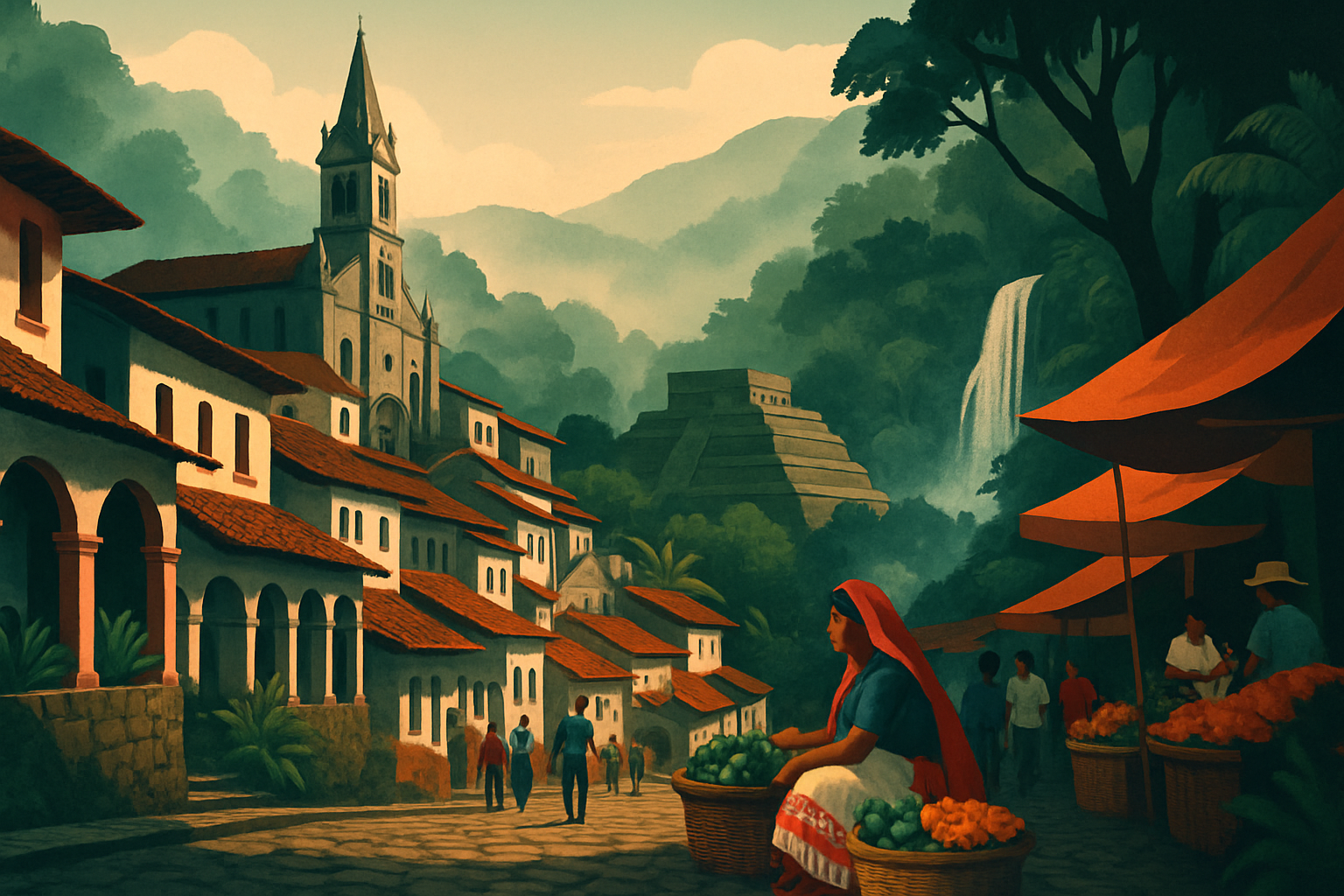
Cuetzalan del Progreso sits at around 1,000 meters above sea level in the Sierra Norte de Puebla, wrapped in cloud forest mist for much of the year. The name comes from Nahuatl — cuezali, meaning the quetzal bird and the flame-colored feathers used in Totonac ceremony. The town earned its designation as a Pueblo Magico in 2002, but unlike many Pueblos Magicos that lean on that branding to paper over an empty plaza, Cuetzalan is specific: its Sunday tianguis fills with Totonac and Nahua vendors in traditional dress selling handwoven textiles, vanilla, and ground cacao; its surrounding hills are planted with shade-grown organic coffee; and eight kilometers outside town, a set of Totonac pyramids sit in a jungle clearing that sees fewer visitors in a month than Teotihuacan gets before noon.
The practical challenge is distance — about 300 km northeast of Mexico City, the last 30 on winding mountain roads. Most visitors make it a weekend trip rather than a single-day dash. But Cuetzalan rewards the commitment in a way that a same-day Cholula run does not. If you want to compare what a Cholula day trip looks like instead, see the Cholula from Mexico City guide.
2. Getting from Mexico City to Cuetzalan
The standard route starts at TAPO — Terminal de Autobuses de Pasajeros de Oriente — reached via Metro Line 1 to San Lazaro. ADO and AU buses run from early morning through early afternoon to Zacapoaxtla, a Sierra Norte market town about 3 hours northeast. Tickets cost 220–250 MXN one way; no advance booking required. At Zacapoaxtla, walk to the main market square and look for the shared colectivo vans running the final 30 km to Cuetzalan. The colectivo takes 45–60 minutes on a descending mountain road and costs 50–70 MXN per person. Total travel time CDMX to Cuetzalan: 4.5 to 5 hours.
Direct ADO service from TAPO to Cuetzalan runs on some weekend departures — worth checking before you go if you want to skip the transfer, but the Zacapoaxtla connection is reliable and not significantly slower. By car, take the Puebla autopista east, then Highway 129 north through Zacatlan toward Zacapoaxtla. The final 30 km descends steeply into the Sierra with hairpin turns that are beautiful in the dry season and demand real caution during the July–September rains.
•TAPO → Zacapoaxtla: ADO or AU bus, ~3 hours, 220–250 MXN one way — Metro Line 1 to San Lazaro to reach TAPO
•Zacapoaxtla → Cuetzalan: colectivo van from the market square, ~45 min, 50–70 MXN per person
•By car: Puebla autopista east, then Hwy 129 north through Zacatlan to Zacapoaxtla — last 30 km is steep mountain road
3. The zocalo, the Voladores, and the tianguis market
The town center of Cuetzalan is built on a hillside, with the main plaza anchored by the Iglesia de San Francisco de Asis — a 16th-century colonial church in gray stone, unusually restrained for Mexico in its decoration, surrounded by trees whose canopies blur the plaza edges. On a clear morning the view from the churchsteps looks out over layer after layer of mist-covered ridgelines.
The real event is the Sunday tianguis. Every Sunday and during major holidays, Totonac and Nahua vendors from surrounding communities fill the streets around the plaza with stalls selling handwoven textiles, vanilla beans and extract, dried chiles, local mezcal, and prepared food. Women vendors often wear the traditional Totonac costume of the Sierra: a white quexquemitl (a triangular woven upper garment) over a dark skirt, with elaborately braided and ribbon-decorated hair. The market is not a craft fair for tourists — it functions as a regional supply market for surrounding communities, which makes it more interesting.
On market days and during the Fiesta de San Francisco in early October, the Voladores ceremony is performed near the plaza: four Totonac men climb a 30-meter wooden pole and descend spinning by ropes tied to their ankles, while a fifth plays a drum and flute at the top. The Voladores ritual is a UNESCO-recognized intangible cultural heritage, and seeing it in Cuetzalan — where it is a living community ceremony rather than a stage performance — is a different thing entirely from seeing it as a tourist demonstration in Papantla.
4. Yohualichan: Totonac pyramids in the cloud forest
Eight kilometers from Cuetzalan on the road toward Zacapoaxtla, the Zona Arqueologica de Yohualichan is the town's most undervisited attraction. The site's name means 'House of the Night' in Nahuatl, and at its peak between 600 and 900 AD it was a major ceremonial center of the Totonac civilization — a regional predecessor to the more famous El Tajin on the Veracruz coast.
What makes Yohualichan architecturally distinctive is the niche style it shares with El Tajin: stepped pyramidal structures whose platforms are marked by rows of small rectangular niches, originally painted and believed to have held offerings or effigies tied to the solar calendar. The main pyramid has characteristic rounded corners and a broad central stairway. The site covers about 3 hectares of excavated and reconstructed structures including the main pyramid, a ball court, and several secondary platforms. Unlike Teotihuacan, where the scale can be overwhelming, Yohualichan is intimate — you can walk the entire accessible area in 45 minutes and have the space to actually look at the stonework rather than navigate crowds. On weekday mornings it is not unusual to arrive and find yourself alone on the site.
To get there, take a colectivo from the Cuetzalan market square toward Zacapoaxtla and ask to be dropped at Yohualichan — about 15–20 minutes and 20–30 MXN. The site is open Monday through Sunday from 10 AM to 5 PM. Admission is the INAH standard: around 85 MXN.
•8 km from Cuetzalan toward Zacapoaxtla — colectivo from the market square, 15 min, 20–30 MXN
•Open Monday through Sunday, 10 AM to 5 PM — admission ~85 MXN (INAH standard)
•The niche-style pyramids share architectural DNA with El Tajin in Veracruz — peak construction 600–900 AD
5. Waterfalls: Las Brisas, Tres Caidas, and El Salto
The waterfalls around Cuetzalan are fed by the cloud-forest precipitation of the Sierra Norte and run strongest from May through October. Three are regularly visited:
Cascada Tres Caidas is the closest to the centro — a three-tiered waterfall about 2 km downhill from the plaza, reachable on foot in around 30 minutes. The path is steep and often muddy; the payoff is a swimming hole at the base that runs cold and clear. It is the most popular waterfall with day visitors.
Cascada Las Brisas sits about 3 km deeper into the cloud forest and involves a more demanding descent. The pool here is larger, the surrounding vegetation denser, and on weekday mornings it is often empty. A local guide is helpful for this one but not essential if you ask for directions at the hotel.
El Salto is the most dramatic — a taller single-drop waterfall that requires either a registered guide or very clear directions, as the unmarked path forks in ways that are easy to misread. Guides are available through hotels and the turismo office on the plaza and typically charge 200–350 MXN for a 3–4 hour waterfall circuit that takes in at least two of these three.
Wear waterproof shoes or sandals you don't mind soaking. In the rainy season (June–October), afternoon clouds move in predictably by 2 PM — plan to be on the trail by 10 AM.
•Tres Caidas: 2 km downhill from the plaza (~30 min on foot), three tiers, swimming hole at the base
•Las Brisas: 3 km deeper, larger pool, best on weekday mornings when it is empty
•El Salto: the tallest drop, unmarked trail — hire a guide (200–350 MXN for a 3–4 hr waterfall circuit)
6. Coffee, vanilla, and what to eat in Cuetzalan
Cuetzalan sits at the edge of one of Mexico's cloud-forest coffee-growing zones, and the shade-grown organic coffee produced in the hills above town is genuinely distinctive — richer and earthier than what passes for coffee in most Mexican tourist destinations. Small cafes around the centro brew it fresh, and local producers sell roasted beans at the Sunday tianguis. If you drink coffee, this is the thing to track down.
Vanilla is the other local product worth paying attention to. The Sierra Norte de Puebla is part of the broader Totonac vanilla-cultivating tradition (the Totonac were the first to cultivate vanilla anywhere), and the artisan vanilla extract and pods sold at the market are significantly different in aroma and quality from commercial extract.
For food, the centro has several pozolerias and antojito spots. The dish specific to this area is mole de Cuetzalan — a dark mole heavy with dried chiles and cacao, typically served with guajolote (turkey) rather than chicken, and more intensely savory than the moles from Oaxaca or Puebla city. Look for it at the small restaurants on Calle 2 de Abril and the surrounding streets near the market entrance. Tamales wrapped in banana leaf (rather than corn husk) also appear at the market — a Totonac variation worth trying if you see them.
7. How many days, best time to go, and is it safe?
One day or two? One day is technically possible if you catch the first bus from TAPO around 6 AM and leave Cuetzalan by 5 PM — enough time for the zocalo, church, and one waterfall. But the real Cuetzalan — morning mist over the plaza, Yohualichan with no other visitors, the market at full pace on Sunday morning — requires an overnight. One night, two days is the minimum to do it properly.
Best time to visit? November through April for dry weather, reliable road conditions, and clear views. The rainy season (June–October) brings the waterfalls to peak volume and turns the sierra dramatically green, but afternoon rains are predictable and the mountain road from Zacapoaxtla requires more attention. Avoid the Fiesta de San Francisco in early October and Semana Santa unless you specifically want the festival — the town fills beyond its accommodation capacity and posadas book out weeks in advance.
Is Cuetzalan safe? Yes — it is a small pueblo magico with active community life and a tourism infrastructure built around its market and natural attractions. Standard precautions apply: use registered colectivos rather than unmarked cars, keep cash in an interior pocket at the market, and don't attempt waterfall trails alone after 4 PM. The population is largely Totonac and Nahua communities with close social fabric; violent crime is not a feature of the town.
What to bring: Cash (ATMs exist but connectivity is inconsistent), insect repellent for the waterfall trails, a rain layer regardless of the forecast, and shoes you don't mind soaking.