A guajolota is one of Mexico City's most specific inventions: a fully steamed tamal, still hot from the pot, slid whole into a split bolillo or telera bread roll. Two carbohydrates, each of which constitutes a complete breakfast on its own, combined into a single handheld object that somehow makes more sense than either one alone.
The name requires an explanation. Guajolote means turkey in Nahuatl. The most repeated theory is that the stuffed, rounded shape of the tamal inside the bread — the way it bulges out the sides — resembles the inflated body of a guajolote. Other sources trace the name to old Mexico City slang where guajolote described something oversized, overstuffed, or slightly absurd. The kind of thing that shouldn't technically exist but does.
The sandwich is also called a torta de tamal in formal writing and food journalism. On the street, in the mouth of the vendor and the customer, it is almost always guajolota. Ordering a 'torta de tamal' at a street cart will get you exactly the same thing — but guajolota marks you as someone who actually lives here.
The guajolota does not make nutritional sense by any modern standard. A tamal is already made from masa (corn dough), filled, wrapped in corn husk, and steamed — a complete starch delivery system. A bolillo is a white bread roll. Putting one inside the other is the food equivalent of putting socks over shoes.
What makes it work is labor economics. A tamal alone dissolves in four bites. A bolillo alone needs filling to be useful. Combined, they create a package with real staying power — enough calories to bridge the 6 a.m. shift start to the 2 p.m. comida, a seven-hour window standard for market vendors, manual workers, and anyone who spends the morning on their feet. The guajolota delivers roughly 800–1,000 calories in a format that takes two hands, 90 seconds, and no utensils.
Mexico City has always optimized for exactly this kind of efficiency. The same logic that produced tacos de canasta — tacos stacked in a basket, pre-filled, sold from a bicycle — produced the guajolota: maximum fuel, minimum time, minimum cost. These are not convenience foods in the modern fast-food sense. They are the product of generations of optimization by a working city.
Get short, interactive stories that make each place easier to remember while you travel.
The tamal inside a guajolota is the same tamal the vendor sells plain — so the filling you choose determines the character of the whole sandwich.
Rajas con queso (roasted poblano strips with melted Oaxacan cheese) is the most popular option and the one most vendors keep in the largest quantity. The chile smoke carries through the corn dough and the cheese adds richness. It is the vegetarian option and the one most likely to still be available after 9 a.m.
Pollo en salsa verde (chicken in tomatillo sauce) has a bright acidity that cuts through the heaviness of the masa. A well-made salsa verde tamal is more complex than it sounds — epazote-scented broth, fresh tomatillo, a little green chile — and the guajolota format keeps it from drying out.
Cerdo en mole rojo (pork in red mole sauce) is the heavyweight. The mole soaks into the masa during steaming so the dough itself carries the flavor. It is the filling most likely sold out by 8 a.m. If you find one, it is worth the extra five pesos.
Tamales dulces (sweet tamales, usually pink or green, filled with raisins or fruit) appear at some vendors alongside the savory options. They work inside a guajolota, though most locals eat them plain. Avoid any vendor still selling from a half-empty pot at 10 a.m. — guajolota is a morning food, and tamales sitting since before dawn show it.
Rajas con queso: the standard — most common, vegetarian, still available past 9 a.m.
Cerdo en mole rojo: the best version — sells out fastest, worth arriving early
If tamales dulces are offered, eat them plain — sweet filling plus bread roll is specifically an acquired taste
Guajolota vendors operate at intersections of foot traffic and hunger: metro exits, market entrances, bus stops, and church corners on Sunday mornings.
Metro station exits are the most consistent source. The exits from Metro Chilpancingo (Line 9) on Insurgentes Sur, Metro Pino Suárez (Lines 1 and 2) in Centro Histórico, and Metro Balderas (Lines 1 and 3) between Centro and Doctores all have established tamal vendors with regular morning operations. The corner holds its reputation regardless of which vendor occupies it — regulars know the spot, and competition keeps quality up.
Mercado de Jamaica (Congreso de la Unión at Hermanos Flores Magón, Colonia Jamaica) is one of the most reliable locations in the city. The market opens at 5 a.m. for the wholesale flower trade, which means tamal vendors outside are set up by 6. The volume of early foot traffic keeps the tamales fresh — they sell fast enough that nothing sits.
Centro Histórico on weekday mornings — the streets feeding into Calle 5 de Mayo, the corridor between Correo Mayor and Pino Suárez, and the sidewalks around the Zócalo metro exits — runs a full breakfast street-food operation between 7 and 9:30 a.m. This is Mexico City in full working mode and one of the better places to eat a guajolota in its natural context.
Sunday mornings outside churches in working-class colonias like Tepito, Colonia Guerrero, and Peralvillo produce the largest concentrations. Post-Mass hunger is a reliable market force, and vendors set up on the surrounding streets accordingly.
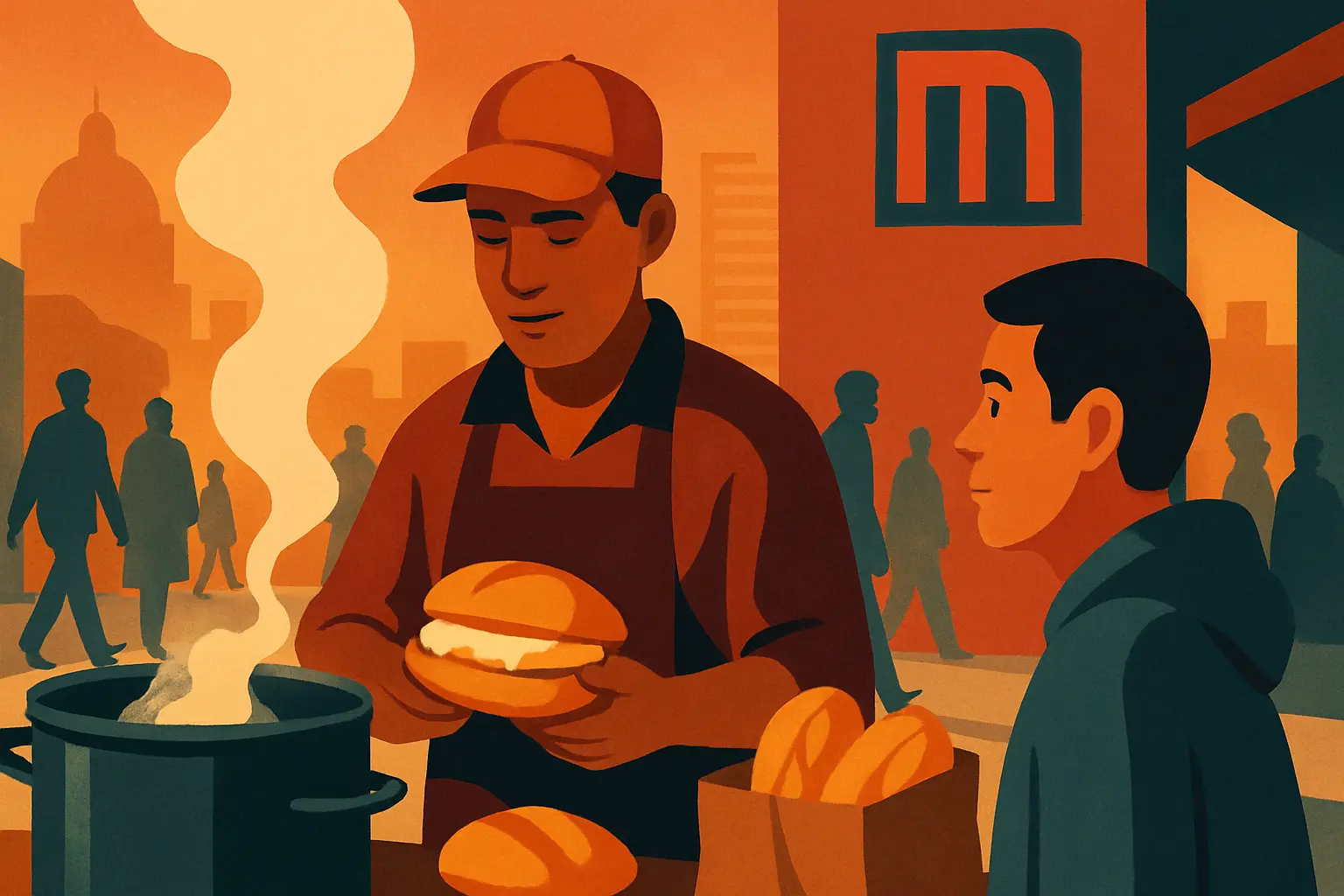
A guajolota vendor has a specific visual profile: a large aluminum pot or wooden crate lined with cloth, filled with corn-husk-wrapped tamales and covered to hold the steam. Beside it, a bag of bolillos or teleras. The vendor stands, not sits, because they expect to be selling continuously.
The tamalero call — a long, echoing '¡Ricos tamales calientes!' or simply '¡Tamaleeeees!' — is one of Mexico City's most recognizable sounds. In residential colonias, tamaleras push carts through the streets at dawn, calling up to apartment windows. The Sunday morning version, in neighborhoods with traditional market culture, carries a sustained musical quality that functions almost as a neighborhood alarm clock.
The transaction is fast. You name your filling. The vendor opens the pot, pulls a tamal with tongs, splits a bolillo, and inserts the tamal — keeping the corn husk on until you hold the sandwich and peel it yourself. Money changes hands after the food is in your hand. No condiments are standard; some vendors offer salsa from a separate container.
The correct way to eat a guajolota is standing on the sidewalk, peeling back the corn husk gradually as you go, using the husk as a handle until the tamal is entirely consumed. Before 8 a.m., ideally.
Corn husk stays on until you peel it back — use it as a handle while eating
Pay after the food is in your hand, not before
For salsa: ask '¿Tiene salsa?' — it's available at some carts but never automatic
If you walk up speaking no Spanish and point at the pot, you will be served. The transaction does not require language. But knowing the words makes it faster and more specific.
'¿Tiene guajolotas?' asks whether guajolotas are on offer and prompts the vendor to list available fillings. Most will answer with something like 'De rajas, de pollo verde, y de mole' — the three they have that morning.
'Una de rajas' means one with poblano and cheese. 'Una de pollo verde' means one with chicken in tomatillo sauce. 'Una de mole' means one with pork in red mole. 'Una de dulce' means a sweet one.
The complete sentence is: 'Una guajolota de rajas, por favor.' Delivered at normal conversational pace, this identifies you as someone who has eaten a guajolota before. Bring exact change when possible — 20 or 25 pesos in coins — since tamaleros work quickly and small bills are easier than large ones in the morning rush.
Standard street food logic applies: eat where the food moves fast and the vendor has a line. A guajolota vendor serving twenty people in twenty minutes has high turnover — fresh tamales in a hot pot and little time for anything to go wrong. A vendor alone with a half-empty pot at 10 a.m. is serving the remnants of a batch made at 4.
The steaming process is a natural safeguard. Tamales are cooked through during preparation and kept at temperature in the covered pot throughout the morning. The bolillo is sealed until the vendor splits it. The main risk is a tamal that has been sitting for three hours and lost its moisture — this affects texture before it affects safety, but it is a sign to find a different vendor.
A practical rule: find a vendor near a metro exit at 7 a.m. on a weekday. The commuter crowd enforces quality. Nobody who eats guajolotas every morning tolerates a mediocre vendor for long, and the good corners hold their reputation over years. The Mexico City street food guide applies the same logic across the full range of vendors you'll encounter.
Tamal and guajolota vendors are a morning-only phenomenon. The peak window is 6–10 a.m. on weekdays. By mid-morning, the best vendors have sold out and packed up. The exception is tamaleras who push residential carts through colonias like Santa María la Ribera and Narvarte — these sometimes run until noon, but the tamales by that hour are older and the selection is limited.
Sunday is the superior guajolota day. The combination of post-church foot traffic, a slower morning schedule, and extra batch preparation means more options and fresher tamales. The Sunday morning vendor cluster is also the more approachable entry point for a traveler — the pace is slower, the transactions are less rushed, and vendors are more likely to run through their fillings without prompting.
If you are staying in Roma Norte or Condesa, the quickest route to a guajolota is the exit of Metro Insurgentes (Line 1) on Avenida Álvaro Obregón. Vendors set up on the pavement by 7 a.m. and are typically gone by 9:30. For the full range of tamale varieties you will encounter across the city — including the regional styles that show up at Mercado de Jamaica and La Merced — the Mexico City tamales guide covers every major type and where each is easiest to find.