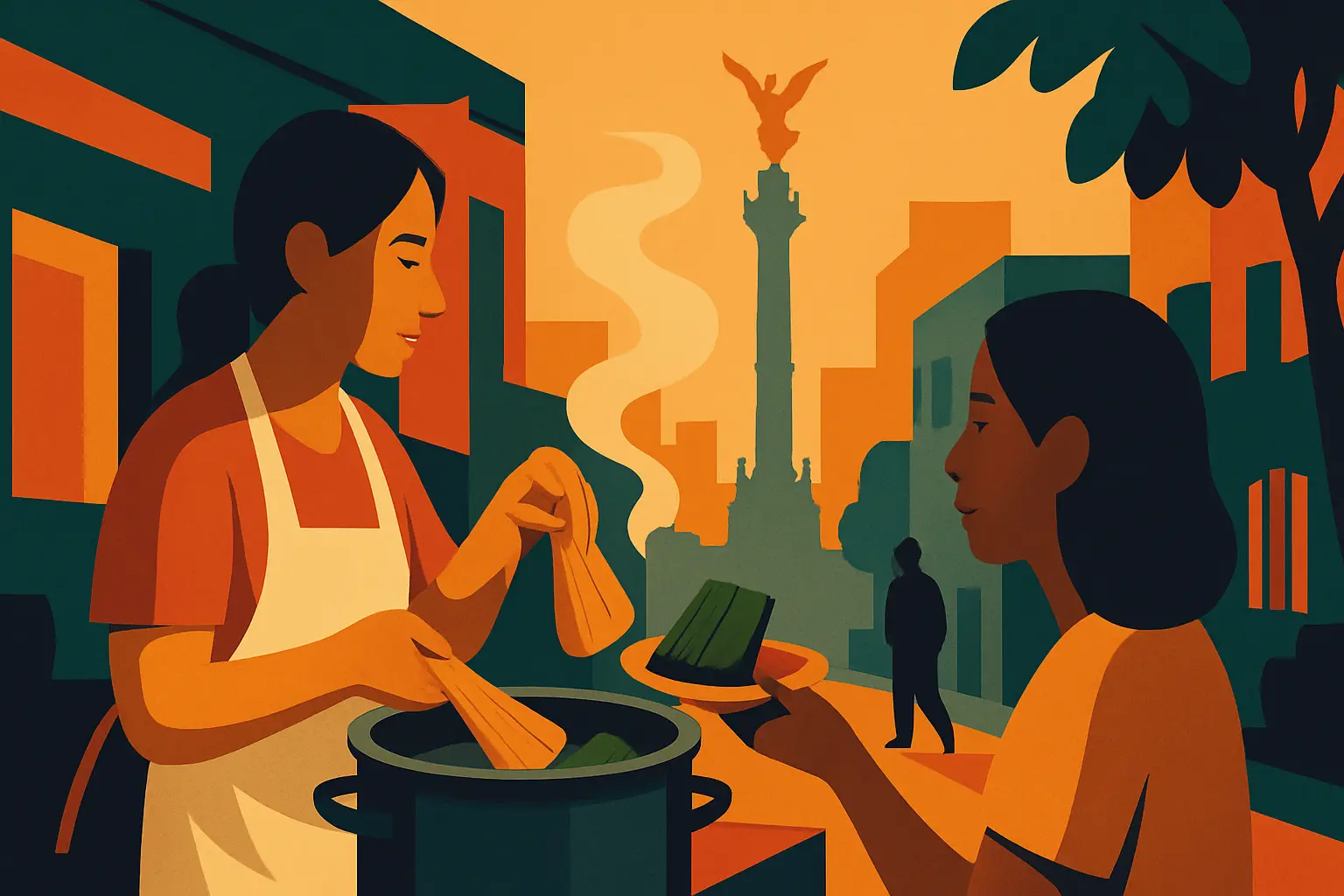
The tamale is one of the oldest prepared foods in the Americas — corn dough wrapped in leaves appears in Mesoamerican cooking as far back as 8000 BCE. Mexico City is not where the tamale was invented, but it is where the format became urban and specific. What CDMX did to the tamale is what it does to everything: absorb regional styles from across the country, compress them into morning infrastructure, and make them part of a daily commute. In most of Mexico, tamales are a festive or weekend food — made in large batches at home, served at celebrations. In Mexico City, tamales are how the city moves before sunrise. Construction workers, market vendors setting up stalls, office commuters at metro exits — all eating a tamale in one hand at 6 a.m. Understanding this is the key to actually finding them. You do not look for tamales in sit-down restaurants at noon. You follow steam and loudspeakers in the dark.
The standard Mexico City tamale is built around a corn masa (dough) enriched with lard, spread onto a dried corn husk, filled, folded, and steamed for roughly 90 minutes. The masa should be light and slightly fluffy — not dense or gummy. Gummy masa means understeamed or packed too tight. The fillings at a typical street cart run four to six options: Rajas con queso — strips of roasted poblano chile with melted Oaxacan cheese, the mildest and arguably most popular option. Mole rojo con pollo — shredded chicken in a dark red mole sauce, earthy and slightly spiced. Salsa verde con cerdo — pork shoulder in tangy tomatillo sauce with serrano chile. Frijoles con queso — refried beans with fresh cheese, the reliable vegetarian choice. Dulce — pink-tinted sweet masa with raisins and cinnamon, more dessert than breakfast but worth ordering once. The correct way to eat a corn husk tamale is to open it by pulling the husk back, eat from the leaf, and leave the husk folded on your napkin. The husk is not edible — it is a wrapper, not a tortilla.
Get short, interactive stories that make each place easier to remember while you travel.
The tamal oaxaqueño is wrapped in a banana leaf instead of a dried corn husk, and this is not a cosmetic difference — it fundamentally changes the flavor. Banana leaf is moist and slightly aromatic, releasing a faint floral-green quality into the masa during steaming. The Oaxacan-style tamale tends to be larger than the CDMX corn husk version, with a softer, more compact masa, and is typically filled with mole negro: a sauce that can contain thirty or more ingredients — dried chiles (chilhuacle negro, mulato, pasilla), plantain, chocolate, dried fruit, and charred tortilla among them. Mole negro has a dark, complex, slightly smoky flavor that layers differently with each bite. It is not sweet the way Americans typically expect chocolate-containing things to taste. It is deep, long, and slightly bitter in the best way. You'll find tamal oaxaqueño at vendors who specifically advertise them on cardboard signs, and at tamalerías in Roma Norte and Coyoacán that specialize in regional varieties. Look for the phrase 'oaxaqueños con mole negro' on handwritten menus — it's one of the most underordered things on any tamale menu because first-timers assume the banana leaf version is harder to eat.
The guajolota is a tamale placed inside a bolillo roll and eaten as a sandwich. It is a completely Mexico City invention that exists almost nowhere else in the country, and it looks absurd on paper: starchy masa inside starchy bread, two carbohydrates with nothing in between except the filling of the tamale. In practice, it works because the crusty bolillo provides structural integrity that a single corn husk tamale lacks when you're eating standing on a crowded metro platform with one hand on a strap. It's the official Mexico City breakfast for people who need one hand free. You'll find guajolotas at street carts outside metro stations — Metro Insurgentes on Sonora, Metro Pino Suárez near Centro Historico, and Metro Tacubaya at the Eje Central entrance are reliable morning spots. The vendor typically has a large steamer pot with tamales, a stack of bolillos, and a cooler with atole. Assembly takes about fifteen seconds. The price is 30 to 45 pesos for the tamale and bread together. Order mole rojo or salsa verde for the guajolota — rajas con queso is too wet for the bread to hold without falling apart. Eat it immediately.
Tamales Flor de Lis (Calle Huygens, Condesa) has operated since 1926, making it the oldest tamalería in continuous operation in Mexico City. It's a casual spot with simple plastic tables, three or four filling options per day, and a menu that barely changes season to season. The corn husk tamales here are lighter than most street versions — the masa has more air in it and less lard. Arrive before 11 a.m. on weekends; they sell out. Tamales Madre (Colonia Juárez) takes the opposite approach: a gourmet tamalería that makes nixtamal fresh daily using creole corn, with fillings that rotate every few weeks. A tamale here costs 60 to 80 pesos and comes plated with a small chile sauce. It is a genuinely different product from anything you'll find at a street cart, and worth the price at least once to understand what the format is capable of. For regional variety in one location, look for tamalerías in Roma Norte and Coyoacán that display chalkboards listing styles from Oaxaca, Chiapas, Veracruz, and Puebla — these spots tend to stock six to eight regional options on any given morning. Show up by 9:30 a.m. before the banana-leaf styles sell out first.
The biggest tamale event in Mexico City is not a festival — it is a debt. On January 6 (Día de Reyes), families across Mexico share a Rosca de Reyes: a large oval sweet bread decorated with candied fruit, with a small ceramic baby Jesus figure hidden inside the dough. Whoever receives the slice containing the baby Jesus is obligated, by informal but completely serious social contract, to buy tamales for the entire group on February 2, Día de la Candelaria (Candlemas). This is why February 2nd is the single largest tamale consumption day of the year in Mexico City — tamalerías take advance orders, steam production roughly doubles across the city, and no one escapes the obligation. Paying for tamales on Candelaria is treated with the same social seriousness as repaying an actual debt. If you happen to be in Mexico City in late January, you'll see tamale pre-orders going up in office kitchens, and by February 2nd, corner steam carts are doing double their normal business. It's one of the clearest windows into how deeply food is woven into social obligation in Mexican culture — a promise embedded in a slice of bread, redeemed one month later in corn and steam.
Prices: Street tamales from a cart or bicycle run 18 to 25 pesos each (roughly $1 to $1.25 USD). A complete breakfast — two tamales and an atole — runs 60 to 80 pesos total. Tamales at a sit-down tamalería like Flor de Lis cost 30 to 45 pesos each. Gourmet tamalerías charge 60 to 80 pesos per tamale. Are street tamales safe? Yes, at high-turnover vendors. Tamales are steamed at temperature and stay sealed inside a covered pot — the closed steam environment makes them one of the safest street foods in the city. The only risk indicator worth watching: a vendor who has been at the same spot for three hours with a nearly full pot has food sitting too long. A vendor surrounded by commuters cycling through a full pot in 45 minutes is fresh stock. Volume and turnover are the real safety signals. What is atole? Atole is a warm, thick corn-based drink paired with tamales since pre-Hispanic times. It comes plain (faintly corn-flavored, only slightly sweet) or as champurrado — a chocolate version thickened with corn masa and piloncillo sugar. Champurrado is the correct pairing with a mole tamale. It is not sweet like hot chocolate; it is thick, starchy, and slightly bitter in a way that cuts through the richness of the masa. Order both at the same time from the same vendor.
When: Tamale vendors operate in two daily windows — early morning (roughly 5:30 a.m. to 10 a.m.) and sometimes early evening (7 p.m. to 9 p.m.). You will not find street tamales at midday. How to find them: Listen for the looping loudspeaker broadcast from bicycle carts — the message cycles through filling names at a volume calibrated to penetrate apartment walls. In neighborhoods like Doctores, Narvarte, and Iztacalco, you can hear them a full block away at 6:30 a.m. You can also look for stationary steam carts near high foot-traffic metro exits — Pino Suárez, Insurgentes, and Salto del Agua (near Centro Historico) are reliable morning spots year-round. Or simply look for any cluster of workers eating standing up near a steaming pot at 7 a.m. — that's the clearest possible signal. Markets are another consistent source: Mercado de Medellín in Roma Sur and Mercado de Coyoacán both have tamal stalls operating from opening until stock runs out. The city's morning food culture — tamale carts, canasta bicycle vendors, corner atole stands — operates on the same principle as the Mexico City taco guide: specific hours, specific geography, and the assumption that you already know the system. Now you do.