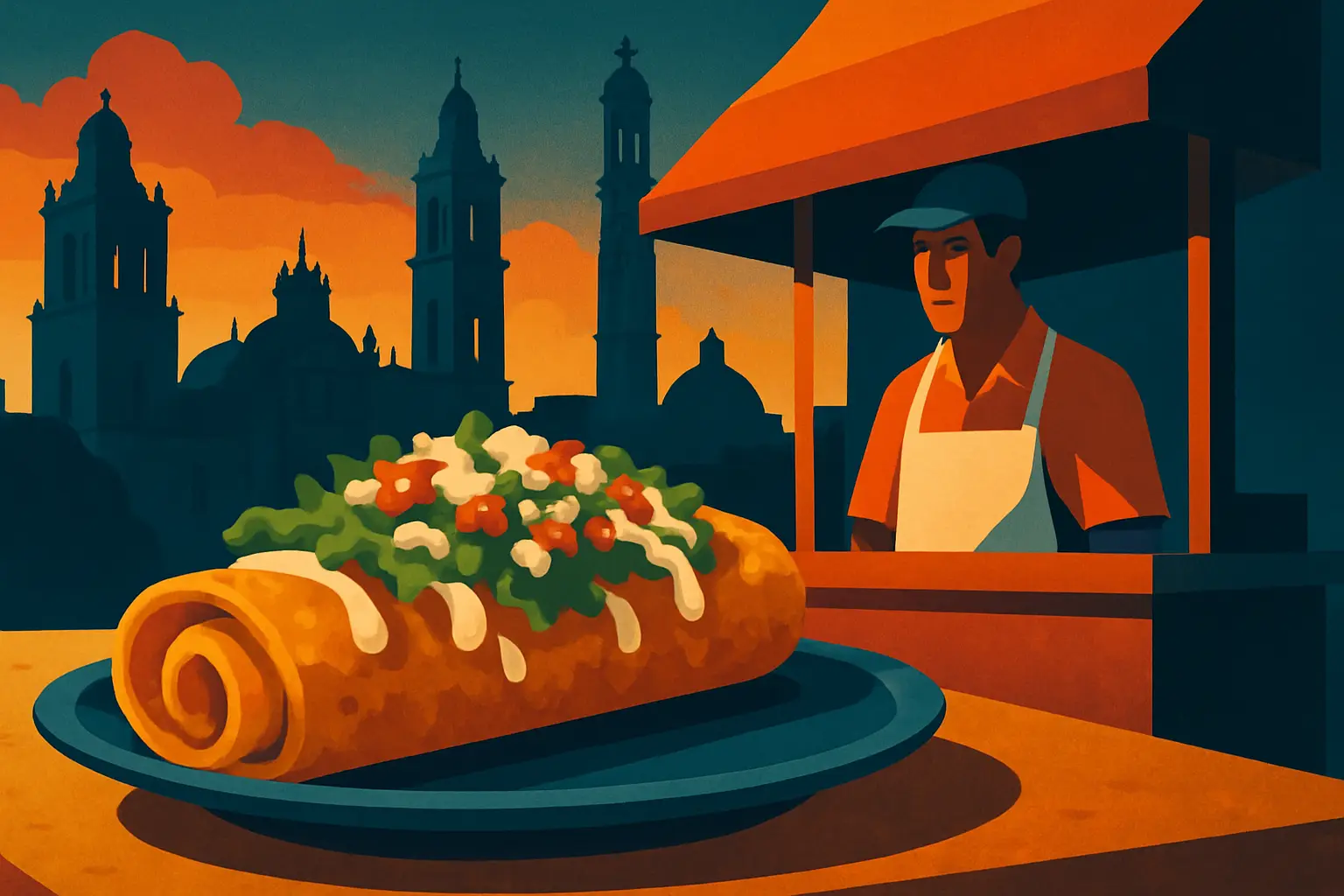
A flauta — the word means 'flute' in Spanish — is a corn tortilla rolled tightly around a filling and deep-fried until firm and golden. The shape is the defining characteristic: narrow, cylindrical, and rigid from frying, which is what makes it a flauta rather than a taco or an enchilada. Enchiladas are soft, sauced, and eaten with a fork. Flautas are crunchy, self-contained, and picked up with your hands. The difference matters texturally: the shell shatters at first contact, the filling inside stays moist, and the construction has a contrast between crisp exterior and soft interior that makes flautas genuinely distinct from any other tortilla preparation in the Mexican street food canon. The size varies — market flautas tend to be longer, made with a standard corn tortilla rolled as tight as possible; restaurant versions are sometimes shorter and thicker. The correct size is irrelevant as long as the shell is fried to order rather than sitting in a warming tray. Pre-fried and held flautas lose the textural contrast within minutes, and that contrast is the entire point of the dish.
The most common question about flautas is whether they are the same as taquitos. The honest answer depends on where you are from. In Mexico City, 'flauta' is the standard term — long, corn tortilla, fried, topped. 'Taquito' (literally 'small taco') is more common in northern Mexico and in Mexican-American cooking in the United States, where it often refers to smaller versions sometimes made with flour tortillas. In CDMX practice, taqueros use both terms without apparent anxiety about the distinction. The one distinction Mexico City food culture does observe is between the standard flauta and the flauta de maíz azul — same preparation, made with blue corn tortilla, which produces a slightly nuttier flavor and a purple-grey shell that looks unusual until you taste it. A few specialty vendors at Mercado de San Juan and in Roma Norte carry the blue corn version. Blue corn tortillas cost more and the flavor earns the premium — but for a first visit, start with the standard corn and save the blue corn for round two.
Get short, interactive stories that make each place easier to remember while you travel.
Most flauta stands in Mexico City offer three or four filling options. Pollo (chicken) is the most common — shredded, typically braised in salsa verde or a mild chile sauce, and the mildest option. It is the right starting point for first-timers because the filling does not compete with the toppings. Papa (potato) is the vegetarian default: mashed potato seasoned with onion and sometimes mixed with rajas (sliced roasted poblano peppers). Papa flautas have a creamier interior texture than pollo and are underrated by people who assume the vegetarian option is the uninspiring one. Barbacoa — slow-cooked beef or lamb — is the most intensely flavored filling, with a depth of seasoning that holds up well inside a fried shell. If a stand has barbacoa, that is the one to order. Picadillo (ground beef cooked with onion, tomato, and chile, sometimes with raisins and olives in the traditional version) is the fourth standard option — more complex than plain chicken, less aggressive than barbacoa. At tianguis stands, fillings are typically visible in trays; you can ask to see what is fresh before committing.
Pollo: mild, good for first-timers, pairs well with salsa verde
Papa: mashed potato filling — underrated, order this if barbacoa is sold out
Barbacoa: most flavorful option, the correct first order whenever it is available
The toppings on a flauta are not optional decoration — they are doing structural and flavor work. The canonical four are: crema (Mexican sour cream, richer and slightly thinner than its American counterpart), lechuga (shredded iceberg lettuce, cold and crunchy — a deliberate temperature contrast to the hot fried shell), cotija (crumbled dry-aged cheese, salty and granular), and salsa (verde for brightness, roja for heat — ask which is hotter before committing at an unfamiliar stand). The assembly sequence matters: crema goes down first as an adhesive layer, then lechuga and cotija, then salsa over the top. Toppings applied in the wrong order slide off the cylindrical shell and you lose the effect of the crema bonding everything. 'Con todo' is the correct order at any stand — it signals that you want all four elements without needing to enumerate them. If a stand offers guacamole as an extra, it belongs under the lechuga, not on top. The combination of temperatures — hot crunchy shell, cold cream and lettuce, room-temperature salsa — is intentional and is one of the reasons flautas function as street food in a way that many other fried preparations do not.
In the 1960s, a small rotisserie chicken shop on Avenida Coyoacan 360 in Colonia Del Valle Norte began serving fried rolled tacos alongside their pollo asado. At some point — the current staff is appropriately vague about the exact moment — the shop started offering a version where finished flautas were lowered into a bowl of salsa verde and left there long enough to absorb the sauce. The shell softened. The filling melded with the salsa. What arrived at the table was neither a crunchy taco nor a conventional enchilada but something in between: the flauta ahogada, the drowned flauta. El Rey de las Ahogadas has spent six decades refining the salsa verde that defines the dish — tomatillo-based, bright and acidic, with fresh chiles that provide heat without obscuring the tartness. The restaurant has expanded to take over adjacent corner space and now runs separate stations for different preparations. Both the crispy standard version and the ahogada version are available, but the drowned preparation is what you are there for. Order a portion of three, request them ahogadas en verde (green salsa, not red), and eat with the spoon that arrives with the bowl — the salsa pools at the bottom and the last third of each flauta is the best part. Thursday through Sunday evenings are the peak window; kitchen volume keeps the salsa at its freshest.
El Rey de las Ahogadas: Av. Coyoacan 360, Colonia Del Valle Norte — operating since the 1960s
Order: ahogadas en verde (drowned in salsa verde) — three pieces is the standard portion for one
Eat with the spoon — the salsa accumulates in the bowl and is part of the dish
Flautas Magos (known locally as 'Las Mugrosas') on Calle Adelina Patti in Colonia Peralvillo is a no-frills street stand with no seating, a fast-moving queue, and flautas made to order with the speed that comes from decades of repetition. The name 'mugrosas' — roughly translating to 'the greasy ones' — is the neighborhood nickname, said with affection. The tianguis on Avenida Amsterdam in Condesa (Tuesdays from around 9 a.m. to 5 p.m.) has a flauta vendor near the eastern entrance that assembles each piece to order, lets you pick your filling from a visible tray, and charges about 15 MXN per flauta. Barbacoa when available; papa if not. Mercado San Juan Arcos de Belen near Metro Salto de Agua has a nameless stand that has been selling corn-tortilla flautas from the same counter location for years — the kind of stall that persists because it is excellent rather than because it is on any list. Comal Oculto in San Miguel Chapultepec (near Calzada Mariano Escobedo) serves a cheese flauta in divorciado style — two salsas, one on each end of the plate so neither overwhelms the other. Michelin-recommended, around four times the tianguis price, and worth it as the sit-down version of the dish.
Flautas Magos (Las Mugrosas): Calle Adelina Patti, Peralvillo — no seating, fast queue, made to order
Tianguis Amsterdam, Condesa: Tuesdays ~9 a.m.–5 p.m. — barbacoa flautas for ~15 MXN
Comal Oculto, San Miguel Chapultepec: cheese flauta divorciado, Michelin-recommended, upscale end of the range
At a market tianguis, three flautas is a standard snack portion. Five or six makes a full meal, though the fried preparation means satiation arrives faster than the count suggests. At El Rey de las Ahogadas, a portion of three ahogadas is standard for one person — the salsa adds volume and the eating pace slows because a spoon is involved. For the Mexico City eating rhythm, flautas fit best as a merienda (the afternoon snack window, roughly 5–7 p.m.) rather than a full comida or late-night meal. This is when most stands are at peak output and when the after-school and after-work crowd that defines good flauta eating creates the right kind of energy. If you eat flautas at a tianguis before noon, the vendor will be functional but the 4 p.m. batch has better texture — the oil is fully at temperature and the cook has found their rhythm for the day. The street food guide covers the broader logic of when and how to eat across CDMX's street food scene if you want the framework behind this.
A flauta at a market tianguis runs 15–25 MXN per piece (roughly $0.75–$1.25 USD). Three pieces with a drink is a satisfying snack for under 100 MXN. El Rey de las Ahogadas runs about 50–80 MXN for a portion of three ahogadas, with drinks extra. Comal Oculto falls in the 120–250 MXN range, comparable to any casual Michelin-listed spot in the city. Getting around: El Rey de las Ahogadas is a 15-minute walk from Metro Coyoacan (Line 3, green) or a short Didi from Del Valle. The Condesa tianguis on Amsterdam is 10 minutes from Metro Chilpancingo (Line 9, brown). Mercado San Juan Arcos de Belen is a two-minute walk from Metro Salto de Agua (Line 8, green). Flautas Magos in Peralvillo is near Metro Tepito (Line 6, red). Budget one hour minimum for El Rey de las Ahogadas — it is a destination worth sitting at rather than eating standing up outside.
Market flautas: 15–25 MXN each — three with a drink is under 100 MXN total
El Rey de las Ahogadas: ~50–80 MXN for three ahogadas — Metro Coyoacan (Line 3), 15-min walk
Metro Salto de Agua (Line 8) → Mercado San Juan Arcos de Belen: 2-min walk from the exit