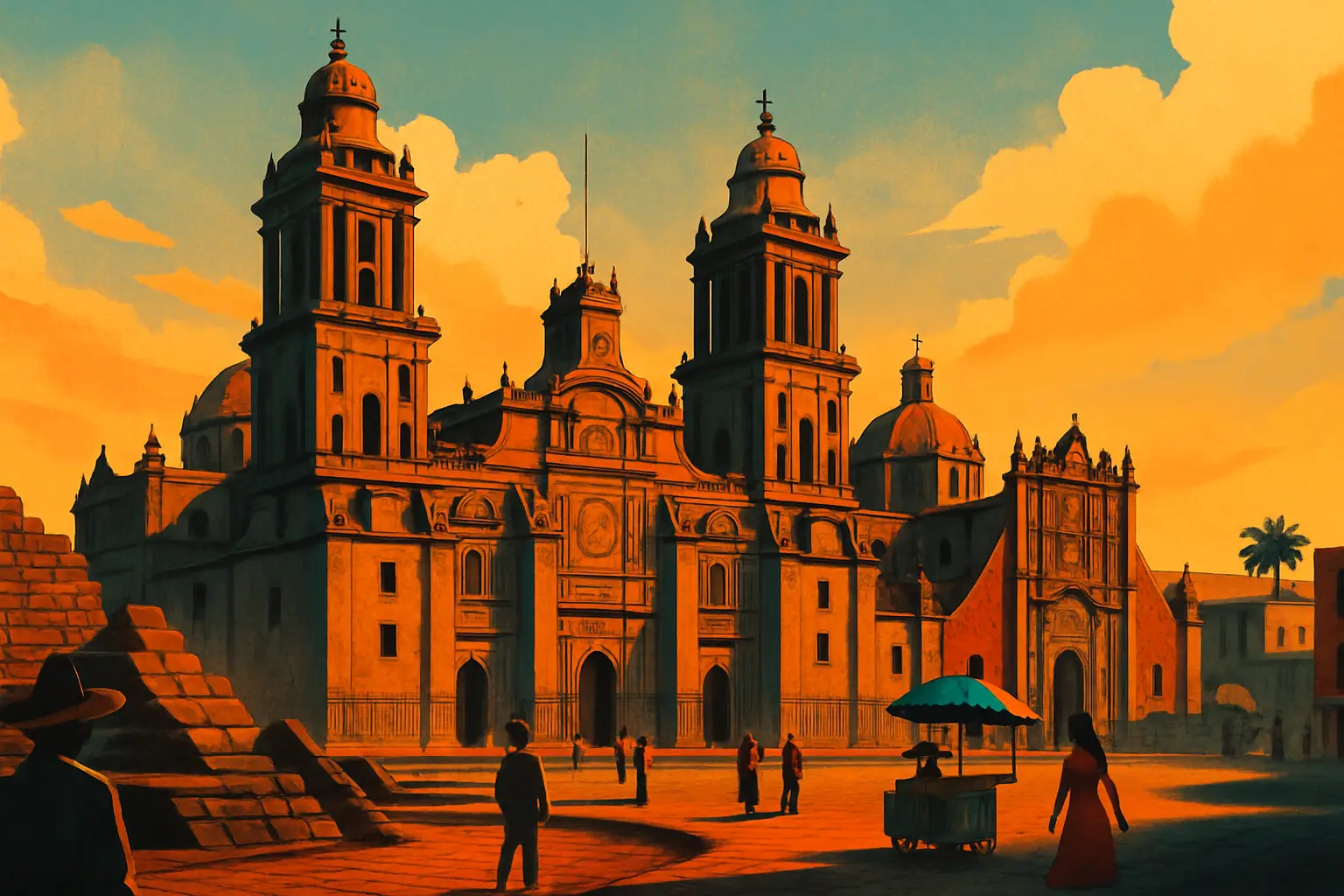
Construction on the Catedral Metropolitana began in 1573. It wasn't completed until 1813 — a span of 240 years across which the building absorbed five different architectural styles, dozens of archbishops' visions, and everything that happened to Mexico in between: the full height of the Spanish colonial period, the Inquisition, the Bourbon reforms, and independence itself. At 59 meters wide and 128 meters long, with bell towers rising 67 meters above the Zócalo, it is the largest cathedral in Latin America and one of the oldest continuously operating churches in the Americas.
The ground it stands on adds a layer that no other cathedral in the world can match. The Spanish demolished the main Aztec temple — the Huei Teocalli, the most important structure in the Aztec sacred precinct — and used its stones as raw building material. The Cathedral occupies the northwest corner of what was that sacred precinct; the Templo Mayor, the double pyramid at the precinct's center, was excavated beginning in 1978 and is now a full archaeological museum 45 meters east of the Cathedral's main door. You are standing, quite literally, at the exact point where two civilizations collided and one built directly on top of the other.
The building's exterior reflects its long construction timeline. The lower facade is Renaissance, built in the 16th century. The upper stories and bell towers are Baroque, added through the 17th and 18th centuries. The central clock tower between the bells is Neoclassical, completed in 1791. Walking the perimeter is a compressed survey of 250 years of architectural history. The carved stone on the main entrance portal — facing south toward the Zócalo — is among the most detailed stonework anywhere in Mexico, and most people walk past it without stopping.
Mexico City was built on the soft clay of a drained ancient lake — Lake Texcoco — and that clay compresses slowly and unevenly under the weight of any large building placed on top of it. The Cathedral has been sinking since construction began in 1573. The problem is not the sinking itself but the differential sinking: the ground under different parts of the building compresses at different rates, so the building tilts rather than settling straight down.
By the late 20th century, the northeast corner of the Cathedral was approximately two meters lower than the southwest corner. The lean was visible to the naked eye inside the nave — if you stood at the altar and looked back toward the entrance, the floor visibly sloped. The 1985 earthquake worsened the differential settling and pushed the building toward genuine structural danger.
In 1989, structural engineer Roberto Meli led a team commissioned to solve the problem. Their solution was counterintuitive: rather than stopping the heavy corners from sinking, they allowed the lighter corners to sink to match them. The team bored a grid of 117 hollow extraction tubes through the Cathedral's foundations into the clay below the heaviest corners and removed precise, calculated quantities of soil — controlled, targeted subsidence — until the building leveled itself over more than a decade of work. The differential was reduced by roughly 70 percent.
The large pendulum hanging from the ceiling of the central nave was installed as a real-time orientation indicator during and after the stabilization process. It is not decorative. If you stand still beneath it for a moment, you can see the very slight tilt that remains — and understand what 700 tonnes of colonial masonry gradually redistributing itself actually looks like.
Get short, interactive stories that make each place easier to remember while you travel.
The Cathedral's interior is organized around five naves separated by columns, with 14 side chapels running along both exterior walls. Most visitors walk the central nave and leave. The chapels are where the art is.
The most important single object in the building is the Altar de los Reyes, in the apse at the far north end. Designed by Jerónimo de Balbás and completed in 1737, it is the defining masterpiece of Churrigueresque architecture — the ultra-ornate Spanish Baroque style that piles carved saints, gilded foliage, twisted estípite columns, and painted panels into a single composition that takes several minutes to fully parse. Two large paintings by Juan Rodríguez Juárez flank the central tabernacle. This is, without qualification, one of the most important Baroque artworks in the Americas, and most people who see it don't realize it.
At the south entrance — directly opposite the Altar de los Reyes — the Altar del Perdón holds a dark statue of Cristo Nazareno, known locally as 'El Señor del Veneno' (Lord of the Poison). The legend holds that the figure turned black after absorbing poison meant for Archbishop Fray Juan de Zumárraga in the 16th century. The image has been actively venerated here for centuries — you'll see candles lit before it at almost any hour of the day.
The Cathedral also houses two of the largest 18th-century pipe organs in the Americas, mounted facing each other above the central choir. The wooden choir stalls in the center of the nave date to the 17th century and are elaborately carved with saints' faces, angels, and geometric patterns — one of the finest examples of colonial woodcarving surviving in Mexico. Both organs still function and are occasionally played during major religious services.
Attached to the east side of the Cathedral is a building that most visitors assume is part of the same structure. It isn't. The Sagrario Metropolitano is a separate church entirely, built between 1749 and 1768 and designed by architect Lorenzo Rodríguez. Its east facade — facing the excavated ruins of the Templo Mayor across the street — is considered the finest example of Churrigueresque architecture in all of Mexico City.
The portal is carved from red tezontle volcanic stone, a material quarried near the city that gives it a warmer color than the gray stone of the Cathedral next door. The carving is extraordinary in its density: every surface between the door frame and the roofline is occupied by figures, foliage, medallions, and geometric interlacing. It took decades to complete. It is worth standing in front of for at least five minutes — which most visitors don't do because they are oriented toward the Cathedral entrance on the opposite side of the block.
Inside, the Sagrario functions as the active parish church of the Cathedral complex — less formal, more regularly used for daily mass and baptisms. Entry is free. On weekday mornings you'll often find it nearly empty, which gives you a quality of quiet the main Cathedral rarely offers. The contrast between the two interiors — the Sagrario's smaller, more intimate scale and the Cathedral's overwhelming mass — is worth experiencing in sequence.
The two bell towers are 67 meters tall and contain 25 bells, including the massive Campana de Santa María de Guadalupe, cast in 1792 and weighing approximately 13 tonnes. Bell tower access has historically been available through a guided tour arranged at the Cathedral entrance — verify current availability on arrival, as schedules change seasonally and have been intermittent in recent years. The cost when offered is minimal (around 20 to 40 MXN) and the view of the Zócalo from the tower level is one of the better elevated perspectives in Centro Histórico.
The crypt beneath the Cathedral has held the remains of Mexican archbishops since the 17th century. Guided crypt visits are offered periodically — ask at the main entrance about the current tour schedule. A crypt tour takes roughly 45 minutes and is one of the more unusual cultural experiences available in the neighborhood: cool, dim, and completely removed from the noise of the Zócalo above.
The sacristy — accessible from the interior — contains one of the Cathedral's most valuable paintings, a large work attributed to Bartolomé Esteban Murillo, the 17th-century Spanish master. A small donation is traditionally requested for sacristy entry. It is not widely known and is rarely crowded.
The three hours you spend in this corner of the city are the most historically concentrated three hours available anywhere in the Americas. A practical sequence for a weekday morning:
Start at the Cathedral at 8 am when it opens. The first 90 minutes are the quietest of the day. Walk the central nave toward the Altar de los Reyes, then work back through the side chapels on the west wall. Exit through the east door and spend 10 minutes in front of the Sagrario facade — most people miss it entirely.
Templo Mayor is immediately east. The entrance is at Seminario 8, roughly 45 meters from the Sagrario's east door. Admission is 90 MXN and includes both the archaeological zone and the museum. The museum holds the massive Piedra de Tízoc, carved stone warrior figures, and thousands of ritual objects recovered from the offerings buried at the base of the pyramid across centuries of Aztec use. The Templo Mayor guide covers what to prioritize inside.
The Zócalo — the plaza directly south of the Cathedral — is Mexico's largest public square. On the east side, the Palacio Nacional contains Diego Rivera's mural cycle 'Epic of the Mexican People,' which is free to enter. The full sequence from Cathedral to Sagrario to Templo Mayor to the Palacio murals covers five centuries of continuous history in sequential order, costs under 100 MXN total, and takes a morning.
Cathedral + Sagrario: 1.5–2 hours, free entry, best before 11 am on weekdays
Templo Mayor: 90 minutes minimum, 90 MXN, includes the museum — east door of the Sagrario is the closest entry point
Palacio Nacional murals: free entry, east side of the Zócalo — 30 to 45 minutes, Diego Rivera's complete interpretation of Mexican history floor to ceiling
Yes, unambiguously. The Catedral Metropolitana is not primarily a religious destination — it's a building that carries the full weight of Mexican history in its stones, its art, and its literal physical position above the ruins of an earlier sacred site.
If you know nothing about Mexican history before you walk in, you'll still find the Altar de los Reyes visually overwhelming and the engineering story of the sinking building genuinely compelling. If you know the history — the Aztec sacred precinct below the floor, the specific political pressures that stretched construction over 240 years, the role the building played in the Spanish colonial project — you'll see layers that a quick visit completely misses.
June is worth noting for context: Mexico City's Pride march, one of the largest in Latin America, ends at the Zócalo on the last Saturday of June. The plaza is closed to traffic and filled with hundreds of thousands of people, making the Cathedral's facade a backdrop for one of the city's biggest annual events. If you're in Mexico City that weekend, the intersection of the Cathedral and the modern city is especially visible.
Dress code: no shorts and no sleeveless tops. This is actively enforced at the entrance. Photography is permitted throughout the building; flash photography is not, and cameras are discouraged during active mass. The Cathedral is free to enter. A donation of 20 to 50 MXN is appreciated and contributes to ongoing maintenance of a structure that costs significantly more to preserve than donations cover.
Address: Plaza de la Constitución S/N, Centro Histórico, Ciudad de México — directly on the north side of the Zócalo.
Hours: Monday through Saturday 8 am to 7 pm; Sunday 8 am to 5 pm. Hours shorten during major religious holidays and special services. The weeks around Semana Santa (Holy Week before Easter) and Día de los Muertos in late October and early November bring modified schedules and significantly heavier crowds.
Getting there: Metro Line 2 (the blue line) — Zócalo station. The exit puts you at the southeast corner of the plaza; the Cathedral's main south door is a 2-minute walk across the square. From Roma Norte or Condesa, Uber or DiDi runs roughly 60–100 MXN depending on traffic. Rideshares drop at the perimeter — Avenida 5 de Mayo or 20 de Noviembre — and the Cathedral is 3 to 5 minutes on foot from either.
June note: The rainy season begins in earnest in June, bringing afternoon showers that typically arrive between 3 and 6 pm and last 30 to 60 minutes. The Cathedral is an excellent midday destination in this season — always cool inside, free, and central. Plan outdoor activity in Centro Histórico for mornings and save the Cathedral interior for the early afternoon if rain catches you.
Time needed: A thorough visit covering the main nave, Altar de los Reyes, 3 or 4 of the side chapels, and the Sagrario facade takes 90 minutes to 2 hours. A walk-through is 30 minutes. The building rewards slowing down — it contains more than most museums and charges nothing to enter.