1. What café de olla actually is — and why the clay pot is not optional
Café de olla — 'coffee of the pot' — is ground coffee simmered directly in water inside an unglazed clay vessel with piloncillo and a stick of canela, then strained and served. The defining preparation detail is the simmer: unlike pour-over or drip methods where water contacts the grounds briefly, café de olla involves several minutes of low-heat extraction in the pot itself. This produces coffee that is fuller in body and smoother in texture than most Western brewing methods, with the piloncillo rounding the bitterness before it can develop and the canela adding warmth without sharpness.
The clay vessel is doing specific chemical work. An unglazed olla is porous — small amounts of air pass through the walls during brewing, slowing extraction and preventing the bitter overextraction that plagues boiled coffee. Minerals from the fired clay, primarily silica, calcium, and iron compounds, leach gently into the liquid during the simmer. The pot also retains heat evenly, holding a consistent temperature throughout the brew rather than spiking and dropping as a metal pot would. Traditional cooks season a single olla exclusively for coffee, never using it for anything else, because accumulated coffee oils and minerals improve each subsequent batch.
The best fondes in Mexico City — market lunch counters that have been running for decades — maintain a dedicated clay pot on a back burner from before 7 a.m. That pot is the point.
•Grounds simmer directly in the clay pot with piloncillo and canela — not a brief extraction like drip or pour-over
•Porous clay walls slow extraction and leach minerals into the brew — the flavor cannot be replicated in glass or metal
•A seasoned olla dedicated exclusively to coffee builds up oils that improve the flavor of every subsequent batch
2. The three ingredients that define it: piloncillo, canela, and the bean
Piloncillo is raw cane sugar poured into cone-shaped molds before it has been refined to remove its molasses. Unlike white sugar, it retains those molasses compounds — which give it a complex sweetness with notes of brown sugar, rum, and earth. It dissolves slowly in hot water, which is one reason café de olla works better with a simmer than a quick steep: the piloncillo needs time to fully integrate. Substituting white sugar produces a flat, one-dimensional sweetness. Substituting honey or agave gives a different drink entirely.
Canela — the cinnamon used in Mexican cooking — is Ceylon cinnamon (Cinnamomum verum), not the Cassia variety dominant in the United States. Ceylon has softer bark, a lighter color, and a more delicate, floral flavor without Cassia's aggressive bite. In café de olla, this distinction is critical: Ceylon blends with the piloncillo and coffee without overpowering either. A version made with Cassia cinnamon tastes hotter and less balanced.
The coffee itself is almost always a medium-roast Arabica from Veracruz, Chiapas, or Oaxaca. Veracruz beans from the Coatepec and Huatusco regions have a mild, nutty profile that integrates cleanly with piloncillo sweetness. Oaxacan beans — often sourced from cooperatives in the Sierra Juárez — run slightly more acidic. Chiapas beans from the Soconusco valley lean earthier. Most fondas use a commercial blend; single-origin beans from a specialty roaster become detectable only when you have the baseline of the traditional version for comparison.
3. Where the tradition comes from: Veracruz coffee and the colonial spice trade
Coffee arrived in Mexico through the Port of Veracruz in the late 18th century, brought by Spanish colonizers who had encountered it via Ottoman and Arab trade networks. Within decades, cultivation spread to the mountainous zones of Veracruz, Oaxaca, and Chiapas — regions with the altitude, rainfall, and volcanic soil that Arabica requires. By the mid-19th century, Mexico had become a significant coffee exporter and, more importantly for this story, a serious coffee consumer.
The clay pot preparation wasn't an invention. It was an adaptation. Clay cooking vessels had been central to Mesoamerican kitchens for thousands of years before coffee's arrival. When Mexican cooks started brewing coffee, they reached for the olla already on the fire — the same vessel used for soups, atoles, and bean broths. The spicing tradition was equally natural: piloncillo was already the standard sweetener for chocolate drinks and atoles; canela had been fully integrated into Mexican cooking within a century of the conquest. Café de olla arrived at something entirely Mexican precisely because every component except the coffee itself was already indigenous to the kitchen.
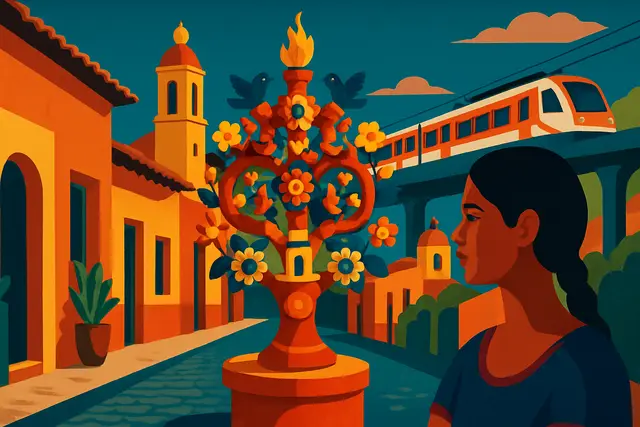
By the early 20th century, the drink had become specifically associated with morning fuel for market vendors, agricultural workers, and traveling laborers. In Tlalpan — when that borough was still connected to central Mexico City by tram — vendors at the tram stops sold café de olla in clay cups to passengers waiting in the cold. The tram is gone. The clay cup is still here.
4. Where to drink café de olla in Mexico City — specific places
Café de Tacuba, Tacuba 28, Centro Histórico. Founded in 1912 on a street named for the ancient Tepanec city-state, this is the most historically resonant cafe in Mexico City. The dining room has hand-painted azulejo tiles on every wall, stained glass in the ceiling arches, and a kitchen that has served breakfast continuously for over a century. The café de olla arrives in a clay cup — the mineral warmth of the vessel is present even though the olla stays in the kitchen — and costs around 55 pesos. Order it with the house tamales or the mole enchiladas. The entrance is on Tacuba, five minutes on foot from Metro Allende (Line 2) or a short walk from the Zócalo.
Cielito Querido Café, multiple locations. This small Mexican chain — the considered kind, built around craft rather than scale — takes café de olla seriously. The version at Álvaro Obregón 101 in Roma Norte is the most atmospheric: a small storefront with a back patio shaded by a ficus tree, piloncillo measured by weight rather than eyeballed, genuine Ceylon canela. Polanco and Masaryk locations serve the same drink to a different crowd.
Market fondas, everywhere. The most honest café de olla in Mexico City is at any fonda inside a major market: Mercado de la Merced, Mercado Jamaica, Mercado de Medellin in Roma Sur, or Mercado de Sonora. A clay cup at a fonda counter costs 15–25 pesos. The cook brews it fresh in an actual olla on a gas burner and pours it alongside your breakfast without ceremony. This is what most chilangos drink most mornings.
•Café de Tacuba — Tacuba 28, Centro Histórico; 5 min from Metro Allende (Line 2); ~55 pesos a cup
•Cielito Querido Café — Álvaro Obregón 101, Roma Norte; proper piloncillo and Ceylon canela
•Market fondas citywide — 15–25 pesos at the counter; Mercado Jamaica and Mercado Medellin are the most convenient from tourist areas
5. The cold brew pivot: how modern Mexico City reinvented the olla
In the last five years, specialty coffee roasters in Roma Norte, Condesa, and Juárez have engaged seriously with café de olla as raw material for modern adaptations. The most successful is the café de olla cold brew: the traditional ingredients — coffee, piloncillo, canela — steeped cold inside an olla for 12–18 hours. The result is a concentrate that is smooth, sweet, and intensely flavored without any bitterness, because cold extraction doesn't activate the acidic and bitter compounds that hot water releases.
Cardinal Specialty Coffee on Calle Orizaba 66 in Roma Norte has made its cold brew olla one of the most-discussed single items on any cafe menu in the neighborhood. Served over ice, with or without milk, it tastes like the Platonic ideal of the traditional drink except cold. Buna on Calle Tokio 36 in Colonia Juárez runs a seasonal olla cold brew that shifts with available beans from their Oaxacan and Veracruz sourcing network. Some baristas at these roasters have started adding orange peel, star anise, or vanilla from Papantla to the cold brew olla — interesting variations, though they depart further from the original.
The cold brew iteration has introduced café de olla to a generation of Mexico City residents and visitors who came up on international specialty coffee and were previously unfamiliar with the traditional preparation. The fundamentals, though, have not changed: piloncillo, canela, Mexican coffee, and time.
6. Is café de olla very sweet — and how to order it correctly
Traditional café de olla is noticeably sweet. The piloncillo dissolves completely into the brew during the simmer, which means there's no adjusting it after the fact at a fonda — the cook makes one batch and pours from the same pot for everyone. What varies considerably between fondas is how much piloncillo went in. Some cooks brew lighter on the sweetener; others make it closer to Mexican hot chocolate in sweetness level. Tasting what arrives before adding anything is the right move.
At specialty cafes that make café de olla to order, you can ask: '¿Me lo puede hacer con menos piloncillo?' (Can you make it with less piloncillo?) Most baristas will accommodate this. Asking for 'sin azúcar' (without sugar) at a fonda will almost always be met with confusion — the batch is already made.
How to order at a fonda: walk in, say 'buenos días,' and ask '¿Tiene café de olla?' If yes: '¿Me da uno, por favor?' You will get a clay cup or a ceramic mug depending on the fonda, filled from the olla on the back burner, for 15–25 pesos. If the fonda also sells pan dulce or has a panadería next door, buy one piece — a concha (the dome-shaped sweet bread with sugar crust), a cuerno (a croissant-style roll), or a polvorón (crumbly butter cookie). This combination, under 40 pesos total, is what millions of people in Mexico City eat every single morning before they do anything else.
7. Best neighborhood to find café de olla — by where you're staying
Centro Histórico: Café de Tacuba on Tacuba 28 is the definitive experience. Hostería de Santo Domingo on Belisario Domínguez 72 — Mexico City's oldest restaurant, founded in 1860 — also serves café de olla alongside classic Mexican dishes in a colonial dining room.
Roma Norte and Condesa: Cardinal on Orizaba 66 for cold brew olla; Cielito Querido on Álvaro Obregón 101 for the traditional hot version; and any fonda inside Mercado Medellin (Campeche between Medellín and Monterrey streets) for the market counter experience at market prices.
Coyoacán: The fondas inside the Mercado Municipal on Abasolo — particularly those near the Abasolo–Higuera corner — brew café de olla fresh from early morning. Pair the visit with a walk to the Viveros de Coyoacán before the heat arrives.
Polanco: Cielito Querido has a location on Presidente Masaryk, which makes it the most accessible version in the neighborhood. More expensive than a market fonda, but the quality holds.
Anywhere else: Find the nearest mercado. If there's a fonda inside with a clay pot on the burner behind the counter, that's your café de olla. The price will be under 25 pesos. The cup will be ceramic or clay. It will be better than anything poured out of a commercial espresso machine with a cinnamon pump.
8. What is the difference between café de olla and café de olla latte?
A café de olla latte adds steamed milk to café de olla concentrate — either the hot-brewed or cold-brew version. It is not traditional, but it exists on many modern cafe menus and is genuinely good. The piloncillo sweetness integrates well with milk's fat content, producing something that drinks like a more complex, spiced café au lait.
Café lechero is a different drink altogether. It comes from Veracruz and is prepared tableside: a server pours hot black coffee from a small clay pot and hot milk from a separate pitcher simultaneously into a glass, at heights ranging from a few inches to almost a meter above the cup. The theater is real and so is the skill — the height aerates the coffee, changing its texture — but the preparation is specific to Veracruz tradition rather than the clay pot brewing that defines café de olla.
A third confusion: café de olla vs. regular café negro. Both are black coffee. The differences are the vessel (clay vs. metal or glass), the additives (piloncillo and canela vs. nothing), and the extraction method (simmer vs. drip or press). Order a café negro at a fonda and you will get instant Nescafé mixed with hot water — a genuinely common outcome in Mexico City that surprises many first-time visitors. Ask specifically for café de olla, or ask '¿Tiene café de grano?' (Do you have ground/bean coffee?) to clarify before anything gets poured.