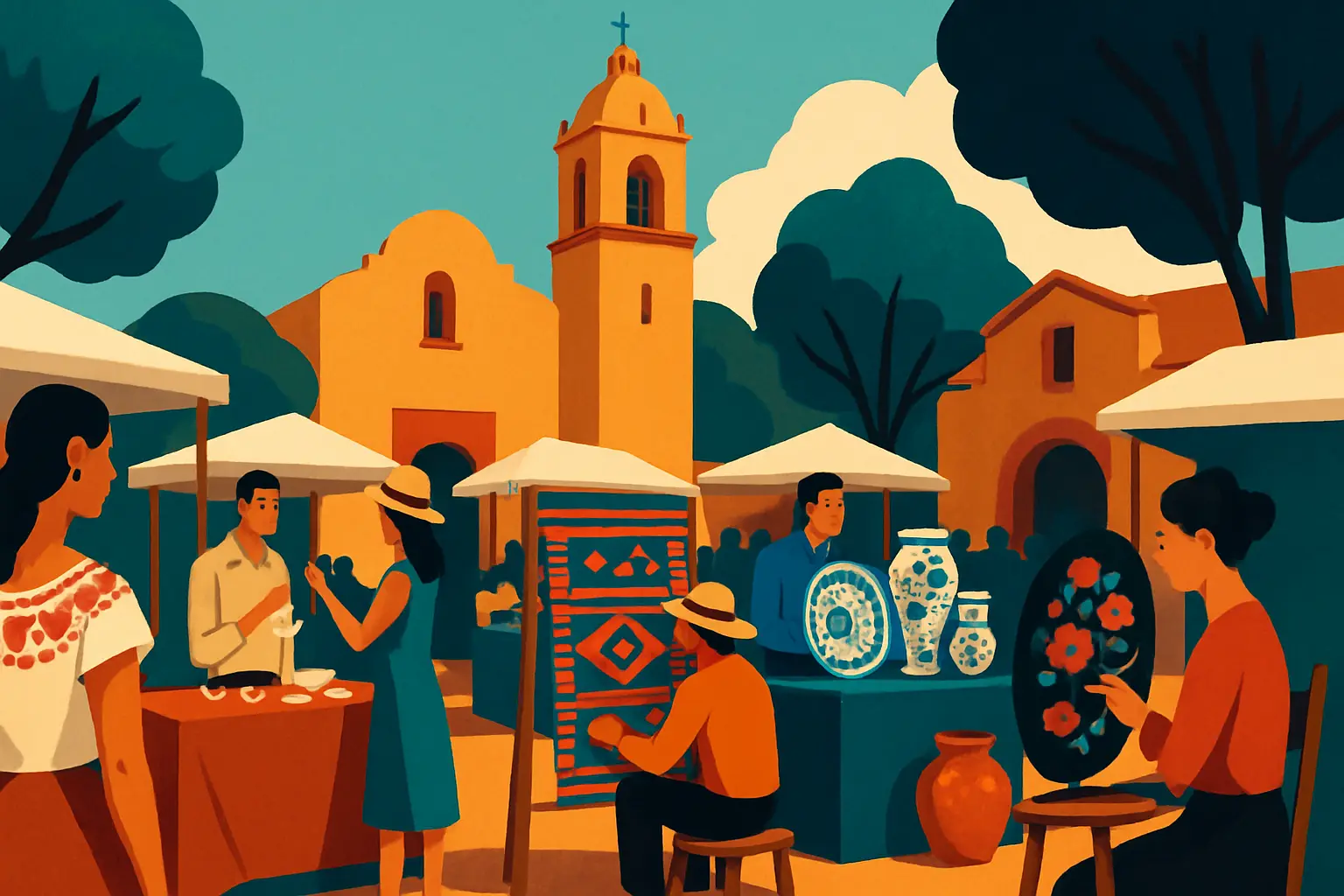
Mexico City has no shortage of markets selling Mexican crafts. Mercado de Artesanías on Londres in Zona Rosa, the souvenir stalls in Centro Histórico, the craft vendors outside Teotihuacán — all of them sell versions of the same mass-produced objects: machine-made textiles, resin 'amber,' factory Talavera, silver-colored jewelry with no markings. None of that is at Bazar del Sábado. The interior bazar at Plaza San Jacinto 11 operates with a juried application process: artisans apply annually, and a selection committee decides who gets a slot based on the quality and authenticity of their work. The result is a single building where a Zapotec weaver from Teotitlán del Valle sits 10 feet from a Taxco silversmith whose family has been working silver for four generations, next to a Talavera ceramicist whose pieces carry the Consejo Regulador de Talavera certification. The outdoor plaza has a second, more casual market with negotiable prices and more variable quality — but even there, the proximity to the interior bazar sets a higher baseline than most of the city's tourist-facing markets.
The Bazar del Sábado opened in 1960, founded by a group of Mexican artists and craftspeople who wanted to sell authentic work directly to collectors and travelers — not through department stores or souvenir shops. They chose Plaza San Jacinto for good reason: San Ángel was already one of the most culturally dense corners of what was then still a semi-separate village southwest of the city center, and the plaza itself dates to 1524, one of the oldest colonial squares in the metropolitan area. The building they chose at Plaza San Jacinto 11 is a two-story colonial house built around a central courtyard — the kind of structure that makes you feel like you've wandered into someone's private estate rather than a market. For over 60 years, the bazar has operated on Saturdays only, maintaining the juried model that distinguishes it. San Ángel was formally absorbed into Mexico City's urban sprawl in the 20th century, but it kept its cobblestone streets, its colonial architecture, and the Saturday ritual that makes it feel like a different city than the glass towers of Santa Fe or the restaurants of Roma Norte.
Get short, interactive stories that make each place easier to remember while you travel.
The interior bazar occupies the covered corridors and rooms of the colonial house, wrapping around a central open courtyard. About 100 artisan vendors set up here each Saturday, and the range covers a broad survey of Mexico's most important craft traditions. Talavera pottery from Puebla is one of the highlights — look for the official Consejo Regulador de Talavera certification stamp on the bottom; genuine hand-painted Talavera runs 3-4 times more expensive than factory imitations, but the difference in craftsmanship is visible immediately. Oaxacan rugs from Teotitlán del Valle are another anchor of the bazar: wool textiles woven on floor looms using vegetable dyes (cochineal for reds, indigo for blues, marigold for yellows) in geometric Zapotec patterns. A single medium-sized rug takes an experienced weaver 2-3 weeks. Taxco silver jewelry is consistently some of the best in the bazar — look for the '950' or '925' stamp on any piece; silversmiths who trained in Taxco often sell here at prices 20-30% below what the same pieces cost in Taxco itself because there's less tourist markup. You'll also find Michoacán lacquerware (painted wooden trays and boxes in traditional Purépecha designs from Pátzcuaro and Uruapan), Chiapas amber from the Simojovel mines in raw and polished forms, and alebrijes — the fantastical carved and painted wooden animals that originated with Mexico City artist Pedro Linares and were later adopted and transformed by Oaxacan carvers in Arrazola and San Martín Tilcajete.
Talavera: look for the Consejo Regulador certification stamp — it's the only way to verify authenticity
Oaxacan rugs: ask which village the weaver is from — Teotitlán del Valle and San Marcos Tlapazola produce the most recognized work
Taxco silver: stamped '950' means 95% pure silver — higher than the US sterling standard of 92.5%
Outside the colonial building, the streets and plazas around San Jacinto fill with a secondary Saturday market that operates under different rules. This is a flea market and open-air vendor zone where prices are not fixed and a counteroffer of 70% of asking price is completely normal and expected — vendors set prices with the assumption of negotiation built in. Quality is more variable here than inside, but the outdoor market has its own worthwhile finds: more affordable ceramics, contemporary jewelry from younger designers who haven't been at the bazar long enough to build an interior reputation, vintage textiles and embroidery, and occasionally genuine antiques. Many outdoor vendors accept cards, but cash gives you negotiating leverage. One practical note: the outdoor market extends beyond the immediate plaza toward Avenida Revolución and the surrounding streets, so it's worth doing a full loop before committing to anything — a vendor 50 meters further might have a better version of the same item at a lower starting price.
The bazar rewards specificity. The items genuinely worth the price here are the ones where provenance and handcraft actually matter: Taxco silver jewelry is exceptional value compared to tourist markets in Centro or Polanco. Oaxacan woven rugs from Teotitlán del Valle at USD 80-150 for a medium-sized piece represent fair compensation for a week or more of skilled labor. Certified Talavera is an investment that holds up — the same pieces in Puebla's tourist market often cost more because of the day-trip markup. Chiapas amber is worth looking at carefully: genuine amber with insect inclusions is the real thing and dramatically cheaper here than in curated design shops. What to avoid: any 'silver' jewelry without a purity stamp, 'Aztec calendar' reproductions (mass-produced and available cheaper in Centro), and any textile sold as Oaxacan without a stated village of origin. The outdoor market has more of the skip items — use the interior bazar as your quality reference point before buying anything outside.
Best value: Taxco silver (20-30% cheaper than in Taxco itself due to lower tourist markup)
Authenticity check for amber: pieces with visible insect inclusions are genuine — imitation resin can't replicate them
Skip any textile without a stated village of origin — 'Oaxacan style' is not the same as Oaxacan made
The Restaurante del Bazar de Sábado operates inside the central courtyard of the bazar building — a shaded open-air dining room surrounded by artisan stalls, which is one of the better lunch settings in San Ángel. The menu is traditional Mexican: pozole rojo, mole negro over chicken, chiles rellenos, enchiladas verdes. In late summer through October the kitchen usually offers chiles en nogada — the Pueblan dish of poblano peppers stuffed with picadillo and topped with walnut cream and pomegranate seeds, traditionally eaten only during the pomegranate season (August through October). Prices are mid-range for Mexico City: 200-350 pesos for a main course, 60-80 pesos for a mezcal. Reservations are not required but by 1 p.m. on Saturdays the courtyard fills and the wait for a table gets long. If you arrive before noon, you can eat between shopping sessions and avoid both the queue and the post-tour-group rush. The chicken with mole negro is the dish most worth ordering — the kitchen makes it properly, with complexity that takes days to build, not the commercial paste version served at most tourist-facing restaurants.
Getting there: The most reliable route is Metrobús Line 1 to La Bombilla — the stop is one block from Plaza San Jacinto and the ride from Roma Norte or Centro takes under 30 minutes for about 7 pesos. Alternatively, Line 3 Metro to Miguel Ángel de Quevedo drops you a 10-minute walk away, or a short taxi or Uber from there. Do not drive on Saturday mornings — parking in San Ángel is scarce under the best conditions, and on market Saturdays Insurgentes backs up for half a kilometer in both directions as people try to park within walking distance. Hours: Saturdays only, 10 a.m. to 7 p.m. The best window is 10 a.m. to 12:30 p.m. — after noon, tour buses from the hotel district arrive and the plaza gets genuinely crowded. How long: Budget 2-3 hours for the market alone. If you add lunch at the bazar restaurant and a walk through the Museo del Carmen (which is directly adjacent and covers San Ángel's colonial history including a crypt with preserved 18th-century mummies), 4-5 hours is realistic. The museum charges a modest entry fee and is one of the least-visited worthwhile museums in the city.
Metrobús Line 1 to La Bombilla: 7 pesos, one block from Plaza San Jacinto
Saturdays only, 10 a.m. to 7 p.m. — arrive by 11 a.m. to beat tour groups
Pair with Museo del Carmen (adjacent, modest entry fee) for a complete San Ángel morning
Yes — with one caveat. If Saturday is one of your days in the city, Bazar del Sábado is the most efficient way to see a genuine cross-section of Mexico's folk art traditions without traveling to multiple states. A single morning at the bazar covers Oaxacan weaving, Taxco silver, Puebla ceramics, Michoacán lacquerware, and Chiapas amber — things you'd have to drive to four different regions to see at source. The caveat is that the bazar alone doesn't fill a full day, and San Ángel is in the southwest of the city, which means logistics matter. The natural extension is an afternoon in Coyoacán — about 20 minutes by car or Uber from Plaza San Jacinto — to see the Frida Kahlo museum and the lively street market around the Coyoacán zócalo. That combination (morning at Bazar del Sábado, lunch at the bazar restaurant, afternoon in Coyoacán) is one of the best single-day itineraries in Mexico City for first-time visitors who want culture and craft without spending the day inside a museum. In June 2026 specifically, Saturday mornings are the sweet spot before the afternoon rains arrive — the market in the open air is at its best in the morning light.