1. What atole actually is — and why it's not quite a drink
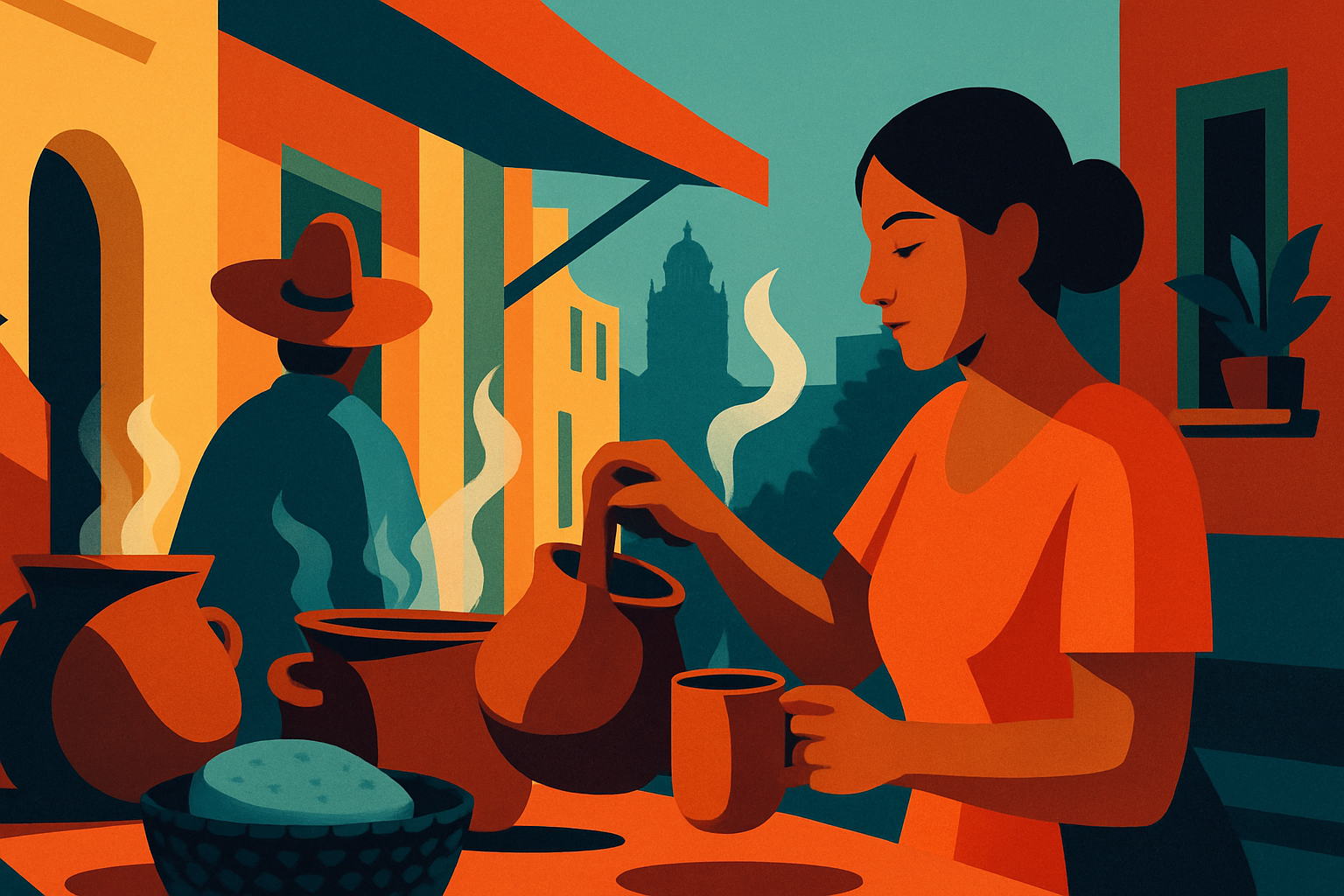
The word atole comes from Nahuatl: 'atolli,' which translates roughly as 'watery thing' — a description that undersells what's actually in the cup. Atole is made from masa, the same nixtamalized corn dough used for tortillas and tamales, dissolved in water or milk and simmered until it thickens into a warm, lightly sweet beverage with the consistency of a thin pudding. Sweetness comes from piloncillo — unrefined cane sugar pressed into dark, molasses-rich cones that give atole a caramel depth you don't get from white sugar. A stick of canela (Mexican cinnamon, softer and more floral than the cassia cinnamon common in the United States) usually goes in during cooking. The result is warm, slightly thick, faintly sweet, and deeply corn-forward. First-time drinkers often describe it as tasting like the water left over from making horchata, but richer and warmer. Atole predates the Spanish arrival by at least 2,000 years. The Florentine Codex, compiled by Friar Bernardino de Sahagún in the 1570s from Nahuatl-speaking informants, documents dozens of varieties served at Tenochtitlán: atole de guajolote (turkey-based), atole de chile, atole with ground squash seeds. The sweet, warm version sold today at metro exits evolved from the same base preparation, with the savory additions dropped and the piloncillo dialed up as Spanish sugar became widely available.
•Made from masa (nixtamalized corn dough) dissolved in water or milk and simmered until thick
•Sweetened with piloncillo (dark unrefined cane sugar) — the caramel depth comes from this, not from added spices alone
•Documented in Aztec codices as a ceremonial and everyday drink for at least 2,000 years
2. Champurrado: when Aztec masa met Spanish chocolate
Champurrado is atole plus chocolate — but the history of how those two ingredients ended up in the same cup is more interesting than it sounds. The pre-Columbian Mexica had their own cacao drink: xocolatl, a cold or room-temperature mixture of cacao paste, water, and usually chile or vanilla, whipped frothy by pouring it between two vessels from a height. It was bitter, ceremonial, and reserved for the nobility and warrior classes — cacao beans were currency in Tenochtitlán's markets and were not casually consumed. When the Spanish arrived and brought cane sugar, cacao was sweetened for the first time. Eventually, the sweet chocolate preparation was combined with the masa-and-piloncillo base of atole, producing champurrado: a thick, warm, slightly chocolatey drink that neither the Mexica nor the Spanish would have invented independently. What makes Mexican drinking chocolate distinctive — used in champurrado — is the tablet form. Ibarra chocolate, in the hexagonal orange box with the molinillo illustration, and Mayordomo, the Oaxacan brand, are both mixtures of roasted cacao, sugar, and cinnamon ground together and pressed into discs. You break off a segment, drop it into simmering atole, and whisk with a molinillo (the wooden whisk with a ridged ball on the end, designed specifically for this) until it melts and froths. In champurrado at its best, the chocolate and masa flavors are roughly equal — you taste both the corn and the cacao clearly, with piloncillo and cinnamon as a warm base note underneath.
•Champurrado = atole (masa base) + Mexican chocolate + cinnamon + piloncillo, simmered together
•The Aztec xocolatl was cold, bitter, and ceremonial — champurrado is its post-colonial evolution
•Ibarra (national brand) and Mayordomo (Oaxacan) are the tablet chocolates used — cinnamon is ground in from the start
3. The other varieties: guayaba, fresa, nuez, and rompope
Champurrado may be the most famous, but Mexico City's street vendors and market fondas offer a wider range. Guayaba (guava) atole is the most common non-chocolate option — a pale pink-white drink with a tropical, slightly tart sweetness that cuts through the corn base. Fresa (strawberry) uses fresh or cooked strawberries blended into the masa and tends toward a brighter, more acidic profile. Vainilla is the simplest version — masa, piloncillo, milk, and Mexican vanilla extract, which is smoother and more floral than the artificial version sold in the United States. Nuez (walnut) appears at higher-end tamal shops and has a slightly bitter, earthy undertone that pairs better with savory tamales than the fruit varieties. Rompope atole is a seasonal variation — rompope is Mexico's answer to eggnog, made from eggs, sugar, vanilla, and rum — and appears at Christmas markets and tamalerías in December. At most street carts, you'll have two or three options; at market fondas, four or five. The vendor usually lists the flavors on a small chalked sign or paper taped to the thermos container. When in doubt: champurrado is the universal crowd-pleaser and always the safe first order.
•Guayaba: pale pink, slightly tart, the most common non-chocolate variety at street carts
•Fresa: made with fresh or cooked strawberries — brighter and more acidic than guayaba
•Rompope: eggnog-style, December only — only at tamalerías and Christmas markets
4. Tamales and atole: the pairing that predates the Spanish
Tamales and atole appear together in Aztec codices — they were served at religious festivals, at royal banquets, and as everyday food in the markets of Tenochtitlán. The pairing makes structural sense: a tamal is dense, filling, and neutral enough in flavor that a warm, sweet drink provides contrast without competing. In modern Mexico City, this combination is still the default morning meal for a huge portion of the working population. Every weekday from about 6 to 9 a.m., vendors position themselves at major metro exits — Hidalgo, Pino Suárez, Salto del Agua, La Merced, Tepito — with two large containers: one steel pot of tamales wrapped in corn husks or banana leaves, and one insulated thermos of atole or champurrado. A tamal plus a cup of atole costs between 35 and 50 MXN total, takes four minutes to eat standing up, and provides more actual food energy than a six-dollar coffee from a specialty shop. The tamales guide covers the variety of fillings in full detail — the important thing to know for pairing purposes is that sweet corn tamales (de dulce, pink-tinted from food coloring) pair best with fruit atoles, while pork or chicken tamales go better with champurrado. The contrast of the chocolate bitterness against the savory pork fat is part of why the combination has lasted 2,000 years.
•The pairing appears in Aztec codices — it is genuinely pre-colonial, not a modern invention
•Street vendors at major metro exits serve tamal + atole for 35–50 MXN, 6 to 9 a.m. on weekdays
•Sweet tamales de dulce + fruit atole; savory pork or chicken tamales + champurrado
5. Where to drink atole in Mexico City: four specific places
Flor de Lis at Huichapan 21 in Condesa has been serving tamales and atole since 1926 — it is one of the oldest operating tamalerías in the city. The setup is minimal: a narrow storefront with a takeout window and a few tables inside. The champurrado here is denser than the street cart version, which reflects Condesa's slightly more residential, slower-paced morning character. They rotate champurrado and fresa atole depending on the day, alongside a short list of sweet and savory tamales. Tamales Emporio at Álvaro Obregón 154 in Roma Norte offers atole de guayaba and rompope alongside a wider selection of tamales and creative fillings. It reliably runs out before noon on weekends — arrive before 10 a.m. Tamales Doña Emi, associated with the area near Mercado de San Juan, is among the harder-to-time vendors in the city: locals arrive before 9 a.m. because the champurrado specifically sells out by 9:30. The most atmospheric low-cost option remains the street vendors outside Metro Hidalgo, on Avenida Hidalgo at the exit toward Alameda Central. Two or three reliable vendors appear on weekday mornings with a full thermos and a tamal pot. This is the version to seek out if you want the experience as most chilangos actually live it: a metal or styrofoam cup, a tamal in its husk, and the morning commute flowing around you.
•Flor de Lis: Huichapan 21, Condesa — open since 1926, champurrado and fresa on rotation
•Tamales Emporio: Álvaro Obregón 154, Roma Norte — guayaba and rompope atole, sells out before noon on weekends
•Metro Hidalgo exit toward Alameda Central — street vendors, 6–9 a.m. weekdays, cheapest and most local
6. Why rainy season is the best time for atole
Mexico City's rainy season runs from June through September, and if you arrive during this period expecting tropical warmth, you will be surprised. CDMX sits at 2,240 meters above sea level, and the altitude means that even the warmest summer day drops sharply when the afternoon rain arrives — usually between 3 and 6 p.m. Mornings in June and July frequently start at 14–16°C (57–60°F), cold enough to make a hot drink feel necessary rather than optional. This is when the street cart atole vendor shifts from a curiosity to a utility. The Mexico City rainy season guide covers the full weather picture, but the relevant detail for atole purposes is this: the cool morning and afternoon downpour cycle makes June through September the most natural time to drink atole in the city. Vendors run larger carts during these months, and the market fondas inside Mercado la Merced serve it more consistently because cold and wet customers want warm, thick things. December through February is the other peak window, when evening vendors also appear alongside morning carts. In December especially, champurrado vendors position themselves near church entrances during Las Posadas — the nine nights of Christmas celebration — serving it as part of the traditional piñata-and-ponche evening.
•CDMX mornings in June–September often start at 14–16°C (57–60°F) — altitude makes even summer cool
•Afternoon rains drop temperatures further, making atole vendors viable through September evenings as well
•December–February is the other peak window, with evening vendors at Las Posadas gatherings
7. How to order atole at a street cart
The street cart interaction is fast and requires about three words. Walk up to the vendor's large insulated thermos — usually a 50-liter container in yellow or green — and say: '¿Qué tiene?' (What do you have?) The vendor will list the flavors available, usually two or three. To order: 'Uno de champurrado, por favor' or 'Uno de guayaba.' They'll pour it into a small styrofoam cup or, at older-school operations, a small clay mug. Say 'Gracias' and pay. Total time: 45 seconds. If you want a tamal with it — and you should — point to the tamal pot and say '¿Me da uno también?' (Can you give me one too?) They'll pull out a tamal in its corn husk or banana leaf and hand it to you. You'll unwrap it and eat the masa straight from the husk. The only additional question worth asking: '¿Está bien caliente?' (Is it nice and hot?) — some vendors have atole that has been sitting for a while and is only warm. A good vendor will have it steaming visibly from the thermos opening; that's the tell at a glance without having to ask.
8. Is atole heavy? What first-timers should expect
The sweetness in atole is calibrated to complement tamales, which are less sweet than most visitors expect. On its own, atole from a street vendor lands somewhere between a milkshake and a sweetened rice porridge in terms of sweetness level — noticeable but not overwhelming. Champurrado is slightly less sweet than the fruit varieties because the cacao and cinnamon add bitterness that balances the piloncillo. If you find it too rich after half a cup, the tamal is there to alternate with. The texture is the thing that surprises most people more than the sweetness: atole is not a drink in the same sense that coffee or juice is a drink. It is warm, filling, and meal-like. Most chilangos drink one cup alongside food, not as a standalone beverage to nurse over an hour. Think of it the way it is actually used: as the liquid component of a complete morning meal. A single cup of champurrado plus a tamal de rajas con queso is a complete and functional breakfast. It will cost you less than 50 pesos and will carry you until the comida at 2 p.m. That is the point, and that is why it has not been replaced by coffee or juice in the 2,000 years since someone first dissolved masa in hot water and decided it was good.