Diego Rivera started collecting pre-Columbian artifacts in the 1920s, buying from dealers, rural excavators, and weekend markets at a pace that alarmed his accountants. By the 1940s, the collection had outgrown every space it occupied — studios, storerooms, the houses Rivera shared with Frida Kahlo in Coyoacán and San Ángel. Crates of ceramics were stacked in hallways. Figurines covered every available shelf. The count eventually reached more than 50,000 objects. Rivera's motive wasn't acquisition for its own sake. He believed that pre-Columbian art represented an intellectual and visual achievement equal to anything produced in Renaissance Europe — a conviction that ran against the grain of the Mexican art establishment, which regarded indigenous art as ethnographic artifact rather than artistic expression. Rivera incorporated Aztec and Teotihuacan compositional principles directly into his murals: the frontality of Teotihuacan figures, the narrative density of Aztec calendar stone carvings, the scale of Maya relief sculpture. His collection was both a personal passion and a source of active study. The decision to build a dedicated museum came from necessity — there was nowhere to put 50,000 objects. But the solution Rivera chose, designing and constructing a volcanic stone pyramid himself, transformed a storage problem into an architectural argument about the relationship between contemporary Mexico and its pre-Hispanic past.
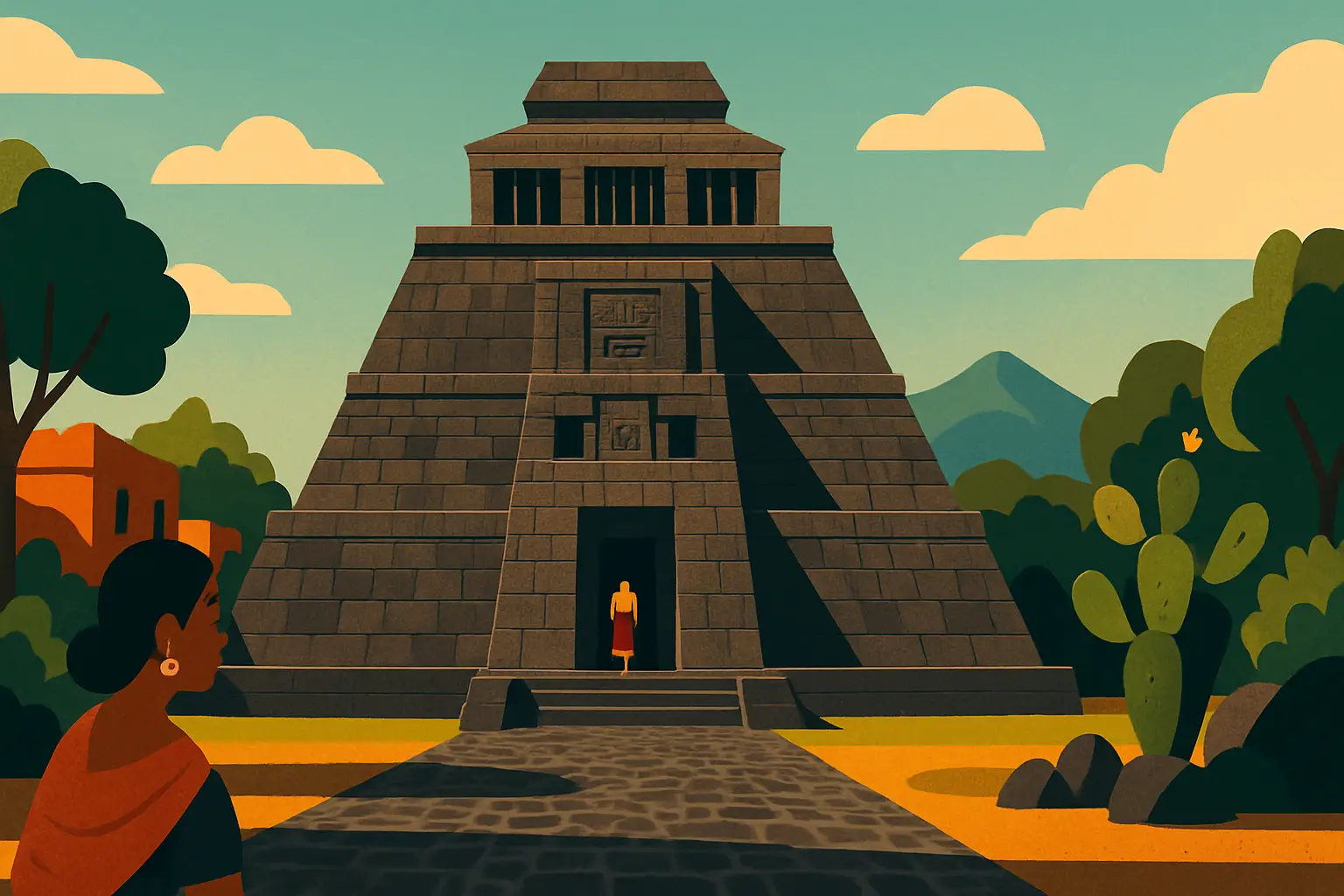
Rivera purchased land in San Pablo Tepetlapa, in the Coyoacán borough, in the 1940s. The location was deliberate. The Pedregal de San Ángel sits on ancient lava fields from the Xitle volcano, which erupted roughly 2,000 years ago and buried the pre-Columbian settlement of Cuicuilco — one of the earliest urban centers in the Americas — under meters of basalt. Rivera was building on geological history. Construction began in 1953 to Rivera's own designs. The exterior walls are built from dark tezontle, the porous volcanic basalt used by the Aztecs in Tenochtitlan construction because of its lightness and workability. The building rises three levels with a central ceremonial axis, a monumental staircase, and proportions that reference Aztec pyramid design without literally imitating it. Rivera incorporated a glass ceiling into the uppermost gallery, creating a dramatic contrast with the deliberately dim lower levels. The effect is intentional: entering from the bright Pedregal exterior into the lower galleries mimics the experiential arc of entering an Aztec ceremonial space — you descend into volcanic darkness, surrounded by ancient stone and ceramic figures, then emerge into sky-lit elevation at the summit. Rivera died in 1957, four years before the museum opened. His daughter, architect Ruth Rivera Marín, completed the structure according to his original plans and oversaw its inauguration to the public in 1964.
Exterior walls are tezontle — the same dark volcanic basalt the Aztecs used to build Tenochtitlan
Three levels, designed by Rivera himself, with a glass ceiling on the top floor for dramatic natural light
Rivera died in 1957; his daughter Ruth Rivera Marín completed the building and opened it in 1964
Get short, interactive stories that make each place easier to remember while you travel.
The museum displays approximately 2,000 objects — a curated fraction of Rivera's total collection, selected to represent the breadth of Mesoamerican cultural production. What you encounter on the three floors spans roughly 3,000 years and six distinct cultures. On the ground floor: Olmec jade masks and stone figures dating from 1500 to 400 BCE, among the oldest and most formally refined objects in the building. Rivera was particularly drawn to the Olmec aesthetic, and the ground-floor display reflects that with a density of small jade carvings and ceramic figures with characteristically downturned mouths. The middle-level galleries hold Teotihuacan figurines and ceramic vessels from the first millennium CE, Toltec warrior figures, and Zapotec funerary urns from Oaxaca with their characteristic helmet-style headdresses. The Nahua (Aztec) pieces occupy a prominent section, including fertility deity figures, ritual vessels, and stone carvings that share formal qualities with the artifacts at the Templo Mayor a few kilometers north in Centro Histórico. Rivera arranged the display thematically and aesthetically, not chronologically. He was interested in visual relationships between objects from different periods — you'll see a Teotihuacan figurine beside an Aztec ceremonial piece because Rivera felt they were in visual conversation. The density of the glass cases can be disorienting at first. Stand in front of a case and look slowly: many of the most remarkable objects are palm-sized clay figures with expressive faces that predate anything in Mexico City's colonial churches by five centuries.
Olmec: ground floor, jade masks and stone figures from 1500–400 BCE — the oldest objects in the museum
Teotihuacan, Toltec, Zapotec, Nahua: middle galleries, arranged by visual relationship rather than chronology
Nahua (Aztec) pieces include fertility deities and ritual vessels comparable to finds at the Templo Mayor excavations
The top floor functions as a studio archive. Rivera used the Anahuacalli as a workspace for drafting preparatory sketches and compositional studies for his major murals, and the walls of the upper gallery contain examples of this process — figure studies, spatial compositions, and color explorations that document how Rivera absorbed pre-Columbian visual language and translated it into a contemporary idiom. The formal borrowings become legible once you've walked the lower floors. The frontal pose and decorative density of Teotihuacan figures reappears in Rivera's mural compositions. The narrative compression of Aztec calendar reliefs — telling complex histories across a single carved surface — informs his approach to large-scale architectural painting. Rivera wasn't romanticizing or preserving indigenous art as a relic; he was using it as active material for a living practice. The glass ceiling floods the studio with natural light that contrasts sharply with the lower galleries' volcanic-stone dimness. From the roof terrace accessible from this level, you see the Pedregal's dark lava fields extending south, the Ajusco volcanic range on the horizon, and on clear days the snow-capped Popocatépetl and Iztaccíhuatl volcanoes rising to the east. It is one of the least-photographed significant views in Mexico City.
The Anahuacalli is at Calle Museo 150 in San Pablo Tepetlapa, Coyoacán borough — roughly 15 minutes by car from Coyoacán's central plaza and about 20 minutes from the Frida Kahlo Museum (Casa Azul). By public transport: take Metro Line 3 (olive green line) to the Coyoacán station, then take a taxi or Uber for the remaining 1.5 kilometers to the museum entrance. The ride from Coyoacán metro station takes about 5-7 minutes and costs around 40-60 MXN by taxi. There is no direct bus from central Mexico City that drops at the museum door; the metro-plus-taxi combination is the most reliable route. The neighborhood immediately surrounding the museum is quiet residential — safe to walk during the day, but there is nothing to explore on foot beyond the volcanic rock landscape of the Pedregal itself. Restaurants and cafés are back in Coyoacán's centro, about a 10-minute drive north. Plan to arrive at the museum rather than wander toward it.
Metro Line 3 to Coyoacán station, then 5-7 min taxi to Calle Museo 150 — 40-60 MXN
15 min by car from Coyoacán centro, 20 min from Casa Azul (Frida Kahlo Museum)
No walkable neighborhood around the museum — pair it with lunch in Coyoacán before or after
Hours: Tuesday through Sunday, 11 a.m. to 5:30 p.m. Closed every Monday. The museum empties out after 3 p.m., which is the best time to move slowly through the dense display cases without other visitors at your shoulder. Tickets: Admission is approximately 80-100 MXN for general entry — one of the better value-to-significance ratios in Mexico City's museum circuit. The shop inside sells prints and reproductions of Rivera's preparatory mural sketches at prices that are significantly more reasonable than the heavily touristed shops near Casa Azul. Photography: Permitted throughout, including inside the collection rooms. No tripods. Visit length: Allow 60-90 minutes at a deliberate pace, longer if you want to spend time with individual pieces. Three things not to miss: the Olmec section on the ground floor for the oldest objects; the comparative display of Teotihuacan and Aztec pieces that demonstrates Rivera's curatorial philosophy; and the roof terrace regardless of weather — the view of the Pedregal lava field from above gives the building's geological and historical context that you simply cannot grasp from inside.
For anyone with more than three days in the city and an interest in pre-Columbian culture, yes — without reservation. The Museo Nacional de Antropología on Paseo de la Reforma is broader and more encyclopedic as a survey collection. The Templo Mayor in Centro Histórico excavates an actual Aztec ceremonial site. The Anahuacalli offers something neither of those does: the experience of a private intellectual obsession made physical, in a building that is itself an artistic statement. Rivera didn't just collect objects — he built a pyramid and filled it with evidence of the civilizations that had shaped his worldview and his art. Walking through the Anahuacalli, you're simultaneously looking at 3,000-year-old artifacts and at the interior of one artist's mind. That's a specific experience, and one that most visitors to Mexico City never find, because the museum sits far enough from the standard tourist circuit to require real intention to reach. The visitors who do make it tend to stay longer than planned.
Yes, and it's one of the best full-day itineraries in southern Mexico City. The two museums are linked historically — Rivera and Kahlo lived and worked in Coyoacán, and the Frida Kahlo Museum at Casa Azul on Londres 247 sits about 20 minutes north of the Anahuacalli by car. Arrive at Casa Azul when it opens at 10 a.m. — advance tickets are required and sell out, so book before your trip. Spend 90 minutes to two hours there, then walk or taxi to lunch near Jardín del Centenario in Coyoacán's centro. La Guadalupana on Higuera 2 has been a Coyoacán institution since 1930: pozole, carnitas, cold Modelos, and tiled walls that haven't changed since the neighborhood was a separate village. Taxi south to the Anahuacalli after lunch and arrive around 1-2 p.m. for the quietest afternoon hours. The full circuit — Casa Azul, lunch in Coyoacán, Anahuacalli — takes five to six hours and covers the two most significant art and cultural destinations in the southern half of Mexico City in a single, logical loop.
Book Casa Azul tickets in advance — they sell out; museum opens at 10 a.m.
Lunch at La Guadalupana, Higuera 2, Coyoacán — open since 1930, traditional pozole and carnitas
Arrive at Anahuacalli by 1-2 p.m. for quieter afternoon hours; full circuit takes 5-6 hours