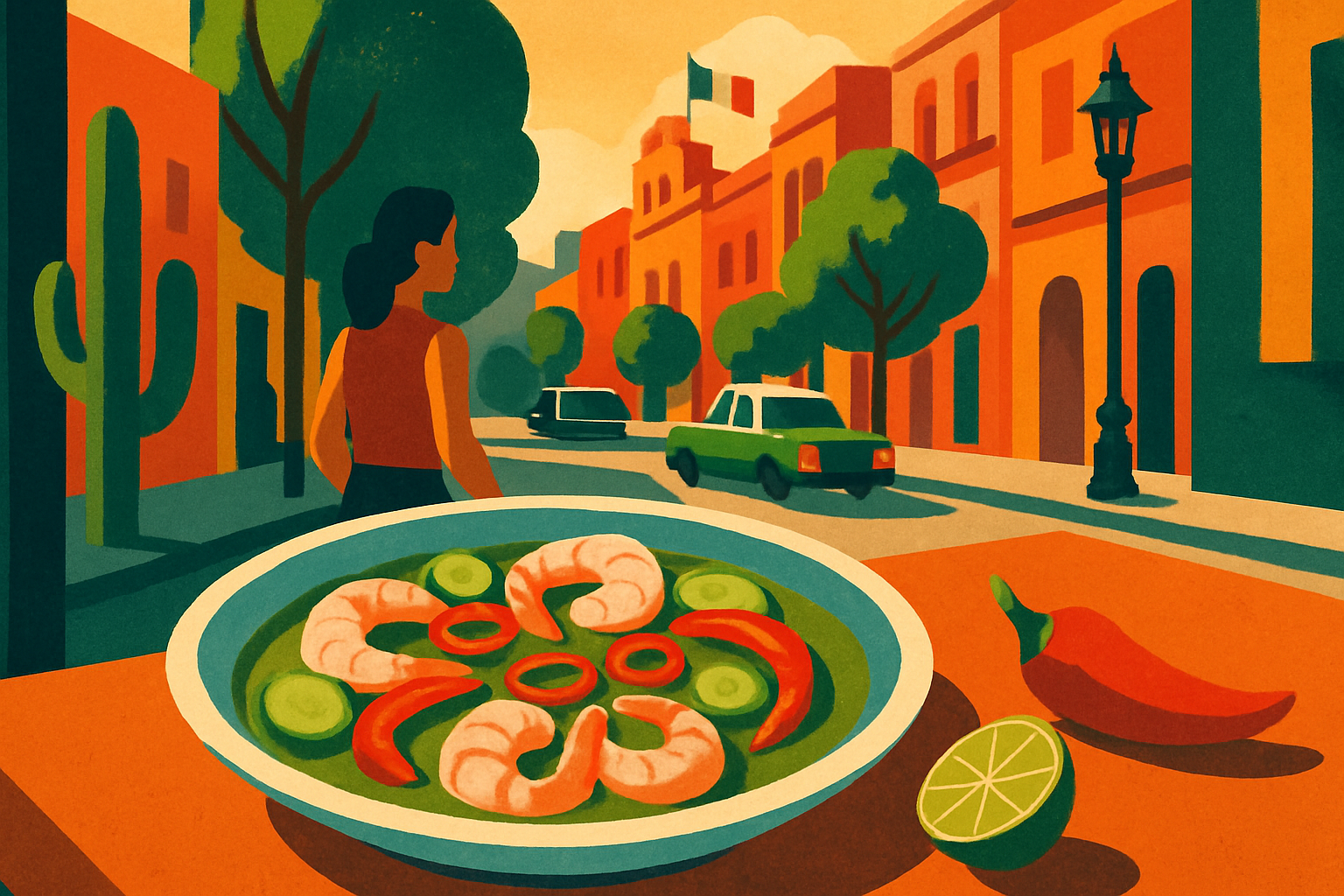
1. What aguachile actually is — and why it keeps getting called 'spicy ceviche'
The confusion is understandable. Both dishes involve raw seafood and citrus. But they are categorically different in timing, texture, and philosophy. Ceviche marinates — the fish or shrimp sits in lime juice for anywhere from fifteen minutes to several hours, and the acid denatures the protein until the flesh goes opaque and firm. Aguachile does not wait. The shrimp is butterflied thin (split lengthwise and pressed flat), submerged in a blended sauce of fresh lime juice, serrano or chile de agua, cucumber, and salt, and served immediately — often within two or three minutes of preparation. The shrimp is still raw at the center. The sauce is so thin and acidic that it barely registers as a sauce at all; it's closer to flavored water that the shrimp floats in, which is exactly what the name says (agua = water, chile = the spice).
The result is a dish that is cold, sharp, and aggressive in a way ceviche rarely is. A well-made aguachile verde hits you with sourness first, then heat, then the clean brininess of the shrimp underneath. The tostada it arrives on goes partially soggy within a minute — this is correct. You are meant to eat it fast. The whole point is immediacy.
2. Where aguachile comes from: Sinaloa's coast and the dish that traveled north
Aguachile originates on the Pacific coast of Sinaloa — specifically from the coastal towns around Culiacán, Mazatlán, Guasave, and El Rosario, where shrimp fishing is one of the dominant industries. The original version was simpler and drier: fishermen would pour water over dried chile piquín and splash it directly onto freshly caught raw shrimp at the beach — no lime, no cucumber, no preparation beyond the spice and the shrimp. The modern form with fresh lime juice emerged in the second half of the 20th century as coastal restaurants began refining the beach food into something that could be served at a table.
Aguachile became known nationally as Sinaloan migrants moved to Mexico City, Tijuana, and other major cities throughout the 1980s and 1990s. In Mexico City the dish took hold in the city's marisquerías — seafood restaurants that cluster in certain colonias and run the same caguama-and-aguachile formula that you'd find at any Sinaloa coast shack. By the 2010s it had crossed into fine dining. Contramar in Roma Norte, which opened in 1998, helped legitimize aguachile as a serious culinary preparation rather than just beach food. By 2026 it sits on menus from 30-peso market tostadas to tasting-menu courses at restaurants on the North America's 50 Best list.
3. Verde, negro, and rojo: the three styles you'll find in Mexico City
Verde is the original, most common, and most widely available style. The sauce is blended fresh serrano or chile de agua with lime juice, cucumber, and salt — sometimes cilantro, sometimes a touch of garlic. The color is an aggressive lime green. The flavor is tart-forward with clean heat. This is the version to order if you are eating aguachile for the first time, or if you want to understand what the dish actually tastes like without modification.
Negro is the more complex variant and has become particularly fashionable in Mexico City over the last decade. The base shifts from fresh serrano to chile negro (pasilla), often combined with habanero, Worcestershire sauce, and sometimes a small amount of soy sauce or dark vinegar. The resulting sauce is deep brown-black, earthy, and smoky, with a slower-building heat that sits at the back of the throat. Some cooks add dried chile morita for a light fruitiness. Aguachile negro rewards slower eating — it has more layers than verde and pairs better with heavier mariscos accompaniments like octopus or scallops.
Rojo uses dried red chiles — typically árbol, guajillo, or morita — blended with lime. It's earthier than verde and less smoky than negro, and it's the least common of the three in Mexico City restaurants. You'll find it most reliably at Sinaloa-focused spots rather than fusion or fine-dining interpretations.
Some places now serve aguachile with non-shrimp proteins — scallops (callos de hacha), octopus (pulpo), or mixed shellfish — which all hold up well to the same verde or negro preparations. The shrimp version remains the standard.
4. How to order aguachile in Mexico City
The default order is 'aguachile verde de camarón' — verde-style shrimp aguachile. At most marisquerías, simply saying 'aguachile' defaults to verde. If you want negro, you need to specify.
Aguachile almost always arrives on tostadas — thin, crispy fried corn tortillas. Sometimes the shrimp comes in a bowl with tostadas on the side so you assemble your own. Sometimes it's already plated on the tostada, in which case eat quickly before the chip softens. A good preparation calibrates the ratio so the tostada holds its structure for roughly sixty to ninety seconds — enough to eat it without it collapsing, not so much that the sauce is stingy.
On heat level: many restaurants in Mexico City have calibrated their aguachile for tourist tolerance — medium heat by Sinaloan standards, which means genuinely mild. If you want it actually spicy, say 'bien picante' when ordering. At a Sinaloa-focused spot like Del Mar in Polanco, the default heat is already higher and 'bien picante' will get you something that clears the table.
On accompaniments: aguachile typically comes with cucumber slices, thinly sliced red onion, and often a few tostada chips to reload from the bowl. Some restaurants add a halved avocado or avocado slices on top — this is optional and slightly softens the acidity. At the Mercado de San Juan, seafood stall vendors will often add an extra squirt of lime and a few drops of salsa Valentina to the finished tostada before handing it over, which is the market protocol.
5. Where to eat aguachile in Mexico City: from market stalls to Michelin recognition
Contramar (Durango 200, Colonia Roma Norte) is the most famous seafood restaurant in Mexico City, open since 1998 and run by chef-owner Gabriela Cámara. The tuna tostadas are the signature, but the green shrimp aguachile is equally considered. The room is loud, light, and almost always full — book online one to two weeks ahead for dinner. This is the version to eat if you want to understand how aguachile performs in a formal restaurant context without veering into tasting-menu territory.
Balandra (Colonia Roma Norte, MICHELIN Recommended 2026) is chef Alejandro Zárate's Baja California fish camp restaurant. His aguachiles have a clarity — technically clean preparations that capture the spice and citrus without muddy additions — that comes from years of cooking Pacific coast seafood. It's a smaller, calmer room than Contramar with a more focused menu.
Del Mar (Julio Verne 62, Colonia Polanco) is a Sinaloa-focused restaurant that serves textbook-authentic aguachile negro and verde. The preparation is honest and the heat level is calibrated for people who grew up eating it rather than tourists discovering it. Less stylish than the Roma spots, more reliable for the actual dish.
La Ostra (Nuevo León 104, Colonia Condesa) has a spicy green aguachile that regulars come back to specifically. Casual room, good value, the kind of place you eat at twice in a week and recommend to everyone you know who's staying in Condesa.
Acamaya (one of North America's 50 Best Restaurants in 2026) serves a classic Gulf shrimp aguachile alongside a hamachi tostada inspired by tacos al pastor. This is the special-occasion version — expect a tasting-menu context and reservation-required booking.
Mercado de San Juan (Ernesto Pugibet 21, Centro Histórico) is the budget option. The interior seafood stalls — several of which have been operating for decades — offer aguachile on tostadas at 30–50 pesos each. It's an efficient way to try the dish in its market-stall form, alongside oysters and ceviche tostadas, before committing to a restaurant meal. For a full overview of the broader mariscos scene in Mexico City, the city's seafood culture goes far beyond aguachile.
6. What to drink with aguachile
The classic pairing is a chelada — cold lager beer with fresh lime juice and salt on the rim, no tomato. The bitterness of the beer cuts directly through the acid of the aguachile and resets your palate between bites. A chelada pairs cleanly with verde; a full michelada (with clamato and salsa) works better alongside aguachile negro, where the tomato-and-spice base complements the earthier sauce.
Agua de Jamaica (hibiscus water) is the other natural pairing — tart and floral, it holds up to the chile without overwhelming it. At market stalls, jamaica is usually the right answer since beer is not always sold there.
At the restaurant level, Contramar has a wine list specifically engineered for seafood preparations. A dry Albariño or Grüner Veltliner works with verde in the same way the chelada does — high acid, low tannin. The general rule: anything high-acid and low-body. Avoid mezcal alongside aguachile — the smoke and sweetness of a good mezcal competes with rather than supports the dish, and you'd be paying not to taste either one properly.
7. Is raw shrimp safe? Practical questions answered
Is aguachile safe to eat in Mexico City? At established restaurants — Contramar, Balandra, Del Mar, La Ostra — yes. These kitchens handle raw seafood as their core business, rotate stock rapidly, and maintain refrigeration standards that keep the shrimp fresh. At Mercado de San Juan, the high-volume seafood stalls have been operating safely for decades. The rule is the same one that applies to raw seafood anywhere: watch for freshness indicators (pearlescent color, no gray edges, no off-smell), choose busy vendors with visible turnover, and avoid anything that looks like it's been sitting in its sauce for hours.
Aguachile is technically raw seafood — the lime juice denatures the outer protein but does not cook the shrimp through. This is fine for most people. If you are pregnant, immunocompromised, or simply prefer fully cooked mariscos, order ceviche (longer acid-cure) or grilled shrimp instead. The restaurants above all offer cooked options.
When is the best time to eat it? Aguachile is year-round in Mexico City, but the shrimp quality peaks in late fall and winter, when Mexico's Pacific coast shrimp season is at its height and supply is freshest. That said, the difference between June aguachile and December aguachile at Contramar is marginal — both are good.
How spicy is it, really? Verde at a Sinaloa-focused spot like Del Mar can be genuinely hot — 6 to 7 on a ten-point scale. At tourist-oriented menus it's often dialed to 3 or 4. Negro tends to be medium-high with slower build. If heat is a concern, ask before ordering; every kitchen adjusts. If you want the full effect, ask for it picante and mean it.