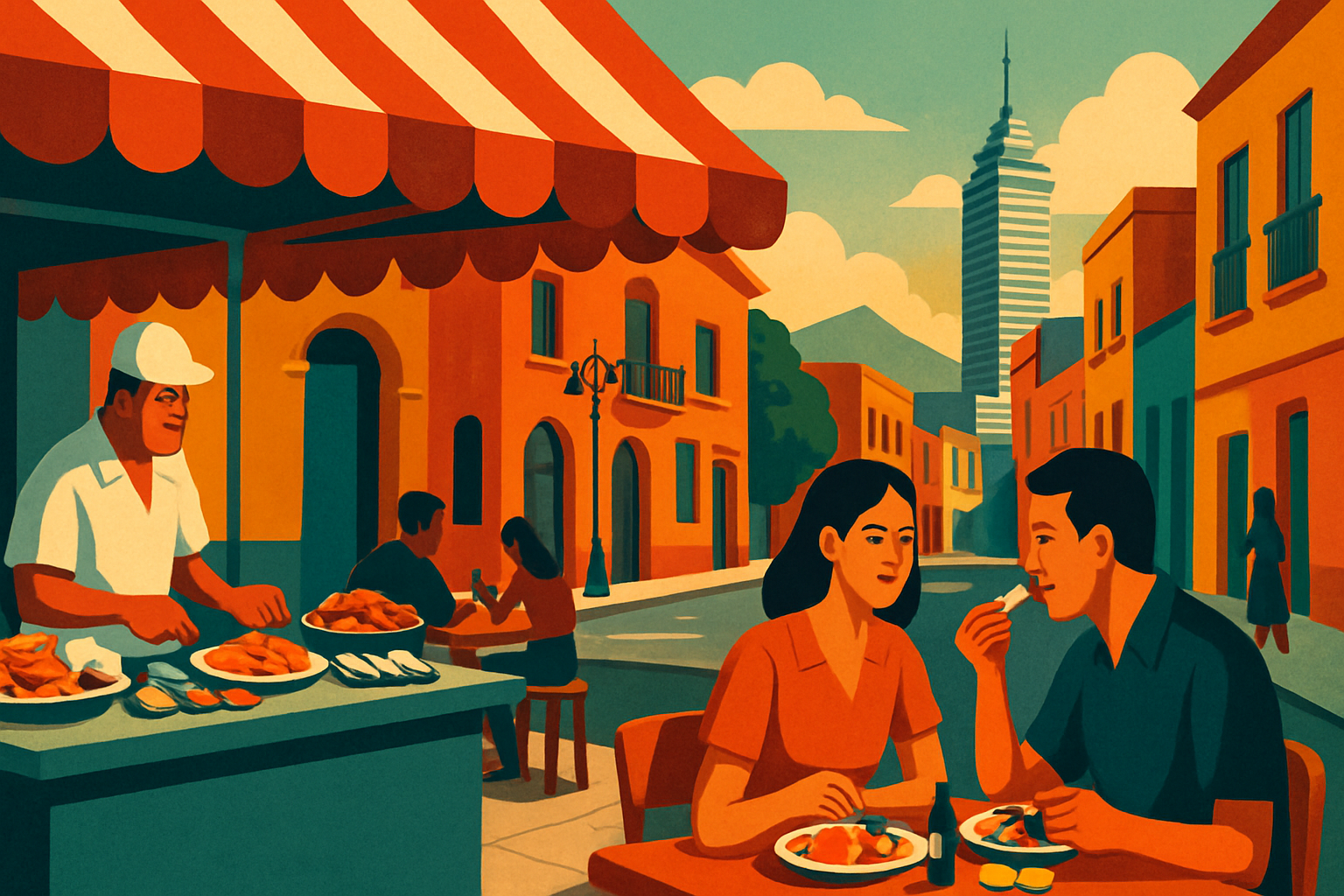
1. Why a landlocked city at 2,240 meters has world-class seafood
The question makes sense until you look at a map. Mexico City is not near the ocean, but it sits at the center of a country with 11,000 kilometers of coastline on two oceans. What the capital lacks in proximity it makes up for in infrastructure and appetite. Every night, refrigerated trucks load at the docks in Veracruz, Tuxpan, and Tampico on the Gulf Coast — as well as from Manzanillo and Mazatlán on the Pacific — and drive overnight to arrive at Mercado de la Viga by 3 to 4 am. A metro area of nine million people demands an enormous supply chain, and CDMX's appetite for mariscos has supported that chain for well over a century. The market at La Viga is now the second-largest seafood market in the world, behind only Toyosu in Tokyo. Most visitors to Mexico City have no idea it exists. The history goes deeper. The canal that gave La Viga its name — the Canal de la Viga — once connected the lake system of the Valley of Mexico to the markets of Tenochtitlán. For centuries before the Spanish arrived, indigenous fishing communities paddled canoes loaded with lake fish, frogs, and axolotls along that canal into the city. The water is long gone, but the market stayed, and the instinct for fresh seafood in a city surrounded by mountains never left.
2. Mercado de la Viga: where the city's seafood begins
Mercado de la Viga sits on Eje 3 Sur near the Canal de la Viga in Iztacalco, a working-class borough southeast of Centro Histórico. It operates as both a wholesale distribution hub — supplying restaurants, market stalls, and street vendors across the entire metro area — and, on weekends, one of the most interesting food destinations in the city. The wholesale floor runs from around 3 am and is where restaurant buyers, market stall operators, and serious home cooks do their shopping before dawn. By 6 am, the retail section is open to the public: whole fish displayed on ice, shrimp sorted by size in large plastic bins, live clams and oysters in burlap sacks, octopus sold by the kilogram. The variety tracks what's in season on the Gulf and Pacific. In late spring and through summer, Gulf shrimp are at their best — large, sweet, and inexpensive. Huachinango (red snapper) runs year-round from both coasts. On Saturday and Sunday mornings, prepared-food stalls at La Viga's perimeter serve ceviche tostadas, cóctel de camarón in tall glasses, and grilled whole fish at plastic tables. It is not glamorous and it does not photograph well — but eating a seafood tostada with a Michelada at a market table at 8 am, surrounded by fish vendors and the smell of the morning's catch, is about as close to the source of Mexico City's food chain as a visitor can get. Metro Iztacalco (Line 8, orange) or a 25-minute Uber from Roma Norte (around 80–120 MXN) will get you there.
3. Contramar and the tostada de atún that changed CDMX dining
Contramar at Calle Durango 200 in Roma Norte is not a secret — it has been one of Mexico City's most-discussed restaurants for over two decades — but it earned its reputation by doing specific things exceptionally well and not changing them. The dish that made it famous is the tostada de atún: a flat, fried corn tortilla spread with chipotle mayonnaise, piled with fresh tuna dressed in soy sauce and lime, topped with sliced avocado, and finished with a drizzle of dark sesame oil. It costs around 180 MXN, takes about four bites to eat, and is one of the best single things to put in your mouth in the city. The restaurant's other signature is a whole grilled huachinango presented split open and painted with two different sauces side by side: bright green parsley-and-garlic on one half, red chile-and-tomato on the other. Contramar is open for lunch only (1 to 6 pm), does not take reservations for parties under six, and has a line on weekends that starts forming by noon. Go on a Tuesday or Wednesday, arrive at 1:30 pm, and you'll usually walk in within fifteen minutes. The tostada de atún format that Contramar popularized has since migrated to markets, street stalls, and casual lunch spots across the entire city. Its sister restaurant, Entremar, in Polanco at Ejército Nacional 433, serves the same menu with shorter waits and a slightly quieter room — worth knowing if the Roma Norte original is fully booked.
4. Aguachile vs. ceviche: what's actually different
Both involve raw seafood and lime juice, but they are different in origin, texture, and intention. Ceviche is the broader category: raw fish or shellfish dressed in lime juice long enough that the acid begins to firm up the protein on the outside — sometimes called 'cold cooking.' The fish is then mixed with diced tomato, cucumber, white onion, cilantro, and serrano chile. The result is tangy, textured, and filling. Aguachile is Sinaloan in origin and works on a different logic: raw shrimp — always shrimp — are submerged in a sauce that is mostly liquid (*agua* seasoned with ground chile, lime, and salt) and served almost immediately, so the shrimp remain nearly raw in texture, cold and intensely flavored by the chile water. The shrimp are butterflied flat so the thin edges take the acid hit while the center stays translucent. In Mexico City, a third version has become standard: aguachile negro, made with tamarind paste, soy sauce, Worcestershire, and dark dried chiles like chile negro or pasilla. It's earthier, slightly sweet, and more layered than the coastal original — and it's a genuinely CDMX creation that doesn't exist on the Sinaloan coast where aguachile came from. La Docena at Álvaro Obregón 31 in Roma Norte, and a second location in Polanco, is one of the better places to try all three versions alongside freshly shucked oysters from Baja California and the Gulf of Mexico.
5. Cóctel de camarón and the street seafood tradition
The cóctel de camarón is Mexico's answer to the shrimp cocktail, and the two dishes share almost nothing but the protein. The base is a cold tomato broth — part ketchup, part clamato, part lime — served in a tall glass or plastic cup with cooked shrimp, diced cucumber, avocado, raw white onion, cilantro, and hot sauce. Saltine crackers come on the side for scooping. The flavor is cold, tangy, slightly sweet, and sharp from the lime — exactly the thing you didn't know you wanted on a warm afternoon until you're standing at a market stall eating one for 100 MXN. Cóctel carts and small marisquería stands are common throughout the city: around Mercado Jamaica in Iztacalco, near the entrance to Mercado de la Merced along Circunvalación, and inside the covered markets of Narvarte and Colonia del Valle. For more heat, many vendors offer a version ahogado ('drowned') — extra hot sauce — or swap the tomato base for a tamarind-soy aguachile negro base. Point and mime if you don't have the word; cóctel vendors are entirely accustomed to it. For Sinaloa-style towers — stacked with octopus, shrimp, scallops, and cucumber on a base of tostadas — Mi Compa Chava Marisquería in Coyoacán (and a Roma Norte location) has built a following among locals who want the full coastal spread without flying to Mazatlán.
6. Best marisquerias by neighborhood
Roma Norte is the densest area for quality mariscos in the city. Contramar (Calle Durango 200) anchors the upper range; La Docena (Álvaro Obregón 31) handles oysters and aguachile; El Pescadito (Culiacán 100) serves casual fish tacos, shrimp, and a solid aguachile de camarón from 10 am to 7 pm. The mariscos corridor inside Mercado de Medellin — a short walk into Roma Sur — has informal stalls serving tostadas and cocktails from the back section on weekday mornings. Polanco runs a dressier version of the same culture: Entremar (Ejército Nacional 433) is Contramar's quieter twin; the weekend morning taco stands along Presidente Masaryk are a less-known option for quick fish tacos and aguachile from carts. Coyoacán has seafood stalls inside and just outside Mercado de Coyoacán on weekends — the tostadas de pulpo (octopus) and ceviche de jaiba (crab ceviche) at the weekend stalls are worth seeking. Centro Histórico has the most dispersed options: cóctel carts near Mercado de la Merced on Circunvalación, and the covered section of Mercado de San Juan (Luis Moya 56) has a reliable fish counter with tostadas and fresh ceviche. For the deeper food market culture, every major market has a seafood section — La Merced's is the most chaotic and the most rewarding.
7. Huachinango a la veracruzana: the colonial-era dish behind the flavor
Huachinango a la veracruzana — red snapper in the Veracruz style — is Mexico's most specific regional seafood preparation and one of the clearest examples of how three cooking traditions merged during the colonial period. The sauce contains tomato, white onion, and garlic from the Spanish pantry; olives and capers that arrived through Moorish-influenced colonial cooking; fresh epazote (an herby indigenous plant) and pickled jalapeños from pre-Hispanic and mestizo tradition. The red snapper cooks in this sauce until it absorbs the fat from the olives and the salt from the capers — the result is tangy, slightly briny, and completely unlike anything from the Pacific side of Mexico. The dish appears most often in mid-range Mexican restaurants and fondas, particularly in Centro Histórico. Fonda El Refugio at Calle Liverpool 166 in Zona Rosa, open since 1954, carries it reliably as part of the weekly comida corrida menu. Order it with arroz rojo and a cold Bohemia between 1:30 and 4 pm — that is the right hour, the right pairing, and the right context for understanding why Veracruz's coastline has fed Mexico City for four centuries.
8. Is seafood safe in Mexico City? Prices, timing, and what to know
Is it safe? Yes, with basic logic applied. High-turnover spots — market stalls at peak hours, busy lunch taquerias, established restaurants — move product fast enough that freshness is not a concern. The risk is the slow vendor at an off hour. Mexico City's mariscos culture is firmly a lunch activity: most seafood restaurants close by 6 pm, ceviche stalls wind down by 4 pm, and cóctel carts mostly disappear after early evening. Raw seafood from a slow cart at 9 pm is a different calculation than the same thing from a packed market stall at noon. Standard local logic: if a place has a line and turns tables quickly at peak lunch hour, order confidently. If it's nearly empty at 1 pm on a Saturday, move on. How much does it cost? A tostada de mariscos runs 60 to 180 MXN depending on filling and venue. A cóctel de camarón is 80 to 150 MXN. A full lunch at a sit-down marisquería — appetizers, main, drinks — runs 400 to 700 MXN per person. Oysters at La Docena cost 60 to 90 MXN each. When is seafood at its best? Spring through early summer (April through July) is peak Gulf shrimp season — the shrimp at La Viga right now are as good as they get. Pacific yellowfin tuna is strongest through summer. Baja oyster season peaks October through March, making La Docena in November one of the better dining decisions you can make in the city.