In 1864, Austrian Archduke Maximilian von Habsburg arrived in Mexico City as Emperor, installed by Napoleon III and a coalition of Mexican conservatives who preferred a European monarchy to Benito Juárez's republic. Maximilian moved into Chapultepec Castle and faced an immediate logistical problem: getting to the National Palace in Centro required navigating narrow colonial streets that hadn't been planned for imperial processions. His solution was Paseo del Emperador — a wide diagonal boulevard modeled on the Champs-Élysées in Paris and the Ringstrasse he had known in Vienna. Construction began in 1865, cutting through what was then open land on the city's edge. Maximilian planted trees, laid gas lamps, and began commissioning grand urban monuments. He never got to use the finished product. Republican forces led by Juárez captured and executed him on June 19, 1867, at the Cerro de las Campanas in Querétaro. The boulevard was renamed Paseo de la Reforma, and the Mexican government began filling its roundabouts with monuments to independence heroes, indigenous emperors, and republican leaders — the precise opposite of what the street was built to celebrate. That irony is still the most interesting thing about Reforma: the Habsburg grand avenue became Mexico's most nationalist street.
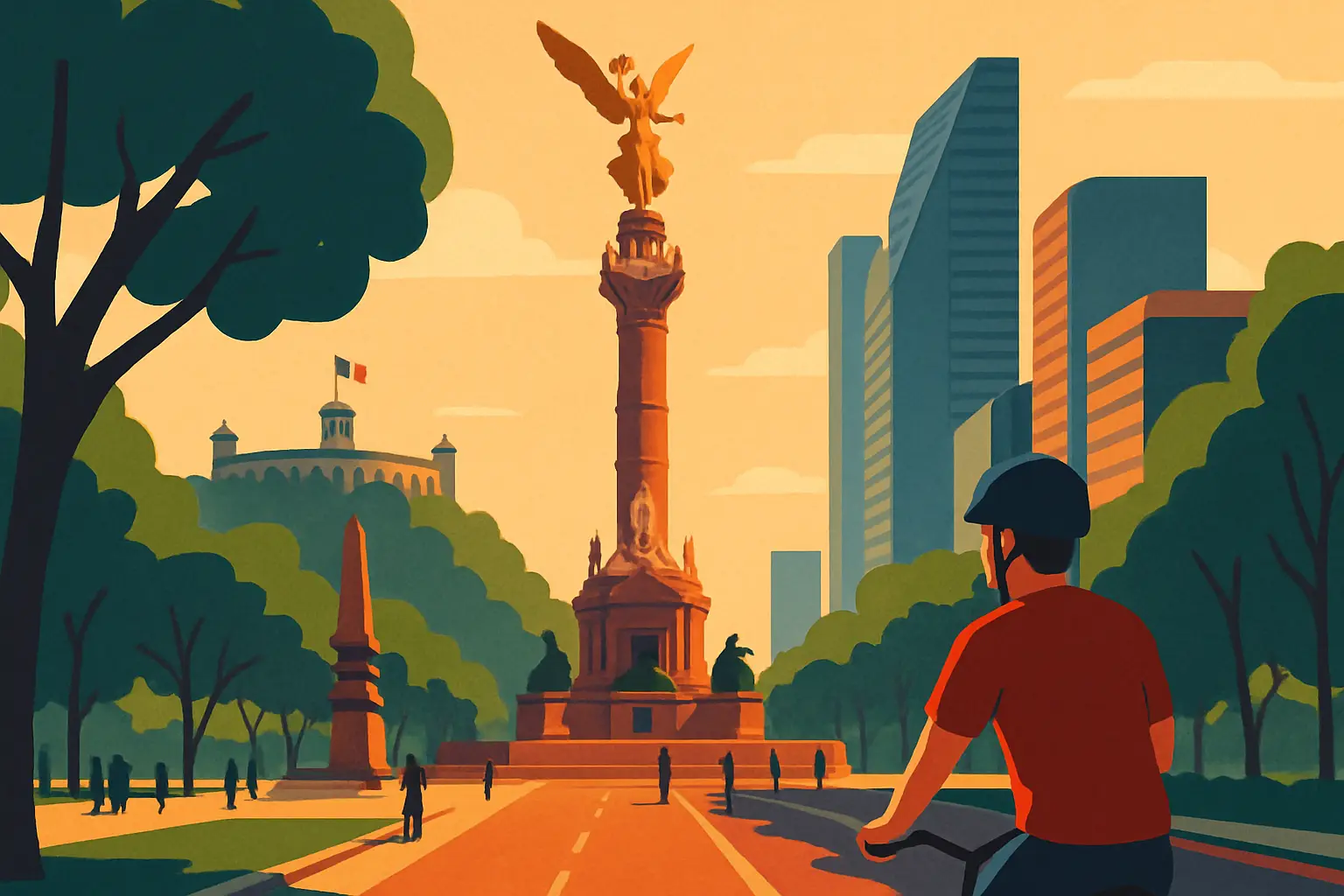
At the intersection of Reforma and Florencia stands the Columna de la Independencia, universally called El Ángel — a 45-meter Carrara marble column topped by a seven-meter gilded bronze Victoria (goddess of victory) with wings spread and a laurel crown raised. It was inaugurated on September 16, 1910, exactly 100 years after Miguel Hidalgo rang the church bell in Dolores Hidalgo to begin the War of Independence. Italian sculptor Enrique Alciati designed the figure from Carrara marble shipped in pieces from Italy. What most visitors don't realize is that the column is a mausoleum: the pedestal holds funerary urns with the remains of Hidalgo, José María Morelos, Vicente Guerrero, Nicolás Bravo, and others who died fighting the Spanish Crown. The crypt is sealed year-round except during Independence Day ceremonies on September 15–16, when the Mexican president descends to touch the urns — and civilians are briefly allowed in after. El Ángel partially collapsed during the 1957 earthquake, bringing down the bronze figure; it was restored and re-installed. If you look at the base near the south side, slight tonal variations in the marble still mark where the 1957 repair work joined the original stone.
Get short, interactive stories that make each place easier to remember while you travel.
One roundabout west of El Ángel, at the intersection of Reforma and Lieja, stands Diana Cazadora — a bronze Diana the Huntress mid-stride with her bow raised, completely unclothed. The statue was installed in 1942, sculpted by Juan Fernando Olaguíbel, and modeled on Helvia Martínez Verdayes, a young Mexico City woman whose identity was an open secret around town. The reaction was immediate. Mexico City's regent, Javier Rojo Gómez, faced sustained pressure from Catholic civic groups, and within months a metallic bronze skirt was welded onto the statue — covering the figure from the waist down. The skirt came off and went back on as administrations changed, giving the roundabout a faintly surreal quality for roughly two decades. President Miguel Alemán finally ordered a permanent restoration of the original figure in 1967, declaring the modification an act of censorship against art. Diana has stood unclothed and uninterrupted since then, and is now one of the most recognizable landmarks on the entire boulevard. The roundabout below her is also one of the better spots to find food vendors working the pedestrian island on weekday afternoons — there's usually an elotes cart and occasionally a quesadilla stand on the eastern side.
At Plaza de la República, just off Reforma near Insurgentes, stands a 67-meter dome that holds a Guinness World Record as the largest triumphal arch on the planet. Its origin is genuinely strange. In 1897, Porfirio Díaz commissioned a massive neoclassical legislative palace for Congress — a building designed to announce that Mexico had arrived as a modern nation. Construction began in 1910, the steel skeleton of the dome went up, and then the Revolution broke out. Work stopped. The unfinished steel frame sat rusting over the city for more than two decades, a ghost of Porfirian ambition visible from most of central CDMX. In 1933, architect Carlos Obregón Santacilia proposed something audacious: finish the dome not as a palace but as a monument to the Revolution that had ended the Porfirian order. The completed Monumento a la Revolución was inaugurated in 1938, its four corner pillars holding the funerary urns of the Revolution's central figures — Francisco I. Madero, Venustiano Carranza, Plutarco Elías Calles, Lázaro Cárdenas, and Pancho Villa, whose remains were controversially transferred here in 1976. The surrounding Plaza de la República was renovated in 2010 and is now one of the better public plazas in the city, with fountains, seating, and at night the monument lit dramatically against the sky. The paid observation deck (around 80 pesos) provides 360-degree views from the base of the dome — far less visited than Torre Latinoamericana and positioned above a much more interesting urban panorama.
Every Sunday from approximately 7am to 2pm, Reforma closes to all vehicle traffic from Chapultepec to the Zócalo. The Muévete en Bici program has been running since 2007 and is one of the best recurring urban experiences in any city in the world: all six lanes of one of the hemisphere's busiest thoroughfares handed over to cyclists, families, skaters, and pedestrians. Ecobici bike-share stations appear every 300–400 meters along the route — register at ecobici.cdmx.gob.mx, and the first 30 minutes of each rental are free. Most people cover the route in three or four legs, returning the bike to any station and re-renting to reset the timer. The best stretch for first-timers runs from El Ángel west toward Chapultepec Park — widest, shadiest, lined with old ahuehuete and ash trees. Street food vendors work the route: aguas frescas from rolling carts, esquites with lime and chili near the Chapultepec gate. Arrive before 9am for the best light and thinnest crowds.
The most logical approach to Reforma is west-to-east: start at the Chapultepec Park entrance (where Reforma dead-ends into the park) and walk toward Centro Histórico. The full route is about 4.5 kilometers and takes 60–90 minutes on foot with stops, or 20–30 minutes by bike. From Chapultepec, the first major landmark is the Diana Cazadora roundabout at Reforma and Lieja. Continue east to El Ángel at Reforma and Florencia, the gravitational center of the tourist stretch. The next major landmark east of El Ángel is Torre Mayor at Reforma 505 — 55 floors of glass-and-steel that became the tallest building in Mexico City when it opened in 2003. The Glorieta de Colón follows: until 2020, this roundabout held a Columbus statue that had stood since 1877. The statue was removed amid debates about colonial-era monuments, and in 2022 a new bronze sculpture of a pre-Hispanic woman by artist Pedro Reyes was installed in its place. Whether you think the swap was right or wrong, knowing it happened is essential for anyone trying to understand contemporary Mexico City. The Glorieta de Cuauhtémoc comes next — the last Aztec emperor, who was captured by Hernán Cortés in 1521 and executed four years later at around age 25. A slight detour north from the next intersection reaches the Monumento a la Revolución at Plaza de la República. Continue east to finish at the Alameda Central — the oldest public park in the Americas, planted in 1592 — before entering Centro Histórico proper.
The stretch from Chapultepec to the Monumento a la Revolución is one of the most heavily policed tourist corridors in Mexico City. Daytime walking is straightforward and safe. During Sunday's Paseo Ciclista, the route is as safe as any public space in the city — families with young children and elderly couples use it without incident. At night, the western half of Reforma (El Ángel toward Chapultepec) stays lively: restaurants and bars on both sides of the boulevard, especially along Zona Rosa on the southern edge, keep the streets well-lit until late. The eastern section past the Monumento a la Revolución toward Centro requires normal urban awareness after 10pm — stick to the main boulevard, use Uber or DiDi rather than unmarked street taxis, and avoid unfamiliar side streets east of Bucareli. The single most common issue on Reforma for tourists is opportunistic phone theft on crowded Sunday mornings — keep your phone in a front pocket or bag rather than waving it around for photos, and you'll be fine.
Metro Line 1 (pink) has three useful stops: Chapultepec drops you at the park entrance (west end of Reforma), Sevilla puts you directly on the boulevard near Zona Rosa, and Insurgentes is a 10-minute walk south of El Ángel. Metrobús Line 7 runs along Reforma itself with stops at the major monuments — it's the fastest option if you want to board or exit at a specific landmark rather than walking the full stretch. Ecobici covers the entire boulevard with stations every few hundred meters; a day pass costs around 90 pesos, the app registers you in about three minutes, and the free 30-minute window per rental covers almost every inter-landmark distance on Reforma. On Sundays during the Paseo Ciclista, the most practical approach is Metro to Chapultepec or Insurgentes, then Ecobici from there — the car-free boulevard is the transit.
Metro Line 1: Chapultepec (west end), Sevilla (mid-boulevard at Zona Rosa), Insurgentes (10-min walk to El Ángel)
Metrobús Line 7: runs directly along Reforma, stops at El Ángel, Monumento a la Revolución, and intermediate points
Ecobici day pass: ~90 pesos at ecobici.cdmx.gob.mx — first 30 min of each rental free, stations every 3–4 blocks