Tinos is the third-largest island in the Cyclades at 194.5 km² — roughly twice the size of Mykonos — and it plays three distinct roles simultaneously. It is one of Greece's most important Orthodox pilgrimage sites: the church of Panagia Evangelistria holds an icon of the Virgin Mary credited with healing miracles, drawing hundreds of thousands of worshippers on August 15th every year. It is the birthplace of modern Greek sculpture: the village of Pyrgos in the island's north has produced more significant marble sculptors per capita than anywhere else in Greece. And in 2026, it is the Cyclades' most discussed food destination: Tinian artichokes, kopanisti cheese, and early-summer capers from hillside terraces are being assembled into menus by chefs who left Athens and foreign kitchens to cook here specifically.
That three-layer identity makes Tinos considerably richer than most Greek islands, where a single dominant character tends to flatten everything else. The interior is where most of it happens: terraced hillsides, marble villages, approximately 600 ornate dovecotes visible across the ridges, and a main mountain (Exomvourgo, 640m) rising steeply above the agricultural plains. The port town of Tinos Town (also called Chora) is the arrival point and the pilgrimage center. Two days is the right amount of time. A day trip from Mykonos, 30 minutes by fast ferry, is enough to understand why people come back.
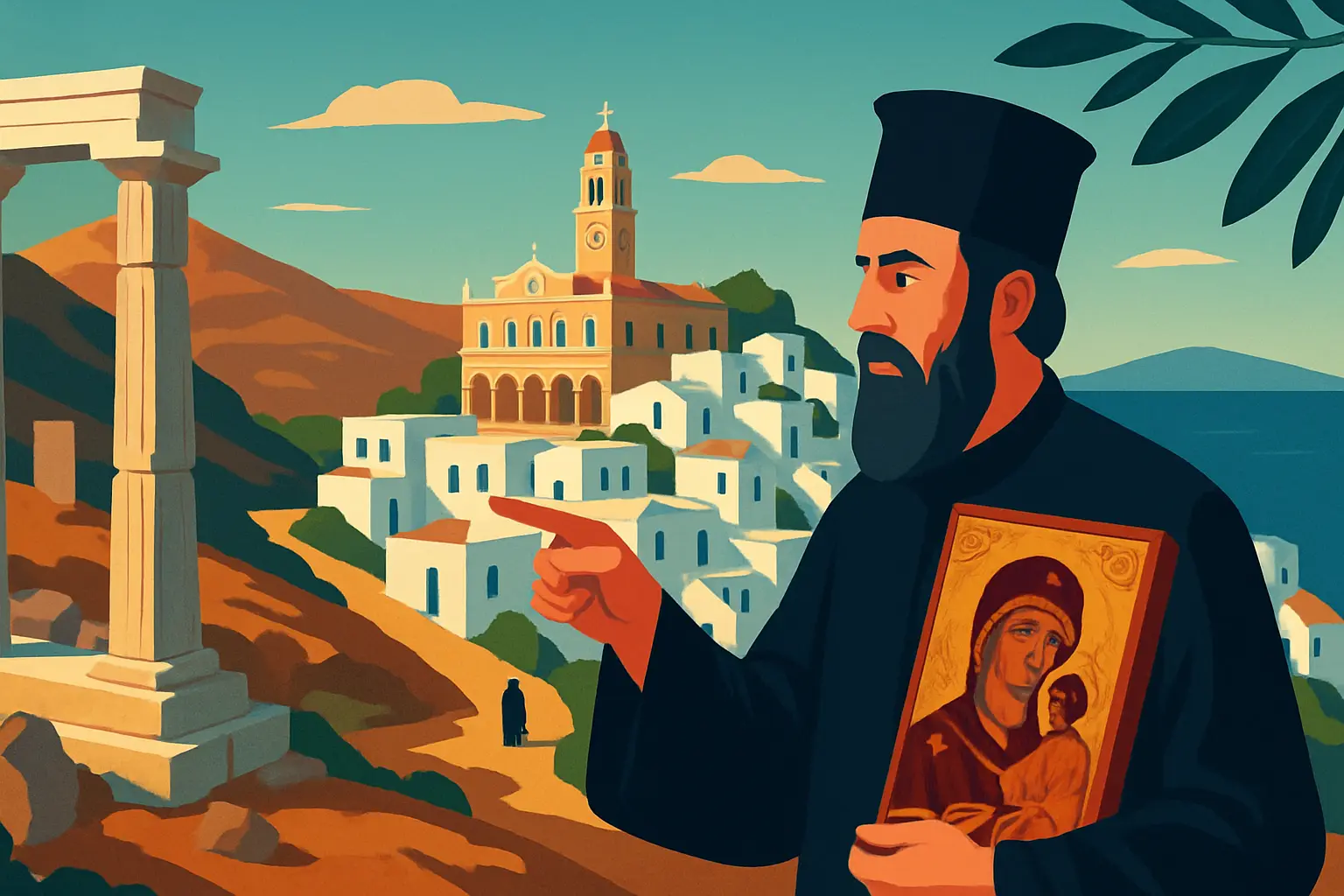
The church of Panagia Evangelistria sits at the top of Leoforos Megalocharis, the main street running from the harbor uphill through Tinos Town. On August 15th — the Dormition of the Virgin, the most important Marian feast in the Orthodox calendar — thousands of pilgrims walk the full 800 meters from the harbor to the church doors on their knees, many carrying long white candles.
The icon was discovered in 1823, excavated from a site revealed in a vision to a local nun named Pelagia. The timing was decisive: Greece was in the middle of its War of Independence against the Ottomans, and the icon's appearance gave it a national significance layered onto its religious one. The church built above the site became simultaneously a pilgrimage monument and a symbol of Greek sovereignty.
Inside, the nave ceiling is hung with tamata: silver votive offerings shaped like body parts, boats, and baby cribs — each one a specific prayer or act of thanks, accumulated over two centuries. It is the most concentrated record of individual devotion you will find in any Greek church. Outside of August 15th the church is accessible from around 7 a.m. daily. Arriving before 9 a.m. gives you the space to read the ceiling properly. The commercial street below — selling candles, incense, and the long-stemmed white lilies that are the traditional Tinos offering — is a completely different experience at those two hours.
Get short, interactive stories that make each place easier to remember while you travel.
Pyrgos sits 28 km north of Tinos Town on a road that crosses the island's agricultural interior and climbs through marble-walled terraces to the village. The place is built from its own material: marble quarried from the hillsides above, carved into facades, door frames, fountain basins, and church iconostases by craftsmen whose families have worked this stone since the Venetian period.
The most important figure Pyrgos produced was Yannoulis Halepas (1851–1938), whose sculpture Sleeping Girl — a recumbent marble figure on a young woman's tomb at the First Cemetery of Athens — is considered the masterpiece of 19th-century Greek sculpture. Halepas had a fractured life: mental illness interrupted his work from age 26 to 67, after which he returned to Pyrgos and carved in his bedroom with improvised tools until his death at 87. The Halepas Museum in Pyrgos represents both periods (€3 admission, covers also the adjacent Museum of Tinian Artists; open 9am–2:30pm and 5–8pm).
The Museum of Marble Crafts — one of nine PIOP Theme Museums, at the entrance to the village — documents the full arc from quarrying to finished sculpture and is the better first stop: it contextualizes the working studios and church facades you see on the village walk afterward. The church of Agios Nikolaos (1874) has the finest carved marble iconostasis on the island. The village square has two kafeneions that operate without urgency.
Approximately 600 dovecotes are scattered across the Tinos interior — more per square kilometer than anywhere else in the Cyclades. They rise from the agricultural terraces across the island: two-story white towers with upper levels cut through with diamond and triangular openings, the tracery made from marble and dark slate in geometric patterns that vary with every builder. No two are identical.
Dovecotes arrived with the Venetians, who held Tinos until 1715 — over a century after the rest of the Cyclades fell to the Ottomans — and introduced organized pigeon-keeping as both a protein source and a fertilizer system. Pigeon manure was the primary soil enrichment for the island's terraced fields and in certain periods became an export commodity. The decorative ambition came from the same marble craftsmen simultaneously building the island's churches: what could have been a utility structure became a demonstration of craft at a miniature architectural scale.
The densest concentration is in the central villages of Tarambados, Komi, and Falatados, about 10 km north of Tinos Town on the road to Pyrgos. Walking the terraced footpaths between Tarambados and Falatados in the morning — when the marble tracery catches the light directly — lets you see the decorative geometry at close range. From the road you pass dozens of them without stopping. Both are worth more than a drive-by.
Tinos has become the most-discussed food destination in the Cyclades in roughly five years. The shift happened because the island's local products are genuinely distinct and a generation of chefs returned from mainland and foreign kitchens to cook with them specifically.
Tinian artichokes are smaller, more tender, and more concentrated in flavor than mainland varieties. The prime season is March through May; by June, fresh artichoke menus shift to preserved preparations — pickled artichoke as a cold starter, artichokes in oil as a base for fish dishes. June is also the beginning of caper season: the red caper flowers are visible on the hillside terraces and the first fresh capers are appearing in kitchens across the island.
Kopanisti — Tinos' signature cheese — is fermented, spreadable, and aggressively pungent with underlying cream. The Tinian version is sharper than what you find on other Cycladic islands, and it is inexpensive at every local market on the island.
Louza is wind-cured pork tenderloin, flavored with spices and dried on the island's northerly winds. Leaner and more herbaceous than prosciutto, it appears as a cold starter in most traditional tavernas.
For restaurants: Thalassaki near the harbor in Tinos Town runs a daily-changing menu around the morning catch and seasonal Tinian products — the island's most discussed contemporary kitchen, with walk-in possible in June before July and August reservations fill it. Marathia at Agios Fokas beach (3 km south of Tinos Town) is run by chef Marinos Souranis, who pioneered fish dry-aging in Greece, applying Nordic and Japanese techniques to Aegean fish to produce concentrated flavors unlike any other Greek fish restaurant.
Agios Fokas, 3 km south of Tinos Town, is the most practical organized beach: sandy, partially sheltered from the afternoon northerlies, with sunbeds, showers, and Marathia restaurant steps from the water. Water temperature in June averages 22°C.
Kolymbithra on the north coast — accessible on the same drive as Pyrgos — has two adjacent bays: one sheltered and organized, one exposed and rockier. It is the island's most scenic beach.
Livada beach near Steni on the southeast coast is Tinos' surf spot: exposed to the open Aegean, with waves that can exceed 3 meters. The Professional Windsurfers Association considers it among Europe's stronger windsurf locations. It is not a swimming beach.
Interior villages worth stopping in: Kardiani sits on a cliff edge with panoramic views toward Syros. Ysternia is built amphitheatrically on a slope with a small fishing harbor below, connected by a winding descent. Volax is surrounded by enormous rounded granite boulders — the landscape looks geological rather than cultivated, because it largely is. The village has a working weaving cooperative and is used by climbers for bouldering. None of these are on standard tourist itineraries, which is exactly the reason to stop.
Is Tinos worth visiting if you are already on Mykonos? Yes, and the fast ferry takes 20–30 minutes. The contrast is the point. Mykonos in summer is a specific product: pools, clubs, and designed luxury experiences for people who want a high-end beach holiday. Tinos is villages, pilgrimage, marble studios, and food connected to actual local agriculture. A day trip from Mykonos — morning ferry, Tinos Town and Pyrgos, lunch at Thalassaki, afternoon boat back — is one of the strongest cultural day trips in the Cyclades, and more substantive than similar day trips from Paros or Santorini.
How crowded does Tinos get? August 15th is extreme: hundreds of thousands of pilgrims converge on Tinos Town, accommodation books out months in advance, and Leoforos Megalocharis fills with candlelit processions. Outside of that weekend Tinos in July and August is busy but not Santorini or Mykonos busy. The interior villages — Pyrgos, Kardiani, Falatados — remain quiet throughout summer because most visitors focus on Tinos Town and the beaches. June is the optimal window: fully operational, 22°C sea, and none of the August pressure.
From Rafina (35 minutes from Athens International Airport by taxi or bus): up to 12 daily ferries to Tinos in 1h50m–3h15m, from €29. Fast Ferries, Golden Star Ferries, and Seajets all serve the route with high-speed catamarans and conventional ferries. This is the correct port for anyone flying into Athens — more frequent departures and shorter crossings than the Piraeus alternative.
From Piraeus: 2–3 daily ferries crossing in 2h25m–5h5m. Piraeus is accessible from central Athens on Metro Line 1 (Green Line) in 45 minutes from Syntagma. Use Rafina when possible.
From Mykonos: 20–30 minutes by fast ferry with multiple daily departures in summer. The most efficient Cyclades connection, and the one that makes a Tinos day trip genuinely easy.
Getting around Tinos: KTEL buses run from Tinos Town to Pyrgos and a few villages several times daily, but the schedule does not cover the interior efficiently. Renting a car or scooter in Tinos Town is the practical choice for a full-island day — the longest single route is 28 km and most of the island is visible in a 4-hour circuit.
Best time to visit: June through early July offers the island fully operational, swimmable water, and accommodation 20–30% below August rates. September is the second-best window: harvest festivals in the interior villages, warm sea through the month, and crowds dropping from the August high.