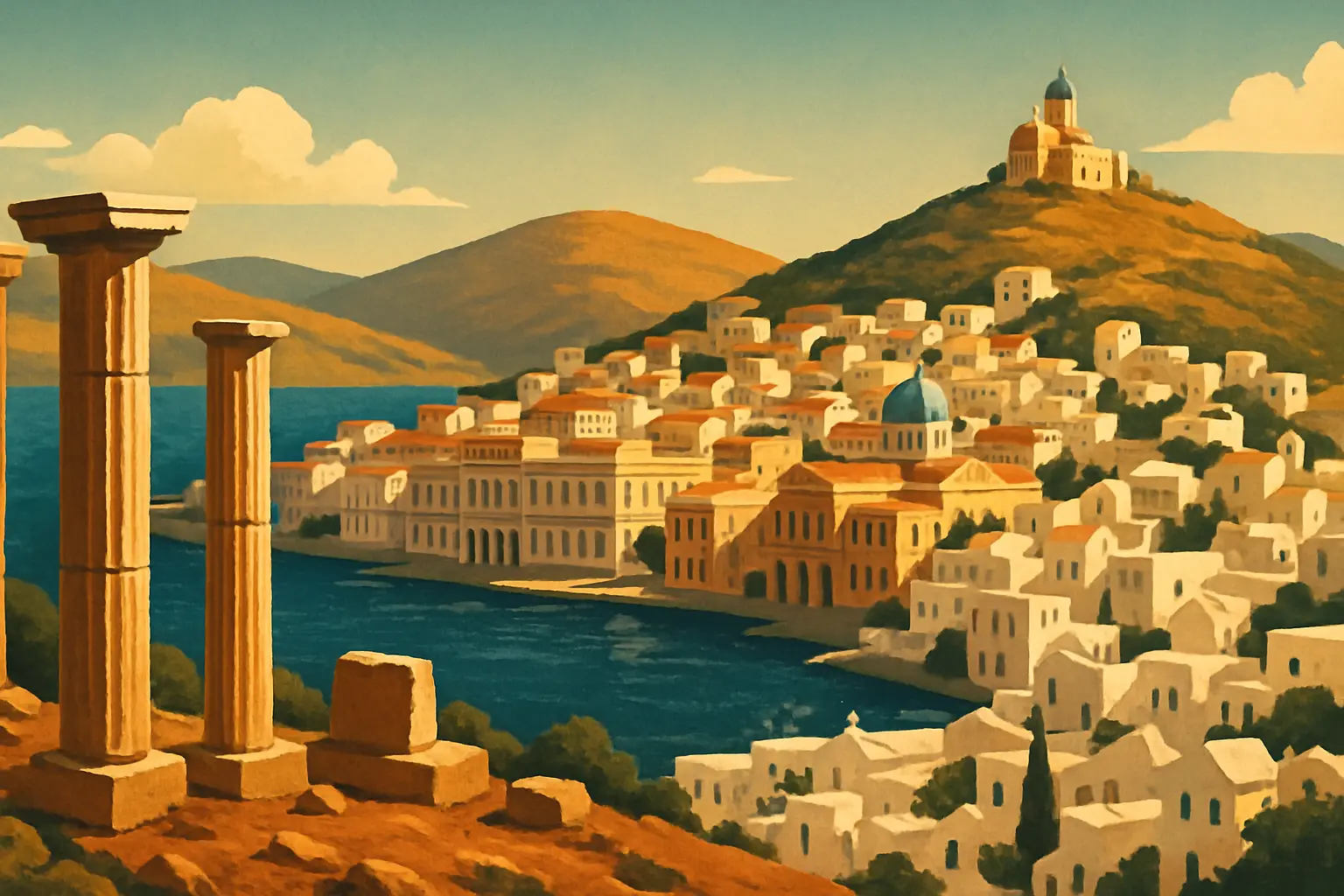
The white-cube aesthetic that defines most people's image of Greece — flat-roofed cubist houses, blue-domed churches, whitewashed alleys — is the architecture of the Cycladic island villages, developed over centuries of insular building with local stone and lime. Syros has that, in Ano Syros on the upper hill, but the dominant architecture of Ermoupolis is something entirely different: a city built during a specific economic boom in the 1820s–1870s and left mostly intact afterward.
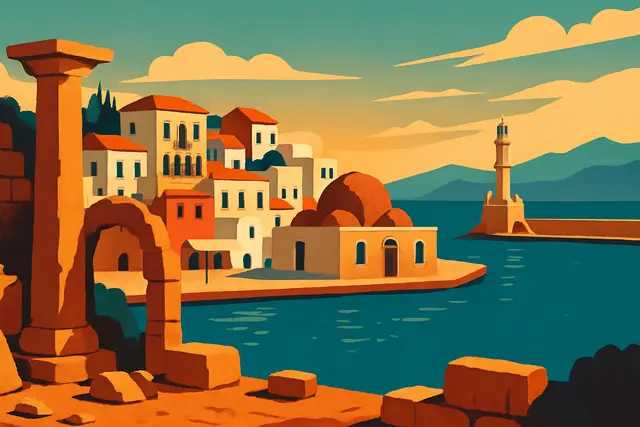
Ermoupolis grew rapidly because Greek refugees displaced from Chios and Psara during the Greek War of Independence settled here with capital and commercial networks. The harbor was already established; the new arrivals built a city on top of the existing settlement in the neoclassical style fashionable in post-independence Greece — the same idiom that was going up in Athens, Nafplio, and Patras at the same moment. Multi-story mansions, colonnaded facades, iron balconies, and a grand central square.
The city peaked economically in the 1850s and declined when Piraeus was modernized as Greece's primary industrial port in the 1880s. The decline meant no incentive to demolish and rebuild. The buildings that went up during Ermoupolis's commercial peak are still standing, which makes Syros a city with an unusually intact 19th-century fabric. Arriving by ferry, the hillside looks more like a prosperous Italian Adriatic port than anything a first-time visitor expects to find in the Aegean.
The name Ermoupolis — 'city of Hermes,' the Greek god of commerce and travel — was chosen deliberately when the city was formally named in 1826. It was an economic statement as much as a geographic one.
By the 1850s, Ermoupolis was handling more imports and exports than any other Greek port, processing cotton from Egypt, silk from the Levant, and grain from the Black Sea. The city had banks, consulates from major European powers, a newspaper (the oldest continuously published regional paper in Greece), and a concentration of merchant capital that made it genuinely more important than Athens in financial terms. Greece's first shipyard — Neorion, established in 1861 — opened here rather than on the mainland because the capital was here.
The merchant families who built their fortunes in this period constructed their houses in the Vaporia district, the clifftop neighborhood above the harbor's eastern edge. The name comes from vaporakia — steam ships — the vessels that their owners operated across the eastern Mediterranean. Walking the Vaporia streets today, the houses are still in use, still owned in many cases by the descendants of the same families. The neighborhood has a small beach at the base of the cliffs — a concrete ledge with metal ladders into clear, deep water — which functions as the neighborhood swimming spot. It is a specific Syros experience: swimming in front of a mansion that a 19th-century cotton merchant built, in water that his steam ships once anchored in.
Get short, interactive stories that make each place easier to remember while you travel.
The center of Ermoupolis is Plateia Miaouli — named after Admiral Andreas Miaoulis, the Syros-born naval commander of the Greek War of Independence. It is a large marble-paved square with palm trees and a significant piece of civic architecture at its head: the neoclassical Town Hall, designed by Ernst Ziller in 1876. Ziller was also responsible for the renovation of the Panathenaic Stadium in Athens and the Presidential Palace — the same architect working across Greece's most ambitious building programme of the era.
The Town Hall still functions as the administrative seat of the Cyclades, which means Syros technically governs Mykonos, Santorini, and every other island in the group. The square fills with Ermoupolis residents in the late evening — families, teenagers, people finishing dinner — in a rhythm of life that is specifically that of a year-round city, not a summer-season tourist island.
From Miaouli Square, the walk north through the Vaporia district takes about twenty minutes at a slow pace. You pass mansions with identically proportioned facades, small marble fountains, and increasingly good harbor views as you climb. The combination of architectural density and direct sea access — the city rising from the waterfront in tight tiers, with water visible between buildings all the way up — is what makes Ermoupolis worth exploring on foot rather than treating as a transit point.
The Apollon Municipal Theatre was built in 1864, explicitly modeled on La Scala in Milan. The architect was Pietro Sampo; the commission came from a city that had the wealth and the cultural confidence to want an opera house rather than just a concert hall.
The Apollon seats around 300 people. The auditorium is horseshoe-shaped with four tiers of boxes, ornate plasterwork, and excellent acoustics that the small scale produces naturally. It closed for decades during Syros's long post-commercial decline and was restored in the 1990s. It now operates as a summer venue from June through September, hosting concerts, opera performances, and theatrical productions.
A performance at the Apollon is worth engineering a visit around. The intimacy of 300 seats means there is no bad position in the house; the sound wraps around you in a way that the large venues in Athens cannot replicate at any price. The programme varies by year — check the Ermoupolis municipality website before booking transport. The season typically opens in late June with chamber music before moving to larger productions in July.
Ano Syros sits on a separate conical hill to the left of the harbor, visible from the ferry as a dense cluster of white houses rising to a church at the summit. Its origins date to the period of Venetian rule in the 13th and 14th centuries — the Venetians were Catholic, and they established a Latin Catholic community here that has coexisted with the Greek Orthodox community below for more than 700 years.
The summit church is the Cathedral of Agios Georgios (San Giorgio in the local Catholic tradition), which looks directly down onto the Orthodox domes of Ermoupolis below. The view from the terrace is the correct one for understanding the relationship between the two settlements — the medieval Catholic quarter above, the 19th-century commercial city below, both on the same island and in continuous coexistence since Greek independence.
The alleys of Ano Syros are steeper and narrower than anything in Ermoupolis, with vaulted passageways connecting houses and almost no motor access above the first few streets. The neighborhood is quiet in a way the city is not. Come in the late afternoon when the stone is warm from the day and the harbor below turns gold before the June sunset at around 8:30 p.m.
Syros produces two food items with PDO (protected designation of origin) status.
Loukoumi — called Turkish Delight in the English-speaking world — has been made on Syros since the late 19th century. The Syros version is specifically marketed as Greek loukoumi, and the historical case for naming priority is real: Syros was producing and exporting it before the Ottoman commercial name became the international standard. The production method uses rose water, mastic, and sugar syrup cooked and set into blocks dusted with powdered sugar. The reference producer is Kanakis, making loukoumi since 1893, with their main shop on Miaouli Square. The rose water version (trandafyllo) is the traditional choice; the mastic version has a resinous quality that is specifically Aegean.
San Michali is a hard cow's milk cheese made only on Syros, named for the village of San Michalis in the island's interior. The cows graze on aromatic scrub vegetation — thyme, oregano, wild fennel — which gives the cheese a sharpness that is distinct from graviera or kefalotyri. Fried as saganaki it is the best version: the exterior caramelizes, the flavor intensifies, and it pairs naturally with the Assyrtiko wines of the Cyclades.
For fish, go to Kini on the western coast — a small fishing village with a harbor and three or four tavernas with tables on the waterfront. The catch is brought in by the boats tied up ten meters from your table. Arrive by 7:30 p.m. in June to eat while the sun is still above the horizon; it sets over open water from Kini at around 8:30 p.m. and the light on the way down is worth staying for.
Syros has beaches organized around different needs.
**Galissas** (west coast): the largest organized beach on the island — a long sand arc with sunbeds, water sports, and a village behind it with evening tavernas. Fully operational in June before peak season congestion.
**Azolimnos** (south coast): a sheltered bay favored by local Syros families, calm even when the meltemi wind picks up in summer. The village is small, the taverna on the waterfront straightforward.
**Vaporia** (Ermoupolis): not a sand beach — a concrete platform with ladders into deep, clear water, five minutes from Miaouli Square. Where Ermoupolis residents swim after work.
**Grammata** (north coast): accessible only by boat from Kini or Galissas. The rockface around the beach is covered in inscriptions carved by ancient sailors who sheltered here from storms, some dating to the 3rd century BC. Charter a small boat from Kini for the day.
Ferries to Syros depart from Piraeus daily year-round. The fast ferry (Blue Star Ferries, SeaJets) takes approximately 2.5 hours; the conventional overnight ferry takes around 4 hours and is the right choice for an extended stay, arriving in Ermoupolis at dawn. The ferry terminal in Piraeus is at Gate E1/E2 — the same terminal serving the Cyclades.
Syros is one of the very few Greek islands that functions year-round. Ermoupolis is a real administrative city with a permanent population of around 21,000 — restaurants, shops, and services remain open in winter because the residents need them to. This means a visit in October or March is entirely viable in a way that is impossible on Folegandros or Milos.
Best time to visit: June is specifically good for three reasons. First, the Apollon Theatre season opens in late June and the first concerts sell out early. Second, the meltemi wind that disrupts ferry schedules and makes northwest beaches choppy in July and August has not yet established itself. Third, the island is at full operational capacity without the August compression — you can book a table at Kini the same day, walk Ano Syros without crowds, and swim at Galissas with space to move. For island context, Syros sits midway between Paros and Mykonos on the Cyclades ferry routes — combining all three in one trip is logistically straightforward.