Pangrati is a residential neighborhood in central-east Athens, bounded roughly by Vasileos Konstantinou Avenue to the north (where the Panathenaic Stadium faces the street), Ymittos Avenue to the east, the Mets quarter to the south, and Rizari Park to the west. It sits next to the embassies and neoclassical villas of Ilisia, and shares its southern edge with Mets — a quieter district of pre-war apartment buildings and small wine bars.
What distinguishes Pangrati from the neighborhoods most Athens itineraries cover is that it was never colonized by tourism. This is where established Athenian families have lived for generations, where the city's architects and academics tend to buy apartments, and where the neighborhood squares operate as genuine social infrastructure rather than visitor gathering points. The main streets — Archimidous, Eforimnos, Hymettou — are lined with small grocers, hardware shops, and old-school coffeehouses.
For travelers who've already done the archaeological circuit and want to understand how Athens actually functions day-to-day, Pangrati is one of the best neighborhoods in the city. It sits adjacent to two of Athens' most undervisited major sites — the Panathenaic Stadium and the First Cemetery — and its food scene is priced and oriented toward people who live there, not people passing through.
The Panathenaic Stadium — Kallimarmaro in Greek, meaning 'beautiful marble' — sits at Pangrati's western boundary, its horseshoe shape immediately visible from Vasileos Konstantinou Avenue. The site dates to around 330 BCE, when the Athenian statesman Lykourgos built a stadium here for the Panathenaic Games — the quadrennial athletic festival honoring the goddess Athena. That original structure was simple earthwork and stone seating.
The stadium standing today was rebuilt entirely in white Pentelic marble by Herodes Atticus, the enormously wealthy Athenian-born Roman senator and civic patron, around 144 CE. Herodes Atticus also commissioned the Odeon of Herodes Atticus on the Acropolis south slope — he had a habit of building monuments that lasted. The rebuilt Kallimarmaro seated approximately 50,000 spectators in a horseshoe configuration still intact today.
The stadium was buried under centuries of sediment, excavated in 1869, and then used for the Zappas Olympics in 1870 and 1875 — revival athletic festivals that prefigured the modern Olympics by two decades. For the main event, the Egyptian-based Greek businessman George Averoff personally funded its full restoration. On April 6, 1896, an estimated 60,000 spectators filled the marble seats for the opening ceremony of the first modern Olympic Games, attended by King George I of Greece. The stadium hosted athletics, gymnastics, weightlifting, and wrestling across nine days — the 100-meter sprint, won by American Thomas Burke in 12 seconds, was run on this track.
It remains the only stadium in the world built entirely of marble, and today serves as the final handover venue for the Olympic torch relay before each host nation receives the flame.
Get short, interactive stories that make each place easier to remember while you travel.
Immediately east of the Panathenaic Stadium, Ardittos Hill rises through a park of pine and cypress trees that feels startlingly quiet for central Athens. The path climbs from Archimidous Street into the hill's forested interior, shaded and peaceful even in June when the surrounding city is hot.
At the summit, two things reward the climb. The first is a view south over Athens toward the Saronic Gulf — the Acropolis clearly visible to the northwest, the sea southward on clear days — that rivals anything you'd get from a rooftop bar, entirely for free. The second is the remnants of an ancient shrine to Tyche, the Greek goddess of fortune, whose cult was maintained here from classical times. The shrine is minimal — stone foundation outlines — but its presence marks this hilltop as a place that held official significance in the ancient city.
The hill also carries a long association with Athenian judicial proceedings. Ancient sources connect Ardittos to the city's system of open-air homicide courts — Athens operated multiple outdoor venues for different categories of legal cases, and Ardittos was among the sites used for trials where the formal separation of the defendant from consecrated ground was legally required. The specifics have been argued over by classicists for two centuries; the site itself is unmarked and unhelpfully sign-free.
The Ardittos path runs alongside the Ilissos riverbed — the ancient river that once ran through the area and gave its name to the adjacent Ilisia district — and connects downward to the jogging paths around Zappeion and the National Garden.
On Pangrati's southern edge, adjacent to the Mets quarter, the First Cemetery of Athens occupies 170,000 square meters of landscaped grounds that the Greek state officially designates as a national museum. Most Athens visitors never enter. This is a significant gap.
Established in 1834 — one year after Athens became the capital of the newly independent Greek state — the cemetery holds roughly 10,000 plots containing some of the most accomplished funerary sculpture in 19th and early 20th century Europe: neoclassical marble monuments, bronze effigies, and Romantic-era angel figures that would draw crowds in any other context.
The most celebrated work is Dormir (Sleep), a marble sculpture by Giannoulis Chalepas carved in 1877. It depicts a young woman in repose — technically flawless, emotionally precise, considered the masterwork of modern Greek sculpture and one of the finest neoclassical works in the Mediterranean. It marks the grave of a young woman named Sofia Afentaki and attracts art historians from across Europe who make it a specific destination.
Among the other notable graves: Heinrich Schliemann, the German archaeologist who excavated Troy and Mycenae, is buried near the main entrance under a neoclassical mausoleum he designed himself, with carved reliefs from the Trojan War — the same stories he spent his life proving were historical, not mythological. Former prime ministers, military figures from the Greek War of Independence, and major cultural figures of the modern Greek state are also buried here, their names recognizable from street signs across the city.
The cemetery is open daily and free to enter. It is densely planted with cypress trees and stone pines. Spend an hour here — it functions as a garden, quite apart from its historical weight.
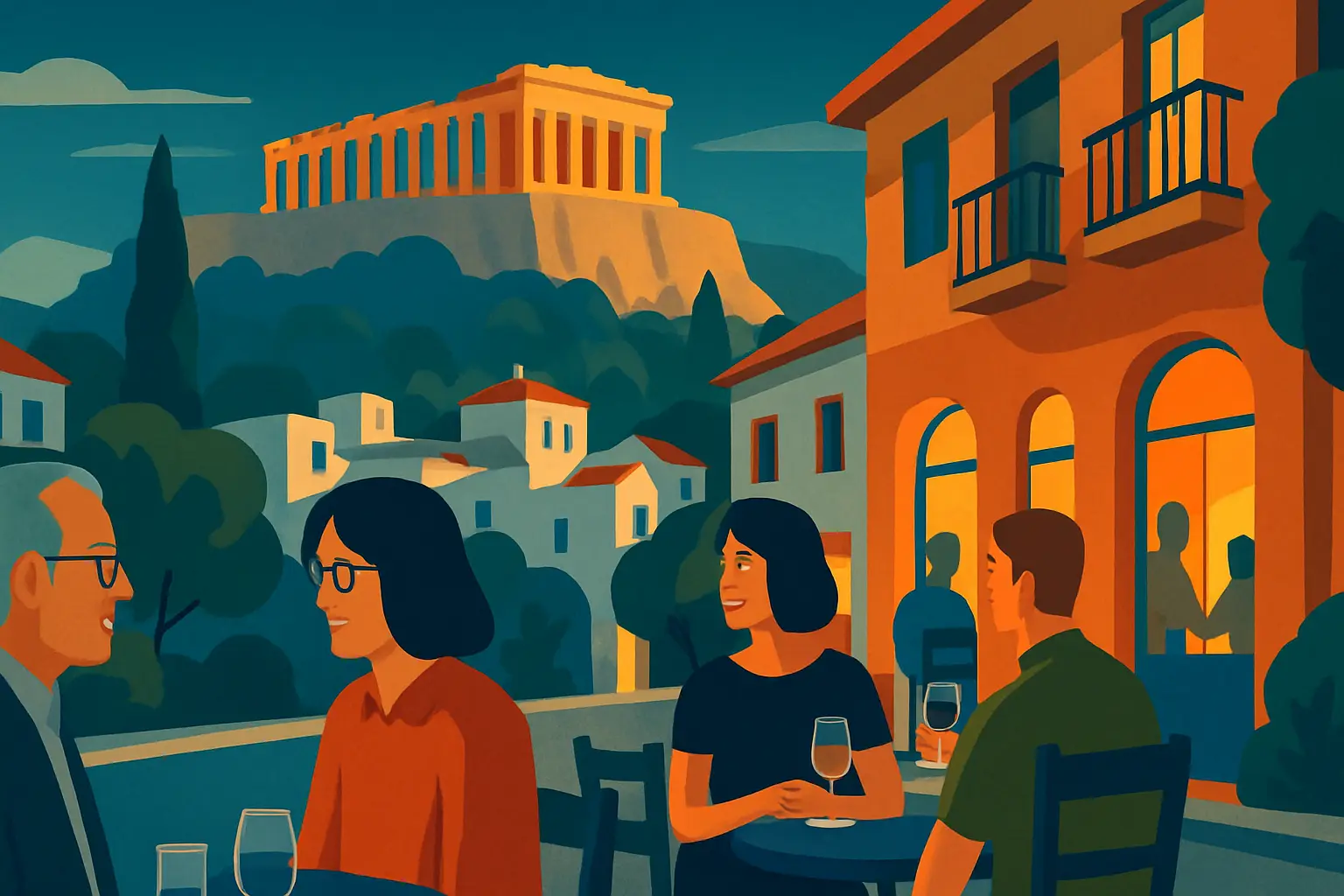
Pangrati's food scene is built around its squares. The three to know are Plateia Varnava, Plateia Plastira, and Plateia Proskopon — each ringed with tavernas, cafes, and bars that cater almost exclusively to neighborhood residents.
Taverna O Kostas, just off Plateia Varnava, is the classic case: the owner runs the entire operation himself — taking orders, cooking, bringing food. The menu is short and orthodox Athenian: stuffed tomatoes, grilled lamb chops, horiatiki salad with feta in a slab, house wine by the carafe. Prices are what you'd pay in a neighborhood where the same people eat twice a week. Come at 7 p.m. or after 10 p.m. — the hours in between fill with regulars.
Elvis, near Plateia Plastira, serves souvlaki that multiple Athens food writers have called the best in the city — a serious claim in a city where the souvlaki ranking is an ongoing civic argument. The pork skewer with tzatziki, fresh tomato, and grilled pita, eaten at the counter or on the square steps, is the standard order. Open late.
For morning coffee: the old-style kafeneions on the side streets off Archimidous serve Greek coffee — dark, unfiltered, served in a small cup with a glass of cold water — at the counter, exactly as they did in 1975. This format, sitting on a wooden stool at a zinc counter for fifteen minutes before going anywhere, is itself a specifically Athenian experience worth seeking out.
Pangrati has more cultural infrastructure than its residential character suggests. The Half Note Jazz Club at Trivonianou 17 is the most serious jazz venue in Greece — international artists include it on European tours, and the programming is strong enough that the club has held its reputation for over three decades without a tourist audience. Shows start around 10 p.m. Tickets vary by act; the calendar is listed on the club's website.
The Goulandris Museum of Modern Art at Eratosthenous 13 opened in 2019 and houses the personal collection of shipping magnates Basil and Elise Goulandris: works by Monet, Picasso, Cézanne, Kandinsky, and Van Gogh alongside a substantial collection of modern Greek art, including Nikos Hadjikyriakos-Ghikas. The building is a converted 1930s neoclassical structure. It is consistently Athens' least crowded major art museum — admission costs around €7 and the galleries run without the queuing that plagues larger institutions.
Oasis is an open-air cinema in Pangrati running May through September, screening international films under the Athens summer sky — often in original language with Greek subtitles. The Petit Palais on Damareos Street is an arthouse indoor cinema programming Greek and European film year-round. Both are within easy walking distance of the main squares.
Best time to visit? June is the right window. The neighborhood runs at full capacity — locals haven't yet left for the islands, the open-air Oasis cinema is running, and temperatures around 28°C by day drop to a comfortable 22°C in the evenings, ideal for lingering in the squares. July and August see Athens partially empty as residents decamp to the coast; some Pangrati restaurants close two to three weeks in August.
American visitor numbers to Athens in summer 2026 are tracking meaningfully lower than last year — June bookings have been running roughly 28% below 2025 levels — which means this summer offers unusually favorable conditions: full local infrastructure operating, lower site congestion, and restaurants running at local-serving rather than tourist-managing pace.
How long to spend? The Panathenaic Stadium and Ardittos Hill together take about 2 hours at a comfortable pace. Add the First Cemetery and you have a half-day. Factor in a lunch at one of the squares and return for dinner in the evening and you've productively filled a full day in a neighborhood most visitors miss entirely.
How to get there? From Syntagma Square, walk east along Vasileos Konstantinou Avenue toward the Panathenaic Stadium — about 15 minutes on foot, passing through the National Garden. From Evangelismos metro station (Line 3, Blue Line), walk south on Vasilissis Sofias and then east — 10 to 12 minutes. There is no metro stop directly in Pangrati; Evangelismos is the closest. From Plaka, the walk through Mets takes about 20 minutes through quiet residential streets.