1. What Kallimarmaro actually is — a 2,500-year athletic site rebuilt twice
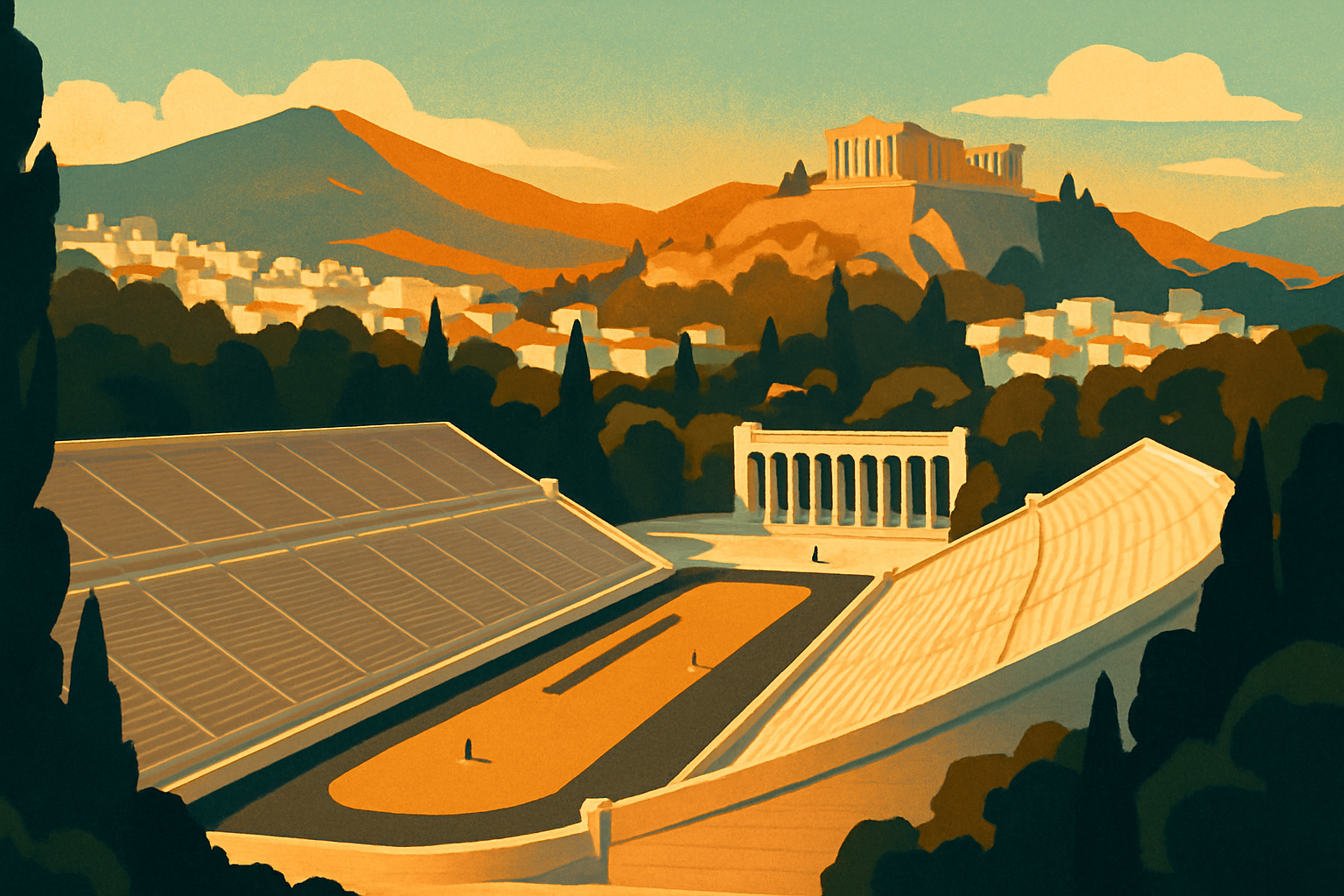
The Panathenaic Stadium occupies a natural valley between Ardettos Hill and the dried bed of the ancient Ilissos River, about 1.5 kilometers southeast of Syntagma Square. The valley was first shaped into an athletic ground in 329 BC under Lykourgos, the Athenian statesman who reorganized the city's public finances and buildings following Athens' defeat at Chaironeia. The original structure was earthen — seats cut into the hillsides, a flat track at the bottom — and served as the main venue for the Panathenaic Games, the athletic competition held in honor of the goddess Athena every four years.
For roughly five centuries it functioned in this form. Then in 144 AD, the Roman-era patron Herodes Atticus rebuilt it entirely in Pentelic marble — the same quarry on Mount Pentelikon that supplied the Parthenon. The renovation produced a U-shaped stadium with 47 tiers of white marble seating, a capacity of roughly 50,000 spectators, and a vaulted stone tunnel through the northern end curve for athlete entry.
After the late Roman period the stadium fell into disuse. Its marble was quarried for construction elsewhere across medieval Athens — a standard fate for ancient stone buildings in a city that never stopped being inhabited. By the 19th century the site was a grass-covered depression in the hillside.
The third chapter opened in 1896, when the Greek-Egyptian merchant banker Georgios Averoff donated 920,000 drachmas — roughly Greece's full annual public works budget — to fund a complete reconstruction in Pentelic marble from the same mountain. The stadium that stands today is Averoff's version, following the ancient plan. His marble statue stands at the entrance gate on Vas. Konstantinou Avenue.
2. The Panathenaic Games: what athletes competed for — and why an olive wreath mattered
The Panathenaia was Athens' most significant annual religious festival — a celebration of the city's patron goddess Athena that combined sacred procession, musical competitions, and athletics. The Greater Panathenaia, held every four years, was the scale the stadium was built for: competitors traveled from across the Mediterranean to participate.
Events at the stadium included the core Greek track disciplines. The stadion — a sprint covering a single length of the track, roughly 192 meters — was the most prestigious race. The word 'stadium' derives from this event: the distance defined the building. The diaulos (two lengths, down and back) and the dolichos (long-distance, roughly 24 lengths) rounded out the running programme, alongside wrestling, boxing, and pankration, a submission-fighting discipline with almost no rules that was one of the most followed events of the ancient Games.
The prize was not gold or silver. Winners received a Panathenaic amphora — a large ceramic vessel filled with 35 to 40 kilograms of olive oil pressed from the sacred olive trees of Athens. These amphorae were painted on one side with a standing figure of Athena and on the other with a scene of the relevant athletic event; they are now among the most studied artifacts of ancient Greek pottery. A stadion champion received 100 amphorae. The commercial value of that oil was significant, but the cultural weight of being a Panathenaic victor — in Athens, at the city's premier festival — was the actual prize.
By the time Herodes Atticus built his marble stadium in 144 AD, the Games drew athletes and performers from Egypt, Asia Minor, and the Italian peninsula.
3. Herodes Atticus: the man who built Athens its marble stadium — and the Odeon under the Acropolis
Herodes Atticus — full name Lucius Vibullius Hipparchus Tiberius Claudius Atticus Herodes — was born around 101 AD in Marathon and died in 177 AD. He was among the wealthiest private citizens in the Roman Empire's eastern half: his grandfather had discovered an enormous buried treasure on the family estate during Nero's reign, and Herodes spent that fortune with deliberate public generosity on buildings across Greece.
His philosophy was explicit. He viewed inherited wealth as something that should be returned to the cities. Athens received the most. Two of his gifts are still standing and still in use: the [Odeon of Herodes Atticus](/gr/blog/odeon-of-herodes-atticus-athens-guide) — the covered theater cut into the south slope of the Acropolis in 161 AD, which still hosts concerts every summer — and the Panathenaic Stadium, rebuilt in marble in 144 AD.
Herodes Atticus was also a prominent sophist — a professional orator and intellectual — who taught rhetoric to the emperors Marcus Aurelius and Lucius Verus. He was a central figure of the Second Sophistic: the cultural movement in which Greek intellectual life flourished inside the Roman Empire's administrative structure. His buildings were not vanity projects; they were a statement that Greek civilization continued and warranted investment from those who had benefited from it.
The marble track Herodes Atticus laid in 144 AD became the template for the track restored in 1896. The dimensions, the curve of the northern arc, and the tunnel through the end wall all follow the ancient plan.
4. 1896: Georgios Averoff, the marble restoration, and the opening of the modern Olympics
In 1894, the International Olympic Committee — formed at a congress in Paris under Pierre de Coubertin, a French educator who argued that organized international athletics would strengthen global society — awarded Athens the rights to host the first modern Olympic Games. The obvious venue for the centrepiece track events was the ancient stadium. The problem was funding: Greece's treasury was exhausted by years of post-independence economic strain.
Georgios Averoff resolved this with a single decision. Born in Metsovo, Epirus, in 1815, Averoff had built a commercial fortune in Egypt's cotton trade and spent much of it on Greek educational and public works projects over decades. In 1895, when approached about the stadium, he committed 920,000 drachmas to fund a full reconstruction in Pentelic marble.
Architects Ernst Ziller and Anastasios Metaxas supervised the work. Marble came again from Pentelikon — 1,750 years after Herodes Atticus had used the same quarry. Workers completed the restoration in approximately a year. On April 6, 1896, the stadium was inaugurated to open the first modern Olympic Games, with an estimated 80,000 spectators in the seats and surrounding hillsides.
The Games drew athletes from 14 nations competing in 43 events across athletics, cycling, fencing, gymnastics, shooting, swimming, tennis, weightlifting, and wrestling. For the first time since late antiquity, an international athletic gathering had a single, dedicated venue and a formal structure of nations. Averoff attended the opening ceremony; his statue was unveiled at the gate that day. He is buried in the First Cemetery of Athens, five minutes' walk southeast of the stadium.
5. Spyridon Louis and the 1896 marathon finish — the race that defined a Games
The last and most anticipated event of the 1896 Games was the marathon — a race from the village of Marathon to the Panathenaic Stadium, covering approximately 40 kilometers. The event was designed specifically to commemorate the legendary run of Pheidippides, the Athenian messenger who, according to ancient accounts, ran from Marathon to Athens in 490 BC to announce the Greek victory over the Persian army, then died from the effort. Historians disagree on whether the run happened as described, but the symbolic power was immediate.
Spyridon Louis was 23 years old, a water carrier from Maroussi — then a village north of Athens, now a northern suburb — who entered the race on the recommendation of his military unit's commander. He was not a trained distance runner. According to contemporaneous accounts, he stopped at an inn near Halandri midway through the course to drink a glass of wine and eat orange slices brought by a relative.
Louis entered the stadium in first place at 5:00 p.m. An estimated 100,000 people had packed the marble seats and surrounding hillsides. King George I and Crown Prince Constantine were in the royal box. When Louis appeared through the northern tunnel in his white shepherd's shirt, the crowd erupted. Crown Prince Constantine and Prince George descended from the box and ran the final curve of the track beside him. Louis crossed the finish in 2 hours, 58 minutes, and 50 seconds.
He was offered extravagant gifts — land, livestock, a barber's concession. He accepted a horse and cart. He returned to Maroussi, resumed his work as a water carrier, and ran no other competitive races. In 1936 he was invited to the Berlin Olympics as a representative of Greece and presented Adolf Hitler with an olive branch from Olympia — a gesture of peace he intended sincerely, though the historical context made it complicated. He died in 1940 at age 67.
6. What you see inside: the track, the tunnel, and the Olympic torch collection
The entrance is through the marble gate on Vas. Konstantinou Avenue, facing the Zappio Gardens. Tickets (€10 adults, €5 reduced) are sold at the gate; an audio guide device in 11 languages is included with admission.
The track: 204 meters, Pentelic marble surface, with the slight horseshoe curve of the ancient design. The 47 tiers of white marble seating rise steeply on both sides and can seat 50,000. You are free to walk or jog the track with your ticket. The experience is disorienting in a productive way — the marble is white enough to feel luminescent in direct sun, the bowl acoustics are unlike any modern stadium, and the sight lines to the seats above are identical to what a Panathenaic Games athlete would have seen.
The northern tunnel: the vaulted stone passageway at the far curved end of the horseshoe, at track level. This is the original athlete entry arch from the ancient design — competitors entered the stadium floor through this passage. It is still intact. Standing inside it with the full track visible ahead and the marble banks rising above is the closest the stadium gets to its original function.
The underground museum: housed in the tunnel complex below the northern curve, the permanent exhibition is titled 'Memories from Olympic Games: Posters and Torches from 1896 till today.' The collection holds Olympic torches from every modern Games since 1896 — the most comprehensive such set in existence — alongside original 1896 marathon medals, race photographs, and detailed documentation of the 2004 Athens Olympics, when the stadium again hosted the marathon finish, exactly 108 years after the first modern Games. Italian runner Stefano Baldini crossed the 2004 finish line here; the photographs and footage document a stadium essentially unchanged in form from the one Spyridon Louis entered in 1896. The museum entrance is through a doorway at the northern arc of the track — follow the signs from inside the bowl.
7. The Mets neighborhood: where the stadium sits and where to eat after
Kallimarmaro sits on the northern edge of Mets — a quiet, primarily residential inner-city neighborhood of neoclassical houses and pedestrianized side streets. The name is believed to derive from the German *Metzgerei* (butcher shop), a reference to German craftsmen who settled in the area after Greek independence in the early 19th century. It is characteristically calmer than the tourist-adjacent neighborhoods closer to the Acropolis: more apartment buildings than bars, more cats on windowsills than foot traffic.
The First Cemetery of Athens (Proton Nekrotafeion), five minutes southeast of the stadium, is an unexpected walking destination. Georgios Averoff is buried here; so is Heinrich Schliemann, the German archaeologist who excavated Troy and Mycenae. The 19th-century marble monuments are among the finest examples of neoclassical funerary sculpture in Europe, and the cypress-lined paths are genuinely quiet during midday heat — something few places in central Athens can offer in summer.
For food after the stadium: Markou Moussourou Street, the pedestrianized strip running southeast from the gate, has a handful of good neighborhood tavernas with outdoor seating. Into Pangrati — about 10 minutes east on foot — the dining scene deepens around Plateia Plastira, where several long-running tavernas serve honest food at honest prices.
The walk from the stadium toward the Acropolis passes through the Zappio Gardens and continues past the Temple of Olympian Zeus — 15 remaining Corinthian columns visible from the road — before reaching the Acropolis entrance in about 25 minutes. It is one of the better Athens walks: continuous historical density in a stretch of under two kilometers.
8. Visitor FAQ: tickets, timing, getting there, and how long to spend
Tickets: €10 adults; €5 reduced (students, visitors over 65, EU citizens with a disability card); free for children under 6. The audio guide in 11 languages is included with admission. No advance booking is needed outside peak July-August weekends. The Acropolis multi-site combination ticket does not include Kallimarmaro — it requires a separate purchase.
Opening hours: Daily 8 a.m. to 7 p.m. (summer, April through October); 8 a.m. to 3 p.m. in winter.
How long to spend: 1 to 1.5 hours covers the full visit — walk the track, enter the northern tunnel, go through the underground museum. If you jog several laps, add time.
Best time to visit: June mornings before 10 a.m. are close to ideal — comfortable temperatures and light that makes the white marble glow. July and August require arriving before 9:30 a.m. or after 5 p.m.; the marble radiates intense heat through midday and there is no shade in the bowl. Autumn — September into early October — is the easiest overall window: lower crowds, pleasant temperatures, and the stadium at its quietest.
Getting there: From Syntagma Metro (Lines 2 and 3), walk 15 minutes southeast along Vas. Amalias into Vas. Konstantinou — the stadium gate appears on the right as the road curves. The tram (Zappio stop) deposits you at the Zappio Gardens, a 5-minute walk from the entrance. Taxi or rideshare from Syntagma runs €5–7.
Can you run on the track? Yes — with your valid admission ticket, at any pace, during opening hours. Wear shoes with grip; smooth marble can be slippery in places. One 204-meter lap covers the full stadion distance the ancient athletes ran.