Nafplio sits 140 kilometers southwest of Athens where the Argolic Gulf narrows to a protected harbor. The town occupies a peninsula barely a kilometer wide, which is why its layout feels compact without feeling small — there was nowhere to expand horizontally, so the old city stacks up between the waterfront and the rising cliffs.
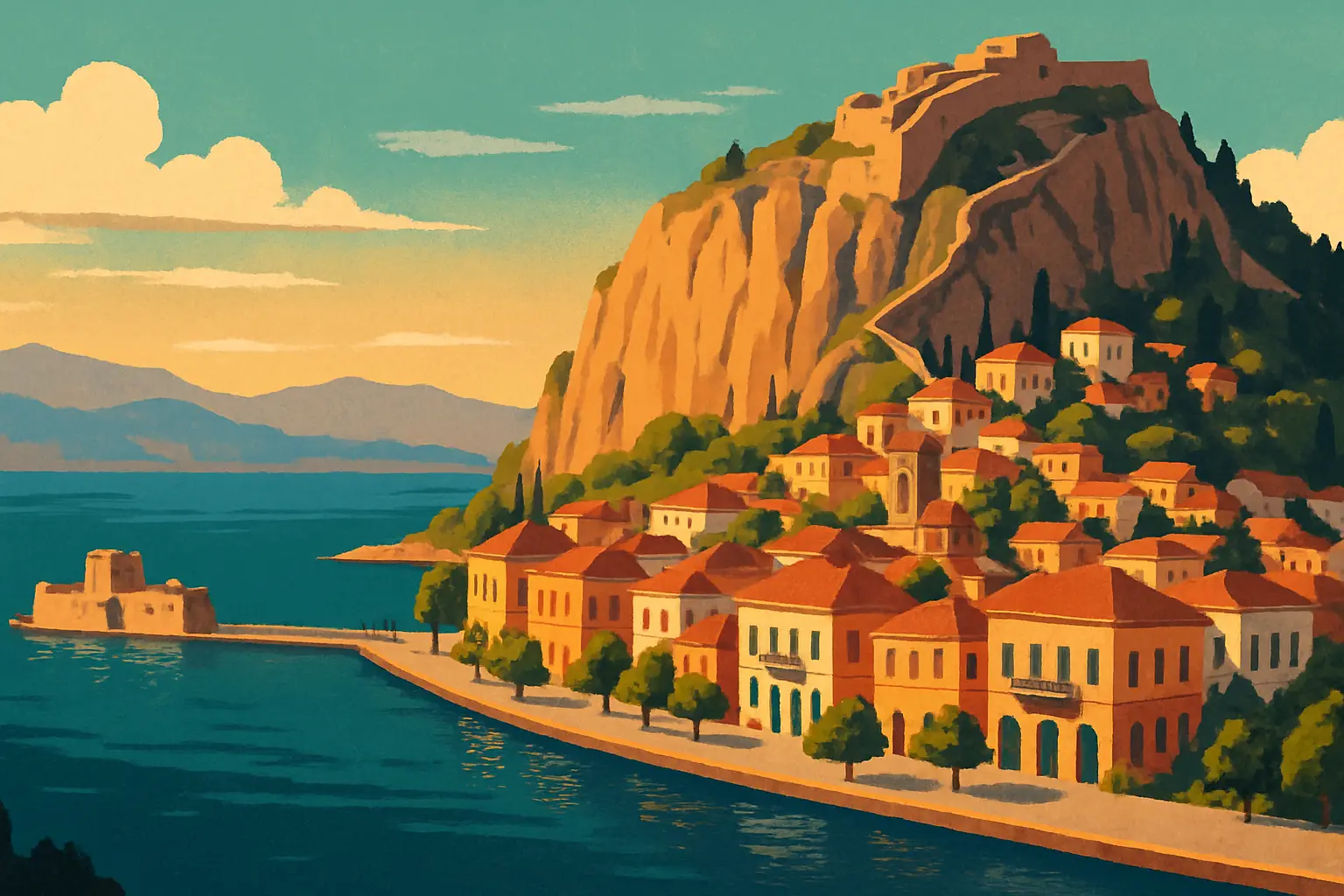
Three fortresses define the silhouette. Akronafplia crowns the original settlement hill with walls in Mycenaean, Byzantine, Venetian, and Ottoman layers — four civilizations of fortification visible in a single cliff face if you know where to look. Palamidi sits on a higher adjacent hill, 216 meters above sea level, a Venetian construction completed in 1714 that controlled the entire peninsula from above. And Bourtzi stands on a tiny island 600 meters offshore, its single tower reflected in the harbor water and visible from every point along the promenade.
What makes Nafplio unusual among Peloponnese towns is the neoclassical layer that arrived after Greek independence. When the new Greek government moved the capital here in 1823, it began building for a permanent seat of power: wide avenues, large public buildings, Syntagma Square as a civic center. Most of that infrastructure survives intact. Nafplio stopped being a capital in 1834, which is precisely why it looks so coherent — cities that remain capitals get rebuilt; cities that lose capital status freeze. Nafplio's center has barely changed since the 1840s.
Nafplio's role as Greece's first capital (1823-1834) was a practical military decision. The Greek War of Independence began in 1821, and the new state needed a defensible seat of government during years of ongoing fighting. Athens itself was still contested — its Acropolis wasn't fully cleared of Ottoman forces until 1833 — and Nafplio, with its ring of fortresses, was the most defensible major Greek harbor.
Count Ioannis Kapodistrias, Greece's first head of state, arrived at Nafplio's harbor on January 7, 1828, appointed at the National Assembly in nearby Troezen. He made Nafplio his administrative center and the town immediately became the hub for the Greek diaspora politicians, military leaders, and European philhellenes who were shaping the new state. The neoclassical buildings on and around Plateia Syntagma were built during this decade of capital status — an architectural confidence you can still read in the proportions.
Kapodistrias was assassinated in Nafplio in 1831 — shot on the steps of the church of Agios Spyridonas on a Sunday morning. The church is still there, on Staïkopoulou Street in the old town, and a small plaque marks the site. It's one of the strangest and most historically weighted spots in any Greek town: a tiny 18th-century church where the political history of modern Greece crystallized in a single moment.
In 1834, King Otto transferred the capital to Athens and Nafplio returned to being a provincial town. The result, 190 years later, is a perfectly preserved 19th-century capital that almost no one outside Greece knows was once the center of the country.
Get short, interactive stories that make each place easier to remember while you travel.
Palamidi is the main event and earns the effort. The fortress was built by the Venetians between 1711 and 1714 — a remarkable three-year construction timeline for a structure covering an entire 216-meter hilltop and organized into eight self-sufficient bastions. The Venetians considered it the most powerful fortification in Greece; it was captured by the Ottomans less than a year after completion, in a 1715 siege that remains a subject of historical debate about whether the garrison was betrayed.
The staircase has 857 steps. Local guides say 999 because it sounds better. The climb takes 20-30 minutes at a steady pace with no particularly steep sections — it's sustained, not technical. Go before 10 a.m. in June. The stone is completely exposed, there's no shade above the first landing, and the difference between an 8:30 a.m. ascent and a 12:30 p.m. ascent is the difference between a brisk walk and an ordeal.
At the top, the eight bastions are named for Venetian figures and military concepts — Sant'Andrea, Themistoklis, Miltiades, Achilles, Epaminondas, Leonidas, Phokion, and Robert — arranged around the hilltop in an irregular pattern forced by the terrain. Bastion Sant'Andrea at the northwest corner gives you the full panorama: harbor, Bourtzi island, the old town below, Akronafplia, and the Argolic Gulf stretching south toward the open sea.
Look for the carved Lion of Morea on the fortress walls — the winged lion of Saint Mark, the symbol of Venetian authority, which appears in multiple locations. After independence, Palamidi became a military prison. General Theodoros Kolokotronis, the most celebrated commander of the Greek War of Independence, was imprisoned here in 1833-1834 by the political faction that opposed him. He was later pardoned, returned to public life, and is now one of the faces on the old Greek 5,000-drachma note.
Tickets: €8 standalone; €12 combined with the Nafplio Archaeological Museum. The site opens at 8 a.m.
Below Palamidi, Nafplio's old town covers about one square kilometer of arched doorways, flower-hung balconies, and lanes too narrow for cars. The Venetian street pattern survives largely intact underneath the 19th-century neoclassical overlay — a layering you see most clearly at the corners where wide, Greek-independence-era avenues meet older, more winding passages.
Plateia Syntagma is the town's center and the correct orientation point. The most striking building on the square is the former Venetian arsenal — a triple-arched 18th-century structure now housing the Nafplio Archaeological Museum, which runs from Neolithic objects found in local caves through Mycenaean bronzes (from Tiryns and Midea, the Bronze Age settlements nearby) to post-Byzantine material. The Mycenaean bronze armor on display — a full body suit excavated in Dendra — is one of the most significant Bronze Age finds in Greece and worth the price of the combined ticket.
For food, the pattern is: harbor promenade for the view at a premium, side streets for local pricing and quality. Arapakos on Bouboulinas Street (the harbourfront) has maintained its reputation for traditional fish consistently enough that it's the benchmark recommendation — grilled whole fish, fresh calamari, and local Argolid wine. For Peloponnesian taverna food without tourist pricing, To Omorfo Tavernaki on Staikopoulou Street one block into the old town runs tables on the narrow lane and serves slow-cooked lamb and local mountain greens alongside the harbor-area standards.
The streets between Staikopoulou and the base of Akronafplia — particularly Kapodistria Street and the cross lanes behind it — are where the town's better bakeries, coffee shops, and the church of Agios Spyridonas sit. Walk them before or after lunch; they're the quietest part of the old town and hold the most history.
Bourtzi's history is one of the stranger administrative careers of any medieval castle in Greece. The Venetians built it in 1473 specifically to control harbor access — a heavy iron chain once connected the island to the Akronafplia mainland, physically blocking ships from entering the port without permission. The Venetians also built a small caretaker's house on the island, which they apparently considered adequate housing for whoever they assigned to manage the chain.
After independence, the fortress served briefly as a prison. Theodoros Kolokotronis was held on Bourtzi before being transferred to Palamidi. The island then passed through its most unusual phase: from 1865 until approximately 1930, it served as the official residence of Palamidi's executioners. The Greek state provided housing; this was considered part of the compensation package. The executioners and their families lived on the island, accessible only by boat.
In the 1930s the Ministry of Tourism converted it into a hotel. It operated as a luxury accommodation through the 1960s, reportedly hosting Greek and European society figures, before closing in the 1970s. It is now an archaeological preservation site.
Small boats cross from the harbor every 20-30 minutes during tourist season. The crossing takes about 5 minutes. Entry is approximately €5-6 including the boat. The island is small enough to walk in 20 minutes; the main value is the reverse view — Nafplio, Palamidi, and Akronafplia seen simultaneously from water level — which is different from any mainland vantage point.
If the afternoon heat makes the old town lanes uncomfortable — and in June, by 2 p.m., they can be — Arvanitia beach is the solution. The beach sits at the base of the Akronafplia cliffs on the eastern side of the peninsula, reached by a signed path that begins near the Hotel Xenia at the far end of the harbor promenade, about a 10-minute walk from Plateia Syntagma.
The path runs along the cliff face above the sea before dropping down to a narrow strip of pebbles. The descent takes about 5 minutes on stone steps cut into the rock. From the beach, looking back up: Akronafplia directly overhead, the fortress walls extending down to the cliff edge. It's a genuinely dramatic swimming spot — the kind where you float on your back and the medieval walls are what you see.
The water is open Argolic Gulf rather than harbor, which means better clarity and visibility for snorkeling around the rocks. The organized section has a few sunbed rentals and a small cafe; the rocks beyond it are completely free. On weekdays in June the crowds are manageable. On summer weekends, Athenians arrive early.
The walk back along the harbor promenade toward the old town passes the Bourtzi boat departure point — the natural late-afternoon sequence is beach, then boat crossing to Bourtzi, then dinner at the harbor as the sun sets behind the island.
Nafplio versus the island options is a question about what you want from a day out of Athens. The Aegina day trip and Hydra day trip are primarily experiential — sea crossings, sun, swimming, seafood on a harbor, minimal historical depth required. They're excellent days. Nafplio is the opposite: heavier on history and architecture, with swimming at Arvanitia as a supplement rather than the main event.
For a first visit to Greece where understanding the country's political history matters, Nafplio is the more instructive choice. The physical evidence of how modern Greece was built is right there in the proportions of Plateia Syntagma, in the neoclassical facades of what was briefly the most important city in Greece, in the chain that once blocked the harbor. For people whose priority is decompress-and-swim, Aegina or Hydra are simpler and faster to reach.
Nafplio with an afternoon at Arvanitia beach is competitive with either island day on both counts: it offers water and sun in the afternoon alongside substantially more historical weight in the morning.
Is Nafplio safe? Yes, entirely. It is one of the safest and most visitor-friendly towns in Greece.
By car: Take the A8/E94 motorway west out of Athens toward Corinth, then the E65 south through Argos to Nafplio. Total distance: 140 kilometers. Journey time: 1.5 to 2 hours depending on Athens traffic. Toll costs: approximately €8-10. The final 30 kilometers through the Argolid on the E65 pass citrus groves and begin offering views of the Gulf — the drive is part of the experience. Parking in Nafplio is available near the bus station at the edge of the old town peninsula.
By bus: KTEL Argolida buses depart from Kifissos Bus Station (Terminal A) in Athens — northwest of the city center, accessible by metro to Stathmos Larisis (Line 1) and then a short bus connection. Journey time approximately 2.5 hours. Tickets around €14-15 each way. Buses run six to seven times daily; book ahead for summer weekends. The bus drops you at the station just outside the old town — 10 minutes' walk from Plateia Syntagma.
What to combine: Ancient Mycenae is 25 kilometers northwest of Nafplio — 30 minutes by car. The Lion Gate and the Treasury of Atreus (the famous beehive tomb) are among the most important Bronze Age sites in Europe. Epidaurus is 30 kilometers east — one of the best-preserved ancient theaters in the world, famous for acoustics that carry a whisper from the stage to the back row. Either combination is excellent; attempting both sites plus Nafplio in a single day is too much. Pick one.
Best time for the day trip: April through June and September through October. July and August work but the Palamidi staircase in peak summer heat is genuinely difficult and the old town is crowded with tour groups. June is the optimal month: warm water, comfortable driving temperatures, and the long evening light on the harbor that makes the post-dinner promenade walk the best hour of the day.