Hydra (pronounced ee-DHRA in Greek) is a crescent-shaped island about 18 kilometers long and 4 kilometers wide at its broadest, with a population of roughly 2,000 year-round residents. It sits in the Saronic Gulf, closer to the Peloponnese coast than to Athens, though all ferry connections run through Piraeus.
The motorized vehicle ban emerged from the island's own residents — an ordinance that preserved a quality of life that cars and motorcycles would have erased on streets too narrow and too steep to accommodate them. The result is that Hydra operates on three modes of transport: walking, donkeys and mules (the official freight system for goods, building materials, and luggage), and water taxis that connect the harbor to coastal coves.
The effect on the experience is real and immediate. Hydra's harbor is among the quietest in Greece in summer — cafes line the waterfront without traffic noise, the alleys between mansions are navigable at a comfortable pace, and the occasional clip of hooves on stone is as loud as anything gets in the afternoon. For a visitor arriving from Athens, the sensory shift is almost disorienting in a pleasant way. Most of the Greek islands that look car-free in photographs have mopeds tearing around the back streets. Hydra genuinely doesn't.
In 1821, when the Greek War of Independence began against Ottoman rule, Hydra was one of the wealthiest places in the Greek world. Its prosperity came not from agriculture — the terrain is rocky and largely barren — but from shipping. From the late 18th century onward, Hydriot merchant families had built an extraordinary merchant fleet that traded across the entire Mediterranean, running blockades during the Napoleonic Wars and accumulating fortunes that were eventually invested in the stone mansions still ringing the harbor today.
When the revolution began, the three great naval islands of the Saronic Gulf — Hydra, Spetses, and Psara — contributed their merchant fleets to the Greek cause. Hydra's contribution was the largest: approximately 150 ships, manned and equipped at the expense of the island's wealthy primate families. The Koundouriotis family, Hydriot merchants who had made their fortune in the grain trade, became the principal financiers of the revolution and later the first presidents of the independent Greek state.
The naval hero most associated with Hydra is Andreas Miaoulis — born on the island in 1769 — a merchant captain who became admiral of the Greek revolutionary fleet. Miaoulis pioneered the tactical use of the brûlot, the fire ship: a vessel packed with combustibles, steered toward the enemy fleet at night, set alight, and abandoned moments before collision. His fire ships destroyed or disabled dozens of Ottoman warships between 1821 and 1827. His bronze statue stands in Hydra's harbor today, facing the sea, and the annual festival bearing his name is the island's largest event of the year.
Hydra also opened what is considered the world's first merchant marine academy in 1749, decades before the revolution, training the captains who would eventually command those 150 warships. The combination of extraordinary wealth, nautical expertise, and specific geography — a harbor naturally sheltered by the crescent hills, invisible from the open sea — made Hydra an ideal revolutionary base.
Get short, interactive stories that make each place easier to remember while you travel.
Every June, Hydra's harbor becomes the stage for the Miaoulia — a festival commemorating the island's naval role in the War of Independence. In 2026, the main celebration runs June 26-28.
The festival's centerpiece is the Saturday evening reenactment of a fire ship attack: a vessel is ceremonially set alight in the harbor and burned on the water while the surrounding quays and hillsides are packed with spectators. Fireworks follow immediately over the water. It is one of the more genuinely theatrical summer events in Greece — not a tourist construction but an annual ritual the island has been performing since the 1930s, run by the community for the community, with visitors welcome.
The weekend also includes a formal memorial ceremony at the statue of Admiral Miaoulis, a military parade, folk dances in traditional costumes, and the procession of a reliquary vessel said to contain the admiral's heart. Concerts, art exhibitions, and lectures run through the preceding week from around June 21 onward.
Accommodation on Hydra is limited — roughly 30 hotels and guesthouses in Hydra Town, ranging from simple rooms in converted captains' houses to the Bratsera Hotel, a restored 19th-century sponge factory with a stone courtyard and pool. For the festival weekend specifically, book accommodation and hydrofoil tickets at least four to six weeks in advance. The last returning hydrofoils on Saturday night after the fireworks are the first tickets to disappear.
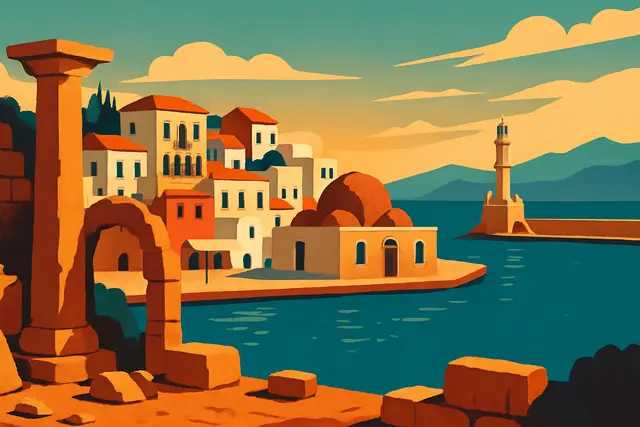
Hydra Town wraps around the harbor in a horseshoe shape, rising steeply up the hillsides on both sides. The dominant architectural feature is the kapetanospita — captains' houses — massive stone mansions built in the late 18th and early 19th centuries by the shipowning families who controlled the island's economy.
The Koundouriotis Mansion on the western hill above the harbor is the best-preserved example: a three-story stone building with a long exterior staircase and formal reception rooms that now function as a museum of the revolutionary period, with original period furniture and portraits of the Koundouriotis family. The Historical Archive Museum of Hydra, at the eastern end of the harbor, holds ship models, logbooks, navigation instruments, and paintings of the 1821 naval battles — a dense but genuinely interesting collection for anyone who wants the full context behind the Miaoulia festival.
The clocktower of the Monastery of the Dormition rises directly above the harbor at its center. The monastery courtyard is open and free to enter, and its Byzantine bell tower provides the most photographed vertical element of Hydra's skyline. Inside, a carved wooden iconostasis and a collection of icons give a sense of the island's Orthodox institutional wealth during the shipping era.
Movement through town happens in two directions: along the harborfront, where cafes and restaurants face the water, and upward into the stepped alley system climbing the hills. The upper alleys are residential, shaded by bougainvillea and morning glory climbing the stone walls, and consistently quiet. The island's feral cat population is large, well-fed by the fishing community, and extremely comfortable around humans.
Hydra's coastline is almost entirely rocky — the island has very little sand — which shapes the swimming experience toward rocky coves and purpose-built platforms rather than beach-lounger infrastructure. The water clarity is excellent; the absence of major hotel development means minimal runoff.
Spilia, five minutes west of the harbor along the coastal path, is a rocky sea platform where locals and visitors swim directly from the rocks. Free, close, and the most genuinely local spot near the port. Hydronetta Bar, just west of Spilia, operates a similar rock platform with a bar — the natural gathering point for afternoon swimming with a drink in hand.
Kaminia, about 15 minutes further west along the same coastal path, is a small fishing village with a narrow pebble beach and some of the best seafood tavernas on the island. The water is calm, sheltered, and the atmosphere is close to what a Greek island fishing village would have looked like before mass tourism changed most of them.
Vlichos (also spelled Vlychos) sits just beyond Kaminia — 30 minutes' walk from the harbor or five minutes by water taxi. A pebble beach with sun beds and a small bar; the water is deeper here and good for snorkeling.
Mandraki, about 25 minutes east of the harbor, is notable as Hydra's only genuinely sandy beach. It's the most organized option — and accordingly the busiest in high season.
Avlaki, deeper into the eastern coastline, is considered Hydra's most beautiful cove: pine trees reaching the water's edge, completely clear water, accessible only by water taxi (approximately €5-7 per person from the harbor, or €100-125 for a private boat). The boat-only access has kept it undeveloped.
Hydra's restaurant scene is built around fresh seafood and traditional mezedes rather than elaborate modern cuisine — appropriate for a fishing island with daily catch determining the menu. The harborfront restaurants are fine but priced for tourism; the better value and atmosphere is at Kaminia, the fishing village 15 minutes west.
Christina's Taverna at Kaminia has tables at the edge of the water, facing the narrow boat channel between the cove and the sea. The menu follows what arrived that morning: fried atherina (sand smelt), grilled red mullet (barbounia), octopus grilled over coal and dressed with olive oil and oregano. A full meal with a carafe of white wine runs around €18-25 per person.
Techne, back at the harbor, is the island's most ambitious restaurant — a modern Greek kitchen using local seafood in preparations that would read comfortably in Athens or Thessaloniki. Worth a meal if you're staying overnight; for a day trip, the Kaminia tavernas are more appropriate and more memorable.
The kafeneions along the harborfront — the old-style Greek coffee houses with formica tables and card games in the corner — are the correct place to sit for an hour with an ouzo and a small plate of olives or saganaki. Isalos, at the far end of the harbor, has the best position for watching the hydrofoils arrive and the donkeys work the dock. This is the Hydra experience: sitting at the edge of a car-free harbor watching freight animals unload a boat, in front of an 18th-century mansion, with the smell of sea and charcoal coming from somewhere just around the corner.
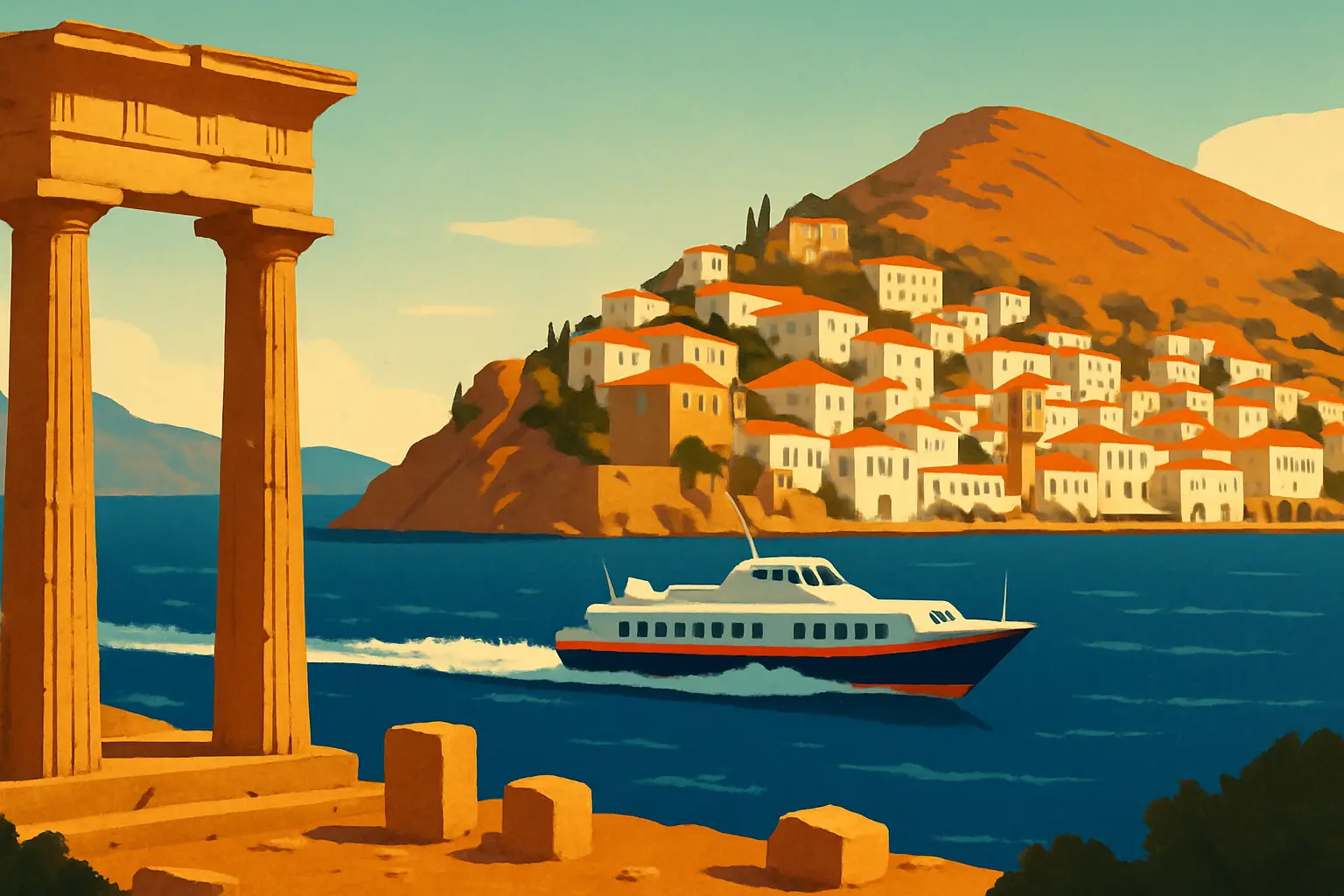
Getting there: Take Metro Line 1 (green line) from Monastiraki, Thissio, or Omonia to Piraeus station (end of the line, approximately 40 minutes). From the station, walk or take a short taxi to Gate E9 at the ferry port. Hellenic Seaways operates hydrofoil services (Flying Dolphin) to Hydra — journey time 1 hour 10 minutes, one-way approximately €30-40. Regular ferries take about 2 hours for €15-20 one way. The hydrofoil is worth it for a day trip; the open-deck ferry is better for the scenic experience if you're not timing it.
Ferries run roughly 5-8 times daily from Piraeus in summer. Same-day tickets are usually available except during the Miaoulia Festival weekend. Book at hellenicseaways.gr or at the Piraeus terminal.
Best time to visit: June is the ideal window — sea temperature at 23-24°C is fully swimmable, day-tripper crowds are meaningfully lower than in July and August, and the Miaoulia Festival (June 26-28) is the island's best annual event. In peak July and August, the harbor fills with day-trippers and the island's limited accommodation becomes extremely tight.
Day trip logistics: A 7 or 8 a.m. hydrofoil from Piraeus arrives in Hydra before 9:30 a.m. — early enough to have the harbor to yourself for the first hour. A full day covers the harbor museums, the walk to Kaminia and Vlichos for swimming, lunch at a Kaminia taverna, and a late afternoon return ferry in time for dinner in Athens. If you're staying overnight, Aegina is an easy next stop on the same Saronic ferry line — a different island character entirely, with pistachio orchards and a well-preserved ancient temple.