Mykonos Town is called Chora — the Greek word simply meaning 'the town', used on every inhabited island to name the main settlement. It is built on a hillside around a medieval castle district called the Kastro, fortified from the 15th century onward. The Kastro's defensive logic is still readable in the street plan: narrow lanes that dead-end without warning, designed so any attacker would get lost while defenders knew every turn.
At the Kastro's edge stands Panagia Paraportiani — the most photographed building on the island and one of the most unusual Christian structures in Greece. It is not one church but five, built gradually between the 15th and 17th centuries, whitewashed into a single organic shape that looks more sculpted than constructed. 'Para-portiani' means 'beside the gate' — the chapels cluster at the Kastro's side entrance. Arrive before 9am or after 6pm to see it without a crowd pressing in from all sides.
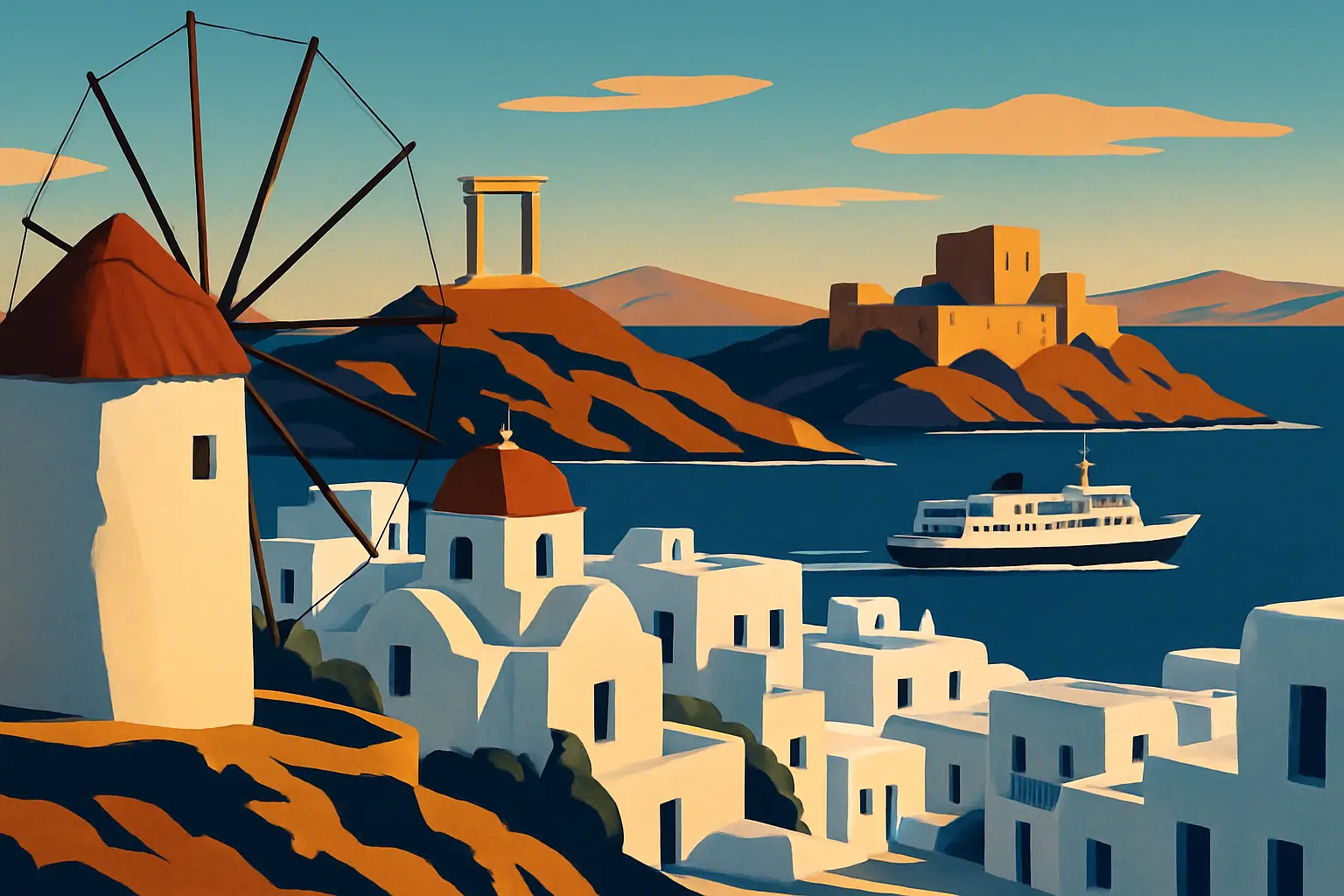
Below the Kastro, the neighborhood called Little Venice (Alefkandra) runs along the western seafront — a row of 18th-century merchant houses built directly above the water, wooden balconies cantilevered over the Aegean. The sea captains and privateers who made Mykonos wealthy during the Ottoman period built these houses. At the end of the row, Kato Mili — the lower windmills — stand in a line above the water. The Venetians built them in the 16th century to mill grain arriving by ship; they operated commercially until the early 20th century. The light on the windmills at sunset is why Little Venice fills up at 7pm every evening in summer — arrive at 6pm to get ahead of it.
Nine kilometers southwest of Mykonos lies Delos — a 3.5-square-kilometer uninhabited island that was, for several centuries, one of the most important religious and commercial centers in the ancient Mediterranean. In Greek mythology it was the birthplace of Apollo and Artemis. In historical reality it was a sacred sanctuary from the 9th century BCE, became a free port under Roman administration in 166 BCE, and handled an estimated 10,000 slave transactions per day at its commercial peak. The entire island is now a protected UNESCO World Heritage site.
The Terrace of the Lions is Delos's most recognized sight: nine marble lion sculptures installed by the Naxians around 600 BCE to guard the Sacred Lake where Apollo was said to have been born. Five originals remain. The Sacred Lake itself was drained in 1926 to combat malaria and is now a flat depression with a single palm tree at its center. The House of Dionysus contains the site's best-preserved mosaic floor — a winged Dionysus riding a tiger, rendered in black-and-white tesserae around 125 BCE.
Practically: boats leave the Mykonos Old Port at 9am, 10am, and 11:30am Tuesday through Sunday. The last return from Delos is 3pm — miss it and you are stranded, since overnight stays are strictly prohibited. Budget at least three hours on-site. Bring water and a hat: there is no shade on Delos and the only food option is a small snack kiosk near the ferry landing.
Get short, interactive stories that make each place easier to remember while you travel.
The Meltemi (the Etesian winds of antiquity — 'annual winds') is a dry, gusty north wind that dominates the Aegean from late June through September. It originates from high-pressure systems over the Balkans and accelerates through the Cycladic island chain, regularly reaching force 5–7 on the Beaufort scale. For travelers, this creates three practical consequences.
First, ferry services on smaller routes get cancelled or delayed on strong Meltemi days — if you are trying to island-hop from Mykonos to Paros or Naxos, check sea conditions the morning you plan to leave. Second, south-facing beaches turn rough and unpleasant when the wind funnels over the island's southern hills. Third, the Meltemi makes the heat bearable; without it, a 35°C July afternoon in the Cyclades would be oppressive.
When the Meltemi is running, reorient toward north-coast beaches. The wind typically drops at night and in early morning, which is when Little Venice and the Chora streets are at their most pleasant to walk — calm air, warm stone, and the light that made every photographer who ever came to Mykonos stay a week longer than planned.
Mykonos has over 25 accessible beaches arranged in an arc from the north coast to the southern tip. Not all are equal — in character, in crowd level, or in conditions on a windy day.
Paradise Beach is the most famous and, in July–August, the most crowded: organized beach clubs, €20–30 sun lounger rentals, DJ sets from 10am. The swimming is good when the Meltemi is light. Super Paradise is smaller with a historically mixed and LGBTQ+-welcoming crowd.
Psarou Beach is the luxury option — a sheltered, beautiful bay with restaurants that charge accordingly. Platis Gialos is the practical beach: bus access from Fabrika Square, calm water most days, tavernas at reasonable prices. From Platis Gialos, a water taxi runs along the coastline to Psarou, Paraga, and Paradise — €5 per leg, runs hourly, the most efficient way to hop beaches without going back through town.
Agios Sostis on the north coast is the counterpoint to all of it: no bus service, a 10-minute drive from Ano Mera village, no umbrellas, no bars, no music. It fills slowly with people who looked up where the islanders actually swim. Fokos Beach on the northeast coast is even more remote — a 4WD track or long hike — and almost always empty. Fokos Taverna there serves fresh fish on its own schedule and requires a reservation in summer.
Seven kilometers east of the Chora, Ano Mera is Mykonos's second settlement and the place that looks like an actual Greek village rather than a backdrop for beach content. The village square is anchored by Panagia Tourliani monastery, founded in 1542 and still active, its marble bell tower and baroque wooden iconostasis intact. The square has a kafeneion — a traditional coffee house where the old men of the village have been sitting at the same tables for decades — and several tavernas serving whatever was caught or slaughtered locally that week.
Ano Mera also produces kopanisti, Mykonos's PDO-protected cheese: a sharp, peppery, soft cheese made from a mixture of sheep and goat milk fermented for weeks until it develops an assertive bite. It appears on bread with a drizzle of local thyme honey, on mezedhes plates at the kafeneion, and in the Chora's morning market on Matogianni Street. Kopanisti is not widely exported and does not travel particularly well — the place to eat it is here.
The Old Port bus from Mykonos Town reaches Ano Mera in 20 minutes and costs €2. Most visitors who make it there spend a quiet hour at the monastery, eat lunch at the square, and take the bus back having seen a version of the island that the beach club economy makes invisible.
How long: Three full days covers Mykonos Town, the Delos day trip, and two or three beaches without rushing. Four to five days adds Ano Mera, the northern coast, and time to let the island's pace work on you rather than against you.
When to go: June is the seasonal sweet spot — warm enough to swim (sea temperature 22–24°C), crowds below July–August saturation, beach clubs running. The Meltemi begins in earnest in late June. September offers warmer water (26–28°C), thinner crowds, and lower prices across the board. October is quiet and genuinely beautiful but some beach services close after the first week.
What it costs: Budget travelers who take the KTEL bus, eat at tavernas in Ano Mera and the Chora's back streets, and stay outside the Old Town can manage €80–100/day. Mid-range — a hotel in the Chora, the Delos trip, taverna dinners with wine — runs €200–250/day. The beach club economy (reserved sun loungers, €20 cocktails, dinner at a Little Venice sunset restaurant) has no effective ceiling and operates on entirely different logic.
Is it worth it despite the price and the crowds? Yes — if you engage with the specific things the island actually offers: the Kastro at dawn, Delos with three hours and a site map, Agios Sostis when the Meltemi is running, kopanisti at the kafeneion in Ano Mera. No — if you arrive expecting to be impressed by a reputation and end up paying €40 for a cocktail you have already seen on a phone screen.