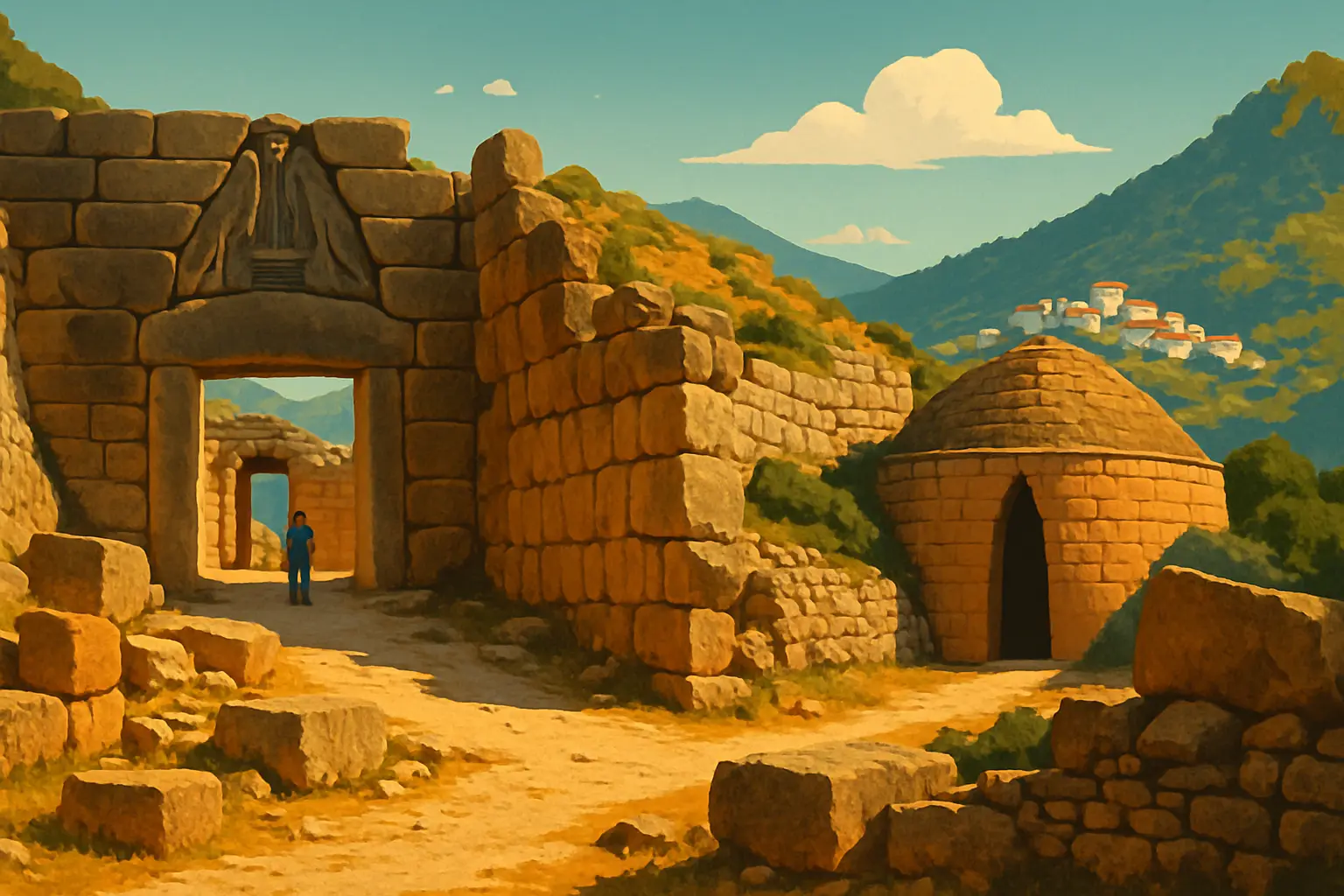
Mycenae is not a ruin in the sense of a known civilization slowly documented over centuries. It is something stranger: a city so completely destroyed and forgotten that when medieval Greeks found its cyclopean walls still standing in the hills of the northeastern Peloponnese, they had no explanatory frame for who had built them. The stones in the citadel walls — many weighing several tons, fitted together without mortar — were too large for ordinary human construction. The Cyclopes of mythology, one-eyed giants, became the most available answer. The word 'cyclopean' now describes any prehistoric unmortared masonry built from massive unwrought blocks, and it came directly from this medieval bewilderment at Mycenae's walls.
The Mycenaean civilization flourished from roughly 1600 to 1100 BCE. At its height, Mycenae was the dominant palace-state of the Aegean — trading with Egypt, the Levant, Cyprus, and Anatolia, writing in a script called Linear B (not deciphered until 1952), and operating the kind of centralized, palace-bureaucracy economy that recorded olive oil distributions and chariot wheel inventories in clay tablets. When the civilization collapsed — part of the Late Bronze Age collapse that brought down almost every major Mediterranean palace culture around 1200 BCE — the city was abandoned so thoroughly that within a few generations no one still living could explain who had built it or what had happened.
Homer was writing about Mycenae roughly 400 years after it had vanished. His Iliad names Agamemnon of Mycenae as the commander of the Greek forces at Troy — which means Homer was working from a centuries-old oral tradition about a city that was already mythological in his own time. When you walk through the Lion Gate today, you are walking into a place that was ancient to the ancient Greeks.
The Lion Gate is the main entrance to the citadel and one of the most recognizable images in all of archaeology. Built around 1250 BCE, it is the only large-scale figurative sculpture surviving from Bronze Age Europe. The gate is formed by four enormous limestone blocks. The lintel alone weighs approximately 20 tons. Above it, a triangular relieving triangle — cut into the masonry to redirect the downward pressure away from the lintel — contains the carved relief that gives the gate its name: two animals (traditionally called lions, though the missing heads may have been lionesses) standing with their front paws raised on a central stepped column in the Minoan sacred-pillar style, facing outward toward anyone approaching.
The exact meaning of the relief is not fully agreed upon. The column between the animals appears in Minoan religious iconography at Knossos on Crete, which suggests the Mycenaeans absorbed and reframed Minoan ritual symbolism while adapting it to their own political purposes. The most plausible reading is simultaneously territorial and religious: this city is under divine protection, and the gate itself enacts that claim architecturally. The 3-meter-wide passage could be sealed by a pair of wooden doors whose pivot holes survive in the threshold stone.
Stand directly under the lintel and look up. The stone above you predates the Parthenon by eight hundred years. The carving on the relieving triangle has been exposed to weather for 32 centuries and is still readable at a glance.
Get short, interactive stories that make each place easier to remember while you travel.
Just inside the Lion Gate and to the right is Grave Circle A — the royal burial ground where Heinrich Schliemann excavated in 1876 and sent one of the most famous telegrams in the history of archaeology. On November 28, 1876, Schliemann wrote to the King of Greece: 'I have gazed upon the face of Agamemnon.' In Shaft Grave V, he had found a gold funeral mask — hammered gold sheet shaped over the face of a dead king — alongside four other masks and hundreds of gold objects: cups, diadems, inlaid bronze daggers, amber beads, and gold dress ornaments in quantities that had not been seen from this period before.
The problem, which archaeology has since settled definitively, is this: the masks date to approximately 1550 BCE. If the Trojan War occurred, it was around 1200 BCE. The man under Schliemann's most famous mask died three to four centuries before Agamemnon would have been born. Schliemann eventually understood this — near the end of his life he reportedly joked about simply calling the anonymous king 'Schulze' — but the name had embedded itself in the public record and has never let go. The Mask of Agamemnon is still called the Mask of Agamemnon.
The originals are not at Mycenae. All the shaft grave gold was transported to the National Archaeological Museum in Athens in the years after excavation. Room 4 of the museum — the Mycenae room — holds the complete assemblage: five funeral masks, gold cups including the two famous Vapheio cups, inlaid daggers with hunting scenes in silver, gold, and niello, and thousands of smaller objects. The mask is case-lit and surrounded by the full context of the grave circle. Visit the museum after the site rather than before: the objects read entirely differently once you have stood in the geography they came from.
What survives at the site is the grave circle itself — a row of upright stone slabs marking the original vertical grave stele that stood above the shaft graves. Six graves, nineteen burials, the concentrated wealth of the Mycenaean world's ruling class in their most elaborate period. The scale of the gold that came out of this relatively compact area — roughly 15 meters in diameter — remains startling even in retrospect.
A 300-meter walk down the main road from the citadel entrance brings you to the Treasury of Atreus — which has its own separate entrance, its own ticket check, and is undervisited by roughly half the people who come to Mycenae. This is a significant error. The Treasury of Atreus is, structurally, one of the most impressive ancient buildings in the world.
It is a tholos tomb — a 'beehive tomb' — built around 1250 BCE at the apex of Mycenaean architectural ambition. The approach is along a dromos (entrance corridor) 36 meters long, cut into the hillside and flanked by dressed ashlar masonry walls. The doorway is 5.4 meters high and 2.7 meters wide. The lintel block above it weighs approximately 120 tons — heavier than the largest stones at Stonehenge. A triangular relieving space above the lintel, similar in principle to the Lion Gate's, once carried carved decorative columns; their bases are now in the National Archaeological Museum.
Inside, the chamber is 14.5 meters high and 14.6 meters in diameter. It was built without mortar using corbeling: each horizontal ring of stone slightly overhangs the ring below it, each course progressing inward until the rings meet at the capstone. This is the largest corbeled dome constructed in the ancient world and it held that distinction for 1,300 years — until the Roman Pantheon was completed in 125 CE. Stand in the center of the chamber and speak at a normal volume. The acoustic is a single low resonant echo that seems to come from the walls themselves.
The tomb was robbed in antiquity, long before any archaeologist arrived, so the chamber is empty. A small side room cut from the dromos wall may have held the primary burial; it is unclear. The architectural achievement is the point. The construction of this chamber, in 1250 BCE, using only human labor and engineering logic applied to locally quarried stone, represents a technical accomplishment that most visitors take too little time to absorb.
Most visitors spend their Mycenae time near the Lion Gate and the Grave Circle, then drift toward the exit without climbing to the upper citadel. The path from Grave Circle A leads upward through the ruins to the palace complex — the Megaron, the throne room of the Mycenaean kings — and the effort is worth making.
What survives of the palace is foundation-level: the floor plan of the vestibule, the anteroom, and the central megaron hall, where the outline of the circular central hearth and the four post holes for the wooden columns that supported the roof are still legible. The complex is less visually dramatic than the gate or the Treasury, but standing in the space gives you the administrative center of Bronze Age Greece — the room from which this palace economy coordinated trade, military campaigns, and bureaucratic record-keeping across the eastern Mediterranean.
At the northern end of the citadel, below the North Gate (a secondary entrance whose construction is architecturally similar to, though smaller than, the Lion Gate), a staircase descends into an underground cistern. The cistern was tunneled through solid rock to a depth of 18 meters and connected by channel to a spring outside the citadel walls — a passive water supply designed to sustain the population during a siege. The staircase descends the full 18 meters into the dark. The majority of visitors turn back at the first landing. Bring a phone flashlight and continue to the bottom. The lowest chamber, where spring water once collected, is one of the least-visited and most atmospherically strange spaces at the site.
Mycenae is 120 kilometers from central Athens by the fastest route: the A7/E65 motorway southwest across the Isthmus of Corinth, then south through the Argolid. With light traffic the drive takes about 1 hour 45 minutes each way. In summer — particularly on Friday afternoons and Sunday evenings when Athenians are moving between the city and the Peloponnese — traffic at the Corinth isthmus can extend this to 2.5 hours. Free parking is available immediately outside both the main citadel entrance and the Treasury of Atreus entrance.
By organized tour: Day tours from Athens operate daily from Syntagma Square and central hotels. The standard tour combines Mycenae with Epidaurus and a short stop in Nafplio, running 10–11 hours door to door. Prices start around €90 per person, typically including a guide but not always the site entrance fee (€12 per person at Mycenae). The guided format delivers good historical context efficiently; the tradeoff is approximately 2 hours at Mycenae rather than the 3+ that the full site deserves. If you've never been to Epidaurus, a combined tour makes the logistics straightforward. If you've already seen the theater, self-driving gives you a better day.
Self-driving: Renting a car from Athens gives you timing control — the ability to stop at the Corinth Canal (the road bridge overlook takes 20 minutes and the narrow sea-level canal cut is worth seeing), spend proper unhurried time at the Treasury of Atreus, and have a long lunch in Nafplio's plateia. The regional road from Nafplio to Mycenae (23 km) winds through olive groves and small villages with the citadel visible on the ridge above you for the last few kilometers.
By KTEL bus: KTEL Argolidos buses depart from Athens Bus Terminal B at Liosion 260 to Nafplio approximately every 1–2 hours; journey time is about 2.5 hours. From Nafplio, local buses connect to the village of Mykines (the modern settlement at the site entrance) several times daily — confirm the current schedule at the Nafplio KTEL station before you go. The timing requires attention but the route is viable if you prefer not to drive.
Is Mycenae worth the trip from Athens? Yes, clearly — but with accurate expectations. Mycenae is not a site of intact buildings and preserved interiors. It is a hillside citadel of massive stone foundations, cyclopean walls, and two extraordinary structures: the Lion Gate and the Treasury of Atreus. The site has almost no shade, the terrain is uneven, and the interpretive materials on-site are minimal. What makes Mycenae powerful is historical weight and specific architectural scale: 3,250-year-old stone work, in situ, at a site that was the political center of Bronze Age Europe and the origin point of the mythology Homer encoded in the Iliad. If ancient history is something you actively care about, the return on effort from Athens is exceptional.
How much time do you need? Plan 3 hours minimum for the main site and the Treasury of Atreus together. Two hours if you're on a tour and moving with a group. Add 30 minutes for the on-site museum (which houses models, inscribed tablets, and architectural fragments; it complements the site well and is air-conditioned in summer).
Best time to visit in June 2026: Summer opening hours run 8:30 AM to 8:00 PM. Arriving at opening is strongly advisable — the first hour at the Lion Gate is the quietest hour of the day, and the upper citadel is manageable before 10 AM. By midday the site is hot and exposed; this is the right time to take the shaded dromos at the Treasury. The late afternoon (4–6 PM) is when the light hits the limestone walls at the angle that makes the site look like the photographs, and the crowds have typically thinned.
Do you need a guide? The Lion Gate and the Treasury of Atreus explain themselves architecturally. The Grave Circle and the palace megaron are harder to read without context — a licensed guide or audio guide (available at the entrance, approximately €5) materially improves those sections. If you've read the site history beforehand, self-guided is entirely viable.