The mythology of Lycabettus is specific and slightly ridiculous, which is part of why it has survived. According to the story, Athena was flying across Attica carrying a massive limestone rock she intended to use as the foundation platform for the Acropolis. A crow intercepted her midflight with some piece of very bad news — the exact nature of the news varies by telling — and Athena, startled or furious, dropped the rock. It landed where Lycabettus stands today. Greeks have been telling this version for over two thousand years; the geographer Pausanias wrote it down in the 2nd century A.D.
The hill sits in isolation from the other hills of Athens — unlike the Acropolis, Philopappos, and Ares Hill, which form a rough chain along the ancient city's western edge, Lycabettus rises alone in the northeast of the basin. The name derives from the Greek for 'wolf path' — lycos (wolf) and bainein (to walk). The hill stood outside the ancient city walls and was wild terrain, genuinely home to wolves in the archaic period.
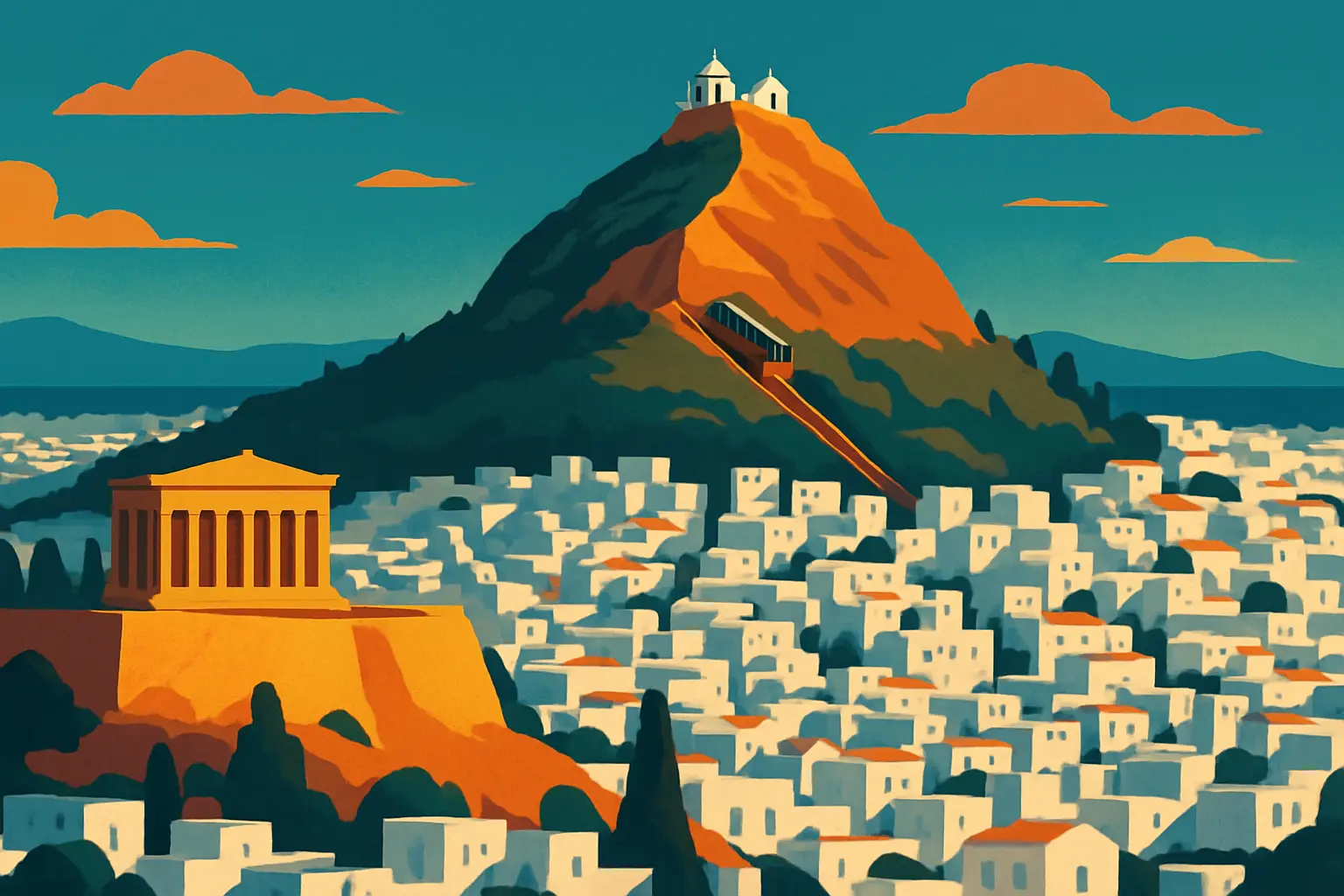
At 277 meters, Lycabettus is the highest point in central Athens — taller than the Acropolis rock (156 meters) by a meaningful margin. From the Acropolis, you are inside Athens looking out. From Lycabettus, you are above it, and the geography of the whole city finally resolves into a legible shape.
Two methods, genuinely different experiences. The funicular is the practical choice; the hike is the better story.
The funicular (officially the Telecabine) departs from the station on Plutarchou Street in Kolonaki, near its intersection with Kleomenous Street. The entrance is marked and moderately easy to find, though Google Maps sometimes routes people to the wrong Plutarchou address. The ride takes five minutes through a tunnel blasted through the hillside and deposits you near the summit. Hours are 9 a.m. to 2:30 a.m. daily, every 30 minutes. Tickets: €13 round trip, €10 one way. The late closing hour exists specifically because the night view is worth the trip.
The hiking route begins on the same street. Walk north on Plutarchou past the funicular entrance and you'll see where the pavement gives way to a path entering the pine forest. The trail climbs through mixed pine and cypress on stone steps and earthen path, steep in the final third and partially exposed to sun. Before 10 a.m. or after 6 p.m. in June, it takes 25–30 minutes at a relaxed pace. Bring water.
A useful strategy: hike up in the morning, descend by funicular. Or simply take the cable car both ways. The hiking path does not loop — the main trail runs up the western face, with a quieter variant approaching from Neapoli, the residential neighborhood on the northwest side of the hill.
Get short, interactive stories that make each place easier to remember while you travel.
The summit of Lycabettus holds the Chapel of Saint George — a whitewashed stone church that has stood in roughly its current form since the 19th century, though built on the foundations of an earlier Byzantine chapel. Inside: candlelight, silver icons, the particular cool air of a stone building that the sun only reaches at an angle. The bell tower is visible from much of northeastern Athens — from Kolonaki and Exarcheia, you can look up and see it.
The chapel is not large. On a normal summer day it holds perhaps twenty people standing. On April 23, Saint George's Day, the hill fills with a procession of Athenians who walk up carrying candles for the patron saint's feast day — one of the more unusual urban religious celebrations in the city.
The chapel sits at the very top of the hill, a few minutes' walk from the funicular arrival point. It is open during the day and the interior is quiet enough to stand in for ten minutes even when the terrace outside is busy. The combination of the church, the views, and the pine trees immediately around the summit gives Lycabettus a different register from the archaeological sites lower in the city — less monument, more place.
On the southern side of the summit, a curved stone amphitheater seats roughly 3,000 people in a space carved into the hillside. The Lycabettus Theatre faces north, which means that when you are sitting in the audience and looking toward the stage, the performing area is framed by the lit-up Athens skyline behind it. In June and July, the Acropolis glows amber against the night sky directly in the sightline of anyone watching from the upper tiers. It is an involuntary scenic design that the theater didn't have to try for.
The season runs May through October. The theater hosts a mix of international concerts — jazz, rock, classical, world music — alongside Greek theatre and dance performances. As part of the Athens Epidaurus Festival (running June 20 through August 29, 2026), several headline events are programmed at Lycabettus for the summer season. Tickets for festival performances are available at aefestival.gr; for commercial concerts, check more.com and ticketmaster.gr.
Practical notes for attending a performance: bring a layer. The summit at 277 meters is reliably cooler than street level in Athens, and after 10 p.m. on a June evening the temperature can drop to 18–20°C while the city below is still 25°C. The difference is noticeable. Arrive early enough to walk the perimeter of the summit before the show starts — the view is part of the evening.
Two places to eat and drink at the top. Orizontes is the upscale restaurant built into the summit infrastructure: Greek cuisine with a terrace, mains in the €25–45 range, reservations typically required in summer. The food is good without being exceptional, but the pricing is not really about the food — it is about spending two hours with the full panorama of Athens below you. A long lunch with a carafe of Greek wine from a terrace at 277 meters is worth what it costs.
Ai Giorgis is the all-day café adjacent to the chapel: coffee, beers, cocktails, light plates. Prices are elevated versus street level (a freddo cappuccino runs about €5 vs. €3.50 in Kolonaki below) but the tables outside look directly over the city. A cold coffee on the terrace while the Athens basin spreads below you is one of the more genuinely arresting ways to spend twenty minutes in the city.
Neither venue has the density or quality of what you can find walking Kolonaki's streets below. The right use of eating and drinking on Lycabettus is to treat it as part of the experience of being on the summit — not as a dining destination in its own right.
The summit gives a 360-degree panorama that no other accessible point in central Athens matches. On a clear June day — and most June days in Athens are clear — the visibility extends 50 to 70 kilometers.
Looking southwest, the Acropolis sits below you with Monastiraki and the old city spreading in every direction around its base. You can read the street grid of central Athens and see why the neighborhoods you have been walking are arranged the way they are — the topography that makes sense of everything becomes visible.
Looking south, the Athens basin opens toward Piraeus port and the Saronic Gulf. On days with low haze, the island of Aegina is visible on the water. The contrast with the landlocked-feeling city at street level is striking — Athens is a seaside city, but you don't feel that from Plaka or Monastiraki.
Looking north and east, the ring of mountains enclosing the Attic basin comes into view: Mount Hymettus (the long ridge to the east, whose marble veins the Athenian landscape), Mount Pentelicus to the northeast (source of the marble for the Parthenon), and Mount Parnitha in the north. The city is definitively in a bowl, and Lycabettus is the one place from which you can see the entire rim at once.
Is it worth the visit? Yes, without qualification. Even 45 minutes on the summit reframes the city in a way that no ground-level walk can replicate. First-time visitors to Athens who skip it are missing the view that makes everything else they've seen fall into place. People who have been to Athens multiple times and never gone up should go.
Is the funicular reliable? Generally yes. It closes in high winds and for periodic maintenance. If you arrive and find it shut, ask at the ticket office — they will usually tell you when it will reopen. On summer weekends, a short queue is normal.
Is the hill accessible? The funicular station is elevator-accessible from street level. The walking path is not — it is uneven terrain with stone steps that require reasonable mobility. Once at the summit, movement around the terrace, café, and chapel is accessible.
Can I combine it with [Kolonaki](/gr/blog/kolonaki-athens-guide)? Yes — the natural sequence is to walk Tsakalof Street and Milioni Street in Kolonaki, then take the funicular up from Plutarchou at the end of the afternoon. Descend for dinner in the neighborhood. The funicular entrance is eight minutes' walk from the main Kolonaki square.
How crowded is it in June? Evenings are the busiest time, particularly 7–9 p.m. on weekends. Weekday mornings before noon are quiet. The summit never feels as crowded as the Acropolis does in high season — the funicular limits throughput and the area at the top is reasonably spread out.