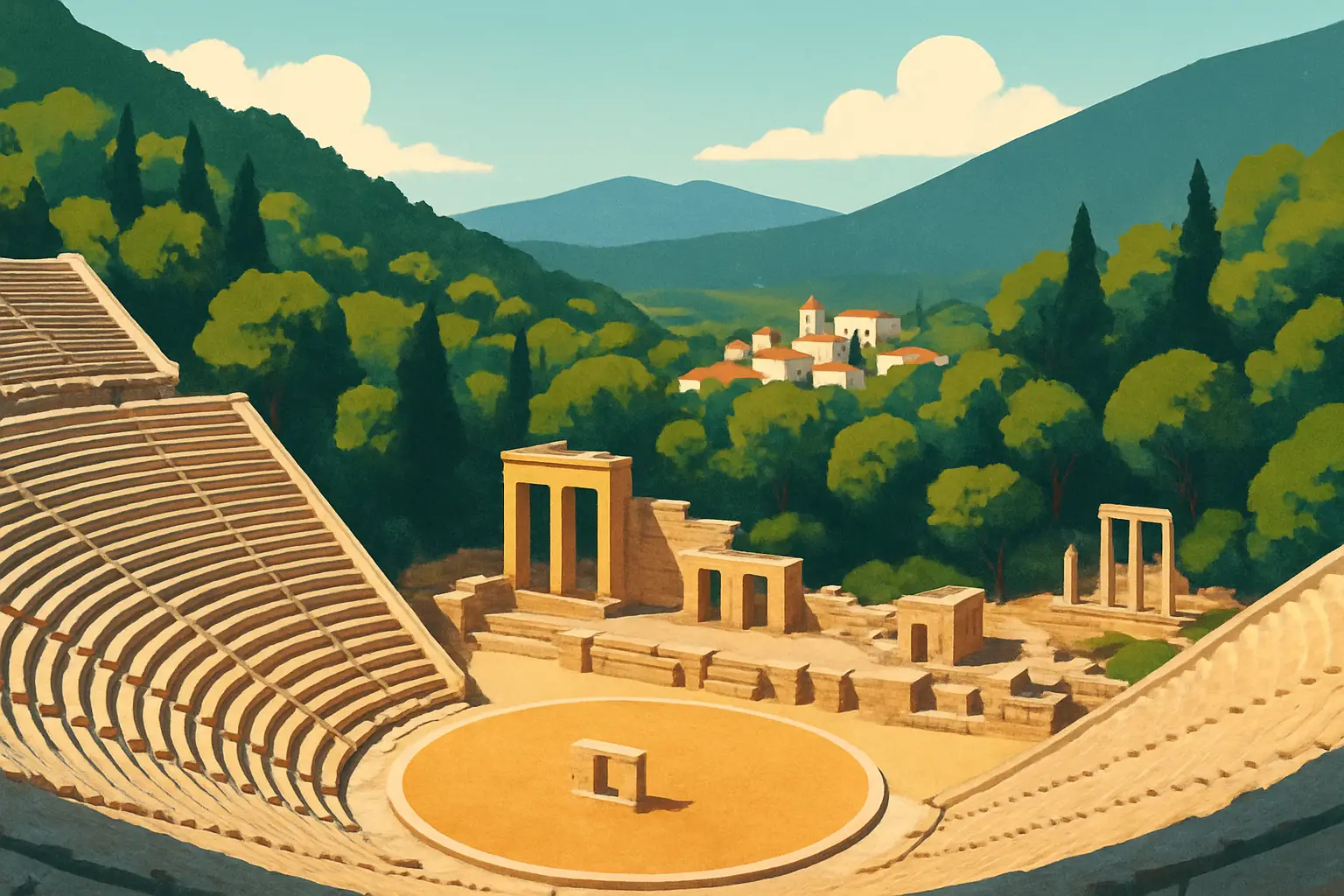
Most visitors come to Epidaurus for the theatre and treat the rest of the site as a bonus. That is understandable — the theatre is the most famous ancient structure in the Peloponnese — but it inverts the original logic of the place. Epidaurus was primarily a sanctuary of Asklepios, the god of medicine and healing, and one of the most powerful pilgrimage destinations in the ancient Greek world. The theatre was built to entertain the pilgrims who came seeking cures.
The Sanctuary of Asklepios at Epidaurus was inscribed as a UNESCO World Heritage Site in 1988 and operated continuously from at least the 6th century BCE through the 4th century CE — roughly a thousand years of activity. People arrived from across the Mediterranean carrying physical ailments and slept in the Abaton, the sanctuary's colonnaded dormitory, waiting for a healing dream in which Asklepios would appear and prescribe treatment. The cure inscriptions found here — hundreds of them, carved in stone and now in the National Archaeological Museum in Athens — record specific cases: a man blind in one eye healed overnight, a woman who had been pregnant for five years finally giving birth, a child with a head wound cured without any visible intervention. The tone is factual, almost clinical. This was not myth — it was the medical record of the ancient world.
The sanctuary complex includes the Temple of Asklepios (its foundations and the base of the cult statue visible), the Tholos circular building, the Abaton dormitory, a stadium used for the Asklepieia athletic games, and the theatre. Walking the site in this order — not heading straight to the theatre — gives Epidaurus the weight it deserves.
The theatre was designed by Polykleitos the Younger around 340 to 300 BCE and is the most celebrated piece of architecture produced by the ancient Greek theatrical tradition. Its dimensions still register as extraordinary: a semi-circular cavea 119 meters wide, with 55 rows of limestone seats arranged in two tiers — a lower section of 34 rows and an upper section of 21 rows, separated by a diazoma walkway. Seating capacity estimates range from 11,750 to 14,700 depending on how tightly you model ancient audience density.
Critically, unlike almost every other ancient theatre in Greece, the Epidaurus theatre was not substantially rebuilt or modified during the Roman period. What you are standing in is the 4th-century BCE original — not a later enlargement or restoration. That fact matters both architecturally and acoustically.
The acoustics are what everyone talks about because they are genuinely verifiable. A coin dropped on the circular stone orchestra — the flat performance space at the centre of the theatre — produces a sound audible from the top row without any amplification. A normal speaking voice carries to the 55th tier as clearly as to the 5th. For decades this was attributed to the geometry of the space, but research published in the 2000s identified a second mechanism: the porous limestone of the seats acts as an acoustic filter, absorbing low-frequency background noise (crowd murmur, wind, rustling clothing) while allowing the higher-frequency range of human speech to pass through undiminished. The theatre does not just project sound — it actively suppresses the interference that competes with it.
The skene — the two-storey stone building behind the orchestra that served as stage backdrop and dressing room — survives in foundation form with some column drums in place. Standing in the orchestra circle and looking up at the full cavea gives you the spatial logic of the space: the mountain behind, the tiers rising steeply, nothing above but open sky.
Get short, interactive stories that make each place easier to remember while you travel.
After the theatre, most visitors drift back toward the car park. The full archaeological site runs several hundred meters further, and it rewards the walk.
The Tholos is the circular building at the centre of the sanctuary, and it remains one of the most debated structures in Greek archaeology. Designed by the same Polykleitos the Younger who built the theatre, its triple-ring plan — Doric exterior columns, Corinthian interior columns, and a concentric subterranean labyrinth below the floor — has no clear functional parallel anywhere in the Greek world. The leading interpretation links it to chthonic (underworld-connected) ritual associated with the Asklepios cult, possibly involving sacred snakes — the serpent was Asklepios' symbol and lived in the sanctuary grounds. The foundations and collapsed column drums are visible at ground level; reconstruction drawings in the site museum show what it looked like complete.
The Abaton is the long colonnaded hall where pilgrims underwent enkoimesis — the sacred sleep during which Asklepios was believed to appear and prescribe healing. Two building phases are visible: the 4th-century BCE original hall and a 2nd-century BCE expansion that doubled its length. The inscribed stele recording cure testimonials were found here; replicas stand on site and the originals are in the National Archaeological Museum in Athens.
The on-site museum is small and worth an hour of your time. It holds the carved marble acroteria (roof ornaments) from the Temple of Asklepios, sections of the elaborately coffered ceiling from the Tholos, medical instruments found in votive deposits, and fragments of the cure inscriptions with their matter-of-fact medical language. The combination of objects makes concrete what the written record only suggests: Epidaurus was a genuine institution, not a devotional site operating purely on faith.
The Athens-Epidaurus Festival has run every summer since 1955, making it one of the longest continuously operating performing arts festivals in Europe. It uses two ancient stages: the Odeon of Herodes Atticus below the Acropolis in Athens and the Ancient Theatre of Epidaurus in the Peloponnese. The 2026 season runs June 20 through August 29, with Epidaurus performances scheduled on Friday and Saturday evenings beginning at 21:00.
The opening night on June 20 is Medea by Luigi Cherubini — an operatic version of the Medea myth staged in the theatre where the classical tradition originated. The programme through the summer rotates through ancient tragedy (Aeschylus, Sophocles, Euripides), contemporary productions of classical texts, dance, and opera. The full schedule is at aefestival.gr.
Practical notes for attending a performance:
- Tickets: Buy through aefestival.gr. Popular productions sell out 3 to 4 weeks early; opening night and productions by major companies go faster.
- Dress warmer than you think. Epidaurus sits in a valley, and even in July the temperature drops sharply at 21:00 once the sun goes down. A light jacket is standard; many Athenians bring a blanket for late August performances.
- Seating is numbered. The limestone has no padding and performances run 2 to 3 hours. Bring a small cushion.
- Festival bus transport from Athens runs on performance nights — the coaches depart from central Athens, arrive before curtain, and return after. Confirm current season logistics at aefestival.gr or through Athens tour operators.
- By car, the route from central Athens takes approximately 2 hours via the A8 motorway toward Corinth, then the A7 through the Isthmus and south through the Argolid to Ligourio and the site.
By car is the most flexible option, particularly if you want to pair the Epidaurus site visit with Nafplio and potentially return for a festival evening. The route runs on the A8 toward Corinth (toll road), continues on the A7 through the Isthmus of Corinth, then follows regional roads through Ligourio to the site — 150 km and just under 2 hours in normal traffic. Parking at the site entrance is free and large. After festival performances (finishing around midnight), the single-lane regional road back toward the motorway can be slow — add 30 minutes to your return estimate.
By KTEL bus, the route from KTEL Kifisos station (Terminal A, Kifissou Street, Athens) runs through Nafplio with connections to Epidaurus. Journey time from Terminal A to Nafplio is approximately 2.5 to 3 hours; local onward buses serve Epidaurus from Nafplio. On festival nights, the Athens-Epidaurus Festival operates dedicated express coaches directly to the theatre — these are the most efficient public-transport option if you are attending a performance and do not have a car.
By guided tour, Athens operators run Epidaurus day trips year-round from Syntagma or Omonia Square, typically departing 7:30 to 8:00 a.m. and returning by evening. Festival-night versions combine an afternoon site visit with the evening performance; book these at least a week in advance for popular dates.
If combining with Nafplio — which sits 30 km from Epidaurus — leave Athens early, give 3 to 4 hours to the Epidaurus complex, drive to Nafplio for a late lunch in the old town, and either return to Athens in the afternoon or stay overnight and spread Mycenae across the following morning.
Yes — and the theatre is actually better visited during daylight, when you can walk every tier, stand in the orchestra, and test the acoustics yourself rather than following the prescribed view from an assigned seat.
The acoustic demonstration is most effective before coach groups arrive in mid-morning. Stand in the orchestra circle while a companion climbs to the uppermost row — 55 tiers and roughly 70 meters back — and speaks in a normal voice. The clarity at that distance, completely unamplified, takes most visitors by surprise. If you are alone, dropping a coin on the stone produces a ring audible from the top rows.
The combination of full site visit by day and performance at night is genuinely one of the better experiences available in Greece during the summer months. Watching Medea or the Oresteia in the theatre where this theatrical tradition was codified, in acoustics that have never been artificially modified, is different in kind from seeing the same production in any modern venue. But the site holds on its own: the Tholos alone would justify the 150-km drive for anyone interested in ancient Greek architecture and the unresolved questions it still raises.
Best time to visit? May through October covers the full season. June specifically offers good weather, manageable daytime crowds, and the opening of the festival (June 20). By July and August the site is busy on non-performance days and packed on performance weekends. If you want the theatre to yourself, come on a Tuesday or Wednesday morning in late May or early October.
Opening hours (summer season, 2026): The archaeological site typically opens at 8:00 a.m. and closes at 8:00 p.m. in high summer; the museum opens at 10:00 a.m. Verify current hours at the Greek Ministry of Culture website (odysseus.culture.gr) before traveling, as hours adjust seasonally.
Entry fees: A combined ticket for the site and museum runs approximately €12 (reduced €6). Festival performance tickets are priced separately by event — typically €15 to €50 depending on the section and production.
What to bring: The site is exposed. In June and July sunscreen, a hat, and more water than seems necessary are all essential. The limestone seating is uncomfortable for extended sitting without padding — if you are attending a performance, a small folded cushion is standard practice among regulars.
Is it too much with [Mycenae](/gr/blog/mycenae-day-trip-from-athens)? Mycenae is about 45 km from Epidaurus and theoretically combinable in a single long day. In practice, both sites deserve more than a rushed hour. The better approach is to overnight in Nafplio — equidistant from both — and spread the two sites across two days. The towns and landscape of the Argolid are good enough that moving slowly through them is not a compromise.