Ancient Greek mythology held that Zeus, wanting to find the center of the earth, released two eagles from opposite ends of the world. They met above Delphi. A stone called the omphalos — the navel — was placed to mark the spot. A replica stands outside the Delphi museum today; the original is inside.
Beyond mythology, Delphi's power was concrete and geopolitical. The Oracle of Delphi — the Pythia, a woman from the local area chosen to serve Apollo and speak his prophecies — was consulted by city-states, kings, and generals throughout the Mediterranean world for nearly a millennium. Before Athens went to war with Persia, they asked Delphi. Before Sparta reorganized its laws under Lycurgus, they asked Delphi. Before the Greeks founded Syracuse in Sicily, they asked Delphi. The Oracle's answers were famously ambiguous — the famous 'wooden walls will protect Athens' prophecy was interpreted to mean the naval fleet, not actual wooden walls — which meant Delphi was also one of the ancient world's great centers of hermeneutics, the art of interpretation.
Cities expressed gratitude for favorable prophecies by building treasuries along the Sacred Way — small temple-like buildings housing votive offerings, gold, and silver. Rivalries between city-states played out architecturally: the Treasury of the Athenians, built after Marathon in 490 BC, was positioned directly in the line of sight from the entrance as a declaration of Athenian power. Delphi was not just a religious site. It was where the political identity of the ancient Greek world was continuously negotiated and displayed.
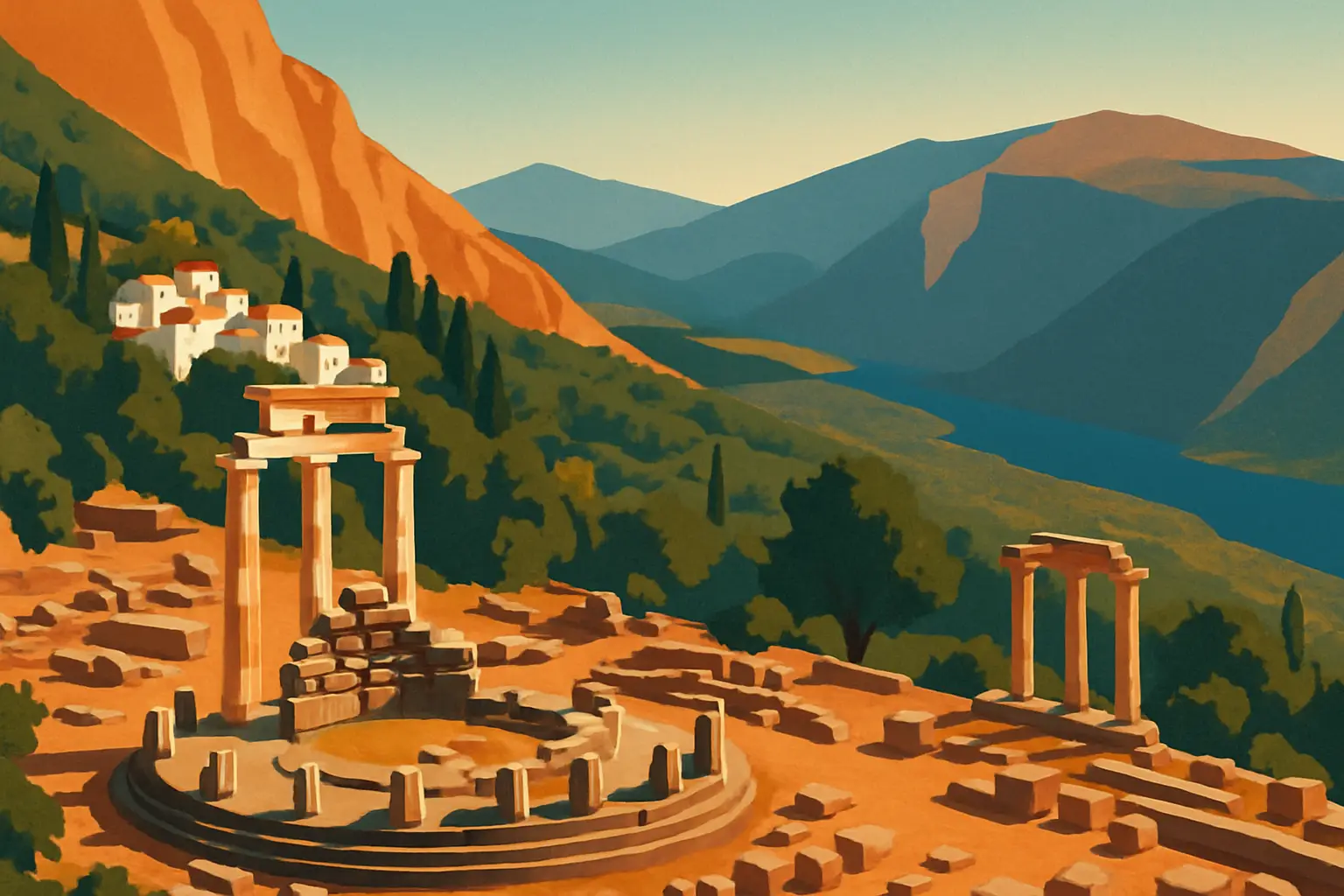
Before the main archaeological site, on the road from Athens, is the Sanctuary of Athena Pronaia — also called the Marmaria ('the marble place,' from the medieval practice of quarrying its stones). This is where visitors arriving from the east encountered first the goddess Athena before proceeding up the hill to Apollo's sanctuary.
The defining structure here is the Tholos — a circular building constructed around 380 BC whose purpose remains genuinely debated. It is not a temple in the conventional sense (there is no altar inside), not a treasury, not clearly a civic building. The three standing Doric columns with their entablature are among the most-photographed structures in ancient Greece precisely because the circular form is so unusual in Greek architecture — most Greek sacred buildings are rectangular. The marble drum foundation and the ring of column bases let you read the full original diameter even where columns are gone.
The Marmaria also contains the remains of two earlier temples to Athena — an archaic temple from the 7th century BC and a Classical-period replacement — as well as a series of Treasury buildings from various city-states. The whole complex is smaller and less crowded than the main site, and the valley views from here, looking south toward the Gulf of Corinth, are arguably better than anything from the main site.
Practical note: The Sanctuary of Athena Pronaia has its own entrance and is included in the main Delphi combined ticket (€20 for site plus museum). It is about a 500-meter walk east from the main site entrance along the road — manageable on foot, but there is no direct connecting path; you walk along the road shoulder. Allocate 30–45 minutes here.
Get short, interactive stories that make each place easier to remember while you travel.
The main Delphi archaeological site is entered from the east side and rises steeply uphill along the Sacred Way (Hiera Odos). The path climbs about 60 vertical meters from the entrance to the Theatre — not a demanding hike, but not flat either. Wear shoes with grip.
On the right side of the Sacred Way, just inside the entrance, is the Athenian Stoa — a long narrow portico built after the Athenian naval victory at Salamis in 480 BC. The niches along its back wall were used to display captured Persian weapons. Immediately uphill, the Treasury of the Athenians is the best-preserved building on the site: a small Doric temple in Parian marble, largely reconstructed in the early 20th century. The reconstruction is controversial among archaeologists but gives a clear picture of what these treasuries actually looked like.
The Polygonal Wall behind the Treasury deserves a pause. The curved interlocking stones are Greek engineering from the 6th century BC — and every surface is covered in ancient graffiti: the names of freed slaves, inscribed here as a public declaration of manumission because the sanctuary of Apollo gave legal force to the record. More than 1,000 inscriptions of freed slaves are carved into this wall. It is the largest surviving ancient document of Greek slavery and emancipation.
At the top of the Sacred Way, the Temple of Apollo itself is partially reconstructed — six standing Doric columns of limestone, with a platform and cella walls indicating the scale of the original structure. The inner sanctuary (adyton), where the Pythia sat above a fissure in the rock to deliver her prophecies, is not preserved; geologists continue to debate whether the fissure existed and what gases, if any, may have influenced the Oracle's state.
Above the Temple, the Theatre offers a complete view of the site below and, on clear days, the Gulf of Corinth visible to the south through the Pleistos valley. Constructed in the 4th century BC and capable of seating around 5,000 people, the Theatre hosted the musical and poetic contests of the Pythian Games. Continue uphill another 500 meters — a genuine climb — to reach the Stadium: 580 meters long, with stone seating along the north side and a starting line still visible on the track. The Pythian Games (held every four years) included both athletic and musical competitions, and the Stadium is the best-preserved ancient stadium in Greece.
The Delphi Archaeological Museum, located immediately beside the main site entrance, contains one of the finest collections of ancient sculpture in Greece. The conventional tourist advice is to start with the museum for context. Ignore this. Visit the site first and the museum second: walking the Sacred Way gives you spatial intuition that makes the artifacts inside legible in a completely different way.
The centerpiece of the museum is the Charioteer of Delphi (Ηνίοχος) — a life-sized bronze figure of a chariot driver, cast around 475 BC. It is one of the most complete ancient bronze sculptures in existence. Most ancient bronzes were melted down for weapons or coinage; the Charioteer survived because it was buried in a landslide around 373 BC and remained underground until 1896. The realism of the figure is startling even by contemporary standards: the eyes are inlaid glass and stone, the lips copper, the individually modeled toes visible below the robe's hem. It was part of a larger chariot group commissioned by a Syracusan tyrant to celebrate a Pythian Games victory; the charioteer alone survives.
Other significant pieces in the museum: the Naxian Sphinx (570–560 BC), mounted on an Ionic column and originally standing 12 meters tall at the entrance to the sanctuary; the Siphnian Treasury frieze, including a detailed battle of gods and giants in high relief; and the Antinous relief, a late Roman work showing the Emperor Hadrian's lover depicted as Apollo — one of the most personal objects to survive from Roman Delphi.
The museum runs guided audio tours in English and allocating 45–60 minutes here gives you the full circuit without rushing.
Eleven kilometers from Delphi on the road back toward Athens, Arachova sits at 950 meters on the southern slope of Parnassus — higher than Delphi itself and considerably colder in winter (it is a major ski resort from December through March). In summer it is a normal Greek mountain village, cooler than Athens by at least 8 degrees, with a high main street and an Ottoman-era clock tower built into the rock face at the village's upper end.
Arachova is worth 90 minutes in June. Two specific things to look for:
Formaela cheese — an AOP semi-hard cheese made exclusively from sheep's milk in the Parnassus area and aged until it develops a firm, slightly elastic paste. It is a pasta filata cheese (pulled curd, like mozzarella or halloumi), which means it softens without melting when heated — traditionally eaten saganaki-style, pan-fried until golden. Arachova has several cheese shops along the main street selling Formaela by the wheel or in smaller portions; it is also available at the roadside stalls just outside the village. The AOP protection means genuine Formaela can only be produced in six specific villages including Arachova.
Local wine — the Parnassus foothills produce Roditis, a pink-skinned white grape variety. Arachova's traditional wine shops (often combined with general goods stores on the upper street) sell local Roditis by the bottle or in bulk. It is lighter and more acidic than Peloponnese Roditis, reflecting the higher altitude and lower temperatures. Drink it cold.
The village also has several tavernas suited for a late-afternoon meal before the final drive to Athens. Emmanouela on the upper main street is one of the longest-running traditional tavernas in Arachova, serving mountain lamb, mountain greens, and homemade pasta. The view down the valley from the terrace tables is worth arriving before sunset.
By bus (KTEL): The KTEL Fokidas bus line connects Athens to Delphi directly from Liosion Terminal (Liosion 260, Athens) — not the Kifissos terminal that serves most other mainland destinations. This is the most common navigation error for independent travelers. The nearest metro is Attiki station on Line 1 (Green Line), roughly a 15-minute walk north from the terminal, or take a taxi.
Buses depart approximately 4 times daily in each direction; the first departure toward Delphi is around 7:30 a.m. The journey takes 3 hours and costs roughly €17 one way. The bus drops you in the modern village of Delphi (separate from the archaeological site) — the site entrance is a 10-minute walk downhill, clearly signposted. Last return buses to Athens depart Delphi village in the late afternoon; check the current schedule at the KTEL Fokidas website before going, as times shift seasonally.
By car: The drive is 178 kilometers via the E75 motorway north to the Levadia exit, then the E962 mountain road west toward Delphi. Total time is 2.5 hours in normal traffic; add 20–30 minutes for Athens morning rush hour. Parking at the archaeological site is free and generally available by 8 a.m. — it fills by 10 a.m. on weekends.
Organized tours: Standard Athens-based day tours depart Monastiraki or Syntagma at 8:00–8:30 a.m., arrive at Delphi by 11 a.m., and give participants about 90 minutes at the site before lunch and the return drive. This is enough time to walk the Sacred Way, see the Temple, and get to the Theatre — but not the Stadium, not the Marmaria, and not the museum properly. For first-time visitors with no particular interest in archaeology, a tour is convenient. For anyone who actually cares about what they're seeing, a self-guided day is significantly better.
Entry tickets: The Delphi Archaeological Site and Museum each cost €12 separately or €20 combined. The Sanctuary of Athena Pronaia is included in the combined ticket. The site opens at 8:00 a.m. and closes at 8:00 p.m. in summer (May–October); the museum opens at 8:00 a.m. and closes at 3:00 p.m. on Tuesdays. Confirm current hours on the Greek Ministry of Culture website before visiting, as Tuesday closures apply to many Greek museums.
Is it worth it? Delphi is the most important ancient site in Greece that is not the Acropolis. If you have any interest in ancient Greek history, the Oracle, or the architecture of sanctuary complexes, it is not optional — it is the whole other half of the story. Athens shows you civic democracy; Delphi shows you the theological and political infrastructure that held the Greek world together across generations of city-state rivalry.
If you are not interested in ancient history and came to Greece for beaches and food, Delphi will be a long day for you. The heat from June through August at the site (limited shade, significant uphill walking, south-facing slope) is real. Allow for that.
Best time to visit? June is the best month in 2026. The summer heat is present but not yet brutal — typically 28–30°C at the site by midday — and arriving early (before 9 a.m.) means two hours of genuinely mild walking before temperatures climb. July and August are hotter, busier, and the midday section of the site (the Temple platform and above) is exposed stone with no shelter. If visiting in July or August, starting at 8 a.m. is non-negotiable.
How long does a day trip take? Door to door from central Athens: about 11–12 hours for a self-guided trip using the first bus. Budget 45 minutes in the Marmaria, 2.5 hours for the main site, 1 hour for the museum, 30 minutes for lunch in the modern Delphi village, and 90 minutes in Arachova on the return. Driving gives slightly more flexibility on the return.
For a complementary day trip from Athens, Nafplio and the Peloponnese takes you south toward Mycenae and the Lion Gate — a very different ancient world from Delphi's sanctuary atmosphere. The two together cover the main poles of Greek civilization in the ancient period.