1. What the Athens Riviera actually is — and where to start
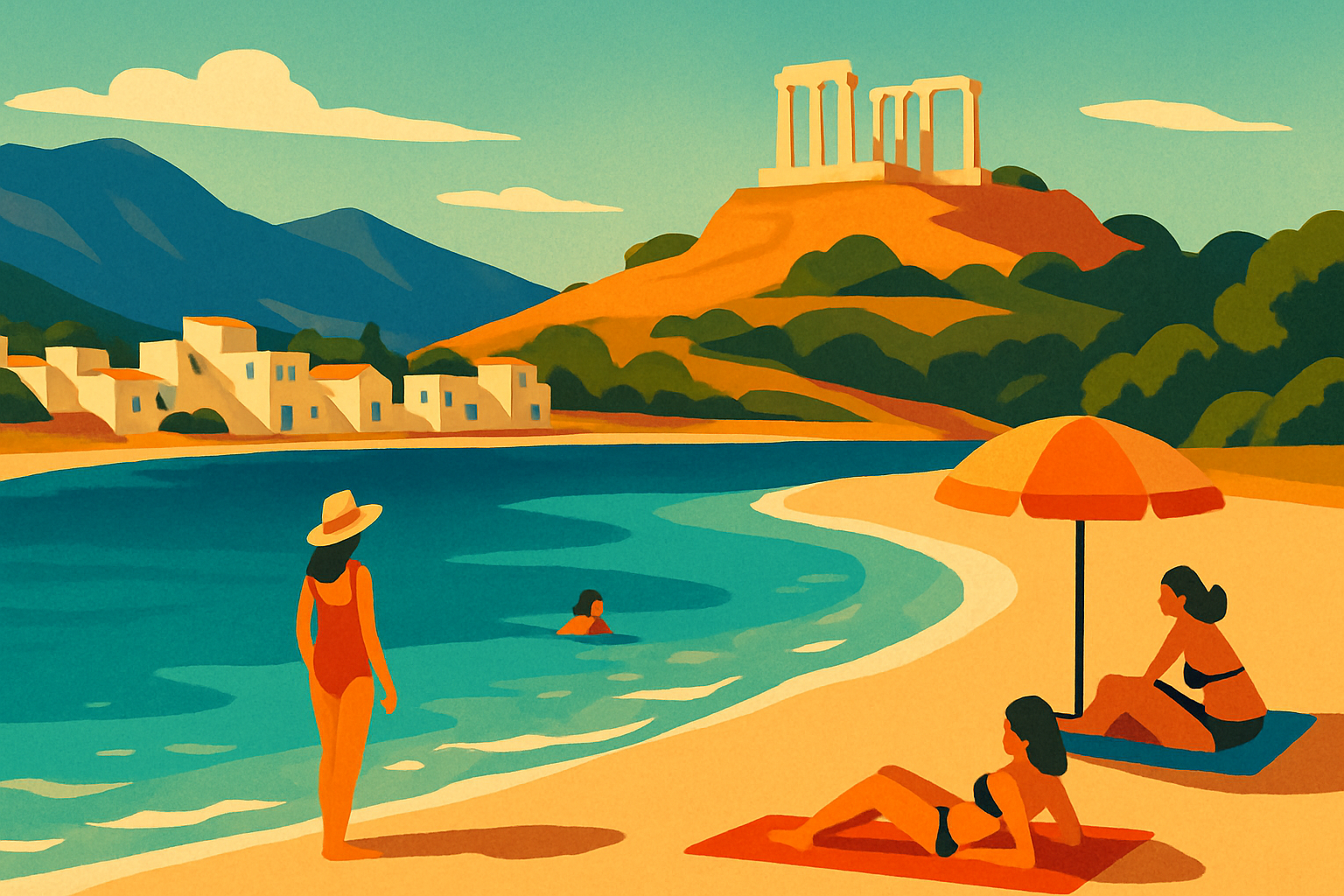
The Athens Riviera is the coastal strip running south along the Saronic Gulf from Piraeus to Cape Sounion — roughly 70 kilometres, connecting a sequence of coastal suburbs and their beaches. The main beach suburbs in sequence from north to south are: Palaio Faliro, Alimos, Glyfada, Voula, Kavouri, Vouliagmeni, Varkiza, and Lagonisi, before the road reaches Cape Sounion.
The water at the northern end — Palaio Faliro and Alimos — is compromised by proximity to Piraeus port. It runs warmer and less clear than anything further south. The practical starting point for swimming is Glyfada. The jump in water clarity between Alimos and Glyfada happens in under two kilometres — you can see it from the coastal road. From Glyfada southward, the water quality improves continuously until Limanakia and Varkiza, where it is excellent.
Mount Hymettus — the 1,026-metre limestone ridge running north-south just east of Athens — defines the visual backdrop of the entire coast. From any beach south of Glyfada, Hymettus appears as a continuous wall of grey-violet stone, bare at the summit and forested below, rising directly behind the coastal road. In the early morning, before the heat haze builds over the sea, the ridge-to-water view is one of the best Athens offers.
2. Getting to the Riviera: tram, bus, and the coastal road
The coastal tram runs on Line T1 from Syntagma Square (and from SEF — Peace and Friendship Stadium) along the coast to the Voula terminal at Asklipio Voulas. From Syntagma, Glyfada is approximately 40 minutes; the Voula terminal is 45–55 minutes. The tram costs €1.40 one-way and operates on the same Athena Card ticketing as the Athens metro. Service runs from around 05:30 to 01:00, later on weekends.
The tram ends at Voula. For Vouliagmeni and Varkiza, the options from the Voula terminal are bus A2 (running south to Vouliagmeni then Varkiza) or bus E22 (which runs directly from central Athens to Vouliagmeni without the tram transfer — useful if your starting point is closer to Syntagma Square). Journey time from Syntagma to Vouliagmeni by bus is 50–60 minutes.
By car, Poseidonos Avenue is the coastal road running south from Faliro with beach access at every suburb. Parking is straightforward at most beaches except for Limanakia, where roadside spots along the clifftop road are first-come. Summer weekend traffic makes the coastal road slow between 10 a.m. and 1 p.m. southbound. Leaving Athens before 9 a.m. or after 4 p.m. on weekends avoids most of it.
3. Glyfada: beach clubs, cocktails, and the accessible choice
Glyfada is the Riviera's most developed beach stretch — a sequence of organized clubs with sunbeds, umbrellas, beach bars, restaurants, and from early afternoon onward in summer, DJs. Free public beach sections run adjacent to the clubs at marked intervals.
Balux Beach Club and Asteras Glyfada Beach are the two defining names. Balux — part of the Astir Palace property — runs the full club format: entrance around €20–25 includes a sunbed, with cocktail service circulating the lounger areas, a pool, and a restaurant. DJ sets begin in the early afternoon and run through sunset. Asteras Glyfada has been operating since the mid-1950s; the beach divides into a lively family zone and a quieter adults-only section. The adults-only area is worth the entrance for the reduced density alone.
Glyfada town is a ten-minute walk from the water — a café-dense high street with good lunch restaurants. The Glyfada neighborhood guide covers the suburb in detail. This proximity makes Glyfada the best option for a beach half-day combined with lunch or shopping rather than a full day planted in a sunbed. If the goal is maximum swimming time with minimum fuss, continue south.
4. Vouliagmeni: the calmest bay on the immediate Riviera
Vouliagmeni bay is more sheltered than the beaches north of it. The bay geometry reduces swell and keeps the surface calmer — the practical difference is noticeable on any day with wind. This makes Vouliagmeni the best choice for families with small children or swimmers who find open-water chop uncomfortable. The water is Blue Flag certified and clear.
Astir Beach is Vouliagmeni's main organized option — and the Riviera's most upscale. A sunbed set (two loungers and one umbrella) runs €60 on weekdays, €100 on weekends and public holidays in 2026. This is not a casual beach club: the property has multiple pools, restaurants, and a private pine-forested setting that justifies the price as a resort day-use, not simply paid sunbeds. The free public section of Vouliagmeni beach runs alongside the Astir property and is entirely acceptable — the distinction is facilities, not water.
From Syntagma, bus E22 runs directly to Vouliagmeni in 50–60 minutes. The bus stop is a short walk from the beach entrance. If arriving by tram and bus A2 connection from Voula, add another 10–15 minutes to the journey.
5. Lake Vouliagmeni: the thermal spa inside a collapsed sea cave
Lake Vouliagmeni is one of the genuinely strange places within reach of central Athens — a semi-enclosed saltwater basin connected to the Saronic Gulf by underground channels running through the limestone cliff face on the lake's western side. The lake was formed by the partial collapse of an ancient sea cave; the ceiling fell in, leaving a dramatic open-air pool backed by a sheer cliff and enclosed by rocky slopes planted with pines.
The connection to the sea through the limestone keeps the water brackish and thermally stable. The lake temperature holds between 22°C and 29°C year-round — in summer the incoming underground water is cooler than the surface, producing a thermocline; in winter the same water is warmer than the open sea, making the lake swimmable on days when the Saronic Gulf is too cold to enter. The karst system extends thousands of metres into the limestone and has never been fully mapped.
Garra rufa fish — the small 'doctor fish' that nibble dead skin — share the water with swimmers. Turtles and ducks are permanent residents. The setting is unlike any other swimming spot in Attica.
Entrance in 2026 is €17 on weekdays, €19 on weekends. Children aged 6–12 pay €14 on weekdays, €17 on weekends. The upgraded 'Under the Pines' zone (€45–55) offers sun loungers in the shaded pine area overlooking the water and is worth it in peak summer heat. The lake opens at 8 a.m. — early morning is the best time to visit, before the midday sun hits the cliff face and the water fills with people. From the lake, Vouliagmeni beach is a 15-minute walk north along the coastal path.
6. Limanakia: the cliff coves with the clearest water on the Riviera
Between Vouliagmeni and Varkiza, the coastal road climbs slightly and the terrain shifts from sandy bay to low cliffs. Along this stretch — the area known as Limanakia — informal paths descend from the roadside to flat rock platforms at water level. Small coves, hidden from the road above, with the sea directly accessible from natural rock.
The water here is among the clearest on the entire Riviera. The depth drops quickly from the platforms, and the sea floor is visible in three metres of water. There are no sunbeds, no umbrellas, no entrance fee, no lifeguards, and no facilities. You carry down your own towel, sunscreen, and water and claim a platform. On weekday mornings in June, Limanakia feels isolated despite being 50 minutes from Syntagma. On summer weekends it fills by 11 a.m.
Access paths are not formally marked. Look for cars parked along the clifftop section of the coastal road and the worn trails descending through low scrub and limestone. There are approximately a dozen accessible platforms across the stretch, some requiring mild scrambling. Solid-soled shoes for the descent are useful — flip-flops are manageable but not ideal on the loose rock sections. The deepest and clearest water sits directly off the platforms nearest the cliff faces. This is the Riviera's best free option by a clear margin.
7. Varkiza: the family beach and water sports hub
Varkiza is the beach suburb beyond Vouliagmeni — broader sandy bay, slightly more casual character, and the Riviera's best setup for water sports. Varkiza Resort (previously known as Yabanaki, now under new ownership since 2024) is the main organized beach: Blue Flag certified, sandy, with an extensive water sports programme including windsurfing lessons, paddleboard rentals, banana boats, and waterski. Entrance runs €5–8, which covers basic facilities. The beach is large enough that even at peak summer weekend capacity it never feels compressed.
Beyond Varkiza, the coast continues south to Lagonisi, Saronida, Anavissos, and eventually Cape Sounion — the southern tip of Attica and the site of the Temple of Poseidon. The temple stands on the headland above a small cove where you can swim with the columns visible above you. That combination — ancient ruins above, Aegean below — is covered in the full Cape Sounion day trip guide. A common itinerary runs: Glyfada or Vouliagmeni in the morning, bus south to Sounion for the late afternoon (the light on the temple is best between 4 and 6 p.m.), return to Athens directly by bus line 121.
8. When to go, what the water costs, and whether Athens beaches are worth it
Sea temperature in June runs 22–24°C in the Saronic Gulf — genuinely comfortable for swimming. It rises to 26–27°C by August. Lake Vouliagmeni runs slightly cooler in summer (22–23°C) because the underground input is thermally consistent rather than sun-warmed.
Is it worth going to a beach in Athens rather than an island? The honest answer is: it depends on the day and the beach. Limanakia and Vouliagmeni on a weekday morning offer water quality and atmosphere that rival many Aegean island beaches. The beach clubs in Glyfada offer a specific social experience — cocktail service, pool, afternoon DJ — that no island village taverna provides. The comparison is not beach-for-beach but rather: do you have a full day to commit to a ferry, or do you have three hours and want to swim? The Riviera is the answer to the second question.
•Best water quality: Limanakia, Vouliagmeni, Varkiza (Blue Flag) — all south of Glyfada
•Best beach club experience: Balux or Asteras in Glyfada (€20–25 entry, DJ, cocktail service)
•Best for families: Varkiza Resort — sandy, calm bay, water sports for kids, €5–8 entry
•Best unusual swimming: Lake Vouliagmeni thermal spa (€17–19) — no equivalent in Attica
•Best free option: Limanakia coves — no facilities, clear water, rocky descent
•Best combination day trip: Glyfada morning + Cape Sounion afternoon, return by bus