1. What the Altis actually is — a sanctuary, not a sports complex
The first thing to understand about Ancient Olympia is that it was not primarily an athletic venue. It was the Altis — a sacred precinct of Zeus, the most important panhellenic sanctuary in Greece — and the Olympic Games were a religious festival. Athletes competed to honor Zeus, and winning was considered a form of divine blessing rather than personal achievement. The fame of an Olympic victor in antiquity exceeded almost any other honor available to a Greek man.
The games ran from 776 BCE — the traditional date of the first recorded competition — until 393 CE, when the emperor Theodosius I banned pagan festivals as part of the Christianization of the empire. That is 1,169 years of uninterrupted competition on the same ground, a continuity of place and purpose with almost no parallel in the ancient world.
The site was then flooded by the Alpheios River and buried under several meters of sediment for over a thousand years — which is why the ruins are better preserved than many famous ancient sites. Systematic excavation began in 1875 under German archaeologists and continues today. The Altis enclosed the main religious and athletic structures within a rectangular sacred wall; outside it lay training facilities, baths, a guest house (the Leonidaion), and the workshop of Phidias. Everything you walk through fits into this hierarchy of sacred center and supporting periphery.
2. The Temple of Zeus — the Seven Wonders connection and the statue that no longer exists
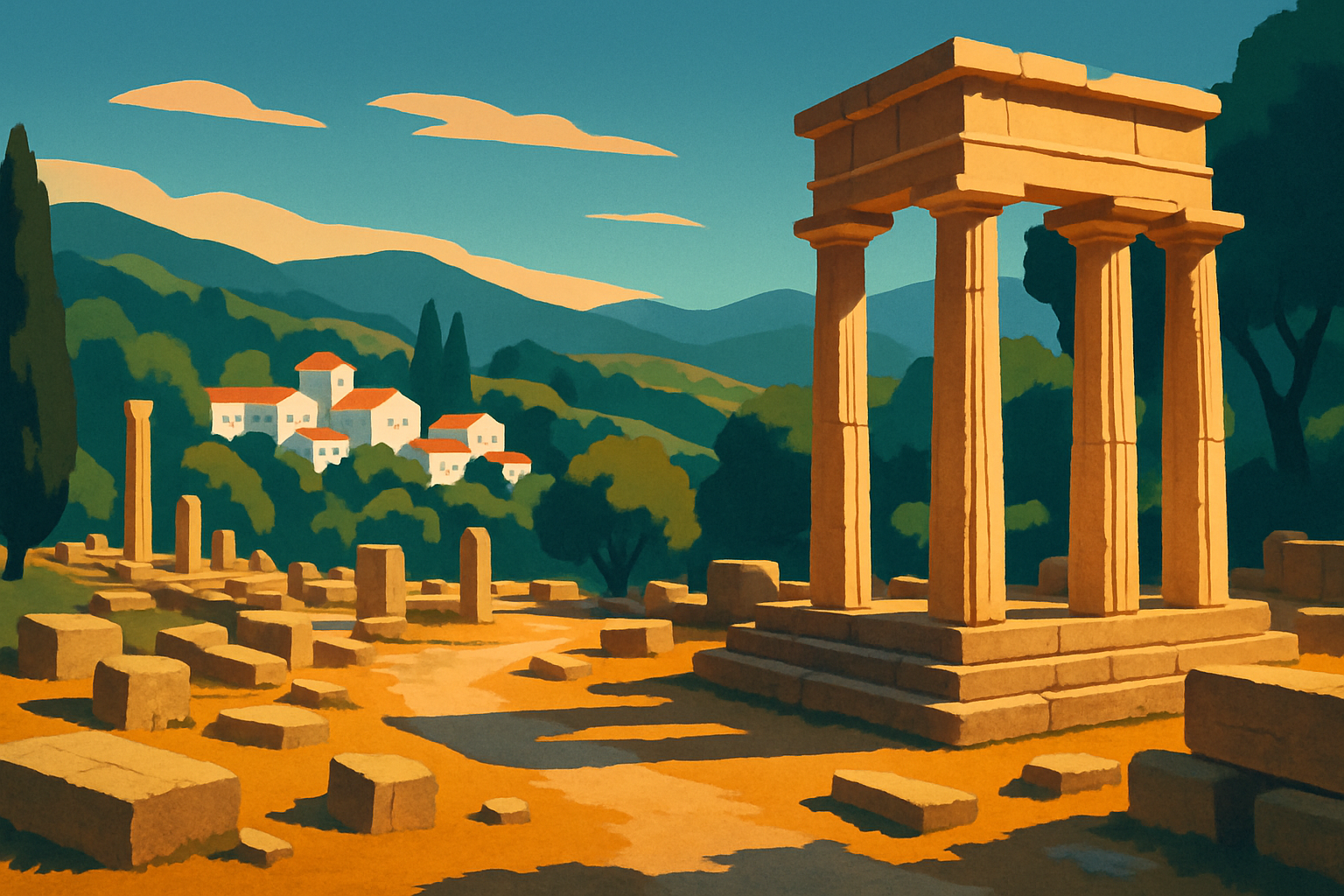
The Temple of Zeus dominates the center of the Altis — or rather, its ruins do. Built between 470 and 456 BCE in the Doric order, the temple measured 64 by 28 meters with 34 outer columns, each 10.4 meters tall. It was the largest temple in Greece at the time of its completion.
Inside, the sculptor Phidias created the Chryselephantine Statue of Zeus — one of the Seven Wonders of the Ancient World. The statue stood approximately 12 meters tall, built over a wooden armature covered with ivory panels for skin and hammered gold sheets for drapery. Zeus sat on a carved cedar throne inlaid with ebony, ivory, gold, and precious stones. The geographer Strabo wrote that it nearly touched the ceiling; Phidias reportedly said that if Zeus were to stand up, he would remove the roof.
The statue was removed to Constantinople in the 4th century CE and destroyed in a palace fire in 475 CE. Nothing survives except ancient descriptions and coins showing its approximate form. What does survive are the temple's pediment sculptures — the chariot race of Pelops on the east pediment and the battle of Lapiths and Centaurs on the west, both now in the Archaeological Museum. The temple columns themselves were toppled by earthquakes in the 5th and 6th centuries CE; 18 of the 34 outer column drums fell in a neat linear row on the south side, and that is still how they lie today.
3. The Stadium — the original 192-meter track you can still run
East of the Altis, connected to the sanctuary by a vaulted tunnel (the Krypte) built in the 3rd century BCE, lies the ancient stadium. Walking through the Krypte is one of the site's most effective architectural moments: a narrow stone corridor, slightly downhill, emerging at track level. Ancient athletes walked this same passage from the preparation rooms to the competition ground. The tunnel still functions as an entrance.
The track is 192.27 meters long — one stadion, the unit of measurement from which the word 'stadium' derives. The length corresponds to 600 Greek feet, which varied by location because foot measurements were not standardized; Olympia's foot was 32.05 centimeters. At the starting end, the balbis — the stone starting line — is still partially visible, with carved grooves where athletes positioned their toes for the sprint start.
You can run the track. Most visitors attempt it in street shoes; barefoot is technically more authentic but the compacted earth in June is also very hot. The earthen banks on both sides originally accommodated an estimated 45,000 to 50,000 spectators standing or sitting on grass slopes — no permanent seating was ever constructed. The one fixed seat in the entire stadium was a marble altar on the south bank, reserved for the priestess of Demeter, the only married woman permitted to attend the Games. Female athletes had their own event, the Heraean Games, on the same track at a different time of year.
4. Phidias' Workshop — the most undervisited corner of the site
In the northwest corner of the Altis precinct, outside the sacred boundary, stands a rectangular structure that most visitors walk past without stopping. This is the Workshop of Phidias — the building where the Chryselephantine Statue of Zeus was actually constructed, and one of the most historically specific small buildings in Greece.
Phidias designed the workshop to exactly the same interior dimensions as the temple cella so he could assemble and proportion the statue correctly before installation. Clay molds for shaping the gold drapery were found here during excavations and are now displayed in the museum. More remarkably, a small terracotta drinking cup with the Greek inscription *Pheidio eimi* — 'I belong to Pheidias' — was found on-site. It is the closest physical evidence we have to the man himself.
After the ancient sanctuary closed, the workshop was converted into a Byzantine Christian church — probably in the 5th or 6th century CE. An apse was added to the east end of the rectangular building following standard basilica orientation. You can see the brick apse clearly against the older ashlar stone of the original workshop walls. The conversion of a sculptor's production space into a Christian church captures an entire historical transition in a single structure, and it is worth the two-minute detour from the main circuit.
5. The Archaeological Museum — what you cannot skip
The museum sits a short walk north of the site entrance and is included in the combined ticket. Plan a minimum of 45 minutes; an hour is better.
The two essential objects are the Hermes of Praxiteles and the Nike of Paionios. The Hermes is a 4th-century BCE marble statue found in the Temple of Hera, attributed to the sculptor Praxiteles. It is one of the very few surviving original Greek marble sculptures by a named artist — almost everything else in the major museums is a Roman copy. The surface shows actual 4th-century BCE tool marks: drill-work for the curled hair, a polished finish on the skin. The infant Dionysus it holds is among the earliest representations of a baby in ancient Greek art.
The Nike of Paionios — a marble figure of the goddess Victory descending from flight, her drapery blown back as if still in motion — originally stood on a 9-meter triangular pillar outside the Temple of Zeus. The museum reconstruction shows the full height, which is important: seeing the statue at eye level in a case gives no sense of the visual impact of a winged figure appearing 9 meters above the sanctuary ground.
The pediment sculptures fill an entire dedicated gallery. The east pediment shows Zeus presiding over the chariot race between Pelops and Oinomaos — the founding myth of the Olympic Games. The west pediment depicts Apollo standing at the center of a violent battle between Lapiths and Centaurs, arm extended to impose divine order. The contrast between static divine authority and kinetic chaos was almost certainly intentional, and the two pediments read as a paired argument about civilization and what gods make possible.
6. The Olympic Flame and the Temple of Hera
Every four years, before each Olympic Games, a lighting ceremony takes place at Ancient Olympia using a parabolic mirror and concentrated sunlight — no artificial flame source is used. The fire is kindled at the Temple of Hera by a performer dressed as a High Priestess, then carried in a torch to begin the relay. The ceremony takes place at the Hera temple specifically because it is the oldest structure at the site and is associated with the Heraean Games, the earlier female athletic festival.
The Temple of Hera itself rewards close attention. It was built with wooden columns, which were replaced with stone one by one as they deteriorated over the centuries — which is why the surviving columns are visually inconsistent. Walk along the north colonnade and compare the capitals: different diameters, different proportions, different stone textures, some more weathered than others. It is one of the clearest examples anywhere of Greek architectural evolution visible in a single standing structure.
For regular visitors between Olympic years, the Temple of Hera and the view north toward the Hill of Kronos is the quietest and most contemplative part of the Altis. Less trafficked than the Temple of Zeus ruins and the stadium, it rewards slowing down.
7. How to get to Ancient Olympia — and whether it is worth staying overnight
By car: Athens to Ancient Olympia is approximately 320 kilometers, taking 3.5 to 4 hours via the A8/E94 motorway toward Corinth, then the E65 south through Tripoli and west toward Pyrgos. The final 45 minutes pass through olive groves and vineyards in the western Peloponnese. Toll costs run approximately 17-20 euros. Driving is the practical choice for a day visit.
By bus: KTEL buses run from Kifissos Bus Station (Terminal A) in Athens to Pyrgos, with a connection to the village of Ancient Olympia. Total journey time is roughly 5.5 hours each way — which makes the bus more practical for an overnight than a day trip.
Stay overnight? Yes, if your schedule allows. The village of Ancient Olympia sits immediately adjacent to the site and has several good hotels and guesthouses. Arriving the evening before and entering the site at 8 a.m. before tour group buses arrive is the highest-quality version of this visit.
Combining with other Peloponnese sites: Ancient Mycenae is about 2 hours east of Olympia by car. Nafplio is 2.5 hours east — the Peloponnese loop from Athens (Olympia on day one, Nafplio and Mycenae on day two, return to Athens) is an excellent two-day circuit that covers the most important historical sites in the region.
Is it worth it versus a day trip to a closer site? Olympia is not a casual detour — the distance means it requires a full day minimum or an overnight. What it offers in return is a level of historical specificity that shorter-range sites cannot match: you are standing in the actual place where 1,169 consecutive years of the Olympic Games took place, on the track where the events happened, in the workshop where the most celebrated sculpture of the ancient world was built. The combination of the site and museum together is one of the three or four most significant archaeological experiences in Greece.