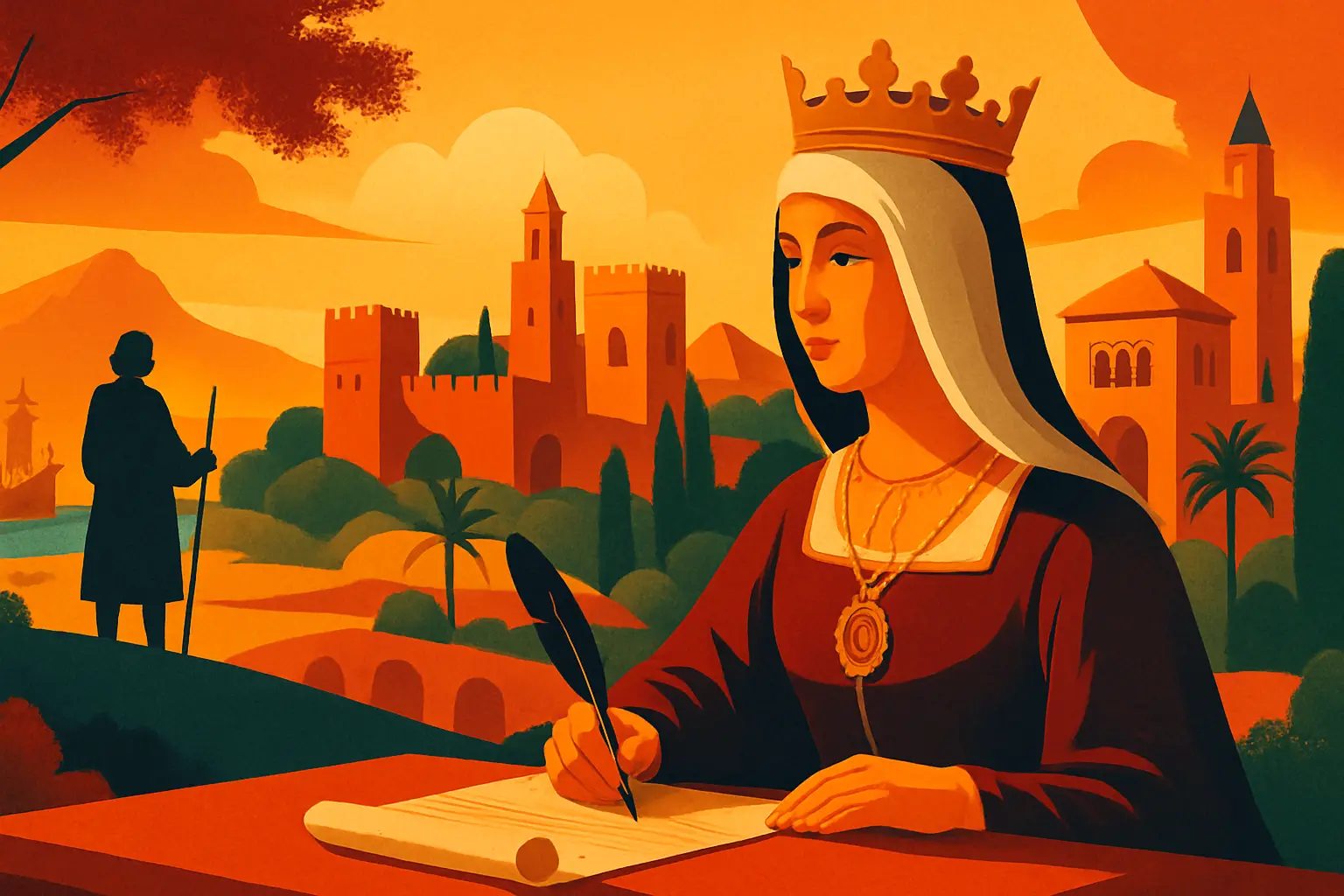
When Isabella was born on April 22, 1451, in Madrigal de las Altas Torres, a small Castilian town in present-day Ávila province, the idea that she would rule anything seemed remote. She was the daughter of King John II of Castile and his second wife, Isabella of Portugal, but her half-brother Henry IV held the throne and had a daughter of his own, Juana, who was the official heir. Isabella spent much of her childhood in relative obscurity, raised in the town of Arévalo with her mother and younger brother Alfonso.
Castile in the 1460s was in genuine political meltdown. Henry IV was a weak king whose authority had been so thoroughly eroded that a faction of Castilian nobles staged the theatrical Farsa de Ávila in 1465 — a mock ceremony in which they deposed a puppet effigy of Henry and proclaimed Isabella's brother Alfonso as king instead. When Alfonso died of plague in 1468, the rebel nobles turned to Isabella. She was 17 years old.
Rather than accept the crown outright and trigger a full civil war, Isabella made a politically shrewd calculation: she recognized Henry as king while extracting his acknowledgment that she, not Juana, was the legitimate heir to Castile. This agreement, formalized in the Treaty of Toros de Guisando in September 1468, gave her the legal standing she needed without forcing a military confrontation she might lose.
She then moved fast on the question of marriage. Henry wanted her to wed Alfonso V of Portugal, a union that would have neutralized her political independence. Isabella rejected him and secretly negotiated her own match with Ferdinand of Aragon — a choice her half-brother never formally approved. They married on October 19, 1469, in Valladolid, in what was essentially a political elopement. The marriage certificate included a forged papal dispensation (they were second cousins and required church approval). Isabella was 18. The audacity of that single act tells you almost everything you need to know about her.
When Henry IV died in December 1474, Isabella proclaimed herself Queen of Castile in Segovia immediately — before Ferdinand could make any competing claim. She was the senior monarch. Ferdinand would have to accept that, and eventually, he did.
Modern Spain traces its origins not to a single founding moment but to the slow institutional construction that Isabella and Ferdinand carried out between 1474 and 1504. When they came to power, the Iberian Peninsula was a mosaic of competing kingdoms, semi-autonomous city-states, and powerful noble families who operated their own private armies and courts. The Catholic Monarchs dismantled this feudal structure with systematic efficiency.
Their most transformative domestic policy was the reform of the Santa Hermandad, a network of rural constabularies that had existed in a disorganized form since the 13th century. Isabella reorganized it in 1476 into a funded, centralized police force with jurisdiction across Castile — effectively creating Spain's first national law enforcement body. Noble families who had grown accustomed to running their own fiefdoms without interference suddenly found royal officers enforcing crown law on their lands.
She simultaneously overhauled the Royal Council (Consejo Real), shifting its composition from high-born nobles to trained letrados — university-educated lawyers and administrators from lesser noble and middle-class backgrounds. This was radical. Governance became a meritocratic bureaucracy rather than an aristocratic club, and it gave Isabella a machinery of state that was loyal to the crown rather than to rival magnates.
The legal legacy is equally significant. Under her patronage, jurist Alfonso Díaz de Montalvo compiled the Ordenanzas Reales de Castilla in 1484, the first systematic codification of Castilian law. This replaced centuries of fragmented regional customs and royal decrees with a coherent legal framework. Scholars of Spanish legal history consider it as significant a document as the Siete Partidas of Alfonso X.
Isabella also centralized control over the powerful military orders — Santiago, Calatrava, and Alcántara — by having Ferdinand appointed as their Grand Master. These orders controlled vast landholdings and private armies. Absorbing them into the crown's authority removed the single greatest threat to royal power in Castile.
For travelers, the city of Segovia offers the most legible physical record of this centralization. The Alcázar of Segovia served as a key administrative center and royal treasure vault during Isabella's reign. The nearby Church of San Martín and the city's Roman aqueduct — which Isabella used as a backdrop for public ceremonies — together create one of the most evocative medieval streetscapes in Spain. Visit the Alcázar's Hall of Kings, where the painted wooden statues of Castilian monarchs culminating in Isabella were installed as deliberate dynastic propaganda.
No aspect of Isabella's legacy provokes more debate than the Spanish Inquisition, which she and Ferdinand formally established by papal bull in 1478. The popular image — black-robed inquisitors, elaborate torture chambers, mass burnings — owes more to 16th-century Protestant propaganda and later Gothic mythology than to the institution Isabella actually created. The historical reality is both less theatrical and, in its bureaucratic systematization of religious persecution, arguably more disturbing.
The Inquisition was initially directed not at Muslims or Jews but at conversos — Jewish and Muslim converts to Christianity who were suspected of secretly practicing their old faiths. By the 1470s, conversos occupied significant positions in Castilian society, including in the church hierarchy and the royal court itself. Old-Christian Spaniards resented their influence and questioned the sincerity of their conversions. Isabella shared those suspicions.
The institution she created operated under crown control, not papal control — a crucial distinction. Tomás de Torquemada, the first Inquisitor General, appointed in 1483, was Isabella's own confessor. He established standardized procedures: denunciation, arrest, interrogation (with torture permitted under specific legal constraints), and sentencing at public ceremonies called autos de fe. Death sentences — burning at the stake — were carried out by secular authorities, not the church itself.
Modern historians, drawing on the Inquisition's own meticulous records (now held largely in the Archivo Histórico Nacional in Madrid), have revised the death toll significantly downward from the millions once claimed. Henry Charles Lea's 19th-century estimates and later work by Henry Kamen suggest that roughly 3,000–5,000 people were executed over the institution's 350-year existence — still an enormous number of state-sanctioned murders, but far fewer than the millions of popular imagination.
The Expulsion of the Jews in 1492, codified in the Alhambra Decree signed in the very palace from which Granada's Muslim rulers had just been evicted, was a separate but related act. Around 200,000 Sephardic Jews were given four months to convert or leave. Many settled in the Ottoman Empire, North Africa, and the Netherlands. Their descendants — Sephardim — maintained Ladino, a form of medieval Castilian Spanish, as a spoken language in communities from Istanbul to Thessaloniki until the 20th century.
You can engage directly with this history in Madrid at the Archivo Histórico Nacional (Calle Serrano 115, open Monday–Friday 8 AM–3 PM, free admission), which holds original Inquisition trial records and is open to the public for research visits.
The standard telling of Christopher Columbus's appeal to Isabella portrays a visionary sailor repeatedly rejected by closed-minded advisors until a sympathetic queen bet on him. The reality is considerably more complicated — and reveals Isabella as a far more calculating patron than the romantic myth allows.
Christopher Columbus first presented his plan to reach Asia by sailing west to the Portuguese court in 1485. They rejected him. He arrived in Castile in 1486 and presented his case to Isabella, who referred him to a royal commission of scholars and navigators. That commission, meeting in Salamanca, rejected his proposal — not because they thought the earth was flat (educated Europeans had known it was spherical since antiquity), but because they correctly calculated that Columbus had dramatically underestimated the earth's circumference. Asia was far more distant than he claimed.
Isabella did not immediately override this expert opinion. Columbus spent years at the Spanish court in a state of limbo, his project neither formally approved nor definitively rejected. The fall of Granada in January 1492 changed the calculus. With the Reconquista complete, Isabella and Ferdinand had both the resources and the political momentum to take on a speculative venture. When Columbus was finally leaving the court in frustration after yet another rejection, it was Luis de Santángel — the royal treasurer, himself a converso — who argued the case to Isabella and offered financing from the crown's own funds and private Aragonese investors.
The Capitulations of Santa Fe, signed in April 1492 near Granada, gave Columbus extraordinary terms: he would be Admiral of the Ocean Sea, Viceroy of any lands he discovered, and entitled to ten percent of all revenues. Isabella was effectively creating a new feudal lordship in territories that didn't yet exist on any map.
When Columbus returned in March 1493 with gold, parrots, and several Taíno people he had taken aboard, Isabella's response was immediate and territorial. She secured the Treaty of Tordesillas with Portugal in 1494, dividing the non-European world between the two crowns along a meridian 370 leagues west of the Cape Verde Islands. This agreement, brokered with papal assistance, defined the colonial geography of the next two centuries.
For a physical connection to this history, the Archive of the Indies (Archivo General de Indias) in Seville — housed in the 16th-century Casa Lonja de Mercaderes on Avenida de la Constitución — holds the original Capitulations document and millions of pages of colonial records. Free admission, open Monday–Saturday 9 AM–4 PM.
The Isabella of popular imagination is a crusader and an inquisitor. The Isabella of cultural history is something more nuanced: one of the most significant art patrons of the 15th century, a woman who brought the Northern Renaissance to Spain at a moment when most of the peninsula's elite still preferred Gothic tradition.
Her personal art collection, visible today in the Capilla Real museum in Granada, is stunning in its specificity. She owned works by Rogier van der Weyden, Hans Memling, and Dirk Bouts — Flemish masters whose psychological realism and luminous color she clearly preferred to the more formal Italian style then fashionable in Naples and Rome. Her Book of Hours, still held in the collection, is illuminated with portraits of the royal family that function almost as a private photo album.
She was also a serious patron of Spanish scholarship. In 1508, she had already supported the founding of the University of Alcalá de Henares (though it formally opened four years after her death under Cardinal Cisneros, whom she appointed Archbishop of Toledo). Alcalá would produce the Complutensian Polyglot Bible — the first critical edition of the Bible in multiple languages, including Hebrew, Greek, and Latin — a landmark of Renaissance humanism.
Her court attracted Antonio de Nebrija, who published the first grammar of a modern European vernacular language, the Gramática de la lengua castellana, in 1492 — the same year as Columbus's voyage. When Nebrija presented it to Isabella and explained that language was the instrument of empire, she reportedly understood immediately what he meant.
Isabella commissioned the Isabelline Gothic style — a distinctly Spanish architectural fusion of Gothic structure with elaborate Mudéjar and Renaissance surface ornament — seen most vividly at the Monastery of San Juan de los Reyes in Toledo (Calle Reyes Católicos 17; ~$3.50 USD), which she built to commemorate the 1476 Battle of Toro. Walk the upper cloister and look at the exterior walls: the chains hanging there were placed by Isabella to honor Christian captives freed from Muslim Granada. It is simultaneously a monument to artistic refinement and religious triumphalism, which is about as Isabella as it gets.
Isabella spent the final years of her life watching her carefully constructed dynastic project collapse around her. She had five children, and she had arranged marriages for each of them as part of a coordinated European alliance strategy. By 1504, four of them were dead or incapacitated.
Her eldest daughter and designated heir, also named Isabella, died in 1498 giving birth to a son, Miguel, who himself died two years later. Her only son, Juan, died in 1497, just months after his marriage to Margaret of Austria — probably of tuberculosis, though rumors of sexual excess circulated widely. Her daughter Catalina — known to English history as Catherine of Aragon — had been sent to England to marry Arthur, Prince of Wales, who died in 1502, leaving her stranded at the English court.
The daughter who survived to inherit Castile was Juana, and Juana was descending into a mental illness severe enough that contemporaries called her Juana la Loca — Juana the Mad. Modern historians debate the diagnosis: some see schizophrenia or severe depression, others argue that her behavior was a rational response to being systematically stripped of power by her husband Philip I of Burgundy and later her own son Charles I (the future Holy Roman Emperor Charles V). Whatever the cause, Isabella recognized by 1503 that Juana was not capable of governing.
Isabella died on November 26, 1504, in Medina del Campo, in the Castillo de la Mota. She was 53. Her will, a remarkable document preserved in the Archivo General de Simancas near Valladolid, asked that her funeral be simple and inexpensive, and that the money saved be given to fund the redemption of Christian captives in North Africa. She also asked to be buried in Granada — in the city that represented the completion of the Reconquista — rather than in any of Castile's traditional royal burial sites. That wish was honored. The Capilla Real in Granada was built specifically for her.
Ferdinand remarried within a year of her death. By the terms of Isabella's will, he lost governance of Castile. He never entirely recovered his political footing. The unified Spain she had built was real — but it was always, first and fundamentally, her creation.
Isabella's reign left a denser physical imprint on Spain than almost any other monarch's. The sites below are organized by city and represent the most historically significant and visitor-accessible locations. Spain's major cities all have efficient public transit; for travel between Segovia, Toledo, and Granada, the RENFE rail network is the most practical option.
Granada is the essential destination. The Capilla Real (Royal Chapel) is where Isabella and Ferdinand are buried, and where her personal art collection and regalia are displayed. Plan at least 90 minutes. The adjacent Granada Cathedral is worth a brief visit for architectural context — its Renaissance nave was begun during Ferdinand's regency, a deliberate stylistic shift from the Gothic chapel Isabella had chosen for her own tomb.
Toledo offers the Monastery of San Juan de los Reyes, built by Isabella after the Battle of Toro, and the broader cityscape of a place that embodied the convivencia — the coexistence of Christian, Muslim, and Jewish communities — that the Catholic Monarchs ultimately ended. The Sinagoga del Tránsito (Calle Samuel Leví, s/n; ~$3.50 USD) was built in 1357 and is now the Sephardic Museum, directly addressing the Jewish community expelled under Isabella's 1492 decree.
Segovia holds the Alcázar where Isabella was proclaimed queen in 1474. The throne room and the Hall of Kings are the primary historical attractions.
Salamanca is where the royal commission evaluated Columbus's proposal and where Isabella supported humanist scholarship. The University of Salamanca (founded 1218) is the oldest university in the Hispanic world; the 15th-century facade features a portrait traditionally identified as the Catholic Monarchs.
Capilla Real, Granada — Calle Oficios s/n. Admission ~$7 USD. Mon–Sat 10:15 AM–6:30 PM, Sun 11 AM–6 PM.
Alcázar of Segovia — Plaza Reina Victoria Eugenia s/n. Admission ~$12 USD (tower extra). Daily 10 AM–6 PM (7 PM in summer).
Monastery of San Juan de los Reyes, Toledo — Calle Reyes Católicos 17. Admission ~$3.50 USD. Daily 10 AM–6:45 PM.
Sinagoga del Tránsito / Sephardic Museum, Toledo — Calle Samuel Leví s/n. Admission ~$3.50 USD. Tue–Sat 9:30 AM–7:30 PM, Sun 10 AM–3 PM.
Archivo General de Indias, Seville — Avenida de la Constitución s/n. Free. Mon–Sat 9 AM–4 PM.
Archivo Histórico Nacional, Madrid — Calle Serrano 115. Free. Mon–Fri 8 AM–3 PM.
University of Salamanca facade — Plaza de Anaya s/n. Exterior viewing free at all hours; university museum admission ~$4 USD.