The Camino Francés: A Practical First-Timer's Guide to the 780km Walk from the Pyrenees to Santiago
Here is the counterintuitive truth about the **Camino de Santiago**: the hardest part is not the 780 kilometers. It is Day Two. By then the initial adrenaline has dissolved, your feet have registered their first real complaints, and the Meseta — the vast, flat, sun-hammered plateau of central Castile — is still weeks away. More than 350,000 pilgrims registered a *compostela* (the completion certificate) at the **Pilgrim Reception Office** in Santiago de Compostela in 2024 alone, and yet surveys consistently show that roughly one in five walkers who begin the Camino Francés in **Saint-Jean-Pied-de-Port** do not finish. This guide exists to put you in the majority. It covers the essential stages of the French Route, how to obtain and use the *credencial del peregrino*, what albergue culture actually looks like at 6 a.m., the clinical reality of blister management, and — perhaps most usefully — the emotional architecture of a five-to-six-week walk that rewires how you think about pace, silence, and arrival. Whether you are motivated by faith, fitness, or simple curiosity about one of the oldest pilgrimage traditions in the Western world, the logistics here are the same. Start with good information.
🇪🇸 Short stories • Collectible cards • Learn as you travel
Pick up the *credencial del peregrino* (pilgrim passport) at the **Pilgrim Office in Saint-Jean-Pied-de-Port** (Rue de la Citadelle 39, open daily 7:30 a.m.–noon and 1–7:30 p.m. in summer) or request one in advance from your national pilgrimage association. The cost is approximately $1–$2 USD. Without it, you cannot stay in most municipal albergues and cannot receive the compostela at the end. Collect at least two stamps per day once inside Galicia.
Book the first two nights only
Reserve albergue beds in Saint-Jean-Pied-de-Port and Roncesvalles before you leave home — these fill by April for summer walkers. After Pamplona the trail opens up and spontaneous walking becomes possible, though the stretch between Burgos and León can surprise you with packed albergues in July and August. Apps like **Gronze** and **Buen Camino** show real-time availability for approximately $4–$10 per night in municipal albergues, up to $25–$40 in private ones.
Ship your heavy pack forward
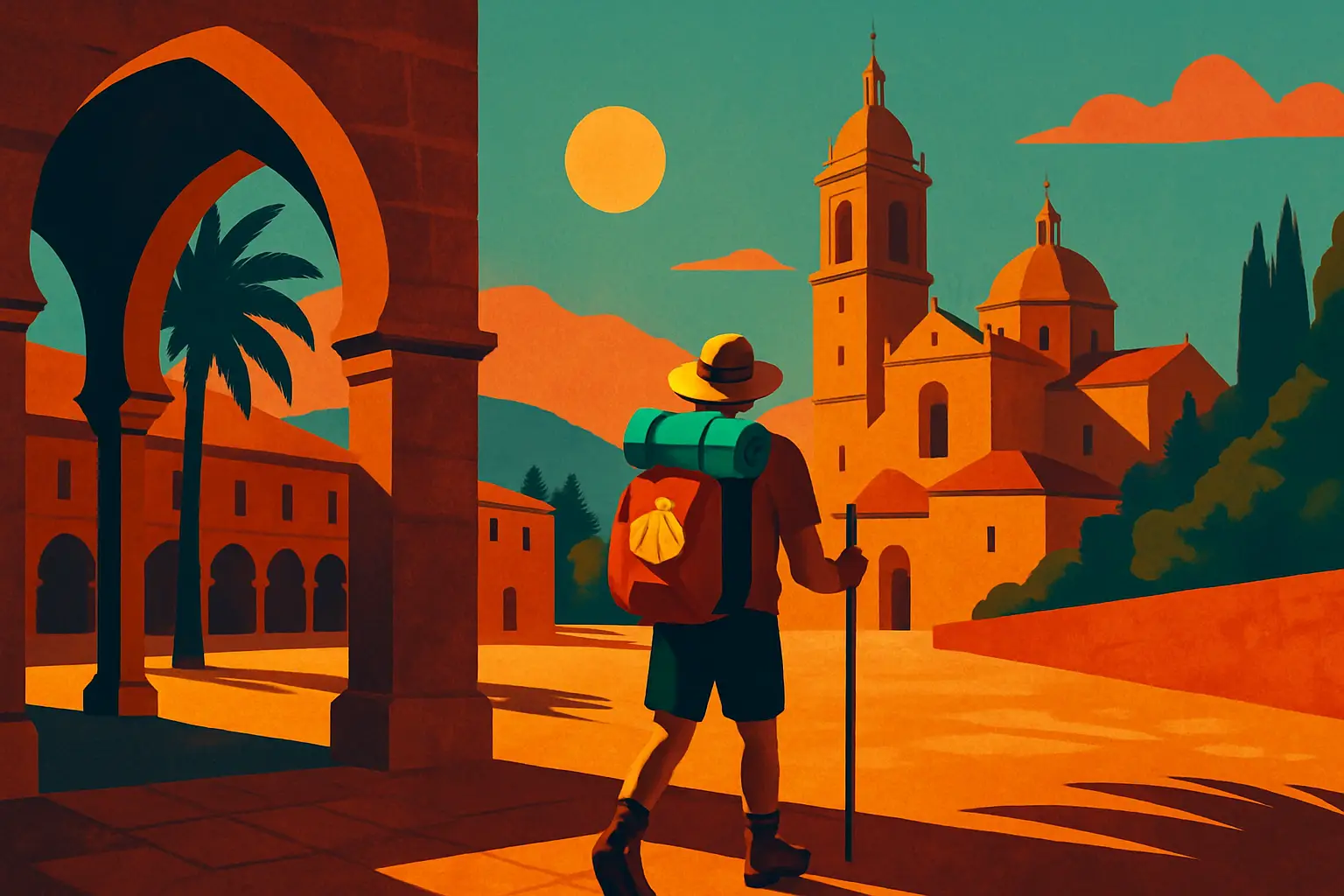
The **Correos** (Spanish postal service) and private companies like **Jacotrans** offer bag-transfer services along the entire Camino Francés for roughly $7–$12 USD per stage. Leave your bag at your albergue reception by 8 a.m. and it arrives at your destination albergue by early afternoon. Use this strategically on the Day One climb over the **Pyrenean Napoleon Route** from Saint-Jean to Roncesvalles — 1,400 meters of elevation gain with a full pack is how injuries happen on the first day.
The complete Camino Francés pilgrimage guide
1Why a thousand years of walkers chose this particular road
The Camino de Santiago — literally the Way of Saint James — traces its modern form to the ninth century, when a hermit named Pelayo reportedly discovered a tomb in the remote northwestern corner of the Iberian Peninsula that church authorities identified as the remains of Saint James the Apostle (Santiago in Spanish). King Alfonso II of Asturias ordered the construction of a chapel over the site around 830 CE, a structure that would eventually become the magnificent Cathedral of Santiago de Compostela still standing today. The timing was not incidental: the discovery of a major apostolic relic gave the embattled Christian kingdoms of northern Iberia a spiritual focal point and a propaganda tool during the *Reconquista*, the centuries-long military and political campaign to reclaim the peninsula from Moorish rule.
The Camino Francés — the French Route — emerged as the dominant pilgrimage road by the twelfth century, formalized in the *Codex Calixtinus*, a remarkable illustrated manuscript compiled around 1140 that functioned as the world's first pilgrimage guidebook. It described the route from the French side of the Pyrenees through Pamplona, Burgos, León, and into Galicia, naming hospices, warning of bad water sources, and even rating the local populations for friendliness. At its medieval peak, the Camino attracted an estimated half a million pilgrims annually from across Europe, making it one of the largest organized mass movements of people in the pre-modern world.
The modern revival began quietly in the 1980s, accelerated by Paulo Coelho's 1987 memoir *The Pilgrimage*, and exploded after Santiago de Compostela was named a European Capital of Culture in 1985 and a UNESCO World Heritage Site in 1993. Today the route is simultaneously an ancient sacred path, a long-distance hiking trail, a sociological experiment in enforced slowness, and — in peak summer — something uncomfortably close to an outdoor hostel chain. Understanding this layered history helps you decide which version of the Camino you want to walk.
2The stages that will break you and the ones that will save you
The 780-kilometer Camino Francés is conventionally divided into 33 stages, though most first-timers adapt the pace to somewhere between 28 and 38 walking days depending on fitness and temperament. The standard guidebook — John Brierley's *A Pilgrim's Guide to the Camino de Santiago*, revised annually and available for about $18 USD — maps each stage with elevation profiles, albergue locations, and distances to the nearest café. It is imperfect but indispensable.
Stage 1 (Saint-Jean-Pied-de-Port to Roncesvalles, 25km): The Napoleon Route over the Pyrenees climbs to 1,430 meters and descends steeply into the Spanish monastery village of Roncesvalles. In poor weather, the Pilgrim Office in Saint-Jean will redirect you to the lower Valcarlos alternative route. Do not ignore this advice. Two to three walkers require mountain rescue on this stage every season.
Stages 3–5 (Pamplona to Logroño, ~80km total): This stretch through Navarre and into La Rioja offers the route's most varied early scenery — medieval bridges, the famous Puente la Reina (a Romanesque bridge built in the eleventh century specifically for pilgrims), wine country, and the Bodega Irache at Ayegui, which has dispensed free wine from a public fountain since 1991. It remains operational, pouring roughly 100 liters of Navarra red daily.
The Meseta (Burgos to León, ~180km): This is the section that ends pilgrimages. The central plateau of Castile offers almost no shade, villages separated by 15 to 20 kilometers of wheat fields, and temperatures that regularly exceed 38°C (100°F) in July and August. It is also, for many experienced pilgrims, the section they remember most vividly — precisely because there is nothing to look at but your own thoughts.
O Cebreiro to Santiago (160km): The final Galician section begins with the brutal climb to the mountain pass at O Cebreiro (1,293 meters) and descends into a landscape of granite villages, eucalyptus forests, and near-constant drizzle. The last 100 kilometers from Sarria — the minimum distance required to earn the compostela — draw large numbers of walkers who join specifically for the certificate, which can create crowding on an otherwise intimate final approach.
Day 1: Saint-Jean-Pied-de-Port → Roncesvalles (25km, 1,430m elevation gain — the hardest day per kilometer)
Day 6: Pamplona → Puente la Reina (24km, wine fountain at Bodega Irache, Ayegui)
Days 12–17: Burgos → León (180km across the Meseta — start before 7 a.m. to beat the heat)
Day 28 approx: Sarria → start of final 100km minimum for compostela eligibility
Day 33 approx: Arrival at the **Praza do Obradoiro**, Santiago de Compostela
3The credencial del peregrino: what it is, how it works, and why you need two stamps in Galicia
The *credencial del peregrino* is a folded cardboard document — roughly the size of a passport when folded — that functions simultaneously as your access card to pilgrim-priced accommodation, your proof of pilgrimage, and an accumulating record of your journey. Each stop along the way offers a *sello* (stamp): churches, albergues, bars, town halls, and even some pharmacies maintain rubber stamps specifically for pilgrims. By the time you reach Santiago, a well-traveled credencial is a dense, colorful archive of where you slept and ate and sheltered from rain.
You can obtain the credencial in several ways:
- At the Pilgrim Office in Saint-Jean-Pied-de-Port (Rue de la Citadelle 39)
- From your national Confraternity of Saint James (the UK, US, Canadian, and Australian confraternities all issue them by post for a small fee)
- At the Cathedral of Santiago itself, or at affiliated pilgrim offices in Pamplona, Burgos, and León, if you are joining mid-route
The stamp-per-day rule is straightforward everywhere except Galicia, where the Pilgrim Reception Office requires a minimum of two stamps per day for the final 100 kilometers (from Sarria onward). This rule exists because the Sarria-to-Santiago section became so popular with certificate seekers that the office needed a way to verify continuous walking rather than a single long day's march at the end.
To collect the compostela — the Latin-language certificate awarded upon completion — you must present your credencial at the Oficina del Peregrino (Rúa Carretas 33, Santiago de Compostela, open daily 9 a.m.–7 p.m., extended hours in July and August). Staff will review your stamps, ask about your starting point and motivation, and issue the certificate with your name written in Latin. The process takes roughly 20 to 45 minutes during busy periods. There is no charge. If you walked for primarily secular reasons, you can request a *certificado de distancia* instead, which acknowledges the distance without the religious framing.
Keep touring
Discover more about Spain in minutes
Get short, interactive stories that make each place easier to remember while you travel.
4Albergue culture: the unwritten rules every first-timer breaks on night one
The albergue (pilgrim hostel) is the social engine of the Camino, and understanding its culture will determine whether you sleep six hours or four. Most municipal albergues operate on a first-come, first-served basis with a check-in window that typically opens at 1 or 2 p.m. Private albergues (sometimes called *albergues privados* or *hostales peregrinos*) allow advance reservations and often offer smaller dorm rooms, better bathrooms, and breakfast for an additional $4–$7 USD.
The morning protocol is non-negotiable by community consensus: lights go out between 10 and 10:30 p.m. and albergues eject guests between 6 and 8 a.m. The logic is survival — if you leave by 6:30, you walk 10 kilometers before the sun becomes dangerous in summer. What the guidebooks do not prepare you for is the noise architecture of a 60-bed dormitory: the crinkle of mylar sleeping bag liners, the industrial drone of someone else's snoring, headlamps clicking on at 5:45 a.m., the particular percussion of hiking poles being assembled in the dark.
Practical survival tactics that experienced pilgrims actually use:
- Bring foam earplugs, not silicone — they compress smaller and block more low-frequency snoring
- Pack your bag the night before, placing tomorrow's clothes in the top pocket so you can dress outside the dorm
- Choose a lower bunk near the bathroom only if you wake frequently at night; otherwise, upper bunks near windows tend to be cooler and quieter
- The *hospitalero* (albergue host) is not hotel staff — they are often volunteers or former pilgrims. Treat them accordingly
- Shoes are left outside dorm rooms universally; do not bring them inside
The communal pilgrim dinner (*menú del peregrino*), offered at most albergues and adjacent restaurants for $12–$18 USD including wine, is where the Camino's social fabric is woven. These three-course meals with shared tables regularly produce conversations — and sometimes friendships — that outlast the walk itself. The first course is almost always soup or salad. The second is almost always chicken or pork. The wine arrives in a ceramic *porrón* and is bottomless. Order water alongside it.
5Blisters, knees, and the 80% rule: what podiatrists and experienced pilgrims actually recommend
The blister is the Camino's most democratic affliction. Experienced marathon runners get them. People in $300 trail runners get them. The difference between a blister that costs you two hours and one that ends your Camino usually comes down to decisions made in the first three days.
Prevention is the only cure that works. Podiatrists who specialize in long-distance walking — including those who staff the volunteer medical stations in Pamplona (at the Albergue de Jesús y María, Calle Compañía 4) and Burgos — consistently recommend the same protocol: two layers of socks (a thin liner sock beneath a merino wool walking sock), Vaseline or Bodyglide applied to all friction points before lacing up, and immediate attention to any hot spot. A hot spot is a blister that has not yet formed. Stop, remove the shoe, and apply Compeed (a hydrocolloid blister plaster available at every Spanish pharmacy, *farmacia*, for about $6–$9 per packet). Do not wait until you reach the albergue.
For walkers who develop blisters despite precautions — which is most walkers — the standard field treatment involves draining the blister with a sterilized needle, threading a length of cotton thread through the base to allow continued drainage, and covering with Compeed. This sounds medieval because it partly is, but it works well enough that volunteer nurses at Camino medical stations teach it routinely.
Knee pain is the second most common reason walkers abandon the Camino, and it is almost always preventable. Trekking poles reduce impact force on descents by roughly 25% according to studies cited by the German Sport University Cologne. Adjust them so your elbow bends at 90 degrees on flat ground and shorten them slightly on uphills, lengthen on descents. The Pyrenean descent into Roncesvalles and the drop from O Cebreiro into Galicia are where knee injuries concentrate — shorten your stride, keep your weight slightly back, and use your poles.
The 80% rule, articulated by ultramarathon coaches and adopted widely among experienced Camino walkers: walk at 80% of your comfortable pace for the first week. Your body is adapting to daily cumulative load, and the damage done in days 3 through 7 often does not manifest as pain until day 14. Arriving 20 minutes later at an albergue is irrelevant. Arriving at all is everything.
6The emotional reality: what happens to your mind over 780 kilometers
No guidebook section on the Camino's psychological dimension fully prepares you, but ignoring it entirely would be a disservice. The evidence from survey research — including a 2019 study published in the *Journal of Experiential Education* that tracked 200 pilgrims over a full Francés walk — consistently shows that most walkers experience a recognizable emotional arc: initial euphoria (days 1–5), physical crisis and doubt (days 6–15), adaptation and deepening social connection (days 16–28), and an often overwhelming final approach (days 29–33).
The Meseta, the central plateau section between Burgos and León, functions as a kind of enforced meditation retreat. With little external stimulus, many walkers find themselves processing memories, relationships, and decisions with unusual clarity. The Spanish philosopher José Ortega y Gasset wrote that authentic selfhood requires *meditatio vitae* — contemplation of one's life — and the Meseta delivers it whether or not you requested it. Some walkers find this uncomfortable enough to take a bus through it. Experienced pilgrims almost universally say this is a mistake.
The arrival in Santiago is genuinely complicated. After weeks of purposeful motion, standing still in the Praza do Obradoiro in front of the cathedral's baroque facade can produce feelings that range from transcendence to anticlimax to flat emotional exhaustion. The Pilgrim Mass celebrated daily at noon in the cathedral (free entry, arrive 45 minutes early) provides structure to the arrival that many walkers find helpful — it marks the end of the journey collectively rather than leaving you alone with your accomplishment.
Perhaps the most practically useful thing to know: plan at least two nights in Santiago before traveling onward. The city — compact, granite-gray, genuinely beautiful — rewards slow exploration. The Mercado de Abastos (Rúa das Ameas, open Tuesday–Saturday 8 a.m.–2 p.m.) sells the best Galician seafood in the city at market prices. The Museo das Peregrinacións e de Santiago (Praza das Praterías, open Tuesday–Sunday, approximately $2.50 USD) contextualizes everything you just walked through. And the rest does what it is supposed to do.
7When to go, what it costs, and the decisions that determine your experience
The Camino Francés can be walked year-round, but the experience varies so dramatically by season that timing is effectively a choice about which Camino you want to walk. The practical breakdown:
Season and conditions:
**May–June:** Best overall conditions. Wildflowers on the Meseta, manageable temperatures (15–25°C), moderate but not crushing crowds. Book the first three nights in advance.
**July–August:** Peak season. Albergues fill by early afternoon, Meseta temperatures exceed 35°C regularly, but the social energy is highest and the *menú del peregrino* culture is at full tilt. Budget an extra $5–$10/day for private rooms when you need recovery sleep.
**September–October:** Many experienced pilgrims consider this the ideal window. Harvest season in Rioja and Castile, cooling temperatures, fewer walkers than midsummer, but Galician rain begins in earnest by mid-October.
**November–March:** Possible but requires preparation. Some albergues close (Roncesvalles stays open year-round; many village albergues do not). Cold, wet, occasionally snowbound above O Cebreiro. Solitude is genuine and profound.
**April:** Weather is unpredictable and albergues are reopening after winter — excellent for experienced walkers, less forgiving for first-timers.
8Total budget, gear list, and the three things every first-timer overpacks
A realistic daily budget for the Camino Francés in 2025–2026 breaks down as follows, based on staying primarily in municipal albergues and eating one *menú del peregrino* per day:
Daily costs (approximate USD):
Municipal albergue: $8–$12 per night
Private albergue or pilgrim hostel: $22–$40 per night
Menú del peregrino (3 courses + wine): $12–$18
Breakfast (café con leche + *tostada con tomate*): $3–$5 at any bar on route
Snacks, water, pharmacies: $5–$10 per day
Total daily average (municipal albergues): $30–$50 USD
Total daily average (mix of private and municipal): $55–$80 USD
Full 33-day Camino Francés total: approximately $1,000–$2,600 USD excluding flights and gear
9The essential gear, and the three things every first-timer overpacks
The golden rule is that your fully loaded pack — including water and food — should weigh no more than 10% of your body weight. A 70kg (154 lb) person carries 7 kilograms maximum. Every experienced pilgrim you meet will have started heavier and progressively mailed things home. The Camino has a functioning economy built on this: post offices in Pamplona, Burgos, and León regularly process boxes of abandoned gear sent to walkers' home addresses.
The three most reliable overpacking mistakes:
1. Books. One paperback exchangeable at the many Camino book-swap boxes. A Kindle Paperwhite weighs 174 grams.
2. Too many clothes. You need two sets of walking clothes, one set of evening clothes, and that is genuinely it. Albergues have washing machines ($3–$4) and drying lines. Merino wool base layers dry overnight hanging indoors.
3. A full first-aid kit. Pharmacies (*farmacias*, identifiable by the green cross) appear in every town of more than 200 people along the route and stock Compeed, ibuprofen, blister needles, athletic tape, and everything else you might need. Carry only a small daily kit.
Non-negotiables that first-timers underpack:
- A rain cover for your pack (not a poncho alone — the pack gets wet first)
- Trekking poles (collapsible; Black Diamond or Leki are the standard)
- A sleeping bag liner (most albergues provide blankets but not always clean ones)
- Flip-flops for albergue showers and evening walks — your feet need to breathe
- Sunscreen SPF 50+ in larger quantities than you think (the Meseta is merciless)
For deeper context on the regions you will walk through — the medieval history of Burgos, the food culture of La Rioja, and the pre-Roman roots of Galician identity — the TourMe guide to Galicia's culture and history is a useful companion to read before you lace up.
Keep touring
Ready to walk the Camino — but want the history to make sense as you go?
TourMe's Spain content brings the Camino's cultural and historical layers to life with short narrative stories, collectible destination cards, and interactive chapters covering everything from the medieval origins of Santiago de Compostela to the Roman roads beneath your feet on the Meseta. Download the app before you leave Saint-Jean-Pied-de-Port and let the route teach you as you walk it.