El Prado's Five Most Important Paintings — and What They're Actually Saying
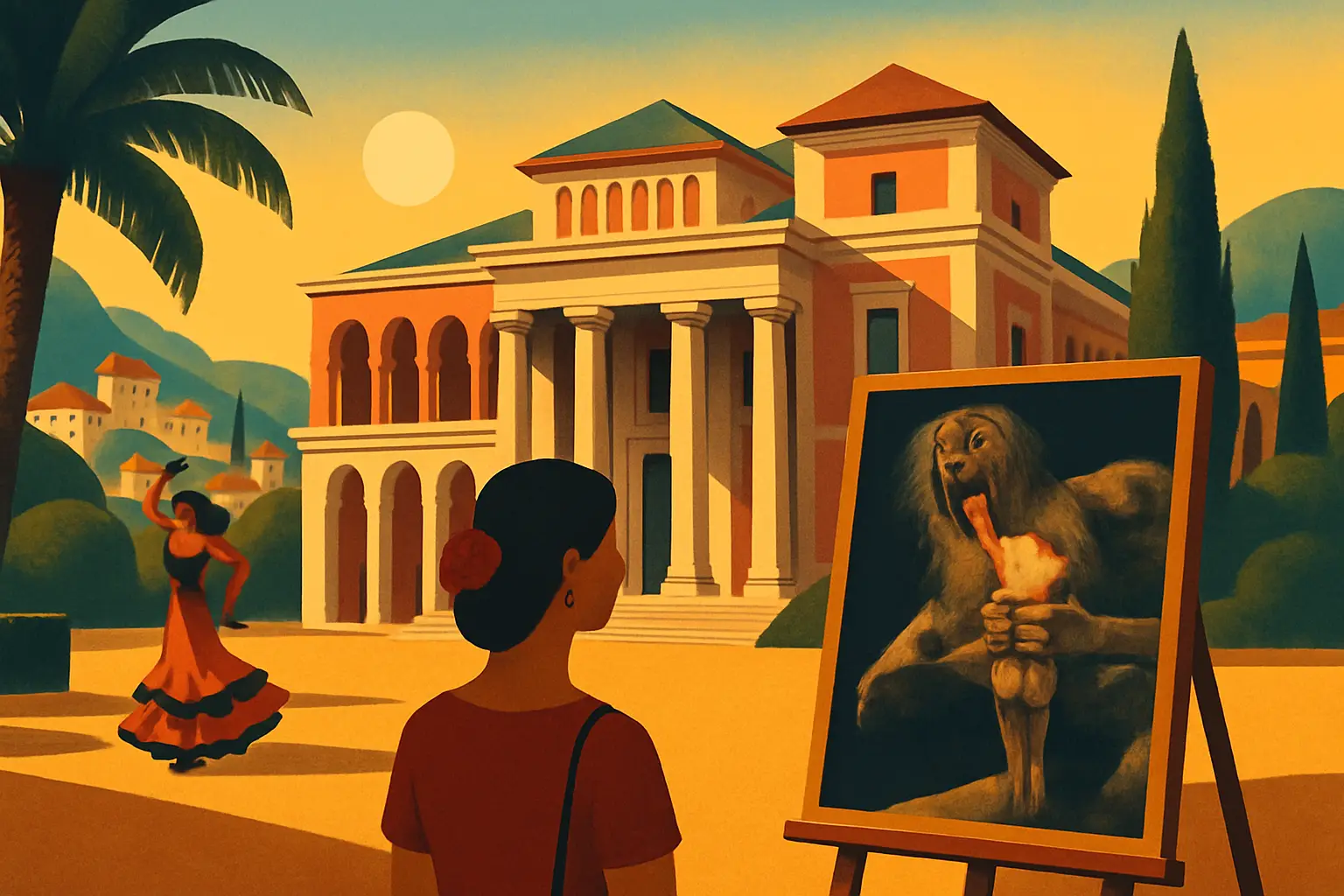
Francisco Goya painted Saturn Devouring His Son directly onto the plaster walls of his own house. He never intended it for public display. The canvas you stand in front of at the Prado today exists only because a later owner had the frescoes painstakingly transferred to canvas in the 1870s — and even that process left the image slightly distorted, which is part of why Saturn's eyes look so grotesquely wide. Most visitors don't know any of this when they walk into Room 67. They see a horrifying giant consuming a limp body and move on in thirty seconds. That's the tragedy of visiting a great museum without context. El Prado holds the single largest collection of Spanish painting in the world — roughly 8,200 works, with about 1,300 on permanent display at any time. Inside those galleries hang paintings that encode royal propaganda, personal psychological breakdown, heretical theology, and imperial anxiety. This guide focuses on five works that reward extended looking: Las Meninas, The Garden of Earthly Delights, Saturn Devouring His Son, The Third of May 1808, and The Triumph of Death — with enough historical and symbolic context that you'll never look at them the same way again.
🇪🇸 Short stories • Collectible cards • Learn as you travel
El Prado (Calle de Ruiz de Alarcón 23, Madrid) sells timed-entry tickets online at museodelprado.es. General admission is €15; free entry every day from 6–8 PM and all day on certain holidays including May 18 (International Museum Day). The free evening slot draws large crowds — if you want Las Meninas without a scrum, arrive at 10 AM on a weekday and go directly to Room 12 before tour groups arrive.
Use the audio guide strategically
The Prado's official multimedia guide (€6 at the information desk, or free via the Prado app on iOS/Android) covers all five works in this article. Download it before arriving so you're not draining mobile data inside the building. The app's 'Masterpieces' route runs roughly 90 minutes and hits Rooms 12, 56A, 57, 64, and 67 in a logical sequence that avoids doubling back through the crowded central galleries.
Plan around crowd patterns
The Prado's busiest hours are 11 AM–2 PM on weekends and any afternoon when cruise groups arrive from Toledo day-trips. Tuesday through Thursday mornings are consistently the quietest. The building maintains two main entrances — Puerta de Goya (ground floor) and Puerta de Velázquez (upper floor). For the five paintings in this guide, enter through Puerta de Velázquez to reach Las Meninas in Room 12 within two minutes of clearing the ticket check.
The complete El Prado masterworks guide
1Why the Prado exists — and why its collection is unlike any other in Europe
Most great European art museums were assembled through conquest, aristocratic bequest, or aggressive buying programs. The Louvre's core came largely from Napoleon's military campaigns. The British Museum was built on colonial extraction. El Museo Nacional del Prado has a different origin: it was always Spain's art, made for Spain's rulers, displayed in Spain's capital — and it almost didn't survive.
The museum opened on November 19, 1819, under King Ferdinand VII, who converted a neoclassical building originally designed by Juan de Villanueva as a natural sciences museum into a royal painting gallery. The initial collection comprised 311 works drawn from the Spanish royal collection, which had been accumulating since the reign of Charles I (also Holy Roman Emperor Charles V) in the early sixteenth century. Spanish kings didn't just collect art: they commissioned it as political infrastructure. Velázquez, Titian, Rubens, and Goya all worked in service of the Spanish crown, producing images that communicated dynastic power, religious authority, and imperial ambition.
The collection survived the Napoleonic occupation of Madrid (1808–1813) largely because French troops looted selectively — they took some works to Paris but left the bulk of the royal collection in place. During the Spanish Civil War (1936–1939), the Republican government evacuated 353 of the most vulnerable works to Valencia and then Geneva for safekeeping, returning them in 1939 after General Franco's victory.
What makes the Prado distinctive isn't just the quality of individual works — the Uffizi has comparable masterpieces — but the depth within specific national traditions. No museum on earth holds more Velázquez, more Goya, or more El Greco. The five paintings in this guide represent the full arc of Spanish and Spanish-adopted art from around 1500 to 1823, and together they tell a story about power, faith, madness, and resistance that no single painting can communicate alone.
2Las Meninas (1656): the painting that is also a trap
Diego Velázquez painted *Las Meninas* in 1656, the year before his death, and art historians have been arguing about what it actually depicts ever since. The surface reading is straightforward: the five-year-old Infanta Margarita stands in the center of a large studio, attended by her ladies-in-waiting (*meninas*), a chaperone, a bodyguard, two dwarfs, and a dog. Velázquez himself appears on the left, brush in hand, working on a large canvas whose face is hidden from us. In the background, a mirror reflects the blurred images of King Philip IV and his queen, Mariana of Austria.
The trap is the mirror. If the king and queen appear in the mirror, they must be standing where *we* are standing — in front of the canvas, posing for their portrait. Which means Velázquez is painting them. Which means *we* are the royal subjects. The painting has reversed the normal hierarchy of artist, patron, and viewer, placing the painter at the compositional center and the monarchs at the margins, blurred, reflected, reduced to background detail.
This was not accidental. Velázquez spent his career fighting for recognition as a nobleman rather than a craftsman — painting was considered a mechanical trade in seventeenth-century Spain, not a liberal art. *Las Meninas* is a sustained argument for the intellectual dignity of painting. Velázquez dressed himself in the painting in the habit of the Order of Santiago, a prestigious chivalric order. He wasn't actually admitted to that order until three years after the painting was completed; according to tradition, Philip IV himself added the red cross to the chest in the painting after Velázquez's death in 1660 as a posthumous honor.
Stand in Room 12 for at least ten minutes. Look at the light sources — the open door on the right, the two windows on the left. Velázquez uses nine distinct light zones in a single painting, a technical accomplishment that wouldn't be equaled until the age of photography.
Keep touring
Discover more about Spain in minutes
Get short, interactive stories that make each place easier to remember while you travel.
3The Garden of Earthly Delights (c.1490–1510): heresy, ecology, or hallucination?
Hieronymus Bosch was Dutch, not Spanish — born in 's-Hertogenbosch around 1450 — but his three-panel masterpiece *The Garden of Earthly Delights* has been in Spain since at least 1593, when it was recorded in the royal collection at El Escorial. Philip II acquired it and reportedly meditated on it frequently. Whether Philip saw it as a moral warning or something else entirely remains genuinely unclear.
The triptych, painted on oak panels with a combined width of roughly 389 cm when open, moves left to right through a theological narrative that is anything but orthodox. The left panel shows the Garden of Eden — recognizable enough, with God presenting Eve to Adam. The right panel is an unmistakable Hell, depicted as a frozen, musical-instrument-themed torture landscape, complete with a man being devoured by a bird-creature seated on a throne and a pair of human ears skewering themselves on a giant knife. The center panel — the titular Garden — is where Bosch loses (or finds) himself: an enormous landscape filled with hundreds of naked humans cavorting with giant fruit, fantastical birds, and strange transparent spheres.
The standard medieval interpretation reads the center as a warning against carnal sin — pleasure as a path to damnation. But Bosch's Hell is so inventive, so darkly funny, that it reads more like fascination than condemnation. A 2014 analysis by musicologists at the University of Oklahoma actually decoded the musical notation tattooed on a human buttock in the Hell panel — it's a real melody, now playable, sometimes called the 600-year-old butt song from Hell.
Bosch painted the exterior of the closed triptych in grisaille — grey monochrome — showing a transparent sphere containing a nascent Earth floating in darkness. It's one of the earliest depictions of the planet as a fragile, bounded object. When the panels are closed, that's all you see: a world alone in void, before everything goes wrong.
Find this in Room 56A, mounted so you can see both the open and the (reproduced) closed-panel configuration.
4The Third of May 1808 (1814): how Goya invented modern war photography
On May 2, 1808, the citizens of Madrid rose against the occupying French army of Napoleon in a spontaneous urban uprising. The French response the following day — mass executions of suspected insurgents on the slopes of Príncipe Pío hill, northwest of the royal palace — was documented by no journalist, photographed by no camera, and witnessed by very few civilians who survived to describe it.
Francisco Goya painted *The Third of May 1808* six years later, in 1814, after the French had been expelled and Ferdinand VII had been restored to the throne. Ferdinand commissioned the painting as political propaganda — a glorification of Spanish resistance. What Goya delivered was something far more ambiguous and far more powerful.
The painting measures 268 × 347 cm and is composed around a single blinding white lantern on the ground. That lantern illuminates the central figure — an anonymous man in a white shirt, arms flung wide, facing a firing squad whose faces we cannot see. The soldiers are rendered as a faceless, mechanical wall of identical dark forms and rifle barrels. The man about to die is individualized, terrified, and Christ-like. The men to his right waiting their turn display every stage of anticipated death: hands over eyes, faces buried in palms, bodies crumpling.
Goya invented the visual grammar that war photographers would use for the next two centuries: anonymous perpetrators, individualized victims, the geometry of industrial killing. Robert Capa's 1936 falling soldier photograph, Nick Ut's 1972 napalm girl image — they are all compositional descendants of this painting. The French soldiers' rifles point at exactly the angle that modern ballistic analyses confirm was used for kneeling executions.
You'll find it in Room 64, typically displayed opposite its companion piece, *The Second of May 1808*, which depicts the earlier street fighting. Together they form a before-and-after narrative about what resistance costs.
5Saturn Devouring His Son (1820–1823): Goya's private breakdown, painted on a wall
In 1819, Francisco Goya — then 73, recently recovered from a near-fatal illness, deaf since 1792, and living in voluntary exile from Madrid's court — purchased a two-story country house on the south bank of the Manzanares River. Locals called it the Quinta del Sordo: the House of the Deaf Man. Whether that name predated Goya's arrival or was applied to it because of him is disputed.
Goya decorated the interior walls of both floors with fourteen large oil murals — the works now collectively called the Black Paintings, none of which he titled, none of which he exhibited, and none of which he ever explained. The paintings are hallucinatory in their darkness: pilgrims crawling through fog, a dog's head emerging from sand, a witches' sabbath presided over by a goat. *Saturn Devouring His Son* — Room 67 in the Prado — is the most extreme.
The classical mythological reference is Saturn (Cronus), the Titan who, warned by prophecy that one of his children would overthrow him, consumed each one at birth. Goya paints the moment mid-consumption: a wild-eyed giant with white hair clutches a small human body (already missing a head in some interpretations, or mid-bite in others) with both hands. The detail that unsettles most is the knuckles — they are gripping so hard they have gone white, suggesting not just violence but desperate compulsion.
The transfer from wall to canvas, carried out by the restorer Salvador Martínez Cubells between 1874 and 1878, introduced some distortions. X-ray analyses conducted in the 1990s revealed that the original Saturn had a less agitated expression — calmer, more calculating — and that the figure below the waist was originally more clearly defined. The mania we see is partly Goya's, partly a hundred and fifty years of material degradation.
Goya died in Bordeaux in 1828 without returning to Spain. He never saw the Black Paintings removed from his walls.
6The Triumph of Death (c.1562): Bruegel's spreadsheet of human mortality
Pieter Bruegel the Elder painted *The Triumph of Death* in oil on panel around 1562, in Antwerp, during the period of Spanish Hapsburg control over the Low Countries. Like Bosch's triptych, it entered the Spanish royal collection early — recorded at El Escorial by 1574 — and its presence there reflects something genuine about how Philip II and his court related to images of mass mortality.
The painting's dimensions are relatively modest — 117 × 162 cm — but its visual ambition is staggering. An army of skeletons in various states of military formation advances across a scorched landscape, systematically exterminating every category of human being: kings, cardinals, soldiers, lovers, peasants, merchants. In the lower left, a skeleton king rides a pale horse over a sea of skulls. In the lower right, two lovers play music, apparently oblivious to the carnage surrounding them. Skeletons ring a bell. Skeletons push a cartload of skulls. Skeletons herd humans into a giant box-trap disguised as a cross.
Bruegel was working in the tradition of the Danse Macabre — the late medieval allegory of death as leveler, visiting every social class equally — but he operationalized it with Flemish merchant-class specificity. This is not an abstract death; it is death as logistics, death as industrial process. The painting was made during the early years of the Inquisition's intensification in the Low Countries, the period that would eventually produce the Dutch Revolt. Whether Bruegel intended a specifically political reading — the Spanish imperial machine as the skeleton army — or simply a universal meditation on mortality is a question that has never been settled.
In Room 57, hang this mentally beside Las Meninas and *The Third of May*: three paintings, spanning two centuries, all meditating on the relationship between power, violence, and the individuals crushed between them.
7Practical guide: how to plan your Prado visit around these five works
The five paintings in this guide are spread across four different rooms on two floors. A focused visit covering all five, with adequate time at each, requires approximately two and a half to three hours minimum. Below is the room sequence and practical information you need.
Address: Paseo del Prado s/n, 28014 Madrid. Nearest metro: Banco de España (Line 2) or Atocha (Lines 1 and 3), both roughly 8-minute walks.
Hours: Monday–Saturday 10 AM–8 PM; Sunday and public holidays 10 AM–7 PM. Closed January 1, May 1, and December 25.
Admission: General €15; reduced €7.50 (students under 25, over-65s with EU ID); free for under-18s. Free entry daily 6–8 PM and all day on May 18 and December 6.
Recommended entry point: Puerta de Velázquez (upper floor, facing Paseo del Prado). This puts you closest to Room 12 (Las Meninas) with minimal corridor navigation.
Room sequence for efficiency: Room 12 (Las Meninas) → Room 57 (Triumph of Death) → Room 56A (Garden of Earthly Delights) → Room 64 (Third of May 1808) → Room 67 (Saturn Devouring His Son). This route flows roughly clockwise through the Villanueva building and avoids backtracking.
Coat/bag check: Free luggage storage at the Puerta de Goya entrance; bags larger than 30 × 20 cm must be checked. Large backpacks are not permitted in the galleries.
Photography: Permitted without flash throughout the permanent collection. Tripods and selfie sticks are prohibited.
Official app: Free download (Museo Nacional del Prado) on iOS and Android. Pre-download the audio content for all five works before visiting — in-gallery Wi-Fi is unreliable.
Guided tours: The Prado's official English-language guided tours run Tuesday–Sunday at 11 AM and 4 PM, cost €5 plus museum admission, and typically cover Las Meninas and Saturn Devouring His Son. Book at museodelprado.es at least 48 hours ahead; they sell out.
On-site dining: The museum café, inside the Jerónimos building annex, serves decent sandwiches and coffee at approximately €4–8. For a proper meal, Restaurante El Brillante (opposite the Atocha entrance, Glorieta del Emperador Carlos V) has been feeding Prado visitors since 1952; their bocadillo de calamares runs about €4.50 and is worth the five-minute walk.
Keep touring
Ready to walk into the Prado knowing exactly what you're looking at?
TourMe's Spain collection includes dedicated story cards on Velázquez, Goya's Black Paintings, and the Flemish masters in the Spanish royal collection — each built as short, collectible chapters you can read before your visit or pull up while standing in front of the canvas. The interactive Prado chapter connects these five works to the broader history of Spanish imperial culture, so the paintings stop being isolated objects and start telling a single, continuous story.