In 1859, Barcelona was still constrained by medieval walls that the Spanish crown had refused to demolish for decades, partly as a political instrument of control over a restless Catalan population. When Madrid finally authorized expansion, the city commissioned civil engineer Ildefons Cerdà to design what would become one of the most influential urban plans in history. His Eixample — Catalan for 'extension' — was a rigorously rational grid of 113-meter-wide blocks, each with chamfered corners to ease traffic flow and interior courtyards originally mandated for light and air. Almost none of the courtyards survive as open green space (private development consumed them over the 20th century), but the octagonal intersections are still one of the most recognizable features of the city from the air.
Cerdà's grid gave Barcelona's architects a blank canvas at exactly the moment when Catalan industrial wealth was peaking. Cotton and textile fortunes, concentrated in a bourgeoisie fiercely proud of its distinct language and culture, created a client class that wanted buildings to say something. What they wanted them to say, broadly, was: we are not Madrid, we are not Paris, and we are certainly not medieval. The result was Catalan Modernisme, a movement that ran roughly from 1888 — the year of Barcelona's Universal Exposition — to around 1920, and that drew on Gothic structure, Islamic ornament, Japanese craft influence, and the new engineering possibilities of iron and reinforced concrete simultaneously.
Three architects dominated the movement: Antoni Gaudí i Cornet, Lluís Domènech i Montaner, and Josep Puig i Cadafalch. All three studied at the same Barcelona architecture school, all three were commissioned by the same social class, and all three were committed Catalan nationalists. Understanding that political dimension — the buildings as assertions of Catalan identity against Castilian centralism — is essential to understanding why they look the way they do. The excess, the color, the refusal of restraint: these were not decorative choices. They were arguments.
If architectural history were allocated by quality rather than photogenic spectacle, Lluís Domènech i Montaner would occupy the same global reputation as Gaudí. He doesn't, largely because Gaudí's late work — the Sagrada Família, Park Güell — has proven infinitely more reproducible as a postcard image. But anyone who has stood inside the Palau de la Música Catalana (1908) and watched afternoon light fracture through its central skylight — an inverted stained-glass dome that drops from the ceiling like a luminous stalactite — tends to reconsider the hierarchy.
The Palau was commissioned by the Orfeó Català, a choral society founded in 1891 as a vehicle for Catalan cultural nationalism. Domènech i Montaner's brief was a concert hall, but what he built was closer to a manifesto. The exterior is sheathed in polychrome ceramic tile and mosaic, with a corner sculpture by Miquel Blay depicting the Catalan folk song tradition. The interior goes further: every surface is covered. Ceramic roses climb the stage arch. Mosaics of the Valkyries face mosaics of Catalan folk singers. The structural iron columns are wrapped in ceramic flowers. In 1997, UNESCO designated the Palau a World Heritage Site.
Domènech i Montaner's other masterpiece, the Hospital de Sant Pau (formally the Recinte Modernista de Sant Pau, completed in stages between 1902 and 1930, with his son continuing after his death), operates on a different scale entirely. The campus covers nine city blocks and consists of 12 pavilions connected by underground tunnels — a design concept based on the then-radical idea that patients recover better in small, light-filled buildings than in monolithic institutional wards. Each pavilion has a different facade, a different tile pattern, a different ceramic program. The campus was a functioning hospital until 2009; it is now a UNESCO-listed cultural site and one of the most undervisited major monuments in Europe.
Get short, interactive stories that make each place easier to remember while you travel.
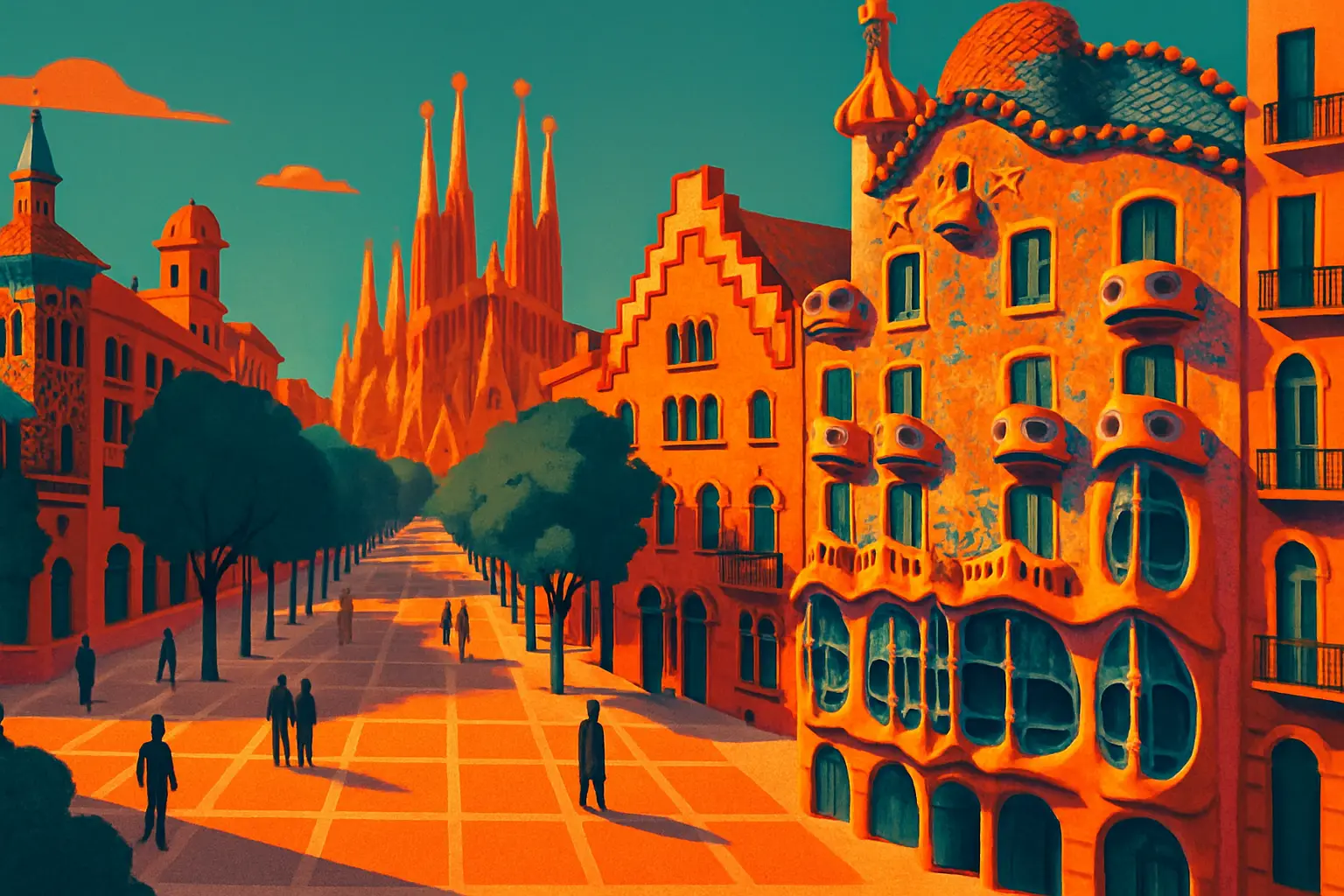
The Manzana de la Discordia — Block of Discord in Castilian Spanish, though Catalans prefer Illa de la Discòrdia — is the name given to the block of Passeig de Gràcia between Carrer d'Aragó and Carrer del Consell de Cent. On this single block, three of the defining buildings of Catalan Modernisme sit in direct, deliberate comparison: Casa Lleó Morera (no. 35), Casa Amatller (no. 41), and Casa Batlló (no. 43). The name is a pun on the Spanish word for city block (*manzana* also means apple, hence the Apple of Discord from Greek mythology), and it reflects a real competitive tension — these buildings were built or renovated within a few years of each other by architects who were simultaneously colleagues, rivals, and political allies.
Casa Amatller (1900) by Josep Puig i Cadafalch is the most architecturally literate of the three in a traditional European sense: its stepped gable facade quotes Dutch and Flemish Gothic, the ironwork is medieval in feel, and the entrance hall uses hydraulic tile floors that became a signature of the Modernisme era. The building was commissioned by chocolate manufacturer Antoni Amatller, and the Amatller Institute of Hispanic Art still occupies the upper floors. Ground-floor visits and the café are free; the full house tour runs approximately $20 USD.
Casa Lleó Morera (1906), by Domènech i Montaner, suffered severe ground-floor alterations in the 1940s when a leather goods shop gutted the original portal sculptures. What remains above the first floor is still extraordinary — ceramic dragons, carved stone balconies, corner towers with art nouveau ironwork. The building is now partially open for guided tours.
Casa Batlló (1906) by Gaudí is covered separately below, but its position on this block is essential to understanding the discourse: Gaudí was not operating in isolation. He was in conversation, and the conversation was loud.
Casa Batlló at Passeig de Gràcia, 43 is the most commercially sophisticated Modernisme experience in Barcelona — the audio guide is narrated in the style of a film, the rooftop dragon-spine terrace is genuinely hallucinatory, and the ticketing operation is slick enough that queues rarely exceed twenty minutes for timed entry. At approximately $35 USD for standard admission (more for 'magic nights' after-dark visits at around $50 USD), it is also the priciest single-building admission on the Passeig de Gràcia. The investment is justified: the interior light well, tiled in gradated blue ceramic from deep cobalt at the base to white at the top to maximize reflected light, is one of the most technically ingenious architectural spaces of its era. The popular interpretation that the facade represents Saint George slaying the dragon — with the roof as dragon scales, the bone-like balconies as victims' skulls, and the tower cross as the lance — was never confirmed by Gaudí himself but is consistent with the Catalan national mythology that permeates the whole movement.
Casa Milà ('La Pedrera'), six blocks north at Passeig de Gràcia, 92, was Gaudí's last secular building (1912) and his most radical. The undulating limestone facade has no straight lines; the iron balconies were designed by Josep Maria Jujol, Gaudí's collaborator and a significant artist in his own right. The rooftop warrior-chimneys — chimney stacks in twisted stone that look like medieval helmets — have become one of Barcelona's iconic silhouettes. Admission runs approximately $28 USD; the rooftop is included. The building also contains a serious permanent exhibition on Gaudí's methods in the attic space.
Both buildings benefit from visiting outside the 10 a.m.–2 p.m. window when tour groups are densest. Opening at 9 a.m. for La Pedrera is an option in summer; the rooftop in the early light is a different experience entirely from the midday version.
Josep Puig i Cadafalch is the third vertex of the Modernisme triangle, and the most explicitly political. He served as president of the Mancomunitat de Catalunya — a form of regional government — from 1917 to 1923, was forced into exile in Paris after Franco's rise, and returned to Barcelona only in his eighties. His buildings are inseparable from this biography.
Casa Amatller has already been mentioned, but Puig i Cadafalch's most ambitious residential commission was Casa de les Punxes ('House of the Spikes'), at Avinguda Diagonal, 416–420. Built in 1905 for the three Terrades sisters, its six conical towers give it the silhouette of a north European Gothic castle transplanted to a Barcelona corner plot. A ceramic panel above the main door reads, in Catalan: 'Sant Jordi patró de Catalunya' (Saint George, patron of Catalonia) — an unusually direct political statement on a private building in a period when expressions of Catalan identity were increasingly contested. The building is open for visits at approximately $16 USD and includes a multimedia exhibition on Puig i Cadafalch's life and the broader Modernisme movement. Unlike the Passeig de Gràcia buildings, it sits on the Diagonal and receives perhaps a quarter of the visitor traffic.
His Palau del Baró de Quadras (1906), just around the corner at Avinguda Diagonal, 373, is now home to the Casa Àsia cultural institution, with free entry to the ground floor and a Gothic-influenced facade that shows Puig i Cadafalch at his most decoratively precise. The carved stone portal rivals anything on the Passeig de Gràcia for quality of craft, and almost no one stops to look at it.
The Eixample's rational grid makes it genuinely walkable in a way that Barcelona's Gothic Quarter is not. Every block is the same size. The main Modernisme sites cluster along or near Passeig de Gràcia (the north-south spine) and can be covered in a single day if you plan the sequence carefully. The optimal route runs roughly north, starting at the Palau de la Música Catalana in the Sant Pere neighborhood (technically just outside the Eixample, near the old city), then moving up through the Manzana de la Discordia, past La Pedrera, and finishing at the Hospital de Sant Pau near the top of the grid.
The reason to end at Sant Pau rather than start there is purely logistical: the Palau de la Música's guided tour runs on a fixed schedule and must be booked in advance, so it anchors the day's start time. Sant Pau, by contrast, is self-guided with an audio device and can accommodate a late-afternoon arrival when the light on the pavilions turns golden.
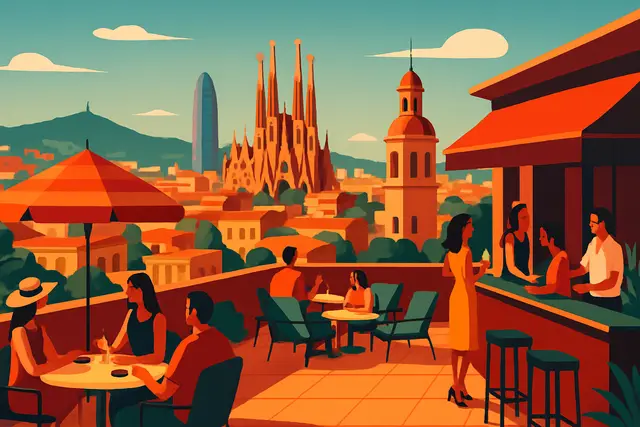
The Avinguda de Gaudí, the diagonal boulevard connecting Sant Pau to the Sagrada Família, takes about eight minutes to walk and offers the composed view Domènech i Montaner intended: his hospital campus in the foreground, Gaudí's basilica in the distance, the two monuments in silent dialogue across the grid. It is one of the best urban views in Barcelona and costs nothing.
For context on the Gothic Quarter's medieval layers that predate the Eixample, TourMe has a separate deep-dive worth reading before or after this walk.
The following reflects approximate 2025–2026 pricing in USD. Exchange rates fluctuate; verify at point of purchase.
**Palau de la Música Catalana** — Carrer del Palau de la Música, 4–6. Guided tours only: ~$22 USD. Daily 9:30 a.m.–3:30 p.m. (to 6 p.m. in August). Book 2–3 weeks ahead via palaumusica.cat. No audio guide alternative; the guided format is enforced to protect the interior.
**Recinte Modernista de Sant Pau** — Carrer de Sant Antoni Maria Claret, 167. Self-guided audio visit: ~$18 USD. Open Mon–Sat 9 a.m.–6:30 p.m., Sun 9 a.m.–2:30 p.m. Arrive at 9 a.m. for the lowest crowds. The cafe on-site is basic but the courtyard table with a coffee is a good reason to linger.
**Casa Batlló** — Passeig de Gràcia, 43. Standard admission: ~$35 USD. Magic nights (after dark): ~$50 USD. Open daily from 9 a.m. Book at casabatllo.es; timed entry available up to same day if slots remain. Priority access tickets add ~$10 but rarely necessary outside August.
**Casa Milà / La Pedrera** — Passeig de Gràcia, 92. Standard: ~$28 USD. Open daily 9 a.m.–8:30 p.m. (summer). Rooftop access included. The evening visit (~$35 USD) includes a rooftop audiovisual show that is well-produced and less gimmicky than it sounds.
**Casa Amatller** — Passeig de Gràcia, 41. Ground floor and chocolate tasting: free to ~$12 USD. Full house tour: ~$20 USD. Book via amatller.org. Least visited of the three Block of Discord buildings; the least overwhelming option for those with architectural fatigue.
**Casa de les Punxes** — Avinguda Diagonal, 416–420. ~$16 USD. Open daily 9 a.m.–8 p.m. No advance booking needed. Combine with the free exterior of Palau del Baró de Quadras five minutes' walk away.
**Skip or deprioritize**: The interiors of Casa Lleó Morera are only partially accessible and the tour experience is inconsistent. The exterior view from the Block of Discord pavement is the main event here. Similarly, Park Güell's monumental zone charges ~$15 USD for timed entry but is not an Eixample building — save it for a separate half-day if Gaudí's landscape work interests you.
**Getting there**: The Passeig de Gràcia metro station (Lines 2, 3, and 4) puts you at the center of the Block of Discord. Sant Pau is a 15-minute walk north, or one stop on the L5 metro to Hospital de Sant Pau. The Palau de la Música is a 12-minute walk from Passeig de Gràcia station, or one stop on L4 to Urquinaona.