Jamón Ibérico vs. Jamón Serrano: What the Labels Actually Mean (and Why Getting It Wrong Is an Expensive Mistake)
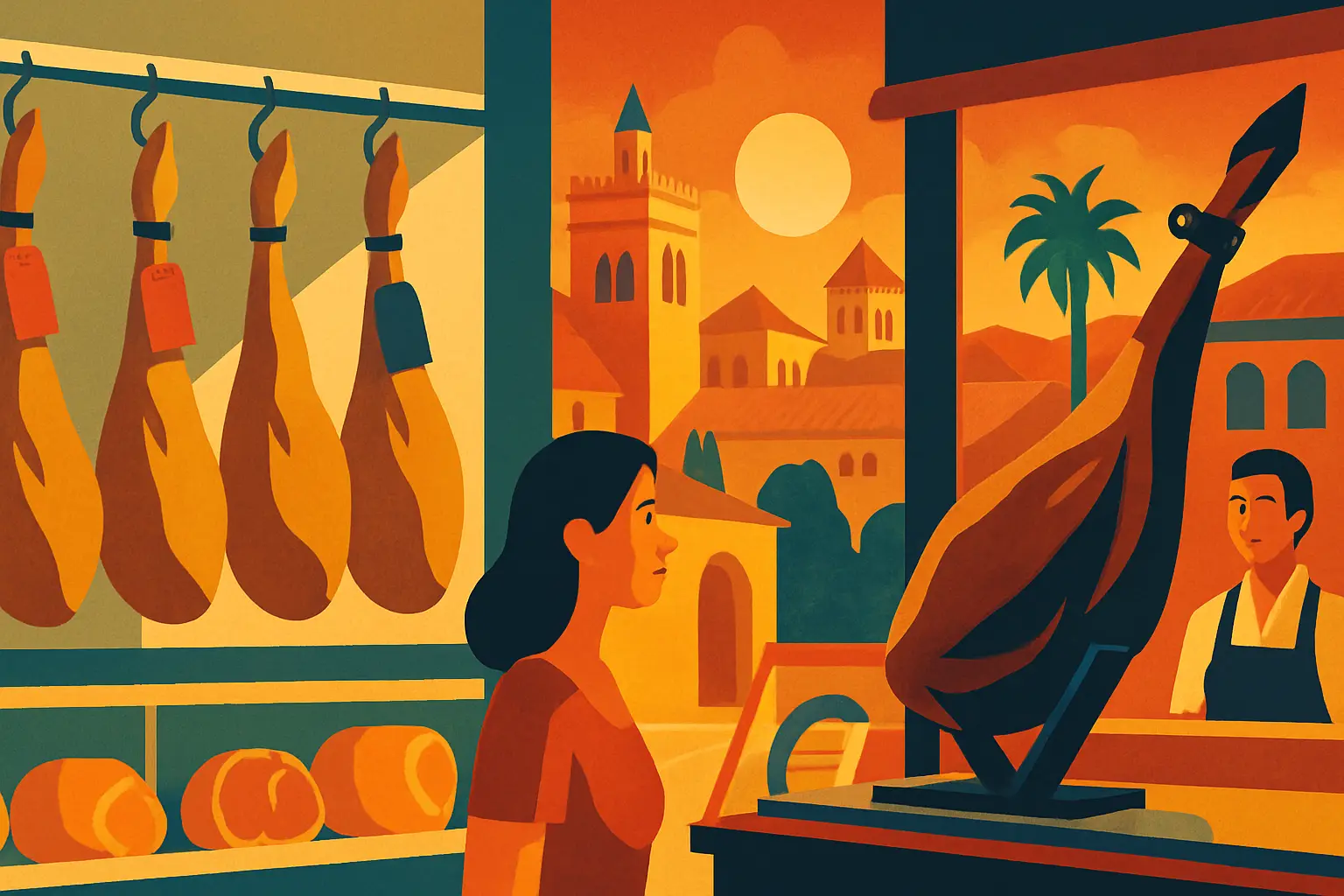
Here's something that catches most visitors off guard: the jamón hanging in a Spanish supermarket for €12 and the one behind the glass at a Madrid charcutería for €180 are both labeled 'jamón ibérico.' Legally, both are correct. The difference lies in three letters printed on a small colored label — black, red, green, or white — that most tourists walk past without a second glance. That label encodes the pig's breed, what it ate, where it roamed, and how long it spent in a mountain cellar. Get it right and you're eating one of the most complex cured products on earth. Get it wrong and you've paid ibérico prices for something closer to a decent supermarket ham. This guide breaks down the full classification system introduced by Spain's 2014 Royal Decree — the breed percentages, the four diet-based designations, and the four Denominaciones de Origen that guarantee provenance. By the end, you'll be able to walk into any Spanish deli, read the label correctly, and make an informed choice about how to spend your money.
🇪🇸 Short stories • Collectible cards • Learn as you travel
Spain's 2014 Royal Decree mandates a color-coded label on all ibérico products: black = 100% ibérico breed, acorn-fed, free-range (pata negra); red = ibérico breed (75–50%), acorn-fed; green = ibérico breed, acorn-and-feed diet (recebo); white = ibérico breed, grain-fed (cebo). Ignore marketing copy on the package — the label color is the only classification that matters legally.
Where to buy in Madrid
Mercado de San Miguel (Plaza de San Miguel, s/n, Madrid) has reliable ibérico vendors, but for serious purchasing head to Jamonería Sánchez Romero on Calle Velázquez 16, or Museo del Jamón's flagship on Gran Vía 72. Budget roughly $25–$40 for 100g of sliced jamón ibérico de bellota negro, the black-label benchmark.
Ask about curing time, not just grade
Even within the black-label (bellota 100% ibérico) category, curing time varies from 36 to 48+ months and dramatically affects flavor. A 48-month leg from Jabugo or Guijuelo will have deeper crystalline fat deposits and nuttier, more intense flavor than a minimum-cure leg. When buying a whole leg ($400–$900+), always ask the vendor '¿cuántos meses de curación?' — how many months of curing.
The complete Spanish ham classification guide
1Why Spain treats ham as a cultural monument, not a grocery item
The Iberian Peninsula has been producing cured pork for at least two millennia. Roman writer Strabo, writing in the first century BCE, recorded that Iberian hams were already being exported across the empire and were prized above all others. The specific geography that makes this possible — the dehesa, a semi-wild oak woodland landscape stretching across Extremadura, Andalucía, and parts of Castile — is as important as any human intervention in the process. The dehesa covers roughly 3.5 million hectares of southwestern Spain and Portugal, and it is the only ecosystem where the acorn-to-fat conversion that defines the finest ibérico hams can occur at scale.
During the montanera — the acorn-feeding season running roughly from October through February — a free-ranging ibérico pig can consume between 6 and 10 kilograms of acorns per day. In a single montanera, a pig may gain 40–50 kg of body weight. The oleic acid content of acorns penetrates the pig's muscle tissue and fat in a way that has no equivalent in grain-fed animals, producing a fat that is chemically closer to olive oil than to typical pork fat — a point Spanish charcutiers will make to you without prompting, and which is borne out by laboratory analysis.
Spain formalized this heritage in Real Decreto 4/2014, a regulatory framework that replaced earlier, looser rules and created the four-color labeling system still in use today. The decree was specifically designed to end consumer confusion caused by producers marketing crossbred, grain-fed pigs under the ibérico banner without clear differentiation. Understanding that legal architecture is the starting point for understanding anything on a Spanish ham label.
2Jamón Serrano: the baseline that deserves more respect than it gets
Before comparing grades of ibérico, it's worth understanding jamón serrano — 'mountain ham' — on its own terms. Serrano is made from white pig breeds, predominantly Landrace, Duroc, and Large White, raised on commercial feed. The name derives from the traditional practice of curing hams in mountain air, where cool temperatures and natural breezes create ideal conditions for slow moisture loss.
Serrano is governed by its own designation: Jamón Serrano TSG (Traditional Speciality Guaranteed), awarded by the European Union in 1999, making it the first EU-certified Spanish food product. The TSG does not specify a geographic region — serrano can be produced across Spain — but it does mandate a minimum curing period of seven months, with premium versions reaching 15–18 months. The most respected serrano comes from the highlands of Teruel (Aragon), which holds a full Denominación de Origen Protegida — the only serrano DOP in Spain — requiring a minimum 14-month cure and pigs raised at altitudes above 800 meters.
A well-cured Teruel serrano is clean, mildly salty, and firm with a pleasant chew. It is absolutely not a lesser product — it is a different product, and pairing it with a chilled glass of manzanilla sherry on a bar stool in Seville is one of the more honest pleasures Spanish food culture offers. Where serrano falls short is at the budget end: factory-produced supermarket serrano cured for the legal minimum of seven months has a uniform, slightly rubbery texture and aggressive saltiness that gives the category an unfair reputation. Price is usually a reliable guide: expect to pay $4–$8 per 100g for quality Teruel DOP serrano, compared to $1–$3 for mass-market versions.
Keep touring
Discover more about Spain in minutes
Get short, interactive stories that make each place easier to remember while you travel.
3The ibérico classification system: four labels, four very different products
The 2014 Royal Decree established two variables that together determine an ibérico product's classification: breed purity and diet during the final fattening phase. These interact to produce four tiers, each with a mandatory colored label.
Black label — Jamón Ibérico de Bellota 100% Ibérico: The pig is 100% Iberian breed (both parents certified ibérico), raised free-range on the dehesa, and fed exclusively on acorns and natural pasture during the montanera. This is what older generations call *pata negra*, though that term is no longer legally defined in the decree. Minimum cure: 36 months. This is the product food writers mean when they describe Spanish ham as a revelation.
Red label — Jamón Ibérico de Bellota: The pig is 50–75% ibérico breed (typically crossed with Duroc), also free-range and acorn-fed during montanera. The flavor profile is genuinely excellent and the price is meaningfully lower than black-label — often 30–40% less for sliced portions.
Green label — Jamón Ibérico de Cebo de Campo: The pig is at least 50% ibérico and raised partly outdoors, but the diet during the fattening phase combines acorns with commercial feed (recebo, a term that has largely been replaced in everyday usage). The product has ibérico character but without the full oleic acid saturation of pure bellota feeding.
White label — Jamón Ibérico de Cebo: The pig is at least 50% ibérico but raised indoors on grain and feed only. The result is closer to a well-made serrano than to a true bellota product, though the ibérico genetics still produce a richer fat than white-breed serrano.
For visitors with a single tasting opportunity in Spain, the red-label bellota offers the best value-to-quality ratio and is genuinely representative of why Spanish ham has the reputation it does.
White label: 50%+ ibérico breed + grain-fed only + indoor raising
4The four Denominaciones de Origen: geography as flavor
Within the ibérico classification system, four geographic Denominaciones de Origen Protegidas (DOP) operate as an additional quality layer, each with its own production rules, inspector regimes, and flavor traditions. Choosing a ham by DOP is as meaningful as choosing a wine by appellation.
D.O.P. Jabugo (Huelva, Andalucía): Centered on the village of Jabugo in the Sierra de Aracena, this is the most internationally recognizable ibérico origin. The high humidity and cool mountain air of Huelva produce a ham with particularly silky fat and an intense, almost floral sweetness. The brand 5 Jotas (Cinco Jotas), headquartered in Jabugo since 1879, is the most exported name in premium ibérico globally. A 100% bellota leg from Jabugo DOP runs $600–$950 whole.
D.O.P. Guijuelo (Salamanca, Castile and León): Spain's highest-volume ibérico DOP, producing around 4 million hams annually. The plateau climate of Salamanca — cold winters, dry summers — drives slower, longer curing. Guijuelo hams tend toward a milder, less aggressively fatty profile than Jabugo, with a subtle sweetness that makes them very food-friendly. The producer Joselito, founded in 1868, is widely considered among aficionados to be the benchmark for Guijuelo style.
D.O.P. Dehesa de Extremadura (Extremadura): The dehesa here is the most extensive in Spain, covering parts of Cáceres and Badajoz. The acorn concentration is high, producing a particularly fat-marbled product. Hams from this DOP tend to be robust and earthy, with a mineral quality associated with the region's granite soil composition.
D.O.P. Los Pedroches (Córdoba, Andalucía): The smallest and least internationally distributed of the four DOPs, centered on the Valle de los Pedroches in northern Córdoba. Production volumes are low, which keeps prices high and availability outside Spain limited. The flavor is rich and sweet, and the breed standards here are some of the strictest in the country.
For visitors in Seville or Huelva, seeking out a Jabugo DOP product at source is straightforward; for those based in Salamanca or Cáceres, Guijuelo and Extremadura hams are the regional pride and significantly fresher than imported equivalents found in Madrid.
5The curing process: what actually happens in those mountain cellars
A jamón ibérico leg begins its post-slaughter life weighing approximately 10–12 kg. What emerges from a 48-month cure weighs perhaps 6–7 kg. The lost mass is almost entirely water — a fact that explains both the concentration of flavor and the price per kilogram of finished product.
The process unfolds in three distinct phases. Salting (salazón): The leg is buried in sea salt for approximately one day per kilogram of weight, drawing out surface moisture and beginning the preservation process. Temperature is held at 1–5°C. For a 10kg leg, this means roughly 10 days in salt.
Post-salting and settling (post-salado): The leg is washed, dried, and moved to cold chambers at 3–6°C for 45–60 days. During this phase the salt migrates inward from the surface while surface moisture continues to evaporate. The leg takes on its characteristic elongated shape as shrinkage begins.
Drying and curing (secadero and bodega): This is the longest phase and the one that defines flavor complexity. The legs move first to natural drying rooms (secaderos), where windows are opened and closed by hand throughout the day to manage airflow and humidity. As temperatures rise with the season, fat begins to liquefy and migrate through the muscle, a process called sudado ('sweating') that distributes oleic acid through the meat. After 12–18 months in the secadero, the legs move to underground cellars (bodegas) for the final slow cure, during which the enzymatic breakdown of proteins produces the cristales de tirosina — small white crystalline deposits visible when you slice a properly aged leg, and one of the clearest markers of genuine long-cure quality.
A master jamonero — the skilled professional who carves a whole leg at a restaurant or event — knows by the sound of a probe inserted into the leg whether the cure has developed correctly. This tactile, sensory knowledge, transmitted through apprenticeship, has no digital substitute.
Salting phase: ~1 day per kg at 1–5°C
Post-salting settling: 45–60 days at 3–6°C
Secadero (drying room): 12–18 months with manual ventilation management
Bodega (cellar curing): 6 months to 2+ years; minimum 36 months total for black-label bellota
Tyrosine crystals (cristales de tirosina): white flecks in the slice = properly long-cured product
6How to taste jamón properly — and what you're actually looking for
Most tourists eat jamón ibérico the wrong way: cold, straight from a refrigerated packet, with a glass of red wine. This is a minor tragedy. Properly served ibérico should be at room temperature — ideally 22–24°C — which allows the fat to soften to a translucent, almost liquid quality at the edges of each slice. When you pick up a slice of well-served bellota ibérico, it should drape like silk rather than hold its shape rigidly.
The slices should be thin enough to be nearly translucent, which is why a skilled jamonero using a proper ham stand (jamonero or porta-jamón) and a long, flexible cuchillo jamonero produces a categorically different experience than pre-sliced vacuum-packed product. If you're in Madrid, watching the carvers at Bodega de los Secretos (Calle San Blas 4) or at the bar counter of Casa Lucio (Cava Baja 35) will demonstrate the standard.
When tasting, look for three things. First, intramuscular fat marbling — the thin white lines running through the deep red muscle. In bellota ibérico, this fat has a sweet, slightly nutty quality and melts on the tongue. In cebo (grain-fed) ibérico, the same fat is blander and slightly waxy. Second, color depth — genuine long-cured bellota should be a deep burgundy to mahogany, not bright pink. Third, finish length — the signature of great bellota ibérico is a finish that lingers for 30–60 seconds, cycling through nuttiness, sweetness, and a faint umami quality similar to aged Parmigiano.
For a structured tasting experience in Spain, El Museo del Jamón operates multiple Madrid locations and offers tasting platters starting around $12–$18 that compare serrano, white-label ibérico, and bellota side by side — a genuinely educational thirty minutes for any food-curious visitor.
7Buying jamón in Spain: practical guide to prices, formats, and what to bring home
Bringing jamón home from Spain is one of the most rewarding food souvenirs possible, but the logistics require planning. The good news for American visitors: US Customs allows sliced and vacuum-packed cured ham from Spain — whole legs are not permitted, as they have not undergone the USDA-approved treatment process. Sliced, vacuum-packed jamón ibérico in sealed commercial packaging typically passes through US customs without issue, though regulations can change and it's worth checking current USDA APHIS rules before departure.
For in-Spain purchasing, the following price ranges (in USD, approximate based on current exchange rates) give a working budget:
For the best dedicated retail experience in Madrid, Patrimonio Comunal Olivarero (Calle Mejía Lequerica 1) stocks regional products with helpful staff. In Seville, the Mercado de Triana (Plaza del Altozano) has excellent whole-leg vendors. In Barcelona, La Boqueria (La Rambla 91) is touristy but has reliable ibérico vendors if you know what label to request.
Sliced ibérico de cebo / white label (100g): $6–$10
Sliced ibérico de bellota / red label (100g): $15–$22
Sliced ibérico de bellota 100% / black label (100g): $25–$45
Whole black-label bellota leg (6–8 kg, 48-month cure): $500–$950
Vacuum-packed sliced black-label (80g gift box): $18–$35 — best format for transporting home
Best Madrid retailers: Jamonería Sánchez Romero (Calle Velázquez 16), Museo del Jamón Gran Vía (Gran Vía 72), Patrimonio Comunal Olivarero (Calle Mejía Lequerica 1)
Best Seville option: Mercado de Triana vendors along the main hall, Calle Castilla side entrance
US customs: vacuum-packed commercial sliced product generally permitted; whole legs are not — verify at cbp.gov before travel
Keep touring
Ready to eat your way through Spain with the full context behind every bite?
TourMe's Spain food and culture chapters bring the history of the dehesa, the DOP regions, and Spain's culinary traditions to life through collectible story cards and interactive audio guides you can use in the market, at the bar, or on the road between Jabugo and Guijuelo. Explore the Extremadura dehesa chapter, the Andalucían food stories, and region-by-region tasting guides — all built to make what's on your plate more meaningful.