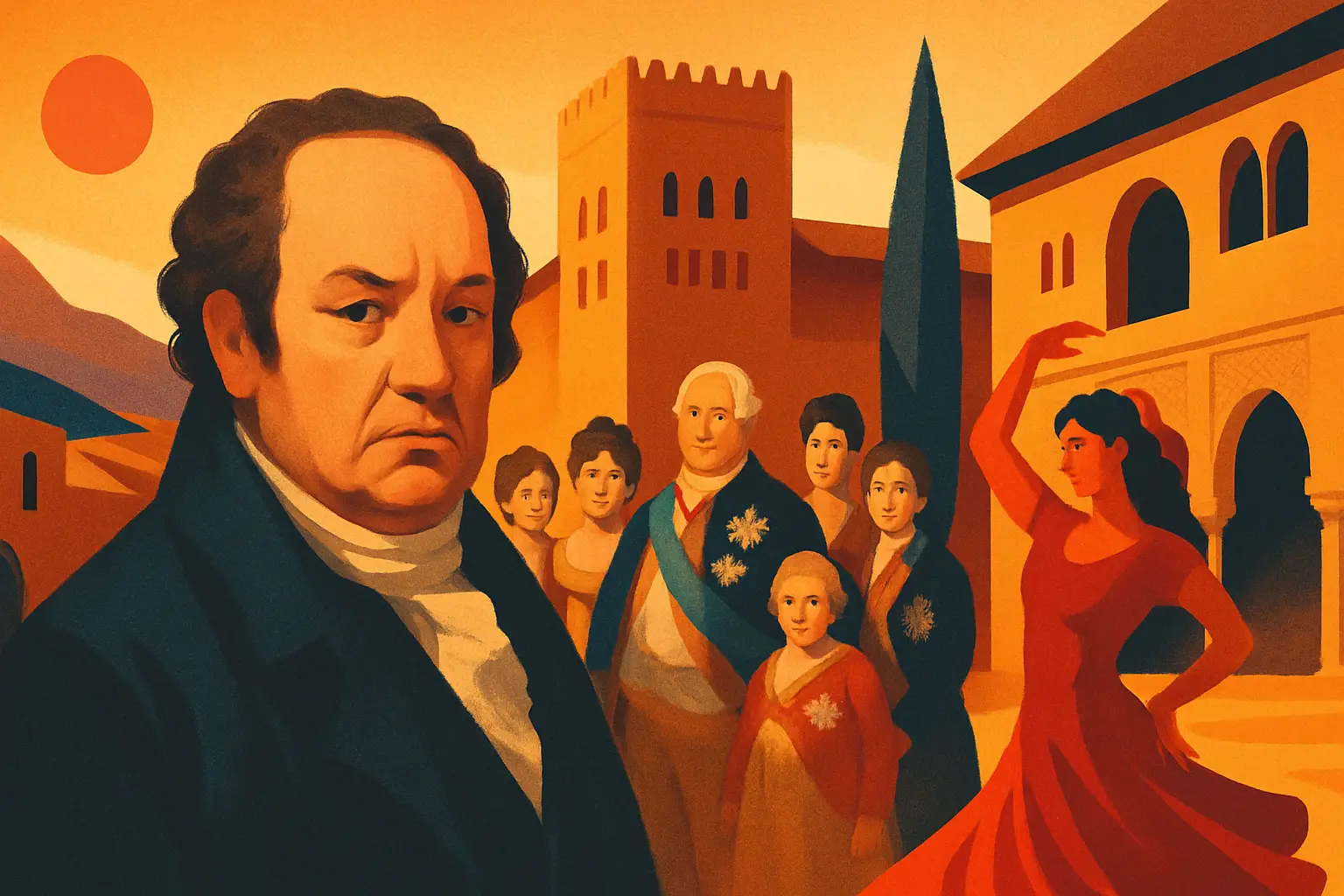
Art historians routinely use phrases like 'precursor to modernism' as a compliment that costs nothing. With Francisco José de Goya y Lucientes, the claim is genuinely defensible. He was born in 1746, squarely inside the Enlightenment, and he died in 1828, just as Romanticism was taking hold across Europe. He outlived both movements and, in his final decades, produced imagery that prefigures Expressionism, Surrealism, and the raw trauma-painting of the twentieth century — all without an audience, all without a movement to belong to.
The conventional arc of Western painting before Goya ran from idealization to idealization: Greek gods became Christian saints became aristocratic allegories, but the underlying assumption — that art should ennoble its subject — remained intact. Diego Velázquez had nudged at this with his unflattering dwarfs and his backstage view of the royal studio in *Las Meninas*, but Velázquez always kept a courtly frame around even his most subversive gestures. Goya dismantled the frame entirely. His *Saturn Devouring His Son* (c. 1820–1823), one of the fourteen Black Paintings he applied directly to the plaster walls of his home, shows a wide-eyed giant cramming a human body into his mouth. There is no mythological dignity, no compositional grace note to cushion the horror. It is simply terror, rendered in brown and black and the white of bone.
That rupture — from court commissions to self-directed nightmare — didn't happen overnight. It was the product of a specific biography: a provincial upbringing, decades of political navigation at the Spanish court, a catastrophic illness, and then a war that showed him what humans are actually capable of doing to one another. To understand the Black Paintings, you have to understand the whole life. And to understand the life, you have to start in Aragon.
Goya was born on March 30, 1746, in Fuendetodos, a village of fewer than two hundred inhabitants set in the dry scrubland south of Zaragoza. His father, José Benito de Goya, was a master gilder — skilled, respectable, but not wealthy. The family moved to Zaragoza when Francisco was still a child, and it was there that he received his first formal training under José Luzán, a competent academic painter who had studied in Naples and kept a solid library of engravings after the great Italian masters.
Goya's talent was evident early but his ambition outpaced Zaragoza's opportunities. He applied twice to the Real Academia de Bellas Artes de San Fernando in Madrid — in 1763 and again in 1766 — and was rejected both times. This was a genuine humiliation, and the young artist apparently responded by doing what ambitious Spaniards with thwarted options often did: he went to Italy. Between 1769 and 1771 he lived in Rome, studying independently, and in 1771 he won second prize in a painting competition held by the Academy of Parma. The certificate survives; it describes him as a student of Francisco Bayeu, who would later become his brother-in-law and an important, occasionally infuriating patron.
Back in Zaragoza, Goya secured a major commission: frescoes for the Basílica de Nuestra Señora del Pilar, one of Spain's most venerated shrines. He would return to paint its dome decades later, but the 1771–1772 frescoes in the *Coreto* section were his public debut at scale. In 1773 he married Josefa Bayeu, cementing his connection to Francisco Bayeu, and the following year the couple moved to Madrid permanently. The real career was about to begin.
Get short, interactive stories that make each place easier to remember while you travel.
Madrid in the 1770s was not a city that rewarded genius on its own terms. The Real Fábrica de Tapices de Santa Bárbara (Royal Tapestry Factory) was where most painters who wanted royal patronage started, designing cartoons — full-scale painted templates — that weavers would then reproduce in wool and silk for the royal palaces. It was repetitive, constrained work, but Goya made it something else entirely. His tapestry cartoons from the 1770s and 1780s, including the luminous *The Parasol* (1777) and *The Swing* (1779), are among the most charming paintings in the Prado's collection: scenes of ordinary Madrileños picnicking, playing games, and flirting, observed with an anthropologist's eye and a colorist's joy.
In 1780 Goya was finally admitted — unanimously — to the Real Academia de Bellas Artes de San Fernando, submitting a *Christ on the Cross* precise enough to satisfy academic taste while alive enough to demonstrate he could do far more. Patronage escalated rapidly after that. By 1785 he was Deputy Director of Painting at the Academy; by 1786, painter to King Charles III; and in 1789, just months after the French Revolution, Charles IV named him Court Painter. The following decade brought a string of aristocratic commissions, including his celebrated portraits of the Duchess of Alba, who became one of the most mythologized figures in Goya scholarship — the subject of persistent rumors about a romantic relationship that the surviving evidence neither confirms nor fully refutes.
In 1799, Charles IV promoted him to First Court Painter, the highest official rank in Spanish art. That same year Goya published *Los Caprichos*, a series of 80 aquatint etchings satirizing superstition, clerical corruption, and human folly — a calculated act of nerve from a man who worked for the Inquisition-era court. He withdrew the series from sale after a month, apparently fearing the Inquisition's attention. The tightrope he walked between transgression and survival would define the rest of his career.
In the winter of 1792–1793, Goya fell gravely ill while traveling in Cádiz. The exact diagnosis has never been established — theories range from lead poisoning (from his paints) to Susac syndrome, a rare autoimmune condition that attacks the brain's small blood vessels. Whatever the cause, the crisis left him permanently and profoundly deaf. He was 46 years old.
The effect on his work was seismic. Isolation from sound pushed Goya inward. During his convalescence he produced a series of small cabinet paintings on tin — scenes of accidents, fires, a lunatic asylum, a bullfight — that he sent to the Academy describing them as works in which he could give free rein to imagination and invention. These were not commissions. Nobody had asked for images of a madhouse. This was the first sustained moment in Goya's career when he painted for himself, and the results are unmistakably proto-modern.
The famous portraits of the Duchess of Alba date from this post-illness period: the 1795 full-length in white (now in the collection of the Casa de Alba, Madrid) and the 1797 black-dressed portrait at the Hispanic Society of America in New York, in which she points to the ground where the words *Solo Goya* — 'Only Goya' — are written in the dust. Whether that inscription was his declaration of love, her joke, or simple artistic ego has been argued for two centuries.
The decade closed with *La maja desnuda* (c. 1797–1800) and its companion *La maja vestida*, two versions of the same reclining woman — nude and clothed — whose identity remains contested but whose existence caused Goya to be summoned before the Inquisition in 1815. He had survived another brush with institutional danger. He always did, until he couldn't.
When Napoleon Bonaparte placed his brother Joseph on the Spanish throne in 1808, it triggered a popular uprising that became the Peninsular War (1808–1814) — one of the most brutal conflicts in European history to that point, and a template for modern guerrilla warfare. Goya, then 62 and First Court Painter, stayed in Madrid and watched.
What he produced in response remains among the most morally serious art ever made. The painting *The Second of May 1808* and its companion *The Third of May 1808* (both 1814, Museo del Prado) depict the Madrid uprising and its suppression with a directness that European battle painting had never attempted. In *The Third of May*, there is no glory: a French firing squad executes kneeling Spaniards on a hillside outside Madrid, and the central figure — arms flung wide, white shirt luminous in lantern light — is not heroic, just terrified. Édouard Manet would study this painting obsessively before creating his own execution scene, *The Execution of Emperor Maximilian* (1867).
But the paintings were only the public face of Goya's response to the war. Between 1810 and 1820 he worked privately on Los Desastres de la Guerra ('The Disasters of War'), a series of 82 etchings depicting rape, summary execution, famine, mutilation, and the grinding dehumanization of both sides. He never published them in his lifetime. The Real Academia de Bellas Artes de San Fernando finally released the series in 1863, 35 years after his death. Even then, the images were shocking — not because they were sensational, but because they refused to assign meaning to atrocity. Goya didn't depict war as tragedy ennobled by sacrifice. He depicted it as plain horror, plain waste.
These prints are viewable in their original states at the Biblioteca Nacional de España (Paseo de Recoletos 20, Madrid) and in reproduction throughout the Prado's Goya galleries.
In 1819, at the age of 73, Goya purchased a two-story country house on the south bank of the Manzanares River, outside Madrid. The property was known locally as the Quinta del Sordo — the House of the Deaf Man — a name its previous owner had acquired before Goya moved in, though the coincidence was noted with dark humor.
Between approximately 1820 and 1823, Goya covered fourteen walls of the house's ground and upper floors with mural paintings in oil applied directly to plaster. There was no commission, no patron, no stated program. The works were not given titles in Goya's lifetime; the names by which we know them — *Saturn Devouring His Son*, *Witches' Sabbath*, *Two Old Men Eating Soup*, *Fight with Cudgels*, *The Dog* — were assigned later, some by scholars, some by the art dealer Frédéric Émile d'Erlanger, who had the paintings transferred to canvas in 1874 and donated them to the Spanish state. They arrived at the Prado in 1881.
*Saturn Devouring His Son* is the most famous and the most discussed, but arguably the most disturbing is the smallest: *The Dog*, in which a single canine head — ears flattened, eyes wide — emerges from the bottom of a canvas that is otherwise almost entirely blank ochre and brown. The dog appears to be sinking, or drowning, or simply stranded in an indifferent void. It is a painting that resists symbolic resolution, which is why it has stayed in the cultural imagination for two centuries.
Psychologists, historians, and art critics have attributed the Black Paintings to Goya's response to the Liberal Triennium, the political crisis that threatened another Bourbon absolutist restoration; to his fear of aging and death; to the effects of his illness on his brain. All these explanations feel simultaneously plausible and insufficient. The most honest answer is that nobody knows, and that uncertainty is part of what makes them inexhaustible.
After the French military intervention of 1823 restored Ferdinand VII to absolute power, Goya — who had served as a court painter under the Napoleonic-installed Joseph I and signed a loyalty oath — found his position precarious. In 1824, at 78, he applied for permission to travel to France for medical treatment, which was granted. He never returned to Spain.
He settled in Bordeaux, where he remained for the last four years of his life, surrounded by a community of Spanish liberals in exile. He was not idle: he learned the newly invented technique of lithography and produced a series of bullfighting scenes, the *Bordeaux Bulls*, that rank among the most technically adventurous works of his final period. He also painted the extraordinary miniature *The Milkmaid of Bordeaux* (c. 1827, Prado), soft-edged and luminous in a way that looks ahead to Renoir.
Goya died in Bordeaux on April 16, 1828, aged 82. He was buried in the city. In 1899, his remains were exhumed for return to Spain — a process that revealed, to the consternation of the Spanish authorities, that his skull was missing. It has never been found. His body, headless, was reinterred beneath the frescoed dome of the Ermita de San Antonio de la Florida in Madrid, where in 1798 he had painted one of his most technically dazzling works: a depiction of Saint Anthony raising a man from the dead, in which the miracle's witnesses are not Biblical figures but recognizable Madrid street types, craning and gossiping and paying only partial attention to the divine event unfolding in front of them.
For visitors to Madrid, the essential itinerary breaks down as follows:
**Museo del Prado** (Paseo del Prado s/n): The largest Goya collection in the world — over 140 paintings including the Black Paintings (Room 067), the royal portraits (Rooms 032–034), the war paintings (Room 064), and the tapestry cartoons. General admission €15 (~$16 USD). Free 6–8 p.m. Tuesday–Sunday.
**Ermita de San Antonio de la Florida** (Glorieta de San Antonio de la Florida 5): Goya's tomb and his complete original ceiling frescoes, intact in situ. Free entry. Closed Monday.
**Real Academia de Bellas Artes de San Fernando** (Calle de Alcalá 13): Self-portraits, *Burial of the Sardine*, and the institution that rejected him twice. ~€6 (~$6.50 USD). Closed Monday.
**Museo Lázaro Galdiano** (Calle Serrano 122): A smaller but rewarding collection including Goya's miniatures and cabinet paintings. ~€7 (~$7.60 USD). Closed Monday and Tuesday.
**Casa Natal de Goya, Fuendetodos** (Calle Alhóndiga 1, Fuendetodos): His childhood home, 44 km from Zaragoza by car. ~€2.50 (~$2.70 USD). Open Tuesday–Sunday.