The Spanish Civil War (1936–1939) did not erupt without warning. The Second Spanish Republic, proclaimed in April 1931 after King Alfonso XIII fled the country, had spent five turbulent years trying to modernize a deeply unequal society — secularizing education, redistributing land, granting Catalan autonomy — while fighting off opposition from the Catholic Church, large landowners, the military, and a growing fascist movement, the Falange Española, founded by José Antonio Primo de Rivera in 1933.
The breaking point came on the night of July 17–18, 1936, when a cabal of generals launched a coordinated military uprising — a *pronunciamiento* in the Spanish tradition — from Spanish Morocco and garrisons across the peninsula. The plotters expected a swift coup. Instead, the government, workers' unions, and loyal military units resisted, and Spain fractured into two zones: the Nationalist side under generals including Francisco Franco, Emilio Mola, and Gonzalo Queipo de Llano, and the Republican side defending the elected government.
Madrid mattered above all others because it was the capital. Taking it would signal the Republic's collapse and give the Nationalists international legitimacy. Franco's Army of Africa — the most battle-hardened force in Spain, composed largely of Spanish Foreign Legion soldiers and Moroccan regulares — crossed the Strait of Gibraltar in July and August 1936 in an airlift organized with the direct support of Nazi Germany's Luftwaffe transport aircraft and Italian planes provided by Benito Mussolini. That airlift was itself a military first: the first large-scale strategic troop airlift in history. By late October, Nationalist columns were on the outskirts of the city, and the Republican government made a decision that shocked observers worldwide — it relocated to Valencia, leaving Madrid to defend itself under General José Miaja and a hastily formed junta.
The first week of November 1936 is the pivot around which the entire war in Madrid turns. On November 6, the Republican government boarded trains for Valencia. On November 7, Nationalist troops entered the western suburbs. The capital's defenders — a mix of regular soldiers, militia columns organized by the anarchist CNT and socialist UGT unions, and Communist Party units — were low on rifles, shorter on artillery, and almost entirely lacking in military coordination.
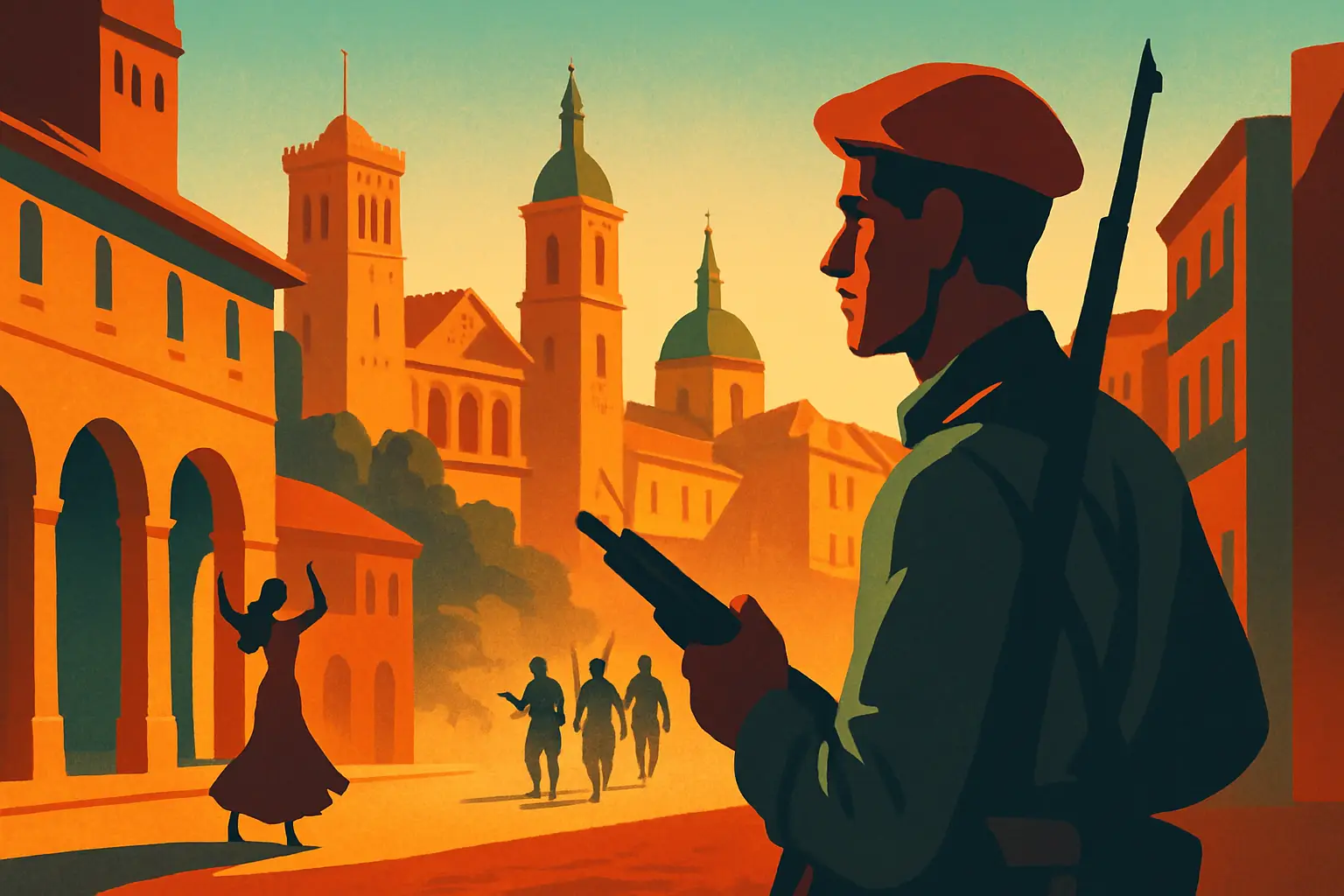
What changed the calculus was the arrival, on November 8, of the XI International Brigade — the first of the Brigades to see combat — marching down the Gran Vía in formation. Their appearance, discipline, and the psychological weight of foreign solidarity arriving at the precise moment of maximum crisis had an outsize effect on morale that military historians still discuss today. The XI Brigade went directly from the march into combat in the Casa de Campo park, the former royal hunting ground west of the city that became one of the war's most brutal killing grounds.
Simultaneously, the first Soviet T-26 tanks rolled into action — supplied under the arms deal the Republic had signed with Stalin in exchange for shipping Spain's gold reserves to Moscow. Soviet military advisors, including the senior officer known as General Kleber (real name Manfred Stern, a Hungarian-born Comintern operative), helped coordinate the defense. Against them, Franco sent the Army of Africa's most seasoned units, supported by Heinkel He 51 fighter aircraft and Junkers Ju 52 bombers from the German Condor Legion.
By November 23, the Nationalist assault had effectively stalled. The Battle of Madrid — the frontal assault phase — was over. The front line ran directly through the university campus, through Carabanchel to the south, and along the Manzanares River. It would barely move for the next two and a half years.
The romantic image of the International Brigades — idealistic young writers and workers rushing to Spain to stop fascism — is largely accurate, and also incomplete. The Brigades were organized by the Communist International (Comintern) in Moscow from September 1936, recruited primarily through national Communist parties, and commanded by a structure that was ultimately accountable to Soviet military intelligence. That institutional reality coexisted with the genuine idealism of the roughly 35,000 individuals who came from over fifty countries.
The largest national contingents were French (~9,000), German and Austrian (~5,000, mostly political exiles from the Third Reich), American (~2,800, organized as the Abraham Lincoln Brigade and the George Washington Battalion), British (~2,500), and Italian (~3,350, again largely anti-fascist exiles). They were organized into numbered brigades — the XI, XII, XIII, XIV, and XV — each with internal battalions named for revolutionary and national heroes: the Thälmann Battalion (German), the Garibaldi Battalion (Italian), the Commune de Paris Battalion (French).
The XV International Brigade, which included the Lincoln Battalion, fought in some of the war's most costly engagements, including the Battle of Jarama in February 1937 — a Nationalist attempt to cut Madrid's main supply road from Valencia — and the Battle of Brunete in July 1937. Losses were catastrophic: the Lincoln Battalion entered Jarama with approximately 450 men and lost around 120 killed in the first two days.
Among those who came were figures who would become famous: George Orwell (though he served with the independent POUM militia in Catalonia, not the Brigades), the American journalist and novelist Ernest Hemingway, photographer Robert Capa, and writer Martha Gellhorn. The Madrid front, centered on the Hotel Florida on the Gran Vía — which took artillery fire throughout the war — became one of the most reported battlegrounds in modern history.
The Brigades were withdrawn in October 1938 as part of the Republic's attempt to demonstrate to Britain and France that it was reducing foreign intervention. By then, approximately 10,000 of the volunteers had died in Spain. A monument to the International Brigades stands today in the Parque del Retiro, near the Paseo de Venezuela entrance.
Madrid's civilian population endured something largely unprecedented in European urban warfare up to that point: sustained, systematic air bombardment of a modern capital city. The Condor Legion — Germany's intervention force — treated Spain as a laboratory. Bombing raids on Madrid in November and December 1936, carried out primarily by Junkers Ju 52 bombers, killed hundreds of civilians and generated the first large-scale international press coverage of urban aerial bombardment. The images and reporting drove significant anti-Fascist public opinion in Western democracies, even as those governments maintained an official policy of Non-Intervention through the Non-Intervention Committee established in London in September 1936.
The Gran Vía — then only a few decades old, Madrid's showpiece modernist boulevard — ran parallel to the Nationalist artillery positions in the Casa de Campo and was shelled so frequently that Madrileños renamed it Avenida de los Obuses ('Shell Avenue'). The Telefónica building at Gran Vía 28, completed in 1929 and at eleven stories the tallest building in Madrid at the time, was used by Republican military and international journalists as an observation post precisely because it overlooked the Nationalist lines. It was also a constant artillery target; the building still stands and its facade, while restored, shows evidence of the structural repairs made after the war.
Artillery also reshaped the Arguelles neighborhood and the area around Moncloa, which sat closest to the university front. Buildings destroyed in that zone were not rebuilt with any coherence until the 1940s and 1950s, and a careful eye on the neighborhood's architecture today reveals the sharp discontinuity between pre-war buildings (early twentieth century, stone facades, ornate cornices) and the utilitarian 1940s replacements that fill the gaps.
In the Carabanchel district to the southwest — today a working-class neighborhood with a busy market and strong local identity — the front line ran through residential streets. The district suffered some of the heaviest ground combat of the entire siege, and the Carabanchel Prison, built by the Franco regime after the war using Republican prisoner labor, stood as a physical reminder of that history until its demolition in 2008.
The most famous single artifact of the Spanish Civil War is not a weapon or a document but a painting — Pablo Picasso's *Guernica*, completed in June 1937 in response to the April 26 bombing of the Basque market town of Guernica by the Condor Legion and the Italian Aviazione Legionaria. The bombing, carried out on a Monday market day and lasting over three hours, killed between 150 and 1,600 civilians (estimates vary widely in the historical literature, though more recent scholarship from the Basque regional government places the figure around 150–200). The town had no significant military value; the attack was designed to test saturation bombing techniques and to break Basque morale.
Picasso, already commissioned by the Spanish Republican government to produce a mural for the 1937 Paris International Exposition, abandoned his original concept and produced *Guernica* in a fury of work over five weeks. The painting — monumental at 11 feet tall and nearly 26 feet wide, rendered entirely in black, white, and gray — became the century's most reproduced anti-war image and has never lost its charge.
For decades, *Guernica* lived in exile. Picasso refused to allow it to return to Spain while Franco governed, and the painting was held at the Museum of Modern Art (MoMA) in New York for safekeeping from 1939. After Franco's death in 1975 and the transition to democracy, the painting was returned to Spain in 1981, initially housed in the Casón del Buen Retiro before moving to its permanent home at the Museo Reina Sofía, where it has been since 1992.
Standing in front of it in Room 206 is a different experience from seeing reproductions. The scale compresses the room. The fractured geometry of the screaming horse, the lamp thrust into the frame from an unseen hand, the severed soldier's arm still gripping a broken sword — these details resolve differently at full scale. The room also displays Picasso's preparatory sketches, which reveal how deliberately he constructed what appears to be a spontaneous explosion of anguish. For any visitor to Madrid with an interest in the Civil War, this is not optional.
Spain's relationship with Civil War memory is one of the most contested and politically alive historical debates in contemporary European democracy. After Franco's death in November 1975 and the subsequent Transition to democracy, the major political parties — including the post-Francoist right and the moderate left — agreed on what historians call the Pacto del Olvido, the 'Pact of Forgetting': an implicit understanding that reopening the wounds of the war and the dictatorship's crimes would destabilize the fragile new democracy. Mass graves were left unmarked. Streets named for Nationalist generals kept their names for decades.
The Law of Historical Memory, passed under Prime Minister José Luis Rodríguez Zapatero in 2007, began to shift this framework — requiring local governments to remove Francoist symbols from public spaces and establishing a center to assist families in identifying victims buried in unmarked graves. A significantly strengthened successor, the Law of Democratic Memory, passed in 2022 under Pedro Sánchez, went further, including provisions to investigate Francoist-era crimes and expand the state's role in exhumations.
In Madrid specifically, the debate has been highly visible. The Valle de los Caídos (Valley of the Fallen), a vast underground basilica carved into the Sierra de Guadarrama by Republican and other prisoner labor between 1940 and 1959, and for decades the site of Franco's tomb, was renamed Cuelgamuros in 2021. Franco's remains were exhumed and reburied in a private family plot at El Pardo cemetery in October 2019, following years of legal battles. The basilica remains a source of national controversy.
In the city itself, street names have been gradually changed — though not uniformly, as the Comunidad de Madrid (the regional government) and the Ayuntamiento have frequently been governed by parties with different views on historical memory. Visitors today can find a city that holds its Civil War history in genuinely unresolved tension: commemorated in some places, erased in others, and fiercely debated in the spaces between.
Madrid's Civil War geography is concentrated in several distinct zones that can be visited independently or combined into a logical walking and transit itinerary. Most of the major sites are free or low-cost; the main expense is museum admission at the Reina Sofía. The city's metro system connects all of them efficiently, and the walks between sites within each zone are short enough to be manageable in a half-day per zone.
**Museo Reina Sofía** — Calle de Santa Isabel 52. General admission €12 (~$13 USD). Free Mon and Wed 19:00–21:00; Sundays 12:30–14:30. Permanent collection includes Guernica (Room 206) and extensive Civil War-era photography and documentary art. Metro: Atocha (Line 1).
**Museo de Historia de Madrid** — Calle de Fuencarral 78. Free. Open Tue–Sun 10:00–20:00. The 'Madrid in War' permanent gallery is the best starting point for understanding the siege's geography. Metro: Tribunal (Lines 1 & 10).
**Ciudad Universitaria / Complutense campus** — The former front line. Bullet marks visible on the Faculty of Medicine's north wall. Free access, open daily. Metro: Ciudad Universitaria (Line 6). Combine with a walk through the adjacent **Parque del Oeste**, where Republican trenches have been partially preserved near the **Ermita de San Antonio de la Florida**.
**Casa de Campo park** — The main western battleground, now a large public park. Free entry. The western edge (near the Lago area) is closest to where the heaviest November 1936 fighting occurred. Metro: Lago (Line 10) or El Lago (Teleférico cable car from Paseo del Pintor Rosales, ~€6 each way).
**Telefónica building, Gran Vía 28** — The exterior is viewable from the street; the building now contains a Movistar flagship store with a small exhibition space on the ground floor referencing its wartime role. Free to enter during business hours.
**International Brigades monument, Parque del Retiro** — Near the Paseo de Venezuela entrance. A modest but moving stone monument erected after the Transition. Free, always accessible. Metro: Retiro (Line 2).
**Guided civil war tours** — Several operators run specialized 2–3 hour walking tours in English. Madrid Urban Layers and Civitatis both offer Civil War-specific itineraries at approximately €15–20 per person. Check current schedules directly with operators as timing varies seasonally.
**Best time to visit**: Spring (April–May) and autumn (September–October) offer comfortable temperatures for the outdoor sites. The Casa de Campo and Ciudad Universitaria are exposed and shade is limited; avoid midday in July–August. The Reina Sofía is busiest on free Sunday mornings — arrive at 12:30 precisely at opening or visit on a weekday morning instead.