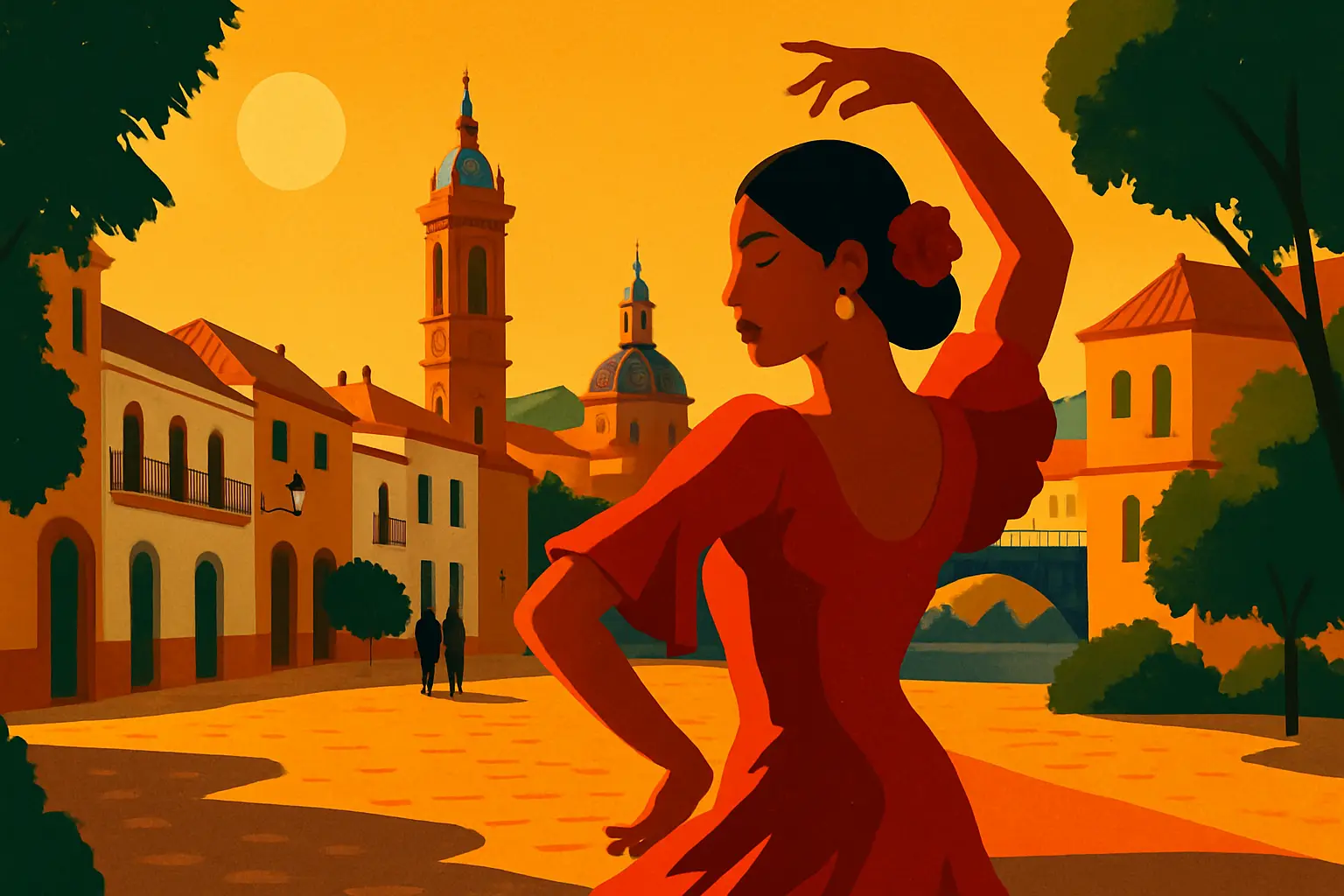
Triana's separateness is not a romantic myth invented for tourists. It was a legal and geographical reality for most of its history. Separated from Seville proper by the Guadalquivir River, the barrio developed under different administrative structures, attracting industries and populations that the wealthier city across the water preferred to keep at a distance. Potters arrived in the medieval period because the river clay was exceptional and because kilns were fire risks best placed outside city walls. Sailors and navigators settled here because the barrio was the last land they touched before the Atlantic expeditions of the 15th and 16th centuries — Amerigo Vespucci and Ferdinand Magellan both departed from or organized voyages through Triana's docks. The Castillo de San Jorge, whose ruins sit beneath the current Mercado de Triana, housed the Spanish Inquisition's tribunal in Seville from 1481 until the institution's abolition in 1820. Thousands of trials and executions took place in those walls, and the castle's moat connected directly to the river, making escape impossible. The Roma community established itself in Triana in significant numbers during the 15th century, following the Pragmática of 1499 — royal edicts that attempted to force Romani people to settle in fixed locations and adopt Spanish trades. Many settled here and became integrated into the ceramic and maritime industries while maintaining their own cultural and musical traditions. By the 18th century, Triana was the acknowledged birthplace of a distinctive flamenco style — deeper, more percussive, and more communally rooted than the forms that developed in the city center. That history of marginalization and creative resilience is precisely what gives the barrio its weight today. The tiles on the walls, the voices in the peñas flamenco clubs, and the market built over an Inquisition prison are not decorative details. They are Triana's actual biography.
Calle Alfarería — the Street of Potters — is the spine of Triana's ceramic quarter, and it has been continuously producing tilework since the 15th century. The craft the workshops practice is rooted in Moorish geometric tradition, transformed after the Reconquista by Christian iconography and later by Renaissance motifs, producing the distinctive Sevillian style that combines bold color fields (cobalt blue, ochre yellow, manganese green) with figurative religious scenes. The standard technique is cuenca (meaning 'basin'), where raised clay ridges separate color pools and prevent glazes from bleeding during firing — a method perfected in Seville by the early 16th century and still used in traditional workshops today. A second technique, cuerda seca ('dry cord'), uses a grease-and-manganese mixture to separate colors, producing flatter, more graphic results. Cerámica Santa Ana, at Calle San Jorge 31, is the oldest continuously operating workshop in Triana, founded in 1870 and still producing hand-painted tiles using wood-fired kilns. The shop floor doubles as a showroom, and staff will explain production processes to visitors without any sales pressure. Pieces range from individual decorative tiles ($18–$45 USD) to full custom commissions for architectural projects. Cerámica Ruiz, on Alfarería 21, specializes in reproduction historical panels — the kind of large narrative tiles that appear on the exterior walls of churches and taverns throughout Andalusia. They accept custom orders and can reproduce historical designs from photographs. For context on how these tiles ended up on Seville's greatest buildings, the Royal Alcázar of Seville provides a vivid counterpoint — much of the palace's most celebrated 20th-century restoration tilework came directly from Triana workshops.
Cerámica Santa Ana — Calle San Jorge 31 | Mon–Fri 10:00 AM–2:00 PM & 5:00–8:00 PM, Sat 10:00 AM–2:00 PM | Individual tiles from $18
Cerámica Ruiz — Calle Alfarería 21 | Mon–Sat 9:30 AM–1:30 PM & 4:30–7:30 PM | Custom panels available
Taller El Ceramista — Calle Antillano Campos 8 | Offers 2-hour tile painting workshops for visitors ($35 per person, book 48 hours ahead)
Get short, interactive stories that make each place easier to remember while you travel.
The most important thing to understand about Triana flamenco is that it predates the tablao format entirely. Before the commercial flamenco venue existed — a concept that dates to Madrid's café cantante era of the 1860s — the music and dance existed exclusively in private homes, courtyards, and the communal gatherings called juergas. Triana's contribution was not merely stylistic but genealogical: the barrio produced interlocking Roma families whose children and grandchildren shaped every major development in flamenco from the 19th century onward. Pastora Pavón Cruz, known as La Niña de los Peines, was born in Triana in 1890 and is widely considered the greatest female flamenco voice in the art's recorded history. Federico García Lorca wrote about her in his famous 1933 lecture on duende — the ineffable emotional force at flamenco's core — describing a performance in Cádiz where she destroyed and rebuilt her own voice mid-song to access something beyond technique. Her family home was on Calle Castilla, and a ceramic plaque marks the location. The Ortega family — including Manuel Ortega Juárez, known as Caracol, and his nephew Juan Ortega — maintained Triana's flamenco identity through the mid-20th century when the Franco regime attempted to sanitize and nationalize the art form into something acceptable for tourism. The regime's version of flamenco emphasized spectacle over authenticity; Triana's peñas kept the rawer tradition alive. Today, the Peña Cultural Flamenca Torres Macarena (Calle Pureza 55) operates as a members' club that hosts public events several times monthly. Admission for non-members at public events runs approximately $8–$12. Check their schedule at the door or via local listings — they do not maintain a reliable online presence, which is itself a statement of intent.
Casa Anselma — Calle Pagés del Corro 49 | No cover, drinks from $4 | Starts after 11:30 PM most nights | No reservations, no website
Peña Cultural Flamenca Torres Macarena — Calle Pureza 55 | Public events $8–$12 | Check schedule posted at door
Teatro Flamenco Triana — Calle Pureza 107 | Formal tablao with guaranteed nightly shows at 7:00 PM & 9:00 PM | Tickets $28–$38 | Book online at teatroflamencotriana.com
The Mercado de Triana, opened in its current iron-and-glass structure in 1823 and renovated in 2010, occupies the site of the Castillo de San Jorge — the fortress that served as the Inquisition's primary operational base in Seville for nearly 340 years. That history is not incidental or hidden: the 2010 renovation incorporated a full archaeological excavation of the castle's foundations, and the resulting Centro de Interpretación Castillo de San Jorge is accessible directly from the market's basement level, free of charge, open Tuesday through Saturday from 11:00 AM to 5:30 PM. The exhibition is serious and well-curated, covering the castle's military origins (it was a 13th-century Almohad fortification before the Castilian conquest), its conversion to Inquisitorial use in 1481, and the documented trials that took place within its walls. Excavated cells, torture chamber foundations, and the watchtower base are visible through glass flooring. The market above is a genuine neighborhood market, not a tourist food hall. About 70 percent of the vendors serve a local clientele — the pescadería (fishmonger) sections are busy by 9:00 AM, the charcutería counters are stacked with jamón ibérico and morcilla de Burgos, and the central bar counter serves draft beer and tapas at prices that haven't adjusted for tourism: a caña (small draft beer) costs $1.50, a plate of coquinas (small clams in garlic and white wine) runs $5. The market closes at 3:00 PM on weekdays and 2:00 PM on Saturdays, after which the neighborhood transitions to siesta and the streets around Calle Pureza become quieter and more residential in character — which is its own reward for visitors willing to linger past the standard tourist schedule.
Calle Betis runs along the eastern bank of the Guadalquivir, directly facing the Torre del Oro and Seville's historic center, and it functions as Triana's most performative street — the place where the barrio presents itself to the city across the water. The view from Calle Betis looking east across the river toward the Torre del Oro and the cathedral's Giralda tower is one of the best urban views in Spain, and it costs nothing. In the evenings from about 8:00 PM onward, the street fills with locals doing the paseo — the slow, social walk that remains a genuine cultural practice in Andalusia rather than a tourist performance. Calle Betis is also where Triana's bar concentration is densest, which creates the paradox that the street simultaneously feels authentic and crowded. The key is timing: arrive before 9:00 PM to find seating and a slower pace; arrive after 11:00 PM to find the street at its most alive. Bar el Tremendo (Calle Betis 56) is the most unassuming and most local of the strip's options — no English menu, fluorescent lighting, excellent boquerones (white anchovies) and cold manzanilla from Sanlúcar de Barrameda, a dry, saline sherry that is the default drink of serious Triana drinkers. A glass of manzanilla runs $2.50; a portion of boquerones, $4. The Isabel II Bridge (locally called the Puente de Triana), connecting Calle Betis to Seville's Arenal district, was designed by French engineers Gustave Steinacher and Ferdinand Bernadet and completed in 1852. It was the first permanent bridge across the Guadalquivir at Seville, ending Triana's centuries of enforced isolation — and, in the barrio's cultural mythology, beginning its slow integration with the city that has been both welcomed and mourned ever since.
Triana's food culture is Andalusian working-class cooking at its most direct — abundant olive oil, fried fish, pulses, offal, and the salt-cured products that sustained sailors and laborers for centuries. It shares the broader Sevillian canon but has a few dishes and preparations it claims specifically. Espinacas con garbanzos (spinach with chickpeas, seasoned with cumin, coriander, and a punch of vinegar) is the barrio's most emblematic tapa, found on nearly every bar menu and reaching its best version at Bar Santa Ana on Plaza de Santa Ana — an outdoor square that is Triana's de facto social center, ringed by orange trees and the 13th-century Iglesia de Santa Ana, the oldest church in Seville, begun in 1280 under Alfonso X. A portion of espinacas con garbanzos at Bar Santa Ana costs $3.50. Cazón en adobo — dogfish marinated in a spiced vinegar and oregano brine, then fried — is another Triana staple, part of the broader Andalusian tradition of pescaíto frito (fried fish) that connects the interior of Seville to its Cádiz coast influences. The marinade is essential: it tenderizes the firm flesh and adds an acidic brightness that cuts the oil. For a full meal rather than tapas, Restaurante El Faro de Triana (Calle Pureza 7) serves traditional Sevillian cuisine at moderate prices — a three-course lunch menu (menú del día) runs $14–$17 including wine, bread, and dessert, available Monday through Friday until 4:00 PM. The restaurant's dining room is small (about 30 covers), and it fills with neighborhood workers by 2:00 PM, so arrive early or book ahead by phone.
Bar Santa Ana — Plaza de Santa Ana | Espinacas con garbanzos $3.50 | Open daily 8:00 AM–midnight
Bar el Tremendo — Calle Betis 56 | Boquerones $4 | Manzanilla $2.50 | Open from 1:00 PM daily
Restaurante El Faro de Triana — Calle Pureza 7 | Menú del día $14–$17 | Mon–Fri lunch until 4:00 PM | Reservations recommended
Triana is best experienced across multiple shorter visits rather than one long day, but if you have only one morning or one evening, the evening (starting around 7:00 PM) wins easily. The ceramic workshops will be closed, but the market's bar counters, the riverside paseo on Calle Betis, and the possibility of ending the night at Casa Anselma create a more coherent and genuinely Trianero experience than a daytime tour. When to go: September and October offer the best balance of manageable heat (daily highs around 78–86°F vs. July's 100°F+) and full neighborhood activity. Avoid August if possible — many local-owned bars and workshops close for their own vacations, leaving the tourist infrastructure running at full speed in a barrio that is more interesting without it. The Velá de Santa Ana, Triana's neighborhood festival held in the last week of July, is the exception: it is one of the last genuinely local Sevillian festivals, with processions, river crossings, and flamenco performances organized by and for the barrio rather than for visitors.
Getting there: Walk across the Puente de Triana from the Arenal district (10 minutes from the cathedral). Bus lines C3 and C4 stop at Plaza del Altozano. No metro access.
Best entry point: Plaza del Altozano, where the bridge meets Triana — orientation square with the market immediately to your right.
Skip: The souvenir ceramic shops on the bridge approaches sell mass-produced, kiln-imported tiles from Portugal and Asia. Go directly to Calle Alfarería or Calle San Jorge for genuine Triana production.
Dress code for flamenco venues: Smart casual at minimum for Teatro Flamenco Triana; no dress code at Casa Anselma, but avoid beachwear.
Language: English is less spoken here than in central Seville. A few phrases in Spanish — 'una caña, por favor,' 'qué recomienda usted' — go a very long way and are received with genuine warmth.
Budget per person for a full day: $60–$90 including market lunch, one ceramic piece, drinks on Calle Betis, and admission to Teatro Flamenco Triana. Casa Anselma cuts this significantly if you substitute it for the formal tablao.