Historians sometimes describe La Movida Madrileña as Spain's punk moment, but that framing undersells how specifically political it was. After 36 years of Francoist censorship — which banned everything from foreign films to the public display of affection — the sudden death of Franco in 1975 and the transition to democracy under King Juan Carlos I created a vacuum that young Madrileños filled with extraordinary speed and intensity. The period between roughly 1977 and 1985 saw an explosion of music, cinema, fashion, photography, and sexual liberation that had no direct precedent in Spanish culture.
Malasaña became the geographic center of this explosion for practical reasons. Rents were cheap. The apartment buildings were old and the landlords disorganized, which meant artists could rent studios without scrutiny. The district had no prestige to protect — unlike the bourgeois Barrio de Salamanca to the east — and so it attracted people who had nothing to lose and everything to express.
The movement's most lasting figure was Pedro Almodóvar, who lived and worked in Malasaña during the late 1970s and early 1980s, before international success moved him upmarket. His early Super-8 films were screened in the back rooms of bars on Calle del Pez and Calle de San Vicente Ferrer. The musician and cultural icon Alaska (Olvido Gara) fronted the band Kaka de Luxe here, a group that many consider the founding act of Spanish punk. The photographer Alberto García-Alix, now internationally recognized, documented the neighborhood's drug-fueled, ecstatic, and often tragic scene in black-and-white images that remain the most honest visual record of La Movida.
Critically, La Movida was not purely hedonistic. It was a deliberate rejection of everything Francoism had enforced: sobriety, heteronormativity, Catholic moral order, and cultural isolation from the rest of Europe. Every drag performance and every punk gig was, in its way, a political act — even when the performers would have laughed at that description. Understanding this context makes Malasaña far more interesting than any surface-level guide to its coffee shops can convey.
Malasaña is bounded roughly by Gran Vía to the south, Calle de Fuencarral to the east, Calle de Alberto Aguilera to the north, and Calle de San Bernardo to the west. Within that rectangle, three streets do the most historical work.
Calle del Pez was the artery of La Movida. It connected cheap flats to cheaper bars, and it was where the informal cultural economy operated — someone would chalk a concert date on a wall, and two hundred people would show up. Today it has been partially colonized by brunch restaurants aimed at foreign visitors, but the building at No. 21 still bears the architectural bones of a 1970s social club that hosted underground events. The bar El Palentino at No. 8 has been open since before La Movida and serves the same unembellished vermouth and house wine it always has, for prices that feel like a historical artifact.
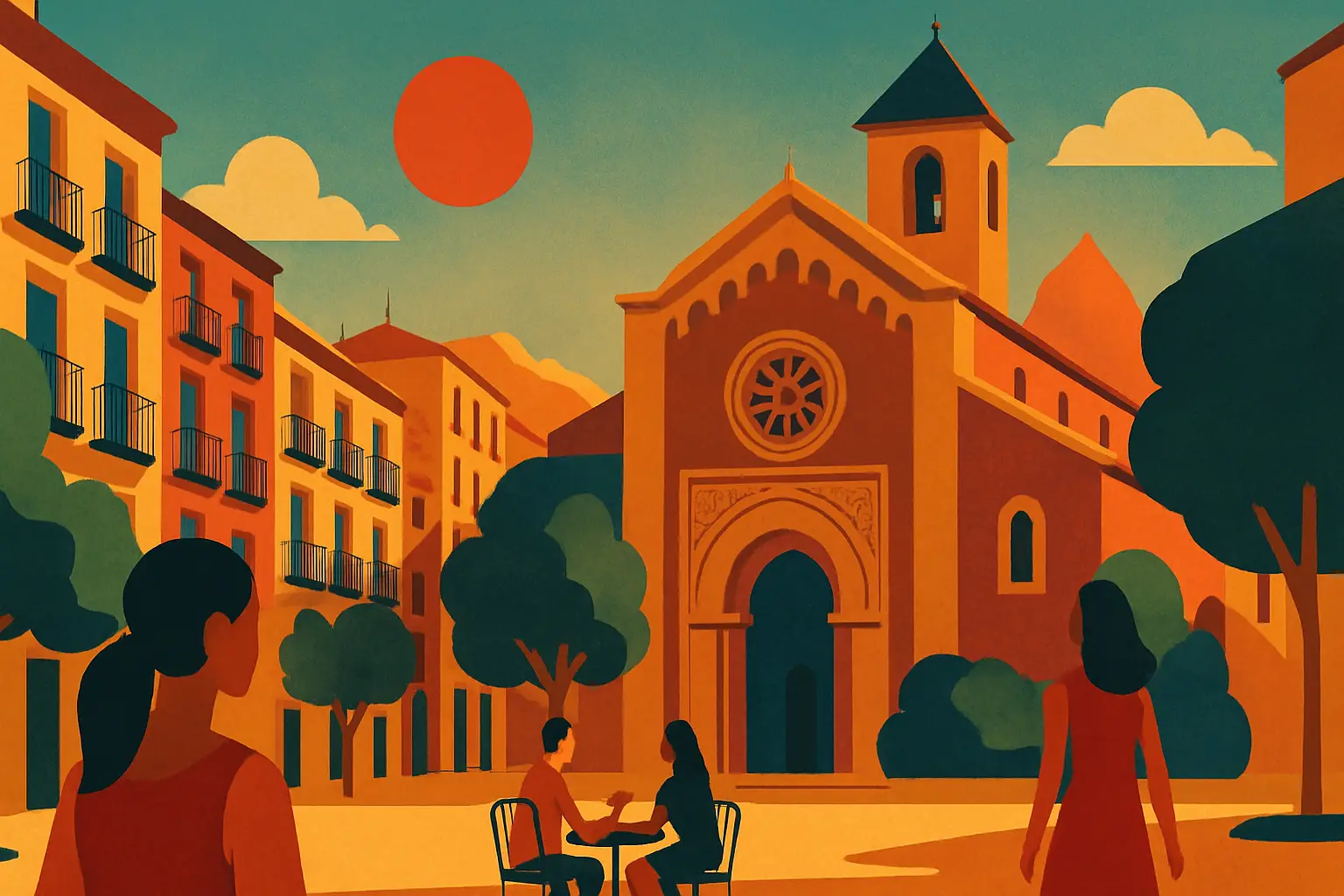
Plaza del Dos de Mayo is the neighborhood's symbolic heart, named for the 1808 uprising against Napoleonic troops — a date that tells you something about how Madrileños understand resistance. During La Movida, the plaza functioned as an open-air living room after dark. Today it still does, though the people drinking there are younger and photographing themselves doing it. The Cuartel de Monteleón gate, the last standing remnant of the artillery barracks where Spanish troops made their stand in 1808, frames the southwestern corner of the plaza.
Calle de San Vicente Ferrer running north from the plaza is where the neighborhood's most intact La Movida-era bar culture survives. The Libertad 8 venue (Calle de la Libertad, 8, technically one block east in Chueca but historically linked to the Malasaña scene) hosted the kind of performances that defined the era. On San Vicente Ferrer itself, small galleries and independent bookshops continue a tradition of cultural commerce that dates to the 1980s, though the economics are considerably more precarious now.
Get short, interactive stories that make each place easier to remember while you travel.
Malasaña's food and drink culture is inseparable from its social function. These are not restaurants designed to showcase regional cuisine in the way that a Basque or Catalan dining room might be. They are places designed for long evenings, loud conversation, and the careful management of time between 9 p.m. and 3 a.m.
Vermut (vermouth) is the drink that defines the neighborhood's afternoon ritual. Served from the tap — never a bottle — with a slice of orange and an olive, it is ordered at around 1 p.m. on weekends as a prelude to lunch, or at 7 p.m. on weekdays as a transition between work and dinner. Bodega de la Ardosa at Calle de Colón, 13 has been serving vermouth on tap since 1892 and is one of the few bars in the neighborhood that has genuinely not changed its formula or its prices disproportionately. Expect to pay around €2.50 for a glass.
**El Palentino** — Calle del Pez, 8. Cash only, no reservations, serves bocadillos and house wine. A caña (draft beer) costs approximately €1.80. Opens daily from noon.
**Bodega de la Ardosa** — Calle de Colón, 13. Tap vermouth, excellent patatas bravas, and a façade unchanged since the early 20th century. Open Mon–Fri 8 a.m.–2 a.m., weekends 11 a.m.–2:30 a.m.
**La Bicicleta Café** — Plaza de San Ildefonso, 9. A post-Movida institution that manages to feel unhurried despite consistent popularity. Good for breakfast or afternoon coffee (~€2.50 for a cortado). Open daily 9 a.m.–midnight.
**Bar Maravillas** — Calle de San Andrés, 33. Live music several nights per week, a direct link to the neighborhood's underground music tradition, and cocktails priced around €8–€10.
**Taberna La Carmencita** — Calle de la Libertad, 16. Madrid's oldest surviving taberna, founded in 1850, with a tiled interior that has appeared in period films. Cocido madrileño (Madrid's signature chickpea stew) runs approximately €18 per person.
No single figure is more identified with La Movida than Pedro Almodóvar, and no single figure did more to give the movement international legibility. Born in La Mancha in 1949, Almodóvar moved to Madrid in 1967, took a job with the national telephone company to pay rent, and spent his evenings making Super-8 films with friends who were willing to act for free. By the late 1970s, he was screening these films in Malasaña's bars and becoming a recognizable face in the neighborhood's social circuit.
His early feature films — Pepi, Luci, Bom y otras chicas del montón (1980) and Laberinto de pasiones (1982) — were shot almost entirely in Malasaña and its surrounding streets, and they function as accidental documentaries of the era. The humor is anarchic, the sexuality explicit, the aesthetics chaotic and deliberate simultaneously. Watching them today, you see a neighborhood that has been demolished and rebuilt, gentrified and mythologized, but whose social geography Almodóvar preserved with precision.
What is often missed in the Almodóvar mythology is how local and communal his early work was. He was not a solitary genius but a figure embedded in a specific social scene — friends with Alaska, collaborating with the actress Carmen Maura, drawing on the lived experience of people who actually inhabited those streets. His later, internationally acclaimed films — Women on the Verge of a Nervous Breakdown (1988), All About My Mother (1999), Talk to Her (2002) — retain their Madrid roots, but Malasaña had already given them their original grammar.
For visitors who want to trace this lineage, the area around Calle de la Luna and Calle del Espíritu Santo preserves the closest approximation to the streetscape Almodóvar filmed. The Filmoteca Española, located at Calle de Magdalena, 10 in Lavapiés (a short metro ride south), screens retrospectives of his work and broader Spanish cinema regularly — check their program at filmotecaespañola.gob.es.
Malasaña did not escape the pattern that has reshaped creative neighborhoods across European cities. By the early 2000s, the cheap rents that had made the district's creative culture possible were rising rapidly. By 2010, the neighborhood that had once housed artists and working-class families was attracting young professionals, international transplants, and the kind of boutique retail that signals a neighborhood's transition rather than its vitality.
The process accelerated after the 2008 financial crisis, which is counterintuitive until you understand the mechanism: the crisis depressed wages and salaries across Spain, making Malasaña's relative affordability attractive to a new cohort of younger Madrileños who could no longer afford the Barrio de Salamanca but refused to live outside the ring road. This cohort brought different tastes — specialty coffee, natural wine, vintage clothing — and a different relationship to the neighborhood's history, treating La Movida as aesthetic inspiration rather than lived experience.
What has genuinely survived is the social infrastructure of the street. Unlike many gentrified European neighborhoods, Malasaña still has a functioning resident population that uses the plazas, argues with the local government about noise ordinances, and maintains the kind of density that prevents any single commercial interest from dominating the streetscape. The Asociación de Vecinos de Malasaña, the neighborhood residents' association, has been active in resisting the conversion of residential buildings into tourist apartments — a battle that is ongoing and imperfectly resolved.
The independent bookshops are fewer than they were but not extinct. La Central de Callao (Calle del Postigo de San Martín, 8) and Desperate Literature (Calle de Campomanes, 13, technically just south of Malasaña but philosophically continuous with it) both maintain serious literary programming. The music venues have thinned, but Sala El Sol at Calle de los Jardines, 3 — which opened in 1979 and hosted some of La Movida's defining concerts — continues to book live music most nights of the week.
Malasaña does not exist in isolation. It is one district in a city that has been the political and cultural capital of Spain since Felipe II moved the royal court to Madrid in 1561 — a decision that transformed what had been a minor Castilian market town into one of Europe's great imperial capitals within a generation. Understanding Malasaña properly requires at least a working knowledge of how Madrid organizes itself.
The city's districts form a series of concentric cultural rings outward from the Palacio Real and the medieval city. Lavapiés, immediately south of the center, is Madrid's most genuinely multicultural neighborhood and the city's current center of experimental theatre and contemporary art — it is where Malasaña's creative energy has partly migrated as rents have risen. Chueca, immediately east of Malasaña, emerged from the same La Movida milieu but developed specifically as Madrid's LGBTQ+ district, a story that also begins in the late 1970s and the particular freedoms that followed Franco's death.
For a broader understanding of Spanish cultural history, the Prado Museum's permanent collection traces the visual culture that preceded La Movida by several centuries — including the Francisco de Goya works that established Madrid's particular relationship between art and political violence. The Reina Sofía Museum at Calle de Santa Isabel, 52, which houses Picasso's Guernica and a substantial collection of 20th-century Spanish art, is the institutional home most directly relevant to understanding the cultural context that La Movida emerged from and reacted against. General admission is €12; free on Monday afternoons (2:30–9 p.m.), Wednesday afternoons, and Sunday afternoons.
Malasaña is also a useful entry point for understanding Spanish regional identity — because what La Movida expressed was not just freedom from Francoism but a specifically Castilian, urban, cosmopolitan identity that was distinct from the regional nationalisms flowering simultaneously in Catalonia and the Basque Country.
Malasaña rewards unhurried visitors who are willing to operate on Madrid's schedule — which means late lunches, long afternoons, and dinners that do not begin before 9 p.m. The neighborhood is compact enough to cover entirely on foot, and the best experiences are the ones that cannot be booked in advance.
**Best months to visit:** May, June, and September offer warm evenings without July and August heat (which can reach 38°C/100°F). The neighborhood's street culture peaks in late spring and early autumn.
**Avoid:** Saturday afternoons in July and August, when tourist density on Plaza del Dos de Mayo and Calle de Fuencarral makes the streets feel more like a theme park than a neighborhood.
**Daily budget (mid-range):** €50–€80 covers two meals, drinks throughout the day, and museum admission. Budget travelers can eat and drink well on €30 by using the €12–€14 menú del día (three-course lunch with wine) offered by most sit-down restaurants Monday through Friday.
**Must-see in 3 hours:** Start at Bodega de la Ardosa for vermouth (Calle de Colón, 13), walk west to Plaza del Dos de Mayo, turn south down Calle del Espíritu Santo, turn onto Calle del Pez, finish at El Palentino (No. 8) with a bocadillo.
**Sala El Sol concerts:** Doors typically open at 9 p.m., shows begin at 10:30 p.m. Tickets range from €8–€20 depending on the act. Check their schedule at elsolmadrid.com.
**Language:** English is spoken in most bars and cafés but not universally. Basic Spanish phrases — 'una caña, por favor' (a beer, please), 'la cuenta' (the bill) — go a long way and are appreciated.
**Safety:** Malasaña is safe by any major European city standard. Standard precautions apply at night: watch your phone on Plaza del Dos de Mayo when it is crowded, and be aware of pickpockets on Gran Vía.