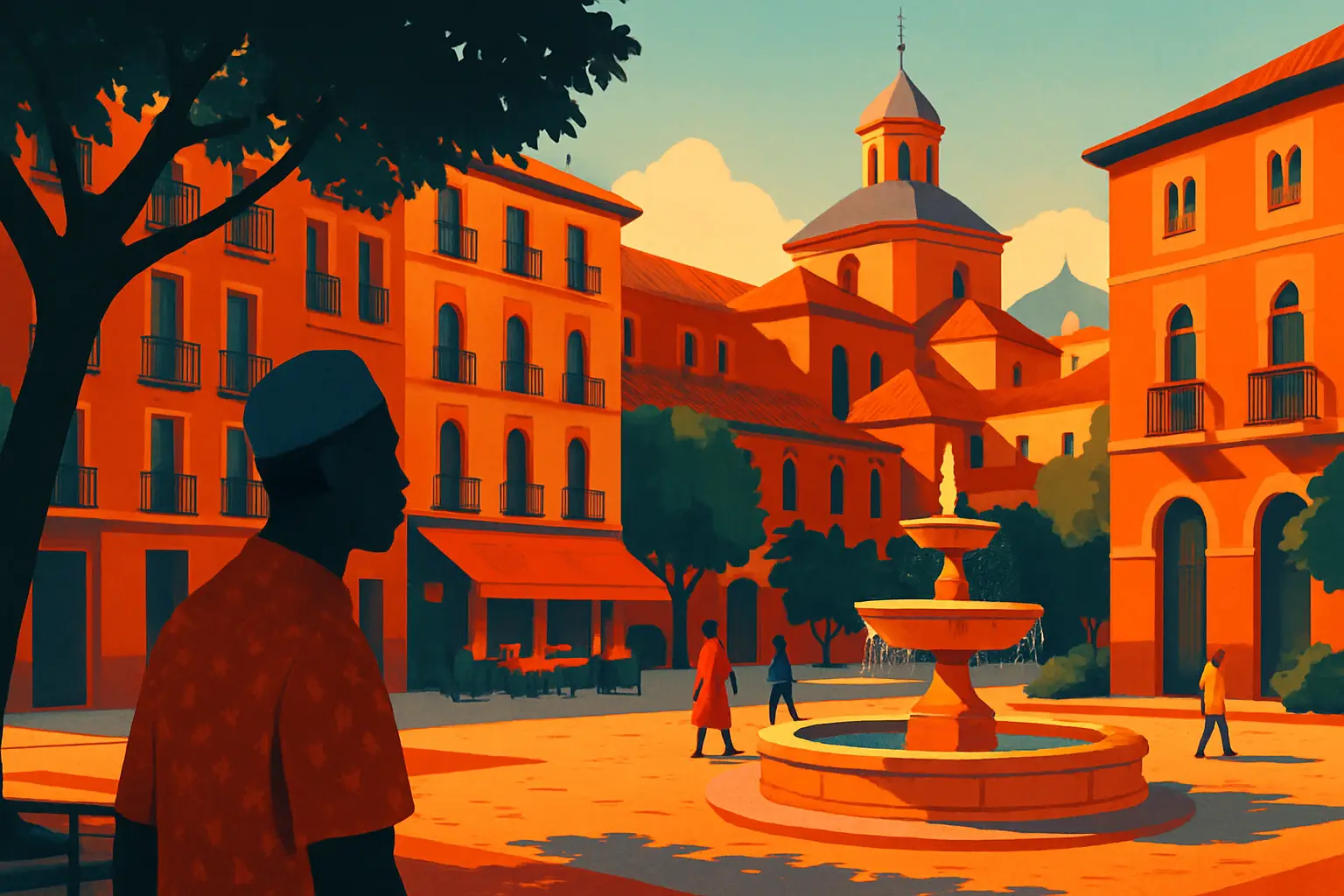
The neighborhood's name is itself a historical artifact. Lavapiés — literally "wash feet" — almost certainly derives from a fountain at the quarter's entrance where Jewish residents were required to wash before entering the broader city, a humiliation codified into the urban geography of medieval Madrid. The aljama that occupied this hill from at least the 13th century was one of the most significant Jewish communities in Castile, and the street grid you walk today still follows its medieval logic: narrow, curved lanes that were designed for a community living under constant surveillance rather than for efficient movement.
When Ferdinand and Isabella issued the Alhambra Decree in 1492, expelling all Jews from Spanish territory, Lavapiés did not empty — it transformed. Many converted Jews, known as conversos, remained and attempted to assimilate into Christian Madrid. The Inquisition, however, treated the neighborhood with particular suspicion for generations afterward, associating its residents with impure blood. This history of being considered *other* within the city never fully left the barrio's cultural identity.
By the 18th century, Lavapiés had become the stronghold of the manolos — Madrid's urban working class, famous for their elaborate fashion and fierce local pride. The playwright Ramón de la Cruz immortalized them in his *sainetes*, short comic plays performed at the Teatro del Príncipe (now the Teatro Español, just north of the barrio). These were people who worked the city's trades — cobblers, water carriers, knife grinders — and who developed a collective identity so vivid that noble families started dressing like them, a phenomenon the sociologist Julio Caro Baroja later called *majismo*.
That working-class identity survived industrialization, the Civil War, and Franco's Madrid. It is the reason why, when property developers arrived in force after Spain's 2008 economic recovery, they found residents already organized, already historically literate about their own displacement, and disinclined to leave quietly.
Almost nothing of the medieval Jewish quarter survives above ground, which makes the traces that do remain genuinely arresting. The Sinagoga del Patio, a prayer space that operated inside a private courtyard on what is now Calle de la Fe (Street of Faith — the name itself is a post-1492 imposition), was converted to a church in the 16th century and is now a community center. The street name is the monument.
The Calle de la Cabeza — Street of the Head — carries one of the more disturbing origin stories in Madrid's toponymy. Local tradition, recorded by the 17th-century writer Jerónimo de Quintana, holds that the name commemorates a severed head found in the street, supposedly belonging to a victim of sectarian violence during the Inquisition years. Historians dispute the specifics, but the street has carried the name since at least 1600.
More concretely, the Museo Nacional Centro de Arte Reina Sofía, which sits on the northern edge of Lavapiés at Calle de Santa Isabel 52, was built on the site of the Hospital General de Madrid, established in 1566. Before that, the land was part of the Jewish quarter's boundary. The museum itself — home to Picasso's Guernica, one of the most politically charged paintings in Western art — feels appropriate for a neighborhood with this particular history of power and resistance. Admission is €14 for adults (free Tuesday evenings after 7 PM and Sunday afternoons after 3 PM).
For visitors who want to understand Madrid's Jewish history more fully before exploring the neighborhood, our guide to Madrid's medieval layers traces the broader city context from the 9th century forward.
Get short, interactive stories that make each place easier to remember while you travel.
The transformation of Lavapiés into a multicultural neighborhood happened gradually from the 1980s onward, accelerating sharply after Spain joined the European Union in 1986 and again during the economic boom of the 1990s and early 2000s. The mechanism was simple and familiar: cheap rents in a central location attracted immigrants who were priced out of other central districts. What distinguished Lavapiés from similar processes in other European cities was the sheer diversity of origin — not a single dominant immigrant community but dozens, each establishing businesses, social clubs, and places of worship within a few blocks of each other.
Bangladeshi restaurants and grocery shops cluster particularly on Calle de Embajadores and Calle del Ave María. The Moroccan community runs several of the neighborhood's best tea houses, including Tetería Al-Alua on Calle de la Fe 4 — a dim, ornate room where a pot of fresh mint tea costs about $3 and where the pastillas (Moroccan pastries) are made in-house. It opens daily from around noon to midnight.
Senegalese tailors, Chinese wholesale textile businesses, and Pakistani halal butchers occupy adjacent shopfronts on Calle de Mesón de Paredes, arguably the most demographically diverse single street in Madrid. Walk its full length (about 400 meters, from Embajadores to Tirso de Molina) at midday and you will hear five or six languages without trying.
This diversity is not decorative or tourist-facing. It is the actual economic and social fabric of the neighborhood, which is why Lavapiés residents have consistently resisted the particular kind of gentrification that converts multicultural barrios into themed versions of themselves. The Asamblea Popular de Lavapiés, a neighborhood assembly active since the early 2000s, has successfully blocked several large hotel development proposals and lobbied the Madrid city government for protected affordable housing. Their office is on Calle del Olivar 2 and their meetings are open to residents.
Eating in Lavapiés rewards patience and willingness to walk past the obvious. The terraza-lined Calle de Argumosa is pleasant but increasingly tourist-oriented; the real eating happens one or two blocks in any direction from the main plaza.
Taberna La Dolores de Lavapiés on Calle de Amparo 22 has been serving vermouth and cured meats since 1925. The vermouth here is house-poured from a barrel — about $2.50 a glass — and the anchovies are from Cantabria. It opens at noon and closes when the regulars leave, which is usually around midnight on weekends. Cash only.
El Clandestino on Calle del Barquillo 34 (technically just north of the barrio boundary but historically connected to the Lavapiés scene) is a music bar that opened in 1994 and became the template for the neighborhood's indie cultural identity — live music most nights, no cover, beer for about $3.50.
La Bientirada on Calle de Miguel Servet 15 is the address for traditional Castilian food done without pretension: *cocido madrileño* (the three-course chickpea stew that is Madrid's signature dish) served Tuesdays and Thursdays for about $14 per person including the broth course. Reserve at least two days ahead.
For Bangladeshi food, Restaurante Dhaka on Calle de Embajadores 64 serves a lunch menu (fish curry, rice, dal) for $9 including a drink — one of the best-value sit-down meals in central Madrid.
The Mercado de San Fernando on Calle de Embajadores 41 is a covered market that avoided the tourist food-hall format that overtook San Miguel and La Paz. It opens Monday–Saturday 9 AM–2 PM and again 5–9 PM. Go for the cheese vendor near the south entrance, the natural wine stall run by a cooperative from Extremadura, and the Moroccan dried fruits stand near the main entrance.
Taberna La Dolores de Lavapiés — Calle de Amparo 22 | Vermouth from $2.50 | Open daily noon–midnight | Cash only
Tetería Al-Alua — Calle de la Fe 4 | Mint tea $3, pastillas $2 | Open daily noon–midnight
La Bientirada — Calle de Miguel Servet 15 | Cocido madrileño (Tue/Thu) $14 | Reserve 48 hours ahead
Restaurante Dhaka — Calle de Embajadores 64 | Lunch menu $9 | Open daily 1–4 PM, 8–11 PM
Mercado de San Fernando — Calle de Embajadores 41 | Mon–Sat 9 AM–2 PM & 5–9 PM | Free entry
One of Lavapiés's least-publicized distinctions is that it hosts a disproportionate concentration of Madrid's alternative theater venues — not the subsidized national theater circuit, but the scrappier, more experimental spaces that have driven Spanish contemporary performance since the 1980s.
La Cuarta Pared at Calle de Ercilla 17 has been one of Spain's most respected laboratories for contemporary dance and physical theater since 1984. It seats around 150 people and programs works by emerging Spanish and international companies; tickets typically run $12–18. The box office opens 90 minutes before each performance.
Teatro del Barrio at Calle de Zurita 20 is explicitly political by design — it was founded in 2014 by a collective that included actors affiliated with the *Podemos* political movement, and its programming reflects that: new Spanish plays that engage with economic inequality, migration, and historical memory. Tickets are kept deliberately affordable at $8–12, and post-show debates (*coloquios*) with the cast are a regular feature.
El Umbral de Primavera on Calle del Tribulete 15 functions as a cultural space somewhere between a theater, a music venue, and a community meeting room. It programs flamenco evenings (not the tourist-circuit kind — these are serious artists playing to knowledgeable audiences), experimental music, and spoken word. Tickets for flamenco evenings are typically $10–15 and should be purchased online at least a week in advance.
The concentration of these spaces in one neighborhood is not accidental. Cheap rehearsal rents, a local audience that actually attends theater, and a long tradition of political organizing have made Lavapiés Madrid's equivalent of off-off-Broadway — which is to say, the place where the most interesting work happens, not the most famous.
La Cuarta Pared — Calle de Ercilla 17 | Tickets $12–18 | Box office opens 90 min before performance | lacuartapared.com
Teatro del Barrio — Calle de Zurita 20 | Tickets $8–12 | Post-show debates most evenings | teatrodelbarrio.com
El Umbral de Primavera — Calle del Tribulete 15 | Flamenco $10–15 | Book 1 week ahead | elumbral.com
Lavapiés has no official outdoor art program. That is precisely what distinguishes its murals from the sanitized street-art trails installed by city councils in other European neighborhoods. The walls here function as a genuinely contested public medium — commissioned by building owners, painted by residents, covered by authorities, repainted by activists, sometimes all within the same month.
The largest and most photographed work is the full-building mural on the north-facing wall of the Mercado de San Fernando on Calle de Embajadores, repainted in 2023 by the Madrid-based collective Boa Mistura (the group also responsible for large-scale works in São Paulo and Johannesburg). It depicts abstract forms in ochre and terracotta that echo the market's early-20th-century tile work inside.
On Calle del Mesón de Paredes, between the intersections with Embajadores and Calle del Sombrerete, a sequence of smaller works by different artists forms an unofficial gallery wall. Several reference the 2017 Lavapiés uprising, when the death of a Senegalese street vendor named Mame Mbaye during a police chase triggered three nights of protests and brought international attention to the treatment of immigrant vendors by Madrid authorities. His face appears in at least four murals in the neighborhood.
For visitors approaching this area from the Reina Sofía — where Picasso's Guernica depicts the bombing of a Basque town in 1937 — there is a coherent thread worth following: art as documented resistance, from oil on canvas to spray on plaster. The walk from the museum's main entrance on Calle de Santa Isabel to the heart of the mural district on Mesón de Paredes takes about eight minutes on foot and crosses three centuries of that tradition.
Related reading: Guernica and the art of Spanish political protest traces the painting's full history from Pamplona commission to Paris premiere to its eventual installation in Madrid.
Lavapiés is a neighborhood for afternoons and evenings — the kind of place that opens slowly and intensifies. If you have only three or four hours, the following sequence works well in any season.
Start at the Reina Sofía (Calle de Santa Isabel 52) — open Tues–Sat 10 AM–9 PM, Sun 10 AM–7 PM, closed Mon. Budget 90 minutes minimum for Guernica and the permanent collection. Tickets $14 (free Tues after 7 PM, Sun after 3 PM).
Walk south on Calle de Santa Isabel to Plaza de Lavapiés (5 min). The plaza is the barrio's social center — sit on the steps at the edge and watch before moving on.
Continue to Mercado de San Fernando on Calle de Embajadores 41. Grab a drink at the natural wine stall, look at the mural on the north wall. Open Mon–Sat 9 AM–2 PM & 5–9 PM.
Walk Calle del Mesón de Paredes from north to south (15 min) for the mural sequence. Stop for tea at Tetería Al-Alua (Calle de la Fe 4) mid-walk.
End at Taberna La Dolores de Lavapiés (Calle de Amparo 22) for vermouth. If it's a Tuesday or Thursday and you planned ahead, book dinner at La Bientirada (Calle de Miguel Servet 15) for 9 PM.
For theater: check Teatro del Barrio (Calle de Zurita 20) and La Cuarta Pared (Calle de Ercilla 17) for evening programming. Both venues are within 8 minutes' walk of the plaza.
Getting there: Metro Line 3 (green) to Lavapiés station, or Line 1 (light blue) to Tirso de Molina and walk 7 minutes south. Avoid driving — the streets are narrow, parking is nearly impossible, and the walk from either metro stop is part of the experience.
Best months: September–November for the full cultural season (theater, music, outdoor markets). July–August is quieter — some venues close for summer break — but the street life continues and evening temperatures make the outdoor taberna culture particularly pleasant.
Budget guideline: vermouth + market wine + dinner at La Bientirada with drinks = approximately $30–35 per person, one of the best-value evenings in central Madrid.