The Nasrid dynasty came to power in Granada in 1238, at the precise moment that most of Al-Andalus was collapsing. Muhammad I ibn al-Ahmar — the founder — took Granada not because he was the most powerful Muslim ruler in Iberia, but because he was the most pragmatic. When Ferdinand III of Castile was sweeping south, Ibn al-Ahmar struck a deal: he would become a vassal of Castile and even provide troops to help conquer Seville in 1248 in exchange for being left alone in Granada. The arrangement was humiliating by the standards of political theology, and the Nasrids knew it. Their dynastic motto — 'there is no victor but God' — was as much a statement of theological consolation as it was a political declaration.
The Emirate of Granada that resulted from this compromise lasted 250 years, from 1238 to 1492, and became the most sophisticated and culturally refined state in 15th-century Iberia. Granada's population grew to roughly 50,000, making it one of Europe's larger cities. It exported silk through a trade network that reached North Africa and the eastern Mediterranean. Its court attracted scholars, poets, and theologians fleeing the Christian reconquest further north.
The Alhambra complex on the Sabika Hill above the city was not built all at once. It accumulated across seven sultans over roughly 130 years. The Nasrids built the Alcazaba fortress first — the military platform visible on the western end of the hill — and then progressively added residential, ceremonial, and administrative palaces. The three Nasrid Palaces that survive today — the Mexuar, the Comares Palace, and the Palace of the Lions — represent the reigns of Yusuf I (1333–1354) and his son Muhammad V (1354–1359, 1362–1391), the dynasty's two greatest builders. Understanding that these spaces were built under existential pressure, by a dynasty surrounded on all sides and fully aware of its precariousness, is the key to reading them correctly.
The tiled dados that line the lower walls of the Nasrid Palaces — the zellij panels of geometric mosaic — are often described as decorative in tour books, and this undersells them badly. Islamic artistic tradition, particularly in its Andalusian form, treated geometric pattern as a form of theology. Because figural representation of the divine was prohibited, mathematically infinite pattern became the artistic analogue for the infinite nature of God. The more complex and self-repeating the geometry, the closer the artwork approached the divine attribute of limitlessness.
The tilework at the Alhambra is among the most mathematically sophisticated surface geometry produced in the medieval world. Crystallographers studying the palace in the 20th century identified 13 of the 17 theoretically possible wallpaper symmetry groups — mathematical classifications of how a pattern can tile a flat surface — present across the Alhambra's surfaces. This wasn't accidental. The Nasrid craftsmen, working within a tradition of geometric theory transmitted from Greek mathematics through Arabic scholarship, were deliberately exploring the edges of what flat pattern could do.
The stucco plasterwork above the tile dados operates by different but related principles. The carved relief panels use a technique called arabesque — interlacing vegetal forms that branch and recurve without terminating — to create the same effect of visual infinity. At the Sala de las Dos Hermanas (Hall of the Two Sisters), the dome above the fountain is formed from an extraordinary muqarnas (stalactite vault) of 5,000 individual plaster cells arranged in 16 tiers. The 14th-century poet Ibn Zamrak, whose verses are inscribed in the frieze below it, described the ceiling as 'a garden where the fruits of the stars are plucked.' That's not poetry for its own sake — it's an accurate description of how the space was intended to be read: as a terrestrial version of the celestial garden promised by the Quran.
The nastaliq and thuluth calligraphic scripts carved into the plaster friezes carry Quranic verses, poems, and the dynastic motto. On the walls of the Hall of the Ambassadors inside the Comares Tower, the inscriptions explicitly identify the sultan as the representative of divine authority on earth — a political claim made in the most durable medium available.
Get short, interactive stories that make each place easier to remember while you travel.
The Patio de los Arrayanes (Court of the Myrtles) is the centerpiece of the Comares Palace, and it was designed from the ground up as a stage for political performance. The rectangular pool — 34 meters long, lined with two hedges of clipped myrtle — functions as a mirror that doubles the reflection of the Comares Tower at its northern end, making the tower appear taller than its actual 45 meters. This was deliberate. Visitors approaching the tower for an audience with the sultan would see his residence magnified, its image seemingly reaching into the sky.
The Hall of the Ambassadors (Salón de los Embajadores) inside the Comares Tower was the throne room of the Nasrid sultans, the largest single room in the Alhambra at roughly 11 meters square and 18 meters high. Foreign delegations — Castilian, Aragonese, Moroccan, Ottoman — were received here. The cedar ceiling above the throne represents the seven heavens of Islamic cosmology, with a central octagonal star symbolizing the divine throne described in the Quran. The sultan seated below it was positioned, architecturally, as a figure placed beneath heaven itself, a visual argument for his authority that worked regardless of the visitor's language.
The walls of this hall contain over 150 individual window niches with carved plaster screens — mashrabiyya work — that control light and airflow simultaneously. Granada's summer temperatures regularly exceed 38°C (100°F), and the Nasrid architects deployed the courtyard's long pool and these screened openings as a passive cooling system of considerable sophistication. The myrtle hedges retain moisture that evaporates in the heat, lowering the ambient temperature in the courtyard by several degrees. Comfort was political here too: a sultan who could offer shade and cool air in a Granadan July was demonstrating a form of mastery over the environment.
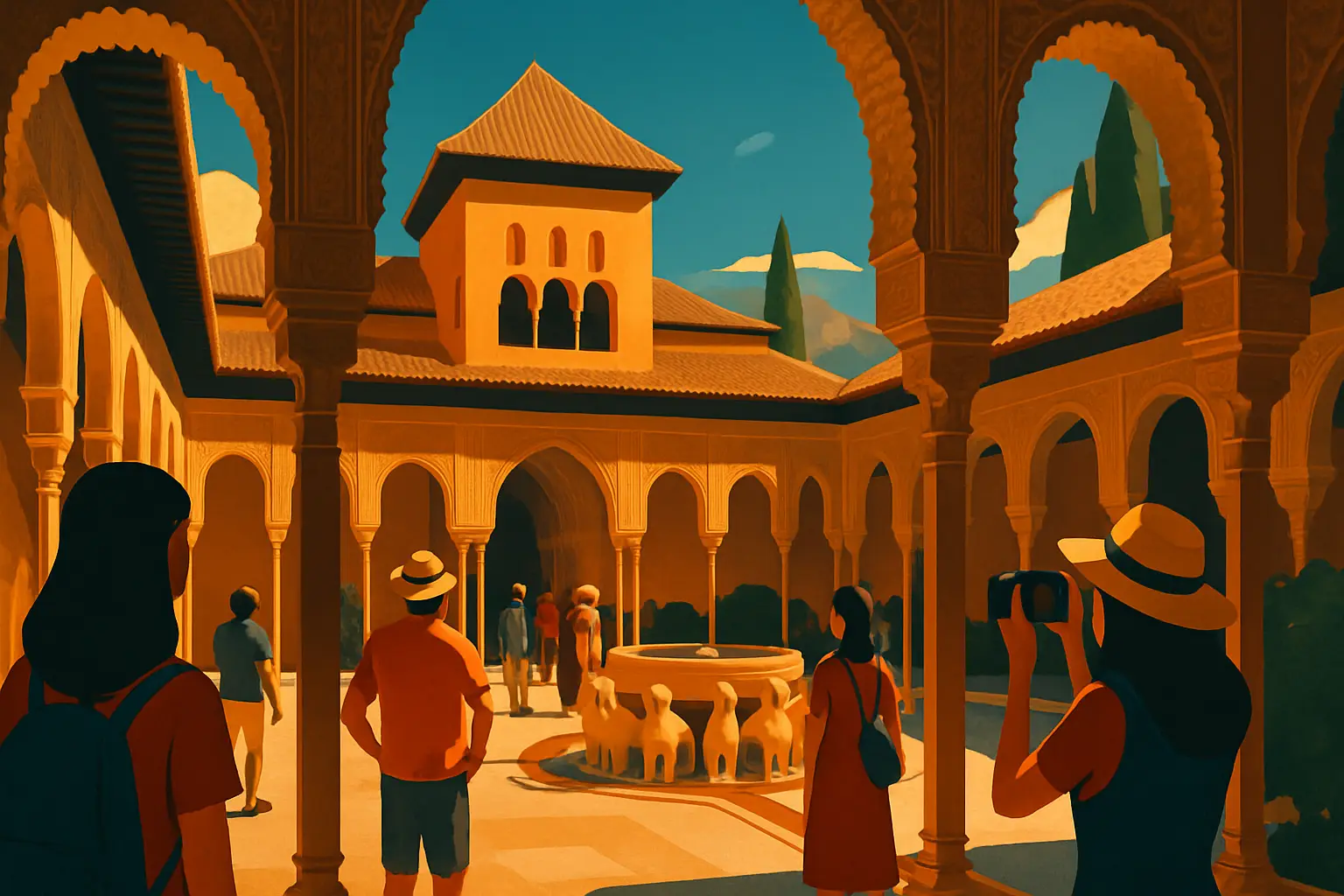
The Patio de los Leones (Court of the Lions) was built by Muhammad V between approximately 1370 and 1380 and has no precise parallel in medieval Islamic architecture. Its 124 slender marble columns supporting filigree arches, arranged around a central fountain carried by 12 stone lions, look unlike anything else the Nasrids built — and unlike anything produced in North Africa or the eastern Islamic world at the same period.
The 12 lions of the fountain have generated more scholarly debate than almost any other element of the Alhambra. They are stylized to the point of near-abstraction, clearly not attempts at naturalistic sculpture. Their number and arrangement almost certainly references the 12 lions that supported the 'molten sea' basin in Solomon's Temple as described in the Hebrew Bible (1 Kings 7:25). Muhammad V was making a deliberate architectural argument: his palace echoed the palace of Solomon, and he was a ruler of equivalent legitimacy and grandeur. This was a message directed specifically at the Jewish and Christian communities within his realm and at foreign courts who would recognize the reference.
The fountain also had a practical function that doubled as a demonstration of engineering mastery. Historical sources, including the court poet Ibn Zamrak whose verses are inscribed on the fountain's basin, indicate that the lions once spouted water at regulated intervals, controlled by a hydraulic mechanism that may have functioned as a water clock measuring the hours of prayer. The precision required to build a self-regulating hydraulic clock into an ornamental fountain in the 14th century was extraordinary, and its public display in a courtyard where guests were received was as much a status symbol as the marble columns around it.
The surrounding halls — the Sala de los Abencerrajes to the south, with its star-shaped muqarnas dome, and the Sala de las Dos Hermanas to the north — formed the private residential quarters of the sultan's household. The octagonal vault of the Abencerrajes hall rises to a height of approximately 18 meters, and its 16-tier muqarnas dome is considered by architectural historians to be one of the finest examples of the form in existence.
On January 2, 1492, Muhammad XII — known in Spanish sources as Boabdil — handed the keys of the Alhambra to Ferdinand and Isabella of Castile and Aragon, ending 250 years of Nasrid rule and over 780 years of Muslim political presence on the Iberian Peninsula. The treaty of surrender (Capitulaciones de Granada) initially guaranteed Muslims the right to practice their religion, language, and customs. Within a decade, those guarantees had been withdrawn, and forced conversions — enforced by the new Archbishop of Granada, Hernando de Talavera's successor, Cardinal Cisneros — triggered a revolt in the Albaicín quarter in 1499.
The Alhambra itself was treated with a mixture of reverence and indifference by its new owners. Ferdinand and Isabella repaired the roofs and lived in the Nasrid Palaces — Isabella reportedly preferred the Alhambra to any of her other residences. Their grandson, Emperor Charles V, was less subtle: in 1527, he ordered the construction of a massive Renaissance palace in the center of the Alhambra complex, demolishing part of the Nasrid residential quarters to build it. The Palace of Charles V, designed by Pedro Machuca, remains unfinished and houses the Museo de Bellas Artes today.
The Nasrid Palaces survived largely because they were continuously occupied and maintained through the 16th century. Neglect and near-ruin came later: by the early 19th century, French troops under Napoleon had used the complex as barracks and blown up several of the defensive towers on retreat in 1812. Washington Irving's 'Tales of the Alhambra' (1832), written while Irving lived in the abandoned palace complex, catalyzed European Romantic fascination with the site and created pressure for its restoration. Serious conservation work began in the 1870s under architect Rafael Contreras and continues today under the Patronato de la Alhambra y Generalife, which manages the site and funds ongoing plasterwork and tile restoration.
Most visitors treat the Generalife — the summer palace and gardens above the Alhambra's main complex — as an afterthought, something to walk through quickly after the Nasrid Palaces. This is a significant mistake. The Generalife, whose Arabic name Jannat al-Arif translates roughly as 'the Garden of the Architect' or 'the Garden of the Knower,' predates parts of the Nasrid Palaces and represents a distinct tradition: the Islamic pleasure garden as a physical argument about paradise.
The Acequia Court (Patio de la Acequia) at the heart of the Generalife is one of the oldest surviving Islamic garden designs in the western world. A long water channel runs down the center of the garden between two parallel flowerbeds, with jets of water arcing across the channel — an arrangement that directly mirrors descriptions of the paradise gardens in the Quran, where rivers of water flow beneath gardens of fruit trees. The channel feeds from the Acequia Real (Royal Water Channel), a 7-kilometer irrigation channel the Nasrids cut from the Darro River to supply the entire Alhambra complex with running water. This infrastructure project, completed in the 13th century, made both the decorative water features and the functional hygiene systems of the palaces possible.
The current planting in the Generalife — roses, cypresses, orange trees, myrtle — is substantially a 20th-century restoration and doesn't precisely replicate the Nasrid garden. Medieval Islamic gardens typically emphasized fruit trees, medicinal herbs, and aromatic plants over ornamental flowers. The structure of the water channels and the spatial geometry of the garden, however, are original, and the views from the upper terraces across the Albaicín quarter and the Sierra Nevada beyond remain exactly as the Nasrid sultans saw them.
The Alhambra complex sits on the Sabika Hill above Granada's city center, roughly a 20-minute uphill walk from the Plaza Nueva or a short ride on the Alhambra bus (Line C3, €1.40, approximately $1.50 USD, departing from Plaza Isabel la Católica). Taxis from the city center cost approximately €6–€8. There is a paid car park on Paseo del Generalife for visitors arriving by car.
Ticket options and current approximate prices (verify at alhambra-patronato.es before visiting, as prices adjust annually):
General Alhambra ticket (includes Nasrid Palaces, Generalife, Alcazaba): €18 daytime, approximately $19–20 USD
Nasrid Palaces night visit only (Tuesday–Saturday evenings): €10, approximately $11 USD
Gardens and Generalife only (no Nasrid Palaces): €9, approximately $10 USD
Timed Nasrid entry slots: morning (8:30–14:00), afternoon (14:00–18:00), or evening. Morning slots have the best light for photography; afternoon slots are hottest in summer but less crowded after 15:00
Free entry for EU citizens under 16 and visitors with disabilities; reduced price for EU citizens 16–25 with valid ID
On-site ticket sales are extremely limited — book online 4–6 weeks ahead in June–September, 2–3 weeks ahead in spring and autumn
Allow minimum 3 hours for a thorough visit to all Nasrid Palaces; 4–5 hours if including Generalife and Alcazaba