Where Flamenco Really Comes From: Moorish, Roma, and Jewish Roots in Andalusia
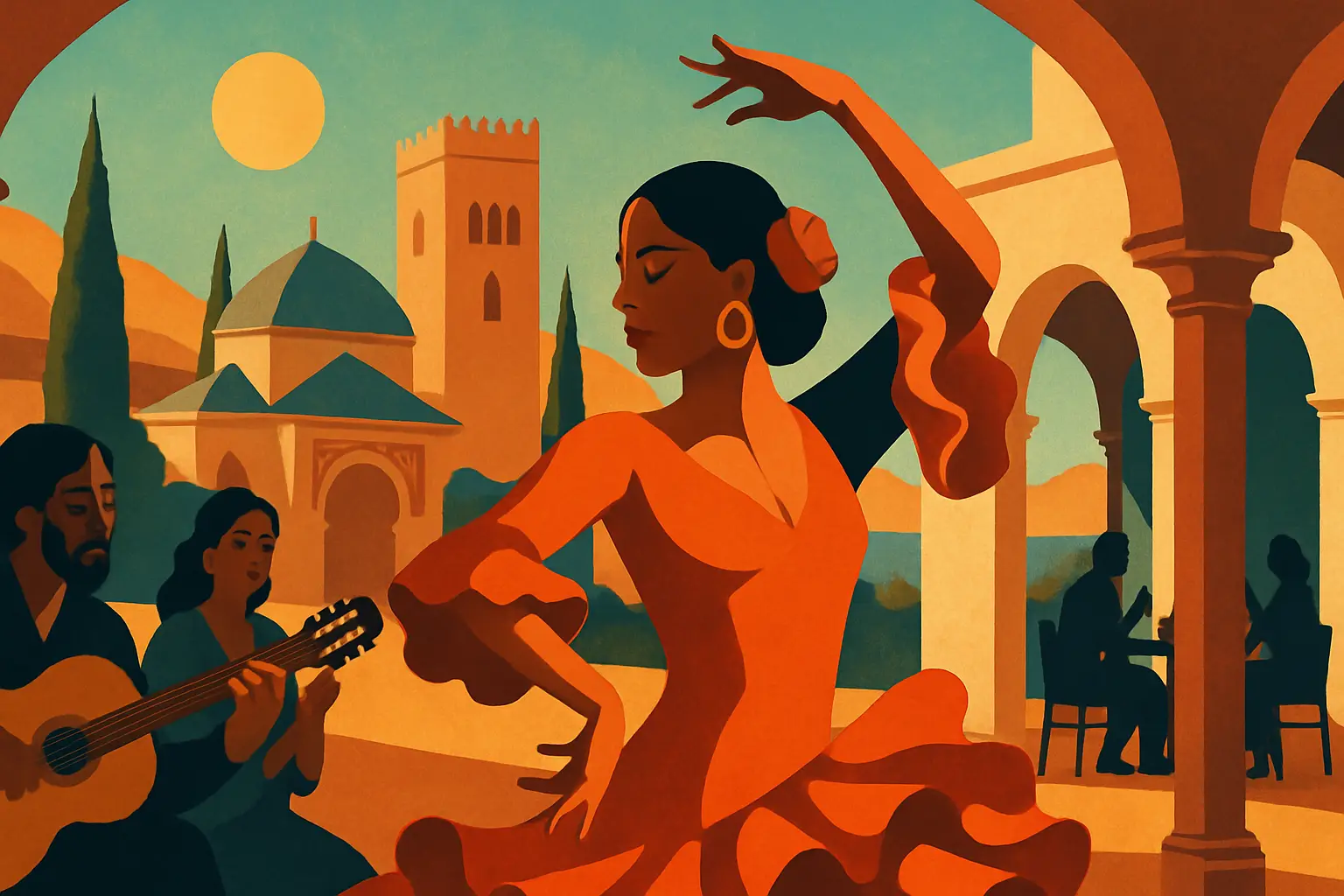
Most tourists watch flamenco in a tablao — a fixed venue with a drink minimum and dancers in ruffled dresses — and assume they're seeing something purely Spanish. They're not wrong, but they're only catching the final frame of a story that begins roughly a thousand years earlier, in the courts of Moorish Córdoba and the mountain encampments of Roma migrants arriving from northern India. Flamenco is the residue of cultural collision: the sound of three persecuted communities — Moors, Roma, and Sephardic Jews — finding common emotional ground in music when they had little else in common. The Arabic maqam modal system gave it its characteristic minor-key tension. The Roma gitano tradition gave it raw vocal intensity and rhythmic complexity. And Sephardic liturgical chant embedded melodic phrases that scholars can still trace in certain palos, or styles, today. Understanding these roots doesn't make flamenco more academic — it makes a live performance in Seville or Jerez feel like standing at the convergence of civilizations. This article unpacks each strand, tells you where to hear the most authentic performances, and explains why the UNESCO Intangible Cultural Heritage designation it received in 2010 barely scratches the surface of what this art form actually represents.
🇪🇸 Short stories • Collectible cards • Learn as you travel
La Carbonería (Calle Levíes 18, Seville) charges no cover and hosts nightly informal juergas — informal flamenco sessions — starting around 10 PM. This is dramatically different from tourist tablaos charging $40–$60 per seat. No reservation required; arrive by 9:30 PM to get a spot.
Visit the Flamenco Museum first
Seville's Museo del Baile Flamenco (Calle Manuel Rojas Marcos 3) costs €10 admission and offers a 45-minute self-guided tour through flamenco's multicultural origins before you see a live show. Open daily 10 AM–7 PM. The basement stages live performances most evenings at €25 — book online at museoflamenco.com.
Go to Jerez in February
The Festival de Jerez, held each February at the Teatro Villamarta (Plaza Romero Martínez, Jerez de la Frontera), is Spain's most serious annual flamenco event. Tickets range from €15 to €45. Jerez is the birthplace of the soleá por bulerías and the bulerías itself — the rhythmic complexity here is several notches above Seville's tourist circuit.
The complete guide to flamenco's origins and where to experience them
1Why Andalusia became the only place on earth where flamenco could have been born
Between 711 and 1492, the Iberian Peninsula hosted one of the most complex multicultural societies the medieval world produced. Al-Andalus, the Moorish-governed territory covering most of modern Spain, wasn't a monolith — it was a shifting patchwork of caliphates, taifa kingdoms, and contested border zones where Arabic, Berber, Romance-speaking Christian, Jewish, and eventually Roma populations lived in proximity that ranged from genuine convivencia (coexistence) to violent suppression depending on the decade and the ruler. The key point for flamenco is that these communities didn't simply tolerate each other — they absorbed each other's music.
The musicians of the Caliphate of Córdoba (929–1031) operated in a sophisticated court culture that valued the Arabic melodic modal system called maqam, which organizes scales and improvisational frameworks in ways that produce the characteristic tension and ornamentation Western ears associate with Middle Eastern music. Córdoba under Caliph Abd al-Rahman III employed professional musicians and hosted scholars from Baghdad. The theorist Ziryab, who arrived in Córdoba from Baghdad in 822 AD, is credited with introducing a fifth string to the oud and systematizing musical modes in Andalusia — a legacy that resonates, at least structurally, in the modal character of flamenco's scales.
At the same time, the Sephardic Jewish communities concentrated in cities like Toledo, Seville, and Granada were maintaining their own liturgical and paraliturgical song traditions — including the piyyut, a form of Hebrew devotional poetry set to regional melodic styles. After the Alhambra Decree of 1492 expelled Jews from Spain, many conversos who stayed continued to sing these melodies covertly, embedding them in the oral culture of southern Andalusia. Ethnomusicologists including Israel Katz and Judith Cohen have documented surviving Judeo-Spanish melodies that share structural features with certain flamenco palos, particularly the petenera, a slow, haunting style that Andalusian tradition has long associated with Jewish communities in Paterna de Rivera, a small town in Cádiz province.
2The Roma migration: how gitano culture provided the spine of modern flamenco
The Roma people — called gitanos in Spanish — began arriving in Andalusia in significant numbers around 1425, migrating westward from northern India through Persia, Anatolia, and the Balkans over several centuries. They arrived with musical traditions that had already absorbed Persian and Byzantine influences, and they encountered an Andalusian culture saturated with Moorish and Jewish musical residue. The synthesis was not immediate or deliberate — it happened over generations, through shared poverty, marginalization, and the social intimacy of communities forced to live on the edges of mainstream Spanish society.
The Roma contribution to flamenco is the most structurally foundational of the three. The cante jondo — literally "deep song" — is the vocal form at flamenco's core, and its characteristics are primarily gitano in origin: extreme vocal ornamentation, microtonal inflections that fall between the notes of a standard Western scale, and an emotional intensity that the poet Federico García Lorca described in his 1922 lecture as containing "the black sounds" of genuine tragedy. Lorca, along with composer Manuel de Falla, organized the famous Concurso de Cante Jondo in Granada's Alhambra gardens in June 1922 precisely to rescue these older gitano forms from commercial dilution.
The rhythmic system of flamenco — its compás — is also fundamentally gitano in character. The bulería, the fastest and most rhythmically complex palo, originated in Jerez de la Frontera, the Cádiz-province city with the largest and most musically influential gitano community in Andalusia. The neighborhood of Santiago in Jerez, roughly bounded by Calle Xerez, is considered the cradle of the bulería, and gitano families like the Moraos and Agujetas dynasties have produced flamenco artists for five or six consecutive generations. The 12-beat rhythmic cycle called compás de soleá — the foundation of the most structurally important flamenco forms — has direct parallels in the rhythmic cycles of North Indian classical music, which points back to the Roma's subcontinental origins.
Keep touring
Discover more about Spain in minutes
Get short, interactive stories that make each place easier to remember while you travel.
3Moorish maqam and how Arabic modal scales shaped flamenco's characteristic sound
If you play a standard major scale on a piano and then play a Phrygian mode — starting on E and using only white keys — you immediately hear something that sounds like flamenco. That sound is not accidental. The Phrygian mode, and specifically the Phrygian dominant scale (which adds a raised third), is the closest Western music theory approximation to the Arabic maqam Hijaz, one of the most common modal frameworks in Andalusian court music from the 9th through 15th centuries.
The Arabic maqam system — the word means "position" or "place" in Arabic — is a sophisticated set of melodic frameworks, each with its own scale, characteristic phrases, emotional associations, and rules for improvisation. Maqam Hijaz, with its distinctive augmented second interval between the second and third degrees of the scale, produces the tension and yearning that Western listeners immediately recognize in flamenco. The musicologist Reynaldo Fernández Manzano, former director of Granada's Casa de los Tiros museum, has spent decades tracing the structural parallels between Andalusian-Arabic musical theory and the modal foundations of flamenco's major palos.
The guitarra flamenca itself — lighter, drier, and more percussive than a classical guitar — carries Moorish influence in its playing technique as well as its tuning conventions. The rasgueado strumming technique, in which the back of the fingers sweep rapidly across the strings, produces a texture closer to the oud than to classical European guitar playing. The oud, without frets, allowed players to land on microtonal pitches that a fretted guitar technically cannot reproduce — but skilled flamenco guitarists compensate with string bending and specific capo positions that approximate those inflections. The Villa-Lobos capo position at the second fret, common in Andalusian flamenco, shifts the guitar's pitch and timbre toward the oud's sharper attack.
4Sephardic threads: the melodies that survived expulsion
The connection between Sephardic Jewish music and flamenco is the most contested and most academically interesting of the three cultural threads. It is also the one most likely to surprise visitors who associate flamenco exclusively with gitano culture. The expulsion of Spain's Jewish population in 1492 — an estimated 100,000 to 200,000 people — scattered Sephardic communities across the Ottoman Empire, North Africa, and the Netherlands. But a significant number converted publicly and remained in Andalusia as conversos or marranos, practicing Jewish traditions covertly for generations.
These converso communities concentrated in the same marginal social spaces as the Roma — on the fringes of cities, in neighborhoods outside formal guild structures, in professions like metalwork and itinerant trading that brought them into contact with gitano communities. Their Judeo-Spanish or Ladino song repertoire, preserved orally, included melodic conventions — particularly the use of descending chromatic phrases and specific cadence patterns — that appear in several flamenco forms.
The petenera is the most documented case. This palo, characterized by a slow triple meter and a particular harmonic cadence, is virtually absent from mainstream flamenco pedagogy because it carries a superstition among gitano performers that singing it brings bad luck. Ethnomusicologists including William Washabaugh have argued that this taboo itself reflects the palo's origins in Jewish religious practice, absorbed into gitano music but never fully integrated — something foreign enough to be treated as dangerous. The Petenera melody bears close structural resemblance to the Kaddish prayer melody in the Sephardic tradition and to melodies documented in Paterna de Rivera, once home to a significant Jewish community.
For travelers interested in this thread specifically, the Jewish Quarter (Barrio de Santa Cruz) in Seville — once the medieval judería — and the better-preserved Judería of Córdoba (centered on Calle Judíos near the Sinagoga de Córdoba, open Tuesday–Sunday, €0.30 admission for EU citizens, approximately $1.50 for non-EU visitors) provide physical and historical context that deepens the musical story considerably.
5The geographic map of flamenco: why Seville, Jerez, and Cádiz are not interchangeable
Tourists often treat Seville as synonymous with flamenco, which is understandable but misleading. Seville is the most accessible city for flamenco tourism and home to the densest concentration of professional tablaos and academies. But the flamenco of Seville (sevillano style) tends toward the theatrical and polished — it has been shaped by centuries of performance for audiences. The raw core of flamenco culture lies in the Cádiz province triangle: Jerez de la Frontera, Cádiz city, and the smaller towns of Lebrija and Utrera in southern Seville province.
Jerez de la Frontera is essential. The gitano barrios of Santiago and San Miguel produced not just the bulería but the entire gitano flamenco aristocracy — the families whose names function as brand guarantees of quality: Agujetas, Morao, Lebrijano, Fernanda de Utrera (from nearby Utrera). The Centro Andaluz de Flamenco (Plaza de San Juan 1, Jerez), which houses the world's most comprehensive flamenco archive, is free to enter and contains video footage, recorded performances, and academic resources that no other institution matches. Open Monday–Friday 9 AM–2 PM.
Cádiz itself claims the alegrías — one of flamenco's most joyful and rhythmically intricate palos — as its native form. The city's carnival tradition and its position as a port open to Atlantic and Mediterranean influences gives Cádiz flamenco a different emotional register than the more intense forms of the interior.
Lebrija, a small agricultural town 60 kilometers south of Seville, is considered by specialists the most flamenco-saturated village in Andalusia per capita. The Peña Flamenca La Charraná there hosts members-only juergas that are occasionally open to visitors who contact them directly — this is the kind of access that reveals flamenco as a living community practice rather than a performance art.
For context on how Andalusia's geography shaped its cultural identity more broadly, see Andalusia's Moorish Legacy: A Guide to Al-Andalus.
6How flamenco nearly died twice — and what saved it both times
Flamenco's survival into the 21st century is not a story of unbroken tradition. It came close to extinction at least twice, and the forces that saved it were as culturally complicated as the forces that created it.
The first crisis was commercial dilution in the late 19th century. The café cantante era (roughly 1860–1910) brought flamenco out of private gitano gatherings and into public entertainment venues across Andalusia, exposing it to broader audiences but also incentivizing simpler, more crowd-pleasing forms. By 1900, critics were already lamenting that the deep forms — the siguiriyas, the soleá, the martinete — were being replaced by lighter, catchier styles for paying customers.
The response was the Generación del 27, a cohort of Spanish intellectuals and artists centered on Federico García Lorca and composer Manuel de Falla. Their 1922 Concurso de Cante Jondo in Granada's Alhambra was a deliberate act of cultural rescue — a public competition that awarded prizes specifically for performances of the oldest, deepest palos and explicitly excluded the commercialized forms. The young singer Silverio Franconetti (actually of Italian-Spanish descent, which complicates any ethnic essentialism about flamenco) had spent decades earlier preserving gitano forms he'd learned directly from Roma masters. His work, and the 1922 concurso, established the canon of "serious" flamenco.
The second crisis was Franco's dictatorship (1939–1975), which promoted a sanitized, folkloric version of flamenco as nationalist propaganda — the España de pandereta (tambourine Spain) that reduced the art to tourist spectacle and patriotic kitsch. Paradoxically, this also drove serious practitioners deeper into private peña culture, which preserved the art's integrity away from state sponsorship. The peñas flamencas — members-only cultural associations — became the underground infrastructure that kept authentic flamenco alive. Today there are over 300 registered peñas in Andalusia alone, and they remain the best access point for visitors who want to hear flamenco that isn't calibrated to tourist expectations.
7Practical guide: how to experience authentic flamenco in Andalusia
The gap between tourist flamenco and authentic flamenco is real, but it's bridgeable with some advance planning. The following breakdown covers every access level, from first-time visitors to serious enthusiasts.
**La Carbonería, Seville** (Calle Levíes 18, Barrio de Santa Cruz): Free entry, nightly informal performances from around 10 PM. No reservation, no minimum spend. The venue is a converted coal warehouse and the atmosphere is genuinely unrehearsed. Best nights are Thursday–Saturday.
**Museo del Baile Flamenco, Seville** (Calle Manuel Rojas Marcos 3): €10 museum entry, €25 for evening performances. Open daily 10 AM–7 PM. Founded by dancer Cristina Hoyos, the museum is the best starting point for first-timers — the exhibits contextualize the cultural history before you hear a note.
**Centro Andaluz de Flamenco, Jerez** (Plaza de San Juan 1): Free entry. Monday–Friday 9 AM–2 PM. The world's leading flamenco archive with viewing rooms, performance footage, and expert staff. Not a performance venue — a research center open to the public.
**Festival de Jerez** (Teatro Villamarta, Plaza Romero Martínez, Jerez): Held annually in February–March. Tickets €15–€45. This is the most credible annual flamenco event in Spain, featuring artists who rarely perform for tourist audiences. Book through the Teatro Villamarta website 3–4 months in advance.
**Peña Torres Macarena, Seville** (Calle Torrijano 29): One of Seville's most active peñas, with regular public nights announced on their social media. Entry typically €5–€10 including a drink. The audience is predominantly local.
**Tablao El Arenal, Seville** (Calle Rodo 7): If you want a proper tablao experience with guaranteed seating and professional dancers, El Arenal is the most historically consistent option. Shows at 7 PM and 9 PM, €45 dinner + show, €28 show only. Less spontaneous than La Carbonería but reliably high-quality.
**Best months**: February (Festival de Jerez), May (Seville's Feria de Abril brings the city's best musicians out), and September–October when summer tourist crowds thin but performance calendars remain full.
**Dress code**: None required anywhere, but smart casual is appropriate for peñas and festival venues. Tourist tablaos have no dress requirements.
Keep touring
Ready to hear flamenco as the living history it actually is?
TourMe's Andalusia collection includes interactive story cards on flamenco's Roma, Moorish, and Sephardic origins — short enough to read between venues, deep enough to change how you hear every note. Unlock the Jerez chapter to follow the bulería's story from the Santiago barrio to the global stage, or collect the Cante Jondo card series that traces each palo back to its cultural source. The more you know before you walk into a peña, the more the music gives back.