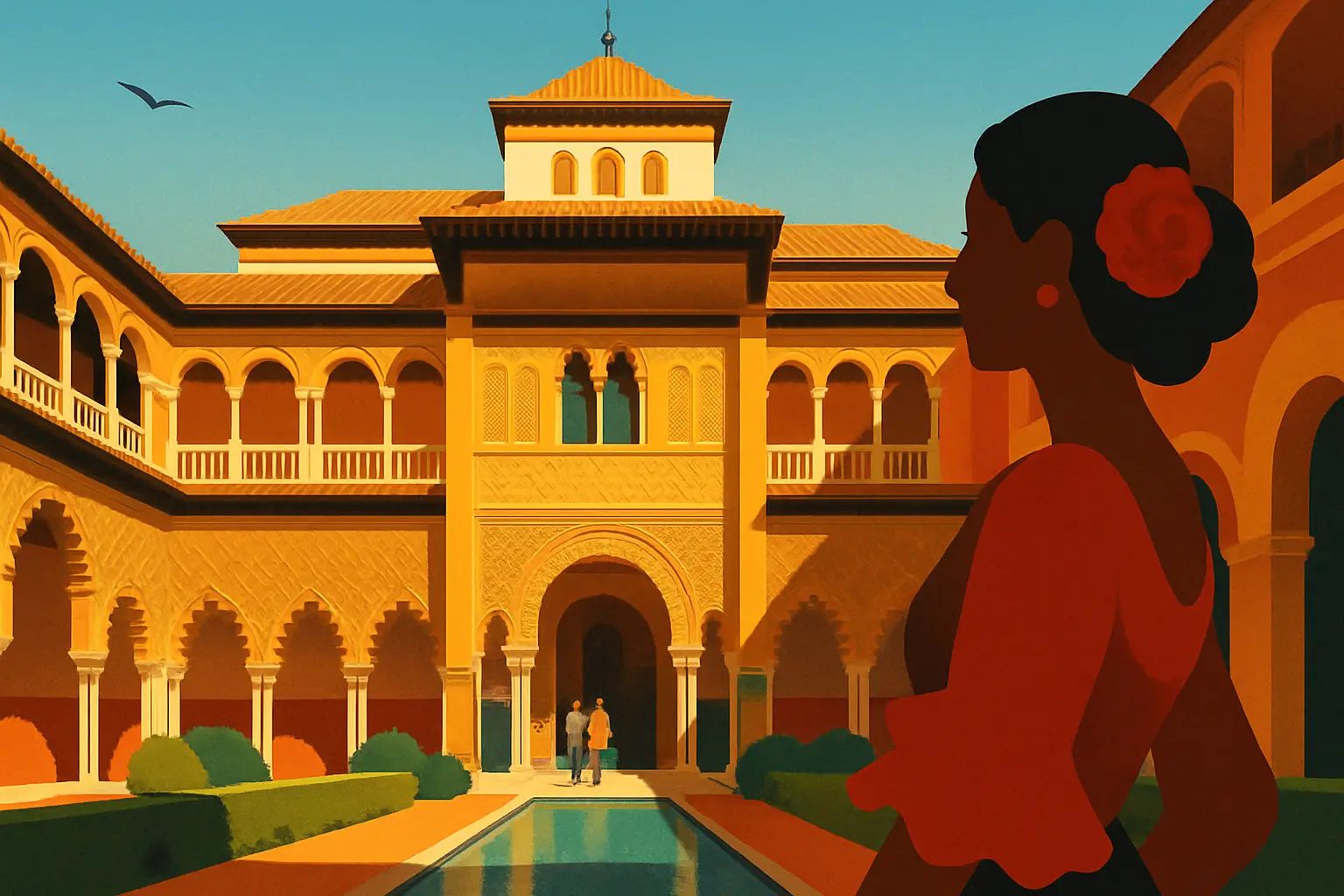
Seville's Real Alcázar: The Mudéjar Masterpiece That's Still a Working Royal Palace
Most visitors to Seville know the Real Alcázar as a UNESCO World Heritage site and one of Spain's most-photographed monuments. Fewer realize they're walking through a building that the Spanish royal family still officially uses — making it the oldest royal palace in continuous use anywhere in Europe, predating Buckingham Palace by roughly seven centuries. When King Felipe VI and Queen Letizia visit Seville on state business, they stay in the upper floors, which remain permanently closed to the public. This isn't a museum pretending to be a palace; it's a palace that also happens to be a museum. The Alcázar's architecture is even more layered than its living status suggests. The complex contains Almohad defensive walls from the 10th century, a Gothic hall commissioned by Alfonso X in the 13th century, the extraordinary Mudéjar palace built by the Christian king Pedro I in the 1360s, and Renaissance gardens expanded under Charles V in the 16th century — all stacked on top of each other across a single 110,000-square-meter site. This guide will show you how to read each era as you walk through, what to prioritize, and how to avoid the single biggest mistake tourists make when visiting.
🇪🇸 Short stories • Collectible cards • Learn as you travel
The Real Alcázar sells timed-entry tickets online at alcazarsevilla.org. General admission runs approximately $16 USD for adults. In peak season (March–October), slots sell out 3–4 weeks in advance. The first entry slot at 9:30 a.m. offers the thinnest crowds and the best morning light in the Patio de las Doncellas.
Skip the audio guide rental
The official rental audio guides ($5 USD) cover broad strokes but skip the architectural detail that makes the Alcázar remarkable. Download TourMe before you arrive for story-driven chapters that explain exactly what you're looking at — including how to spot the difference between original Almohad tilework and 19th-century restorations in the same courtyard.
Allow at least three hours
Most tourists budget 90 minutes and leave having seen only the main palace. The Gothic Palace, the Admiral's Chamber (Cuarto del Almirante), and the 15-hectare gardens are all included in the base ticket. The gardens alone warrant an hour, particularly the Mercury Pool (Estanque de Mercurio), a 16th-century reflecting pool still fed by the original Roman aqueduct system.
The complete Real Alcázar history and visitor guide
1Why the Alcázar outlasted every other Moorish palace in Europe
The story of the Real Alcázar (the name simply means 'Royal Fortress' from the Arabic *al-qasr*) begins in 913 CE, when the Umayyad Caliph Abd al-Rahman III ordered a military fortification built on the southern edge of what was then the city of Ishbiliya — the Moorish name for Seville. That original structure was a straightforward defensive garrison, not the ornate palace complex visible today. The transformation began under the Almohad dynasty, the Berber rulers who controlled Andalusia through the 12th and early 13th centuries. The Almohads expanded the site into a true palatial complex and built the Patio del Yeso (Courtyard of Plaster), which survives today as one of the oldest intact sections of the Alcázar. Its carved plasterwork arches, with their geometric interlace patterns, predate the Alhambra in Granada by roughly a century and show the direct visual grammar that would later define Nasrid architecture.
When Ferdinand III of Castile captured Seville in 1248 — an event the Spanish call the Reconquista — he did something that would shape the entire character of the building: he didn't tear it down. He moved in. His son, Alfonso X ('the Wise'), went further, commissioning Gothic halls within the existing Moorish complex and establishing the practice of layering Christian architecture onto Islamic foundations rather than erasing them. This decision, repeated by subsequent monarchs, is the reason the Alcázar today reads as a compressed archive of eight centuries of Spanish architectural ambition rather than a monument to any single period.
The real inflection point came in 1364, when King Pedro I of Castile — a figure so polarizing that history calls him either 'the Cruel' or 'the Just' depending on which chronicle you read — demolished a significant portion of the existing Christian additions and built an entirely new Mudéjar palace from scratch. Pedro's choice to hire craftsmen from the Islamic kingdom of Granada and the Muslim community of Toledo to build a palace in the Moorish style was not nostalgia. It was a deliberate political and aesthetic statement about the sophisticated court he intended to run.
2Pedro I and the Mudéjar palace: a Christian king who built like a Caliph
Pedro I completed his palace within the Alcázar complex around 1366, and it remains the emotional and architectural heart of the entire site. The building is a canonical example of Mudéjar architecture — the term for the hybrid style developed by Muslim craftsmen (*mudéjares*) working under Christian patronage after the Reconquista. But Pedro's palace is Mudéjar at its most extreme. Walking through it, particularly in the Patio de las Doncellas (Courtyard of the Maidens), it is genuinely difficult to believe you are looking at a building commissioned by a 14th-century Castilian king rather than an Andalusian caliph.
The Patio de las Doncellas is the palace's central ceremonial courtyard and its most visually overwhelming space. The name — 'Courtyard of the Maidens' — likely derives from the legend that the Moorish kings of the region demanded 100 virgins annually as tribute from Christian territories, though historians debate whether this tribute was ever literally enforced. Architecturally, the courtyard features double-tiered arcades of interlaced arches with stucco panels carved in ataurique (foliated Arabesque scrollwork) so precise that individual leaves are still sharp after 660 years. The lower register of the walls is lined with azulejos (glazed ceramic tiles) in geometric patterns, while the upper story was added in the Renaissance period under Charles I (the Holy Roman Emperor Charles V), creating one of the building's more abrupt historical seams — the Gothic-Renaissance windows sitting somewhat incongruously atop the Moorish arcades.
Deeper in the palace, the Salón de los Embajadores (Hall of Ambassadors) is the throne room and the building's single most spectacular interior. Its defining feature is a media naranja (half-orange) wooden dome built in 1427 — technically added after Pedro's original construction — that rises above a drum of interlaced arches in the manner of the Alhambra's Hall of the Two Sisters. The dome is gilded and painted in deep reds and blues, with a star pattern radiating from a central oculus. Look for the portraits of Spanish monarchs that ring the drum: they were added in 1599 under Philip III, making this room a literal ceiling of dynastic ambition.
Keep touring
Discover more about Spain in minutes
Get short, interactive stories that make each place easier to remember while you travel.
3The Gothic Palace and the Admiral's Chamber: the layers Pedro didn't build
Because Pedro I's Mudéjar palace is so visually commanding, visitors often overlook the other distinct architectural periods embedded within the Alcázar complex. Two spaces in particular deserve time: the Gothic Palace (Palacio Gótico) and the Cuarto del Almirante (Admiral's Chamber).
The Gothic Palace was originally built for Alfonso X in the second half of the 13th century, making it roughly a century older than Pedro's Mudéjar rooms. After a catastrophic earthquake in 1755 — the same Lisbon Earthquake that destroyed much of Portugal and southern Spain — the Gothic hall was extensively reconstructed, which is why it feels more subdued than the rest of the Alcázar. The vaulted Sala de las Fiestas (Banqueting Hall) is the main room, a large, austerely elegant Gothic space that was used for royal celebrations. Its tapestries depicting the Conquest of Tunis (1535) are among the most historically significant objects in the entire complex: they were commissioned by Charles V to commemorate his North African campaign and are based on cartoons drawn by the Flemish artist Jan Cornelisz Vermeyen, who accompanied the military expedition specifically to document it for the tapestry project.
The Cuarto del Almirante sits near the entrance to the complex and is frequently skipped because it appears to be an administrative section. This is a mistake. The chamber was established in 1503 by Queen Isabella I as the official headquarters of the Casa de Contratación — the trading house that regulated all commerce between Spain and its newly discovered territories in the Americas. Every ship sailing to the New World was licensed here. Every conquistador's contract was drawn up in these rooms. The Virgen de los Mareantes (Virgin of the Navigators), painted by Alejo Fernández around 1535–1536 and displayed in the chapel within the chamber, is considered the first painting produced in Europe to depict the Americas: beneath the Virgin's protective cloak you can see figures representing Columbus, indigenous Americans, and Spanish sailors crowded together in a composition that captures the bewildering scope of the moment. It is one of the most consequential paintings in Spanish art and receives a fraction of the attention it deserves.
4How to read the tilework: Almohad originals versus later restorations
One of the Alcázar's quiet frustrations — and one of its deepest pleasures for attentive visitors — is that not everything you see is as old as it appears. The 19th century was not kind to Moorish monuments in Spain. Well-intentioned but heavy-handed restoration campaigns under the Romantic movement replaced damaged or missing tilework, plasterwork, and architectural details with new material in a period style. At the Alcázar, some of this restoration work is so good it fools experts at first glance; some of it is obviously inferior once you know what to look for.
The key diagnostic difference is in the azulejos themselves. Original medieval tilework uses the cuerda seca technique (literally 'dry cord'), in which a grease-based separator is drawn between areas of different-colored glaze before firing, preventing the colors from bleeding into each other during the kiln process. The result is tiles with very fine, slightly raised lines of dark manganese between the color fields — lines that look almost like lead came in a stained glass window. Later 19th-century replacements frequently used cuenca tiles (molded tiles with raised clay ridges rather than grease separators) or even industrially produced tiles, which have a crisper, more mechanical regularity to the pattern edges.
In the Patio de las Doncellas, crouch down and examine the lower register of tile panels at eye level. Original cuerda seca panels show subtle color variation within a single glaze field — evidence that the mineral pigments were applied by hand with slight irregularity. Replacement panels from the 1850s–1870s restoration campaign have a flatter, more uniform color saturation. The difference is subtle but, once seen, impossible to unsee. The Patio del Yeso, by contrast, is one of the most authentically preserved sections of the complex: its plasterwork arches retain original Almohad carving from the 12th century and were deliberately left un-restored after debate among conservation scholars in the 20th century. The fragility you see there — the slightly eroded edges of the geometric patterns — is authentic medieval wear, not damage.
5The gardens: fifteen hectares of living history from Rome to the Renaissance
The gardens of the Real Alcázar cover approximately 15 hectares and represent as many centuries of landscape design as the palace represents architectural history. Unlike the building, where different eras are stacked vertically and can feel compressed, the gardens allow the different historical periods to spread out horizontally, giving each its own coherent space.
The oldest surviving element is not Moorish but Roman. The water supply to much of the garden still flows through channels originally laid during the Roman occupation of Hispalis (the Roman name for Seville), later adapted and extended by both Almohad engineers and 16th-century Spanish hydraulic projects. The Estanque de Mercurio (Mercury Pool) — a large rectangular reflecting pool at the garden's main axis — was built in the 16th century under Philip II and is still fed by this ancient water system. A bronze Mercury figure by the sculptor Diego de Pesquera, dating to 1576, stands on a central island.
The formal gardens closest to the palace — the Garden of the Galera, the Garden of the Dance (Jardín de la Danza), and the Garden of the Poets — were laid out in the Renaissance manner under Charles V in the 1520s–1540s: geometric hedged compartments, clipped box parterres, and covered walkways of myrtle (*Myrtus communis*) that create green-walled corridors fragrant enough to stop you mid-stride. Charles V added a pavilion (the Pabellón de Carlos V) in 1543 that still stands at the garden's south end — a small Renaissance loggia with Mudéjar tilework on its lower walls, which manages to be both architecturally modest and historically significant as one of the few Renaissance structures in the complex.
At the garden's far eastern edge, the landscape becomes wilder and less formal: an English-style romantic garden added in the 19th century, a small maze of cypress hedges, and the Galería del Grutesco — a 17th-century elevated gallery built into the old Almohad city wall, offering elevated views across the gardens that most visitors never reach because it requires a ten-minute walk from the main palace. The view from the gallery at mid-morning, with the orange trees in the lower gardens and the Giralda tower of the Seville Cathedral visible above the walls, is one of the best unphotographed vantage points in the city.
6The Alcázar on screen: how Game of Thrones changed visitor expectations
In 2015, the production team for Game of Thrones chose the Real Alcázar as the primary filming location for Dorne — the southern kingdom of the fictional continent of Westeros. The Patio de las Doncellas became the Water Gardens of Dorne, and the palace's gardens and lower courtyard were used for several key scenes in Seasons 5 and 6. The filming arrangement was negotiated directly with the Spanish royal household, which retains administrative authority over the palace.
The decision had an immediate and measurable impact on visitor numbers: annual admissions to the Alcázar rose from roughly 1.2 million in 2014 to over 1.6 million by 2016, and the palace has maintained elevated visitor levels since. It's now common to encounter tour groups specifically organized around the filming locations, and the Alcázar's official gift shop stocks Game of Thrones merchandise alongside more conventional art books.
This is worth knowing because it shapes how you'll experience the space. The Patio de las Doncellas in particular can feel, on a busy day, less like a medieval royal courtyard and more like a film set that people are taking selfies in front of. The architectural significance gets lost in the noise. The best counter-strategy is to arrive in the first entry slot (9:30 a.m.) and move immediately to the Patio de las Doncellas before the tour groups arrive — you'll typically have twenty minutes of relative quiet before the space fills. Then work outward to the Gothic Palace and gardens while the majority of visitors are still crowding the main Mudéjar rooms.
The screen tourism phenomenon does have one legitimate benefit: it has pushed the Alcázar into conversations about Moorish architecture among audiences who might otherwise never have encountered it. For travelers who arrive curious about the actual history rather than just the filming locations, that curiosity is an excellent starting point for a much deeper engagement with Mudéjar architecture across Andalusia.
7Practical guide: tickets, timing, and what to skip
The Real Alcázar sits at Plaza del Triunfo s/n, directly adjacent to Seville Cathedral in the Santa Cruz neighborhood. The main entrance faces the plaza; there is no secondary entrance. All tickets, including those purchased on the day, must be collected or shown at the same gate.
**Hours:** October–March: 9:30 a.m.–5:00 p.m. (last entry 4:00 p.m.). April–September: 9:30 a.m.–7:00 p.m. (last entry 6:00 p.m.). Closed January 1, Good Friday, and December 25.
**Admission prices (approximate USD):** General entry ~$16. Reduced rate (students, seniors 65+) ~$4. Children under 16 free. Night visits (summer only, Tuesday–Saturday from 10:00 p.m.) ~$20 — worth booking separately for a radically different atmosphere.
**Book online:** alcazarsevilla.org releases tickets up to 60 days in advance. Credit card required; no refunds but date changes are permitted up to 24 hours before entry.
**Best time to visit:** First slot (9:30 a.m.) on a weekday in shoulder season (late September–November or February–April). July and August are the busiest months and also the hottest — interior rooms reach uncomfortable temperatures without air conditioning.
**What to skip if time is short:** The small **Sala de las Bóvedas** (Vaulted Hall) near the exit contains replica archaeological finds and can be safely bypassed. The upper-floor royal apartments are permanently closed — don't waste time looking for access.
**What almost everyone skips but shouldn't:** The **Cuarto del Almirante** (Admiral's Chamber) and the **Virgen de los Mareantes** painting — arguably the most historically significant objects in the entire complex. Also the **Galería del Grutesco** walkway along the eastern garden wall.
**Getting there:** A 12-minute walk from Seville's Santa Justa railway station is not realistic given the distance — take the **C4 bus** to the Archivo de Indias stop or use the **Sevici** city bike-share system. Taxis from Santa Justa typically run $8–10 USD.
**Combine with:** The **Archivo General de Indias** (across the plaza, free entry) holds original Columbus letters and conquest-era documents — a logical pairing with the Alcázar's Admiral's Chamber. The [Seville Cathedral and Giralda](/es/blog/seville-cathedral-giralda-tower-guide) are immediately adjacent and covered by a separate ticket (~$14 USD).
Keep touring
Ready to walk through the Alcázar's eight centuries in real time?
TourMe's Seville chapter includes interactive story cards dedicated to Pedro I's Mudéjar palace, the Virgen de los Mareantes, and the Almohad origins of the complex — each designed to be read while you're standing in front of the actual space. Collectible architecture cards let you build a visual record of Mudéjar, Gothic, and Renaissance details as you move through the rooms, and the audio chapters give you the historical context that the official signage consistently leaves out.