The Basque Country occupies a strip of Atlantic coastline and Pyrenean foothills straddling Spain and France, and its relationship with food is not incidental to its culture — it is the culture. To understand pintxos, you first need to understand the txoko (also spelled *sociedad gastronómica*), the private all-male dining clubs that emerged in San Sebastián in the mid-19th century. In these clubs, men gathered to cook for each other, swap recipes, and compete over technique. The competitive, artisanal seriousness that Basque men poured into these private kitchens eventually spilled over into the city's bars and restaurants. By the late 20th century, this ethos had produced Nueva Cocina Vasca, the Basque New Cuisine movement pioneered by chefs like Juan Mari Arzak and Pedro Subijana in the late 1970s. These chefs, influenced by French nouvelle cuisine but rooted in Basque products — salt cod, anchovies, txakoli wine, Idiazabal cheese, Iberian pork — created a template for modern Spanish gastronomy that long predates Ferran Adrià and El Bulli.
Pintxos bars became the democratic expression of this same competitive seriousness. Unlike the txoko, which excluded women and non-members, the bar counter was public. Bars began competing to attract customers by offering increasingly creative bites, and that competition has never stopped. Walk down Calle 31 de Agosto in San Sebastián today and you are, without exaggeration, walking through the living result of 150 years of accumulated culinary ambition, expressed in portions small enough to eat standing up.
Travel writers routinely describe pintxos as 'Basque tapas,' and the description is understandable but wrong in ways that matter to anyone who wants to genuinely engage with the culture. The differences are structural, historical, and social.
Tapas originated in Andalusia and Castile as small accompaniments — often free — served with a drink. The word derives from the Spanish verb *tapar* (to cover), referencing the practice of covering a glass with a small plate of food. Tapas are typically ordered from a menu, brought to the table by a waiter, and shared or eaten individually at a leisurely pace. The format is service-oriented.
Pintxos are defined by their format (a bite-sized portion, traditionally skewered with a toothpick through a slice of bread), their display method (arranged on the bar counter for customers to take themselves), and their social context (the txikiteo, the bar-hopping ritual). Crucially, the pricing system differs: in pintxos bars, you typically take what you want from the counter and keep your toothpicks — at the end, the bartender counts them to calculate your bill. The honor-system element reinforces the social trust that underpins the txikiteo. You are not a table being served; you are a participant in a shared public ritual.
The bread base (the *rebanada*) is also not optional decoration — it absorbs flavors, prevents mess when eating standing up, and provides structural integrity for toppings that would otherwise be impossible to eat without a plate. When Michelin-starred chefs like Elena Arzak or the team at Bar Zeruko produce elevated pintxos, they are working within these constraints, not abandoning them.
Get short, interactive stories that make each place easier to remember while you travel.
The txikiteo (pronounced chee-kee-TAY-oh) is the Basque ritual of moving from bar to bar in the early evening, having one small drink and one or two pintxos at each stop before moving to the next. The word comes from *txikito*, a small glass of wine holding roughly 100ml — the traditional drink of the txikiteo, though Basques are equally likely to order a zurito (a very small beer) or a glass of local txakoli, the sharp, slightly sparkling white wine made from Hondarribi Zuri grapes grown on coastal hillsides.
The ritual has a specific social grammar. You arrive at the bar, you stand (sitting is for restaurants), you make eye contact with the bartender, you order your drink and point to or ask for your pintxos. You eat and drink, you talk — loudly, because everyone talks loudly — and after one round you leave. The speed is important: a well-executed txikiteo covers five or six bars in ninety minutes. Lingering at one bar is socially legible as either a tourist or someone who has nowhere else to be.
The txikiteo is not a drinking ritual with food as an afterthought — the proportion of food to alcohol is deliberately managed. Locals rarely arrive drunk; the food, the pace, and the movement between bars all moderate consumption. It is, fundamentally, a social and culinary practice that happens to involve alcohol, not the reverse.
In Bilbao, the txikiteo is centered on the Casco Viejo, particularly the Siete Calles (Seven Streets) district — one of the oldest urban grids in the Basque Country, laid out in the 14th century. In San Sebastián, the Parte Vieja (Old Town) and the upscale Gros neighborhood across the Urumea River are the two main circuits, with different characters: Parte Vieja is louder and more competitive; Gros is calmer and increasingly favored by locals priced out of the tourist-heavy old town.
San Sebastián (Donostia in Basque) has the highest concentration of exceptional pintxos bars in the world, and the Parte Vieja is where the competition is most visible. Three streets dominate serious conversations:
Calle Fermín Calbetón is consistently cited by local food journalists as the single best street for pintxos density. Bar Txepetxa (No. 5) specializes exclusively in anchovies — the Cantabrian anchovy, cured in salt and packed in olive oil, is one of the great Basque ingredients, and Txepetxa has built an entire menu around its combinations: anchovy with sea urchin roe, anchovy with piquillo pepper, anchovy with smoked salmon cream. Counter pintxos run €2.50–€3.50.
Calle 31 de Agosto offers a slightly less chaotic experience and houses Bar Borda Berri (No. 12), which is widely considered one of the most technically accomplished casual pintxos bars in the city. Their slow-cooked veal cheeks on bread and the mushroom risotto pintxo (the latter breaking the bread-base convention in an accepted way) are benchmarks. Expect to pay €3–€4.50 per piece.
Bar Zeruko on Calle Pescadería 10 represents the avant-garde end of the spectrum — this is where theatrical presentation meets serious technique. A smoked cod pintxo arrives under a glass dome of applewood smoke. Prices reflect the ambition: €4–€6 per piece, and worth it as one stop on a longer circuit.
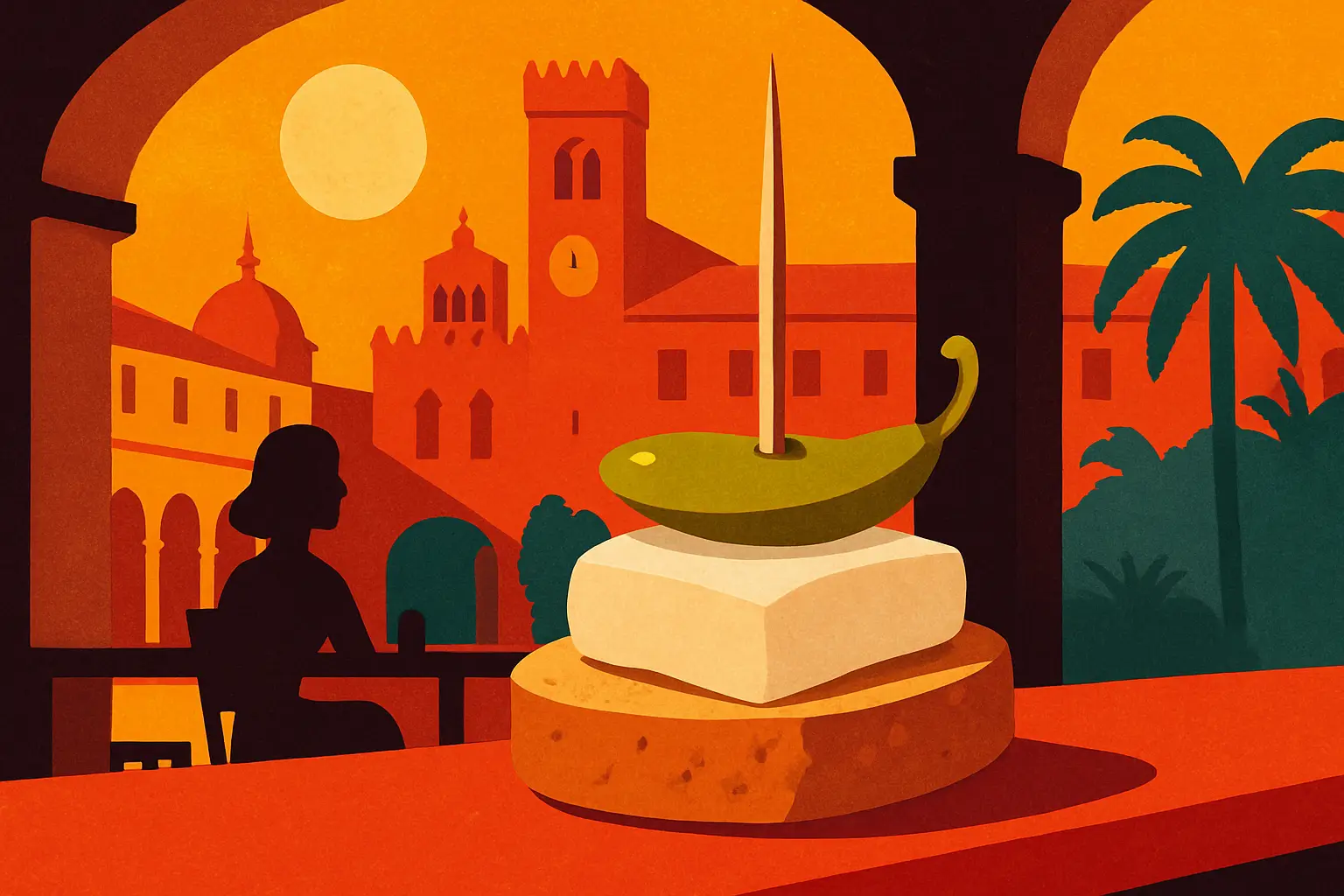
For the canonical gilda (olive, guindilla pepper, and anchovy on a skewer, the original pintxo), return to its birthplace: Bar Casa Vallés, Calle Reyes Católicos 10. The gilda costs €2.20 and has tasted approximately the same since 1942.
Bar Txepetxa — Calle Fermín Calbetón 5, San Sebastián. Anchovy specialists. Open Tue–Sun from 7:00 PM. Pintxos €2.50–€3.50.
Bar Borda Berri — Calle 31 de Agosto 12, San Sebastián. Creative hot pintxos. Open daily from 12:30 PM and 7:00 PM. Pintxos €3–€4.50.
Bar Zeruko — Calle Pescadería 10, San Sebastián. Avant-garde. Open daily 12:00–15:30 and 19:00–23:00. Pintxos €4–€6.
Bar Casa Vallés — Calle Reyes Católicos 10, San Sebastián. Birthplace of the gilda. Open Mon–Sat from 10:00 AM. Gilda €2.20.
Bilbao has spent two decades living in San Sebastián's gastronomic shadow, which is partly unfair and partly self-inflicted — the city's bar culture is genuinely different in character, rooted in the working-class industrial history of a port city rather than the bourgeois resort culture of the Belle Époque coast. The Guggenheim Bilbao, which opened in 1997 and transformed the city's international profile, drew visitors but didn't immediately reshape the pintxos scene, which continued on its own terms in the Casco Viejo.
Calle Ledesma and the surrounding streets around Plaza Nueva in the Casco Viejo constitute Bilbao's main pintxos circuit. Bar Gatz (Calle Santa María 10) is the most reliably excellent option — their salt cod and pepper pintxos are textbook Basque, and the bar's energy on a Thursday evening is as good as anything in the Parte Vieja. Counter pintxos here run €2–€3, and the beer is cheaper than in San Sebastián.
El Globo (Calle Diputación 8, in the Ensanche neighborhood rather than the Casco Viejo) is worth crossing the river for. The bar has been operating since 1953 and produces some of the city's most technically accomplished hot pintxos — their foie gras on brioche has been on the menu, in evolving form, for over twenty years. Pintxos €2.50–€4.50.
The honest comparison between the two cities: San Sebastián has more exceptional high-end pintxos bars; Bilbao has a more authentic, less tourist-modified everyday bar culture. If you are visiting the Basque Country for the first time and have only one evening, San Sebastián's Parte Vieja is the answer. If you are returning, Bilbao's Casco Viejo on a weeknight will show you how Basques actually drink and eat when they are not performing for visitors.
For a deeper dive into Bilbao's transformation from industrial port to cultural destination, see our guide to exploring Bilbao beyond the Guggenheim.
Bar Gatz — Calle Santa María 10, Bilbao Casco Viejo. Open Mon–Sat 12:00–15:00 and 19:00–23:00. Pintxos €2–€3.
El Globo — Calle Diputación 8, Bilbao Ensanche. Open Mon–Sat 11:00 AM–11:00 PM. Pintxos €2.50–€4.50.
Plaza Nueva bars (multiple options) — Open most evenings from 7:00 PM. Good entry point for the Bilbao txikiteo circuit.
The flavors of the pintxos world are not accidental — they reflect a specific geography and centuries of trade. The Bay of Biscay delivers anchovies, bonito tuna, hake, sea bream, and kokotxas (the gelatinous throat cuts of hake or salt cod that are an acquired but essential taste). The interior provides Idiazabal, a firm smoked sheep's milk cheese produced in the Basque and Navarre highlands with a protected designation of origin (PDO) since 1987. The western Basque coast produces txakoli, the wine that has become so associated with pintxos bars that the theatrical high-pour from bottle to glass — done to aerate the wine and preserve its light carbonation — is practically a logo for the culture.
Salt cod (bacalao) deserves separate attention. The Basques developed one of the world's great salt cod fishing traditions, sending boats to the Newfoundland and Iceland grounds from at least the 16th century, arguably earlier. The three canonical salt cod preparations of Basque cuisine — pil-pil (an emulsified sauce made only from the cod's own gelatin and olive oil), a la vizcaína (with dried choricero peppers and onion), and al club ranero (a hybrid of the two) — all appear in pintxos form regularly. Understanding bacalao is understanding the Basque relationship with patience, technique, and the sea.
Guindilla peppers — the long, thin green pickled peppers used in the gilda and dozens of other preparations — grow in the Ibarra valley in Gipuzkoa province and have their own PDO designation. They provide the acidity and mild heat that makes fatty or briny ingredients readable on the palate. In the gilda, the guindilla is not a garnish — it is structural.
For context on how Basque ingredients connect to Spain's broader culinary geography, the contrasts with Mediterranean and Andalusian food cultures are as instructive as the similarities.
The best time to experience the txikiteo is Thursday through Saturday evening, between 7:00 PM and 10:00 PM, which captures local participation without the Saturday-night chaos that makes some Parte Vieja bars genuinely difficult to navigate. August in San Sebastián is spectacular weather but maximum tourist density — the bars are open and excellent but the experience is more crowded. September and October offer the combination of good weather, local festival season (the San Sebastián Film Festival runs in September, the Donostiako Jazzaldia jazz festival in July), and a bar scene that has exhaled slightly.
Budget realistically: a full txikiteo covering six bars, with one drink and two pintxos per bar, will cost €40–€60 per person in San Sebastián. Bilbao runs approximately 20% cheaper. The most common mistake is over-ordering at the first bar — the displayed counter pintxos are tempting, but pacing is the point.
A few logistical notes:
Dress code: none, but clean casual is the norm. Basque bar culture is not formal, but it is put-together.
Language: Spanish works everywhere. Basque (Euskera) greetings are appreciated — 'Kaixo' (hello), 'Eskerrik asko' (thank you). French is occasionally useful near the French border.
Payment: most bars accept cards, but carry €20–€30 in cash as backup. Some older bars, particularly in Bilbao's Casco Viejo, are cash-only.
Accessibility: the Parte Vieja and Casco Viejo are compact walking districts. San Sebastián's Parte Vieja covers roughly 8 city blocks — a full circuit without rushing takes 2 hours on foot.
Getting there: San Sebastián is 1 hour from Bilbao by bus (ALSA, roughly €7–€9 one way). Direct trains from Madrid take approximately 5 hours 15 minutes; from Barcelona, approximately 5 hours 30 minutes. Bilbao Airport (BIO) has direct connections to London, Paris, and major Spanish cities.
Guided options: the TourMe app includes an interactive pintxos and txikiteo chapter for both San Sebastián and Bilbao with mapped bar routes, audio stories, and collectible cards for key dishes and ingredients.