The Zócalo's stone surface is not the beginning of the story — it is a layer on top of a layer. When Spanish conquistadors destroyed Tenochtitlan after the 1521 siege led by Hernán Cortés, they did not build on cleared land. They built directly on top of the Aztec ceremonial center, using the rubble as foundation and the surviving stones as raw material. The great pyramid of Templo Mayor stood almost exactly where the Cathedral's altar is today. The palaces of the tlatoani, the ball courts, the sacred precinct — all of it became landfill for the colonial city above.
This was deliberate. Building on the exact site of Aztec power was a political act, a visual declaration that one civilization had replaced another. For 400 years, the Aztec foundations were invisible. Then in 1978, a construction crew digging for underground cable near the Cathedral hit something: a massive stone disk, 3.5 meters across, carved with the dismembered body of the moon goddess Coyolxauhqui. That discovery triggered emergency excavations and ultimately created the Templo Mayor archaeological zone, which now exposes what had been buried since 1521. You can stand in the center of the Zócalo and look simultaneously at the Cathedral and the exposed pyramid ruins next door — two capitals, same square meter of earth.
The Catedral Metropolitana de la Asunción de María anchors the north side of the Zócalo and is the oldest and largest cathedral in the Americas. Construction began in 1573 — 52 years after the conquest — and was not completed until 1813. That 240-year build window means you can watch the architecture shift styles as you walk around the exterior: early Renaissance columns gave way to Baroque, then Neoclassical, as each generation of architects added their layer.
The Cathedral was built using stones taken directly from Aztec temples. If you walk along the base of the exterior walls on the east side near Calle de la Moneda, you can spot pre-Hispanic carved blocks incorporated into the structure — the marks of an earlier civilization literally holding up the one that replaced it. Inside, 16 chapels line the nave, each with a distinct retablo (altarpiece) ranging from stripped colonial simplicity to gilded Baroque excess. The Altar de los Reyes at the far eastern end is the most extravagant: gold-leaf panels floor to ceiling, painted saints, and a ceiling fresco all competing simultaneously for attention.
The building is visibly sinking — a consequence of draining the ancient lake bed that Mexico City sits on — and the lean is perceptible from the main entrance when you look toward the altar. A stabilization program completed in the early 2000s halted further sinking, but the tilt remains. Entry is free; photography is discouraged during the morning masses that run continuously.
Get short, interactive stories that make each place easier to remember while you travel.
The Palacio Nacional occupies the entire eastern face of the Zócalo — a 200-meter facade of red tezontle stone that has housed Mexican executive government functions since 1562. Today it is the formal workplace of the President, but most of the building is open to visitors for free, and the reason to go is Diego Rivera.
Between 1929 and 1951, Rivera painted a three-panel mural on the main staircase called Epopeya del Pueblo Mexicano (Epic of the Mexican People). The central panel — roughly 5 by 8 meters — traces Mexican history from pre-Hispanic civilization through the Spanish conquest, the colonial era, independence, the 1910 revolution, and into Rivera's vision of a Marxist future. Every major figure is here: Cuauhtémoc (the last Aztec emperor), Hernán Cortés, Sor Juana Inés de la Cruz, Benito Juárez, Miguel Hidalgo, Emiliano Zapata. Rivera's politics are written on every face — the Spanish colonizers rendered grotesque, the indigenous figures noble, Karl Marx appearing in the upper-right corner pointing toward a communist utopia. It is not subtle, and it is extraordinary.
There is no timed entry, no roping off, and on a quiet weekday morning you can stand on the staircase alone for as long as you want. Bring your passport — the gate guards check ID. Admission is free. The Diego Rivera murals guide covers what specifically to look for in each panel.
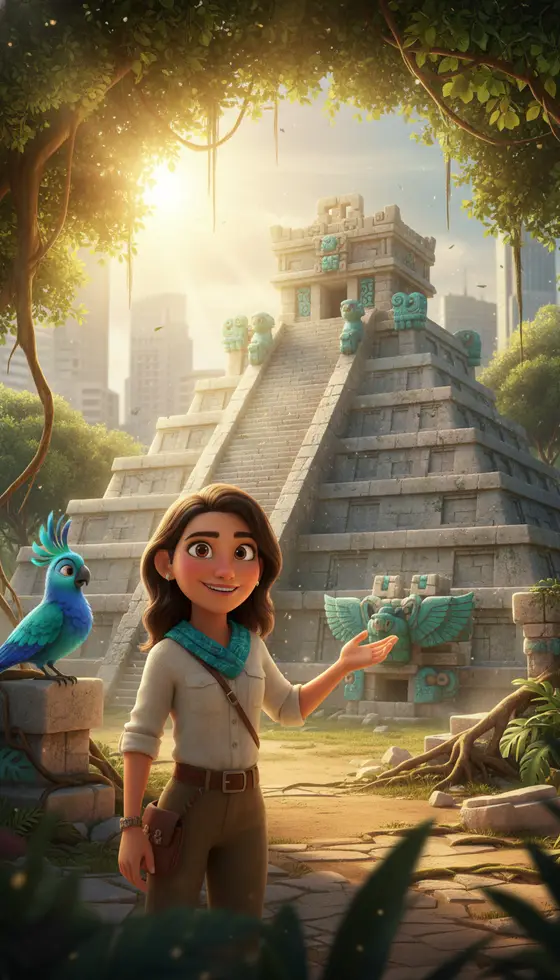
Just northeast of the Cathedral, behind a low fence off Calle Seminario, lies what remains of the main pyramid of Tenochtitlan — the Templo Mayor — excavated since 1978 and now open as an outdoor archaeological zone and museum.
The site is smaller than visitors expect, but the density is extraordinary. The pyramid was rebuilt seven times by successive Aztec rulers, each new structure built directly over the previous one like a nesting doll — and the excavations expose multiple construction phases simultaneously. You can walk around the outer shell of one pyramid and look down into the interior of an older one beneath it. Stone serpent heads, sacrificial platforms, and offerings including jaguar bones, coral from the Gulf of Mexico, and obsidian blades are still in situ behind glass panels.
The adjacent Museo del Templo Mayor is included in the same ticket and holds the most significant finds, including the original Coyolxauhqui disk that triggered the entire excavation — 3.5 meters of intricately carved stone that was identified within hours of the 1978 discovery by a worker who recognized it for what it was. The full Templo Mayor guide covers the museum's collection in depth. For the outdoor site, budget 90 minutes minimum. Entrance is 90 MXN (roughly $4.50 USD), free for students, teachers, and Mexican seniors. Closed Mondays.
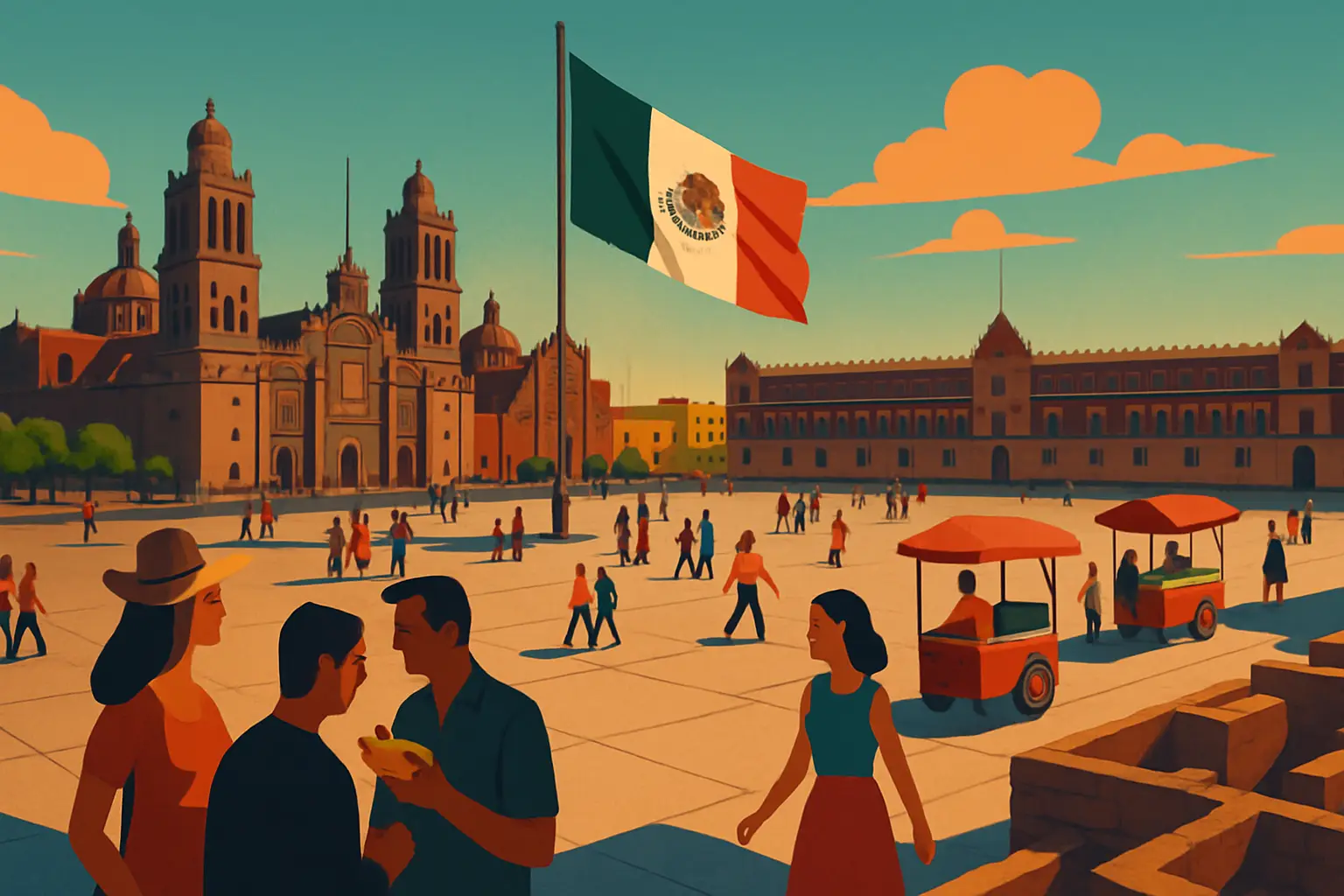
Every morning at 8 am, a contingent of the Mexican Army's Guardia de Honor marches from the Palacio Nacional to the center of the Zócalo to raise the national flag to bugles and drums. The ceremony is precise and formal — no crowd participation, no announcements, just the ritual — and it draws a consistent crowd of locals who stop on their morning commute to watch. The flag lowering at sunset follows the same protocol. Arrive 15 minutes early to position yourself near the center of the plaza; the full ceremony takes about 20 minutes.
The flagpole stands 50 meters tall and flies one of the country's largest flags: 14.3 by 25 meters. On windy mornings, you can hear the flag snapping from across the plaza before you see it.
Beyond the ceremony, the Zócalo shifts character by the hour. Weekday mornings are quiet and local — office workers cutting across, ambulant vendors setting up coffee carts. Midday weekends fill with performers, craft sellers, and occasionally political encampments, since the Zócalo has served as the city's principal site of public protest for decades. The square's biggest moments come on national holidays: the Independence Day ceremony on the night of September 15 (when the President performs the Grito de Independencia from the Palacio Nacional balcony to hundreds of thousands of people below), the Day of the Dead altars in early November, and the winter holiday light installations that run through December and January.
The blocks surrounding the Zócalo hold some of the most historic dining rooms in Mexico City, alongside the predictably tourist-facing restaurants on the plaza's perimeter that should be skipped.
El Cardenal at Palma 23 (one block west of the plaza) is the standard-bearer for traditional Mexican breakfast in Centro Histórico: tamales, atole, enchiladas in mole negro, chilaquiles with crema, and café de olla served in a high-ceilinged room tiled in Talavera. It has been operating since 1969. Go before 11 am; by noon the business-lunch crowd arrives and the wait grows.
Café de Tacuba at Tacuba 28 (three blocks north of the Zócalo) opened in 1912 and feels like eating inside a painting — colonial arches, hand-painted tiles, religious murals on every wall, and mariachis who circulate through the room on weekend afternoons. The food runs to reliable traditional Mexican: mole enchiladas, chiles en nogada during August and September, tamales year-round. The atmosphere justifies the tourist-facing prices.
La Opera at 5 de Mayo 10 (four blocks west) has been a cantina since 1870. The ceiling has a bullet hole that regulars attribute to Pancho Villa, who reportedly fired his pistol into it during a visit in the revolutionary years. Whether true or apocryphal, the bar is genuinely beautiful — original wood bar, pressed tin ceiling, operatic proportions. Arrive before 1 pm or after 4 pm to avoid the midday lunch rush.
Getting there: The Zócalo has its own Metro station (Zócalo, Line 2, the blue line) on the east edge of the plaza. The exit deposits you at the corner of Pino Suárez and 16 de Septiembre — a one-minute walk from the plaza's center. It is one of the most direct Metro stops in the city. The Mexico City Metro guide covers navigation and payment if you have not used the system before.
What is free: The plaza itself (open 24 hours, no charge). The Metropolitan Cathedral (free, open daily approximately 8 am to 8 pm; closed during masses for tourists). Palacio Nacional and the Diego Rivera murals (free with photo ID, Tuesday through Sunday 9 am to 5 pm).
What costs money: Templo Mayor archaeological zone (90 MXN for adults; free for students, teachers, and Mexican seniors with valid credential; closed Mondays). The Museo del Templo Mayor is included in the same ticket.
Is it safe? Centro Histórico is among the most heavily policed areas in Mexico City given its status as both a major tourist hub and the seat of federal government. Petty theft — pickpocketing in crowds around the flag ceremony, on the Metro platform — is the main concern. Keep your phone in a front pocket, avoid loose bags in dense crowds, and stay aware on the walk between the Metro exit and the plaza. The area is active and well-lit until around 9 pm; after that, foot traffic drops and the surrounding streets are better navigated by Uber than on foot.