The neighborhood's official name is Clinton — a designation coined by a real estate coalition in the 1960s to attract buyers who balked at renting somewhere called Hell's Kitchen. The rebranding never fully took. New Yorkers still say Hell's Kitchen; only Times Square-area hotel listings ever said Clinton with a straight face.
The name itself is disputed. The most credible account dates to 1881, when the New York Times used 'Hell's Kitchen' to describe a particularly violent tenement block near 39th Street and 10th Avenue. The competing story — repeated in countless histories — credits a veteran police officer who watched a riot in the mid-1880s and told his partner: 'This place is hell itself.' The partner replied: 'Hell's a mild climate. This is Hell's Kitchen.' Whether or not that exchange happened, the phrase captured something real: the neighborhood was genuinely dangerous, genuinely poor, and genuinely crowded.
The working boundaries are 34th to 59th Street (north-south) and 8th Avenue to the Hudson River. Inside that rectangle: the Lincoln Tunnel approach on 40th Street, the Jacob K. Javits Convention Center at 34th, the massive Hudson Yards development anchoring the southern edge, and the Port Authority Bus Terminal at 42nd Street. It is not a neighborhood that was designed; it accumulated — Irish immigrant laborers in the 1840s, railroad yards and slaughterhouses along 11th Avenue in the Gilded Age, Puerto Rican families moving in after World War II, theater workers following the Lincoln Center build-out in the 1960s.
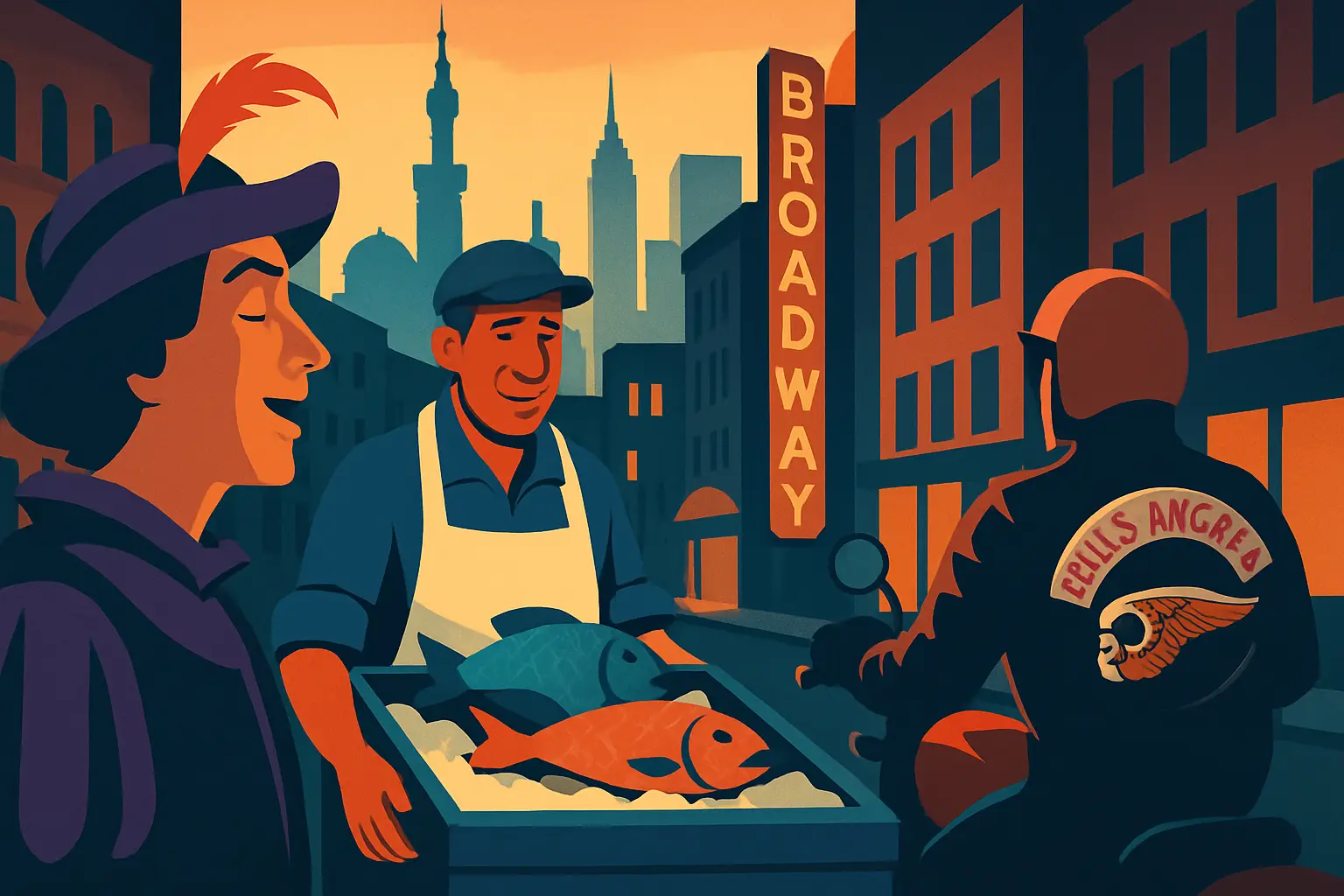
The Hells Angels Motorcycle Club has maintained a New York chapter clubhouse at 37 East 3rd Street in the East Village since 1969. They are sometimes confused with the neighborhood — they are not in Hell's Kitchen — but the association tells you something about how the name was used as a general marker for working-class New York toughness. The neighborhood grew into its reputation and then, slowly, out of it.
The travel math in Midtown pushes visitors toward Times Square and the High Line. Almost nobody walks west of 8th Avenue unless they're heading to the Intrepid or catching a bus at Port Authority — which means 9th Avenue, a 20-block stretch running from the low 40s through the upper 50s, operates at a lower tourist density than it has any right to.
What's on 9th Avenue is a concentration of specialty food shops and restaurants that represents what New York's neighborhood food culture looked like before it went fully upscale. A Lebanese grocery on 46th. A Greek fish restaurant on 47th. A Korean fried chicken spot on 52nd. An Eastern European wine bar that spills into a restaurant after 5 p.m. These are businesses that opened when the avenue was cheap enough to take a risk.
Specific stops worth planning around:
Amy's Bread (672 9th Ave, near 46th St): A Hell's Kitchen institution since 1992. The sticky buns are famous, but the focaccia sandwiches at lunch are the overlooked daily offering. Arrive before noon.
Kashkaval Garden (856 9th Ave, at 56th St): A Bulgarian-run wine bar with a specialty grocery at the front and a full restaurant in the back. The Eastern European charcuterie board — cured meats, smoked cheeses, pickled vegetables — is the anchor order. Outdoor seating in season.
Danji (346 W 52nd St, between 8th and 9th): Modern Korean small plates by chef Hooni Kim. The pork belly buns are the signature dish. Small room, eight tables, reservations recommended.
Gallagher's Steakhouse (228 W 52nd St): Opened in 1927 as a speakeasy and steak joint during Prohibition. The front window has always displayed a dry-aging case — currently holding 21-day dry-aged prime beef. It is a legitimate piece of New York restaurant history, operating continuously through the Depression, the Midtown hotel boom, and the neighborhood's hard decades. Order the bone-in New York strip.
The 9th Avenue International Food Festival happens every May on Mother's Day weekend, closing 18 blocks of the avenue from 37th to 57th Street. It has run since 1974 and draws roughly 100,000 people. Street-fair prices, vendor-booth format. It is genuinely more food than one visit can handle.
Get short, interactive stories that make each place easier to remember while you travel.
Restaurant Row is a single block: West 46th Street between 8th and 9th Avenues. The nickname comes from the concentration of pre-theater restaurants — Italian, French, Greek — that lined up to serve theatergoers before curtain. The block's reputation peaked in the 1970s and 1980s when the theaters were active and the dining alternatives near Times Square were otherwise grim. The theaters are still there; the ritual persists.
The Richard Rodgers Theatre (226 W 46th St), where Hamilton ran from 2015 to 2022, sits directly on Restaurant Row. The August Wilson Theatre (245 W 52nd St), the Majestic (247 W 44th St — home to The Phantom of the Opera from 1988 until its 2023 close after 35 years, the longest-running Broadway show in history), and the Nederlander (208 W 41st St) are all within a 10-minute walk.
September is when Broadway's fall season opens. New productions typically begin previews in the first two weeks after Labor Day, making September through December the most active stretch of the calendar before holiday shows dominate. Pre-theater dining has a specific rhythm: arrive by 5:30 p.m. to eat and reach the theater by 7:45 p.m. Most restaurants within a four-block radius of Times Square understand the window.
On Restaurant Row itself, Orso (322 W 46th St) — rustic Italian, theater-industry crowd, thin-crust pizzas — has been the neighborhood's most reliable choice since 1983. Azalea (321 W 46th St) is the best bet for the prix-fixe pre-theater menu that the block is known for.
The Intrepid Sea, Air & Space Museum occupies Pier 86 at 46th Street and 12th Avenue, hard against the Hudson River. The museum is built around the USS Intrepid, an Essex-class aircraft carrier commissioned in 1943 that participated in the campaigns at Leyte Gulf and Okinawa, survived five kamikaze strikes and a torpedo hit, and was decommissioned in 1974. It is enormous — 888 feet long, 36,000 tons — and has been a museum since 1982.
The exhibit most visitors don't expect is on the outdoor flight deck: the Space Shuttle Enterprise.
Enterprise was the first orbiter NASA built, constructed in 1976 specifically to test atmospheric flight and landing. It never reached orbit — it lacked the heat shield and main engines for spaceflight — but it flew eight captive-carry flights atop a modified 747 and five independent glide tests over the Mojave Desert in 1977, proving the shuttle design was viable before NASA committed the full production budget. Its name came from a campaign by Star Trek fans who wrote to the White House asking that the orbiter be named after the starship Enterprise.
Enterprise spent decades at the National Air and Space Museum's Udvar-Hazy Center in Virginia. When the Space Shuttle Discovery — an actual orbital vehicle — was transferred there in 2012, Enterprise moved to New York and was installed in a purpose-built pavilion at Pier 86. Seeing a shuttle-size vehicle at pier level, at eye height rather than hung from a museum ceiling, is unexpectedly affecting.
The museum also holds Concorde Alpha-Alpha (one of only 20 Concordes ever built), an SR-71 Blackbird reconnaissance aircraft, and the USS Growler — a Cold War-era guided missile submarine moored alongside the pier, open for interior tours.
Intrepid Museum: Pier 86, 46th St and 12th Ave; open daily 10 a.m.–5 p.m. (later on weekends in summer)
Space Shuttle Enterprise pavilion is included with museum admission
Budget 2–3 hours for the carrier, Enterprise pavilion, and submarine — each is a separate space requiring separate time
The Hudson River Greenway runs the full length of Manhattan's western shoreline — from Battery Park at the southern tip to Inwood at the northern end — and the Hell's Kitchen segment, from roughly 34th to 59th Street, is among the best stretches. The path is separated from vehicle traffic, wide enough for cyclists and pedestrians to share without conflict, and sits directly on the water's edge.
From the greenway in Hell's Kitchen you can see the Hudson at its full width, with the Palisades of New Jersey rising across the river. At sunset, the light hits the water from the west — the opposite of what you get from any east-facing Manhattan location. The view is not incidental.
Riverside Park South at 72nd Street, reachable by following the greenway north from the Hell's Kitchen section, is a quieter alternative to the crowded Hudson River Greenway closer to Chelsea. The 79th Street Boat Basin — a marina embedded in Riverside Park where a small community of Manhattanites actually live on houseboats year-round — is a 20-minute walk north from the Intrepid pier.
South of the Intrepid pier, the greenway connects to Chelsea Piers (23rd Street) — a sports complex built inside four historic piers that once received the Titanic's survivors. Today Chelsea Piers holds a golf driving range, ice rinks, a gymnastics facility, and a marina. From there, the path continues south to the High Line at Gansevoort Street — making the entire west side of Manhattan walkable without ever touching a car lane.
Is Hell's Kitchen safe? Yes, consistently in 2026. The neighborhood's violent reputation dates to the 1970s and 1980s, when the crack epidemic, disinvestment, and sustained poverty made much of Midtown's West Side genuinely dangerous. That era ended over 30 years ago. Today Hell's Kitchen is a mid-density residential neighborhood with a mix of long-time residents, theater workers, and families. Standard urban awareness applies — don't display valuables on quiet cross-streets late at night — but visitor safety concerns are low.
When is the best time to visit? September and October. The Broadway season opens in September (new productions begin previews right after Labor Day), the 9th Avenue corridor restaurants are at full capacity, and Hudson River Greenway weather is excellent. If your priority is the food festival specifically, May's 9th Avenue International Food Festival is the single largest reason to come.
How does it connect to the rest of Manhattan? Hell's Kitchen's position in Midtown makes it central. Times Square is a 10-minute walk east from the middle of the neighborhood. South along the Hudson Greenway leads to the High Line and Chelsea — check our guide to the High Line for what's at that end. Soho and Greenwich Village are subway stops south on the A/C/E. North of 59th Street, the neighborhood blends into the Upper West Side near Lincoln Center, which opened in 1962 and effectively stabilized the northern edge of Hell's Kitchen by bringing institutional money and foot traffic to the area.