Before the High Line existed, freight trains ran at street level down 10th Avenue — through moving traffic, pedestrians, and horse-drawn wagons. The carnage was severe enough that the stretch earned the name 'Death Avenue.' Rail workers called West Side Cowboys rode horses ahead of the trains, waving red flags to warn pedestrians, a precaution that didn't prevent the roughly 540 deaths recorded in the late 19th and early 20th centuries.
The New York Central Railroad and the City of New York funded the West Side Improvement Project — a complete grade separation that buried street-level tracks in the south and elevated them through the mid-section. The elevated line, built 1929–1934, ran from 34th Street south and threaded directly into the meatpacking houses and food warehouses along Gansevoort and Horatio Streets. Refrigerated boxcars of beef arrived at the upper floors of distribution buildings without ever touching the street.
The last train ran on the High Line in 1980, carrying a load of frozen turkeys. Freight distribution had shifted to trucking, the line was expensive to maintain, and the city acquired the structure while immediately receiving demolition proposals from property owners whose buildings abutted the rusting steel.
Joshua David was a freelance writer who lived in Chelsea. Robert Hammond was an artist recently moved to the West Village. They met at a community board meeting in 1999 called to discuss demolition of the High Line's southern section — and discovered they were the only two people in the room who thought preserving it was a good idea.
They founded the Friends of the High Line that same year with no money and no political connections. Their most effective early move was commissioning photographs by Joel Sternfeld showing the wildflowers and grasses that had colonized the abandoned tracks — images that communicated what the space could become better than any architectural rendering. The photographs circulated widely, the idea caught, and over the following decade the Friends raised $150 million, lobbied the city, and organized the international design competition that selected the team that would build the park.
The winning team — James Corner Field Operations (landscape architects), Diller Scofidio + Renfro (architects), and Dutch plantsman Piet Oudolf — opened the first section from Gansevoort to 20th Street in June 2009. The second section, to 30th Street, followed in June 2011. The northern spur toward 34th Street came in stages through 2014. By the time Hammond and David stepped back in 2011, the High Line had become the most-visited new cultural destination in New York in decades.
Get short, interactive stories that make each place easier to remember while you travel.
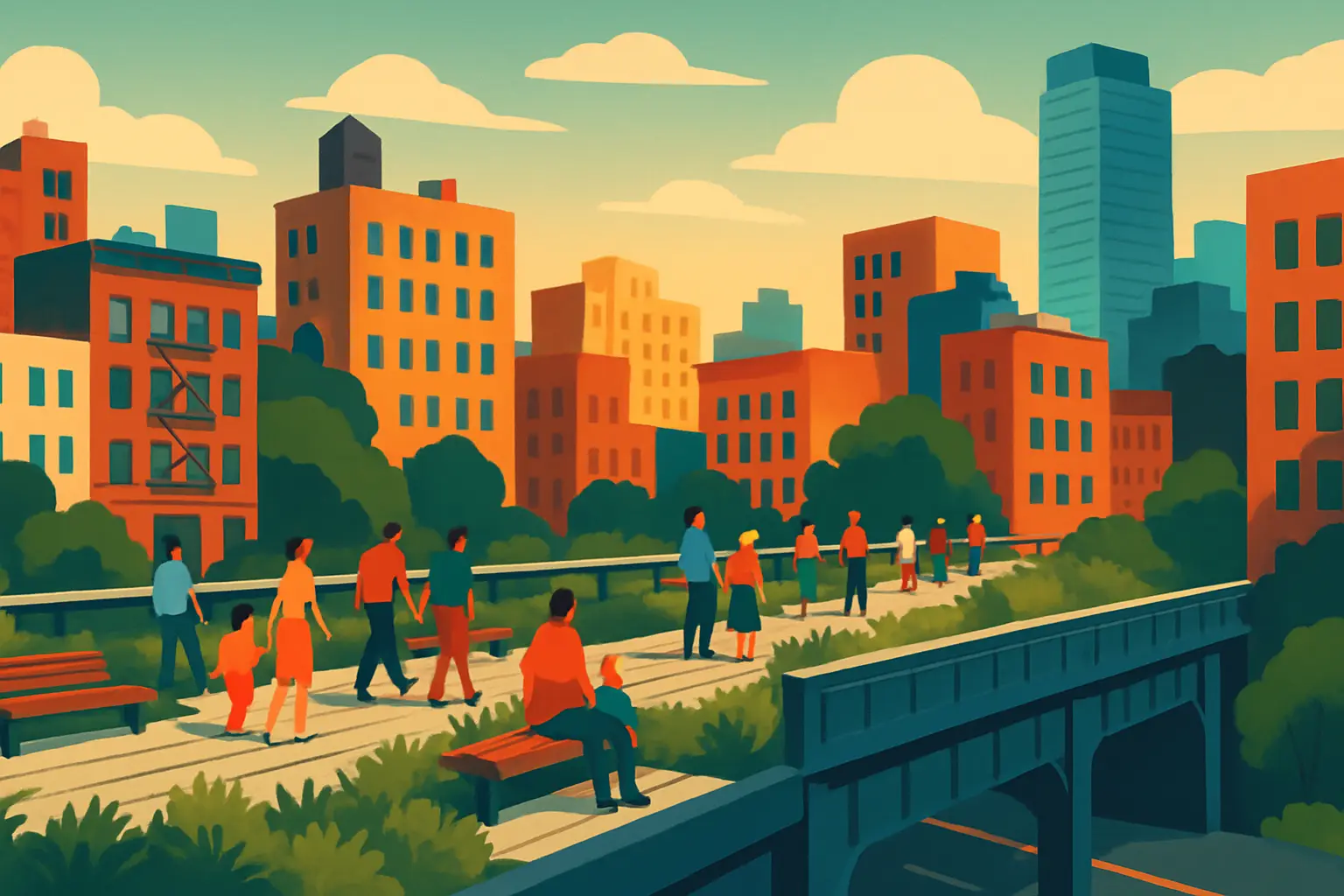
Most visitors notice the plants without processing them. The High Line's planting design by Piet Oudolf is genuinely unusual and worth understanding before you walk it.
Oudolf is a Dutch horticulturalist whose 'New Perennial' style rejects the traditional park approach — annuals in formal beds, groomed grass, static compositions that look the same all year. Instead, he plants perennials and grasses in dense, naturalistic drifts that behave like meadow and prairie species: they emerge slowly in spring, peak in midsummer, and in fall and winter become a different kind of beautiful — dried seed heads, bronze grasses, skeletal structure against the New York skyline.
On the High Line, Oudolf worked with plants already self-seeding in the abandoned rail bed — evening primrose, mugwort, goldenrod — and layered in designed species: catmint, alliums, black-eyed Susans, switchgrass, feather reed grass, Joe Pye weed. The original concrete rail ties and sections of steel track were preserved and woven into the planting beds, which is why the path alternates between paved walkway and areas where the walking surface integrates with the plants.
In August, the High Line is at peak bloom. The grasses are tall, late-summer perennials are at full height, and the planting does exactly what Oudolf designed it to do: make wild plants in an industrial frame feel like they belong there.
The southern entry at Gansevoort Street (accessible from Washington Street, one block from the Hudson River) is the park's most theatrical opening. Directly below stands the Whitney Museum of American Art (99 Gansevoort St), designed by Renzo Piano and opened in 2015. The Whitney relocated here from its longtime home on the Upper East Side specifically to anchor this neighborhood — ground-floor galleries open toward the street, and upper-level terraces overlook the High Line directly.
The Meatpacking District surrounding the southern entry was, until the 1990s, an actual meatpacking district — roughly 250 slaughterhouses and packing plants operating in a 13-block area around Gansevoort, Washington, and Ninth Avenue. The cobblestone streets are original 19th-century Belgian block. The loading docks embedded in the sidewalks are original. The transition from industrial district to the current mix of hotels and restaurants happened fast, between roughly 1998 and 2004, driven partly by the LGBTQ+ bar and club scene that had occupied the warehouse spaces at night.
On the High Line itself, the first section heading north moves through the Gansevoort Woodland — a dense planting that funnels you into the park — then the Washington Grasslands and the 14th Street Passage, where the park narrows through surviving industrial rail infrastructure.
Whitney Museum: 99 Gansevoort St; Thu–Mon 10:30 a.m.–6 p.m., Fri until 10 p.m., closed Tue–Wed; free for NYC residents on the first Friday of each month
High Line Gansevoort entry: stairs and elevator from Washington St between Gansevoort and Horatio Streets
The cobblestone pavement on Gansevoort Street is protected by landmark designation — it cannot be repaved
The High Line passes directly above West Chelsea — the largest concentration of contemporary art galleries in the United States. Between 18th and 27th Streets, the blocks between 10th and 11th Avenues hold roughly 200 galleries, from project spaces to the New York flagships of the world's most powerful dealers. All of them are free to enter.
Gagosian Gallery operates two Chelsea spaces — 522 W 21st St and 555 W 24th St — with the 24th Street building's 24-foot ceilings making it one of the largest privately held art spaces in Manhattan. David Zwirner (519–537 W 19th St) occupies multiple connected buildings and regularly shows the artists most discussed in the contemporary market. Paula Cooper Gallery (534 W 21st St) was founded in 1968 and is the oldest gallery in Chelsea, among the first to migrate here from SoHo in the 1990s. Hauser & Wirth (548 W 22nd St) is the New York outpost of the Zurich-based gallery representing the estates of Philip Guston and Lee Lozano.
From the High Line, stairs at 23rd Street deposit you into the heart of the gallery district. A loop through the 21st–24th Street blocks and back up to the park at 26th Street covers the highest-density section in under an hour. For the broader Chelsea neighborhood — the residential streets east of 10th Avenue, the history of the neighborhood before the galleries — see our Chelsea neighborhood guide.
Chelsea galleries are open Tuesday through Saturday, 10 a.m. to 6 p.m.; closed Sunday and Monday
No tickets, no appointments required — walk in, look at whatever's up, leave when you like
The 22nd–24th Street blocks between 10th and 11th Avenues are the densest — a single block can have four or five major gallery spaces
The High Line's northern terminus at 34th Street deposits you into Hudson Yards — a $25 billion mixed-use development built on a platform over active rail yards, the largest private real estate development in American history. It opened in 2019.
The most visited structure is the Vessel — a 16-story, 154-interconnected-staircase sculpture designed by British designer Thomas Heatherwick. After a series of fatal falls and a safety redesign, a ticketed reservation system is in place as of 2026; check availability at hudsonyardsnewyork.com before making it a priority. The views from upper levels are significant — Hudson River and the Manhattan skyline heading south — but the experience is a stairclimb, not a conventional art encounter.
The Shed (545 W 30th St) is the more interesting institution nearby: a movable-shell performing arts center designed by Diller Scofidio + Renfro (the same architects who worked on the High Line) and Rockwell Group. The outer shell rides on large wheels and rolls over an adjacent plaza to expand the performance space from a 500-person black box to a 2,500-person arena. Even if you're not attending a show, the building's exterior mechanics are worth walking around. Programming calendar at theshed.org.
For most visitors, the north end is a brief detour rather than a goal — the denser content is in Chelsea and the Meatpacking District. If you want to spend the most time in Chelsea with your legs fresh, walk the route in reverse: enter at 34th Street and exit at Gansevoort.
How do I get to the High Line from Midtown or Downtown? For the Gansevoort southern entrance: A/C/E to 14th Street, then walk west to Washington St. For the Chelsea midsection: C/E to 23rd Street, then walk west to 10th Ave. For the north end: 7 train to 34th Street-Hudson Yards, which drops you at the eastern plaza of Hudson Yards.
How long is the walk? End to end is roughly 45 minutes at a steady pace. With the Whitney Museum, a Chelsea gallery loop, and the Hudson Yards detour, budget 3–4 hours for a full day.
Can I bring a bike or scooter? No. The High Line is pedestrian-only — no cycling, electric scooters, or skateboards.
Is it accessible? Elevator access at 14th, 16th, 23rd, 26th, and 30th Streets. The path surface is mostly even throughout. Dogs on leash are welcome.
What art is on display right now? High Line Art runs rotating commissions — sculpture, video, performance — along the length of the park. Specific installations change seasonally; check the current program at thehighline.org so you know what you're looking at when you walk past it.
What's nearby at the south end? The SoHo cast-iron architecture district is a 15-minute walk south and east — see our SoHo neighborhood guide for what to see there. The Greenwich Village neighborhood is a similar walk south; the Greenwich Village guide covers the neighborhood's literary and architectural history.