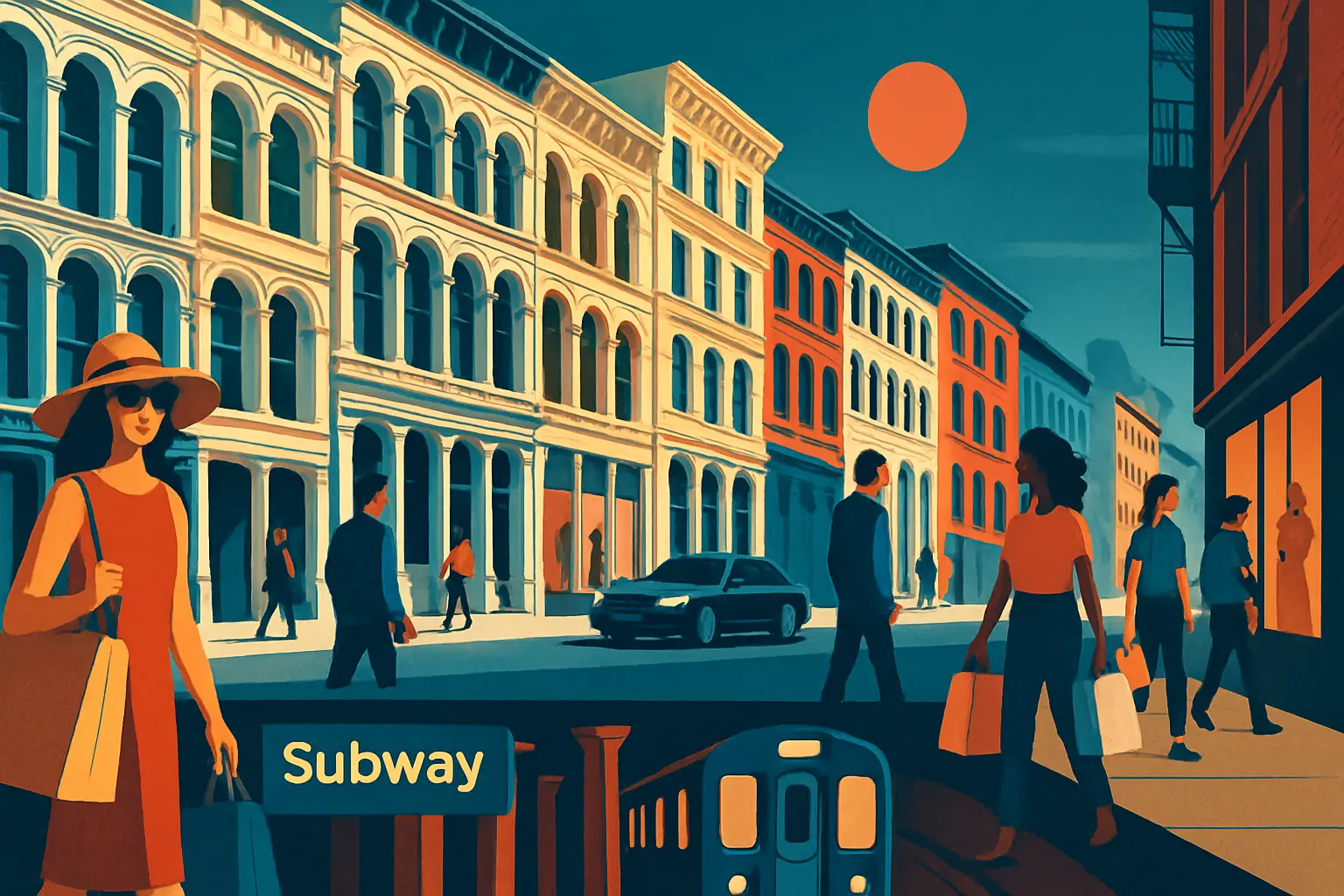
SoHo's boundaries are roughly Houston Street to the north, Canal Street to the south, Lafayette Street to the east, and West Broadway to the west — about 26 blocks of Manhattan grid. The footprint is small enough to walk entirely in an afternoon, which disguises how much is packed into it.
The name was practical before it was cool. City planners in the late 1960s needed shorthand for the district they were studying, which at the time was officially the Washington Square South Urban Renewal Area — a designation that reflected decades of neglect. The acronym stuck after a 1969 New York Magazine article used it. By the mid-1970s, SoHo was on every New York map.
The adjacent neighborhoods borrow the same naming logic: NoHo (North of Houston) runs from Houston to Bleecker between Broadway and Lafayette; TriBeCa (Triangle Below Canal) begins at Canal and extends south. SoHo connects to both on foot — a walk from the West Village east along Spring Street covers all three zones in under thirty minutes.
What distinguishes SoHo from either neighbor is the architecture. Houston to Canal on Broadway and the side streets is the largest concentration of cast iron commercial buildings in the world.
Cast iron construction peaked in New York between roughly 1850 and 1880. The technology solved a problem that masonry construction could not: speed. Cast iron facades were prefabricated in foundries — columns, arches, cornices, window surrounds — and bolted together on-site in weeks instead of months. The material could also be cast to imitate carved stone at a fraction of the cost, which gave the buildings their characteristic ornate appearance.
The result in SoHo was five- and six-story loft buildings designed to look like Italian palazzos, covering block after block. At the time they were built, this was one of the densest manufacturing and wholesale dry-goods districts in the country.
The Haughwout Building (488–492 Broadway, built 1857) is the most significant surviving example. Designed by John P. Gaynor for a china and glassware merchant named E.V. Haughwout, its facade repeats a Venetian arched motif across five bays on two street-facing elevations — 92 identical cast iron columns. Its real distinction is mechanical: in 1857 it installed one of the first commercial Otis passenger elevators, which is why Haughwout had to be built taller than its neighbors. The elevator made upper-floor space rentable for the first time.
Greene Street is the single best block for cast iron variety. Walk it from Canal to Houston and look for: columns with Corinthian capitals, arched window frames with decorative keystones, elaborate cornices along the roofline, and the horizontal joint lines where prefabricated sections were bolted together. The 'King' building at 72–76 Greene Street (1873) runs across five bays with floor-to-ceiling Corinthian columns and is often cited as the grandest surviving example on the street.
The SoHo-Cast Iron Historic District was landmarked in 1973, protecting 26 blocks at a time when such buildings elsewhere in New York were routinely demolished.
Get short, interactive stories that make each place easier to remember while you travel.
The loft buildings emptied as manufacturing migrated out of Manhattan after World War II. By the 1950s, the district's upper floors were legally zoned for manufacturing only — no residential use permitted. Artists discovered that the zoning gap created something rare in New York: enormous, cheap, unfinished space with north-facing windows ideal for painting.
They moved in anyway. By the mid-1960s, SoHo had a functioning illegal residential community of visual artists. The city faced a choice: enforce the law and displace hundreds of working artists, or accommodate the reality. In 1971, New York passed a law creating the Artist in Residence (AIR) program, which allowed certified working artists to legally live in manufacturing lofts. Certification required proof of professional practice. The building had to post a small blue AIR placard on the exterior — you can still find these on some SoHo facades.
Donald Judd purchased 101 Spring Street in 1968 for $68,000 — a five-story 1870 cast iron building — and spent the next 26 years converting it into one of the most precisely considered live-work environments in American art. He installed his own sculptures, furniture he designed, and works by other artists he respected (Dan Flavin, John Chamberlain) with the intention that the building would be preserved intact. The Judd Foundation maintains it exactly as he left it at his death in 1994: no rearrangement, no new labels, no concession to contemporary museum norms.
Galleries followed. Paula Cooper Gallery opened on Wooster Street in 1968. Leo Castelli moved his operation to 420 West Broadway. Ivan Karp opened O.K. Harris Works of Art at 383 West Broadway in 1969, championing photorealism at a time when most serious galleries ignored it. By the late 1970s, SoHo had become the center of the contemporary art market. The Chelsea neighborhood did not yet exist as a gallery district — that would come later.
The transformation happened quickly. As SoHo's reputation grew, commercial rents climbed. By the early 1990s, most galleries could no longer afford the neighborhood they had created. The exodus to Chelsea — where industrial buildings with high ceilings and cheaper leases were available — accelerated through the mid-1990s. Paula Cooper moved to West 21st Street in 1996. By 2000, the gallery era was largely over.
What replaced the galleries was the current SoHo: a dense concentration of flagship retail for global fashion brands, interspersed with restaurants and a handful of surviving cultural institutions. Broadway between Houston and Canal now reads as an outdoor mall with architectural bones.
A few institutions held on. The Drawing Center at 35 Wooster Street opened in 1977 and has remained in SoHo through every transition, maintaining a serious exhibition program focused on drawing as a primary medium. It is genuinely undervisited relative to its quality — admission is free. The Leslie-Lohman Museum of Art on Wooster Street focuses on LGBTQ+ art and artists, with a permanent collection spanning more than a century.
The cast iron buildings themselves are the most durable surviving artifact of the bohemian era. You cannot buy them or displace them, and nothing about a Gucci storefront changes the facade behind the signage.
Balthazar (80 Spring Street) is the restaurant SoHo built. Keith McNally opened it in 1997 as a French brasserie — all red banquettes, zinc bar, and floor-to-ceiling mirrors — and it has been full for every service since. The steak frites and the plateaux de fruits de mer are the orders that never disappoint. Book two weeks out on Resy; walk-ins at the bar are sometimes possible for lunch on a weekday.
Raoul's (180 Prince Street) has been open since 1975, making it a genuine SoHo original. The back room is dark, crowded, and reliably good for a French bistro dinner. It predates the gallery era's peak and survived the retail takeover with its character intact.
Jack's Wife Freda (224 Lafayette Street) does a Mediterranean-leaning all-day menu — the rosewater waffles and poached eggs with harissa are the breakfast standards — in a bright, no-reservation room. Expect a wait on weekend mornings; the line moves fast.
Dominique Ansel Bakery (189 Spring Street) originated the cronut in 2013. The original croissant-donut hybrid still has a daily allotment that sells out by mid-morning. The shop has expanded its menu considerably since then; the DKA (Dominique's Kouign Amann) is equally good and easier to get.
Balthazar: 80 Spring St, open daily for breakfast through late dinner; reserve on Resy for dinner
Raoul's: 180 Prince St, dinner only, closed Monday
Dominique Ansel Bakery: 189 Spring St, open 8 a.m.–7 p.m.; arrive before 9 a.m. for cronuts
Start at Greene Street between Canal and Houston. This is the cast iron showcase — walk the full length from south to north and look at every facade without worrying about where you're going. The density of ornamental detail is highest here and the street is narrow enough that the buildings feel monumental.
Turn east onto Prince Street at the north end of Greene. Prince Street is the retail corridor: the storefronts are famous brands, but the facades above the awnings are original cast iron. Walking east toward Broadway, look up.
South on Broadway from Prince to Spring gives you the Haughwout Building on the east side of the street (at Broadway and Broome, southwest corner). Cross the street to examine the facade close — at ground level you can see the individual bolts holding the prefabricated sections together.
West on Spring Street toward West Broadway covers Balthazar territory and begins the walk back toward the subway. Spring Street is more residential in feel than Prince — less tourist density, better windows into the buildings' interiors through the ground-floor retail.
The Judd Foundation at 101 Spring Street is identifiable by the small AIR placard on the exterior even if you haven't reserved a guided tour. The building is almost unchanged from the outside — five stories of cast iron, modest signage, the exact building Judd bought in 1968 for the space and the light.
Is SoHo worth visiting in 2026? Yes — with adjusted expectations. The neighborhood is primarily a shopping destination now, and the weekend crowds on Prince Street and West Broadway can feel like Times Square with better architecture. The payoff is genuine: the cast iron streetscape is irreplaceable, the Judd Foundation is one of the best art experiences in New York, and the restaurants that have been here for decades (Balthazar, Raoul's) are excellent.
When is the best time to go? Weekday mornings before 10 a.m. give you the streets before shops open and before the tourist density peaks. The architecture reads better with fewer people in the frame. Saturday afternoons in August are the most crowded.
How far is SoHo from other neighborhoods? TriBeCa is two blocks south of Canal Street — a ten-minute walk. NoHo and the East Village are directly north of Houston. The Lower East Side is east of Lafayette, walkable in fifteen minutes. SoHo works best as part of a lower Manhattan loop rather than a standalone destination.
What should I actually come for? The architecture first: pick one block and look at every detail above the storefronts. The Judd Foundation second, if you've reserved. Balthazar for lunch. The Drawing Center if contemporary art interests you. The shopping is incidental — SoHo earned its reputation on its bones, and the bones are still there.