1. Why the East Village Is Not the West Village
New Yorkers will correct you on this immediately: the East Village and the West Village (part of Greenwich Village) are different neighborhoods with different histories, different demographics, and a different relationship to money.
The West Village — the area of crooked streets west of Seventh Avenue below 14th Street — was already expensive by the 1970s. It has long been a neighborhood of brownstones, boutiques, and celebrity residents.
The East Village was poor. Bounded roughly by 14th Street to the north, Houston Street to the south, Fourth Avenue to the west, and Avenue D to the east, it was a working-class immigrant neighborhood — first German (hence 'Kleindeutschland' in the 19th century), then Eastern European, then Puerto Rican — that became cheap enough in the 1960s and 1970s to attract artists, radicals, and anyone else who needed to pay almost nothing for rent. That cheapness made CBGB possible. It made the punk scene possible. It made the neighborhood's character possible.
The [Lower East Side](/us/blog/lower-east-side-new-york-neighborhood-guide), just south of Houston Street, is a separate neighborhood with its own Jewish immigrant history that runs parallel to the East Village story. The two are often confused by visitors and are genuinely close to each other, but the character and the history diverge on opposite sides of Houston.
•East Village boundaries: roughly 14th St (north), Houston St (south), Fourth Ave/Bowery (west), Avenue D (east)
•The neighborhood was officially part of the Lower East Side until the 1960s, when real estate agents began marketing it separately as the 'East Village' to differentiate it from the poorer blocks further south
•Alphabet City — Avenues A, B, C, and D — is the far eastern section, the farthest from the subway, and historically the least expensive part of the neighborhood
2. CBGB, 315 Bowery, and How Punk Rock Started in a Bar That Smelled Like Mildew
CBGB stood for Country, BlueGrass, and Blues — which is what Hilly Kristal intended to book when he opened the club at 315 Bowery in December 1973. The bands that actually showed up were something else entirely.
The Bowery in 1973 was skid row — cheap rooms, pawn shops, men sleeping in doorways. Real estate at 315 Bowery cost almost nothing. The club took the basement level of a flophouse called the Palace Hotel. Kristal had no money to be selective: he booked whoever came in off the street.
In March 1974, Television — led by Tom Verlaine and Richard Hell — became the first band to play a regular Sunday night residency at CBGB. They were playing a angular, minimalist rock that had no genre name yet. Through 1974 and 1975, the Patti Smith Group, the Ramones, Blondie, Talking Heads, and the Heartbreakers all became CBGB regulars. These were not bands playing to tiny audiences because they were obscure — they were obscure because the music they were making did not fit anything that existed on AM radio or in mainstream record contracts. CBGB was the room where it all coalesced.
The Ramones' first show at CBGB was August 16, 1974. They played 17 songs in 17 minutes. The sound that would become punk rock — fast, stripped down, deliberately anti-virtuosic — was already fully formed.
CBGB ran until 2006, when Kristal lost a rent battle with the Bowery Residents' Committee, which owned the building. The club closed in October 2006 with a final concert by Patti Smith. The room had hosted thousands of acts across 33 years. By the end, the walls were so covered in stickers and graffiti they were almost structural.
John Varvatos opened a clothing store in the same space in 2008 and kept the stage, the toilet-paper-holder set lists tacked to the walls, the original counter, and the concert posters preserved behind glass. The decision was equal parts homage and commercial calculation — the brand wanted the association — and it was genuinely controversial. The store closed in 2023. Whatever occupies the space now, the address matters: 315 Bowery, at Bleecker Street, is where American underground music found its form.
3. Tompkins Square Park and the 1988 Riots That Defined New York's Gentrification Wars
Tompkins Square Park (East 7th to East 10th Street, Avenues A to B) is the East Village's central park and the site of the most significant public confrontation in the neighborhood's modern history.
By the mid-1980s, the park had become a semi-permanent encampment for homeless residents. The East Village around it was simultaneously becoming attractive to artists and wealthier renters — the same gentrification pressure that would eventually push rents up across the neighborhood. In the summer of 1988, the city attempted to enforce a midnight curfew to clear the park of its homeless population.
On the night of August 6–7, 1988, a protest against the curfew turned into a multi-hour confrontation between police and protesters and residents. Officers on horseback charged crowds on Avenue A. Journalists were beaten. Residents were beaten. The video footage — shot by locals — documented police behavior that the city would spend years litigating. The riots became one of the defining events in New York City's ongoing debate about public space, housing, and who the city was for.
The park was fenced and closed for renovation in 1991; the encampment was cleared. It reopened with a restored dog run, playground, and basketball courts. Today, Tompkins Square is a genuinely pleasant neighborhood park — farmers' market on Sundays, dog run open daily, chess tables along the south end, and a bandshell that still hosts summer concerts. The elm trees along the central path are among the oldest in Manhattan.
Alphabet City — the blocks on Avenues A, B, C, and D east of the park — went from one of Manhattan's most dangerous areas in the 1980s to a neighborhood of bars and restaurants by the early 2000s. The old saying about the avenues was: 'A you're all right, B you're brave, C you're crazy, D you're dead.' None of that applies now. Avenue A has wine bars. Avenue B has brunch spots. The history is real but it's history.
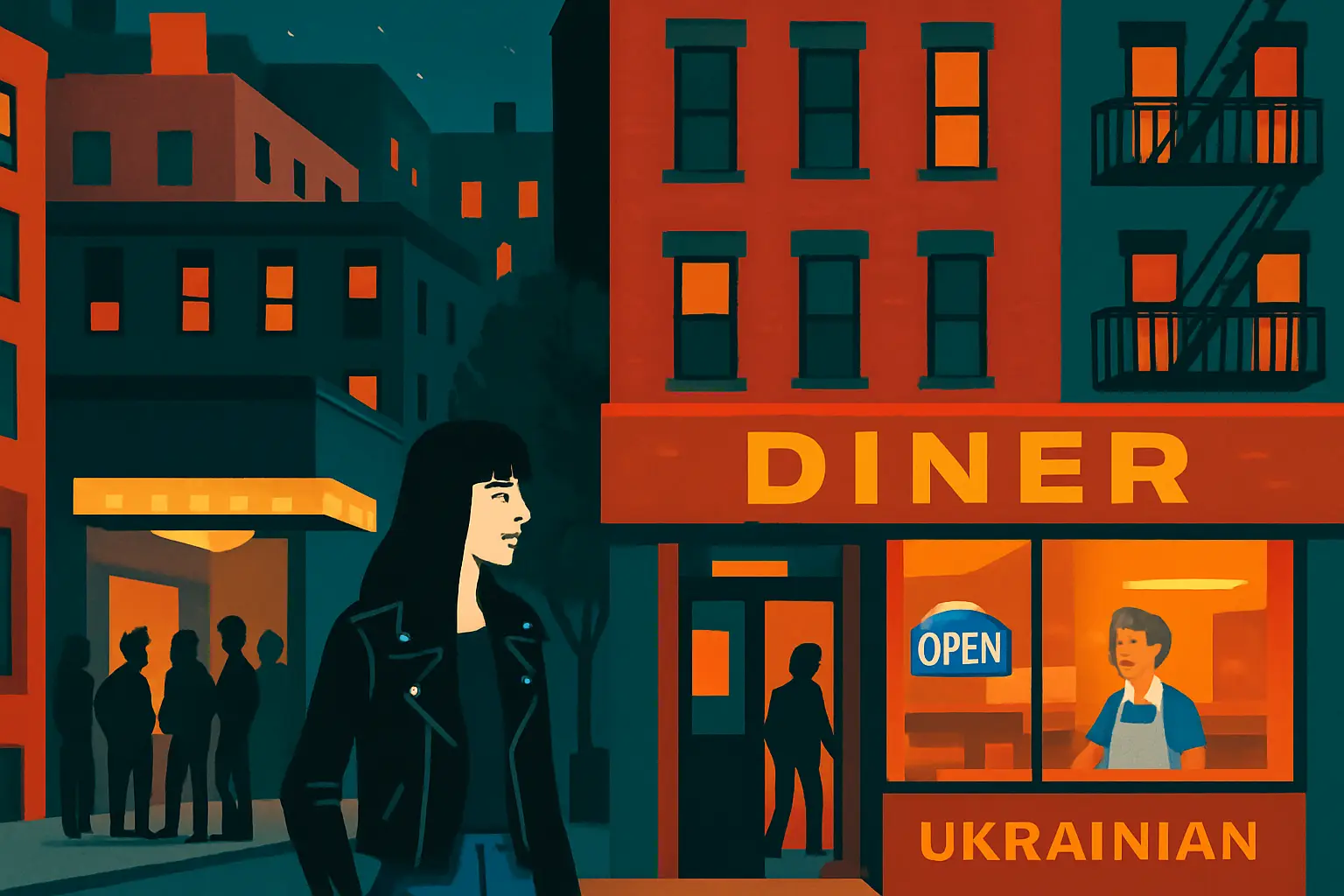
4. The Ukrainian Community: Why This Block Speaks Two Languages
The Ukrainian East Village is one of New York's most intact ethnic enclaves from the postwar era — and one of the least discussed by anyone who doesn't live there.
Ukrainian immigrants arrived in significant numbers after World War II, settling around Second Avenue between 6th and 14th Streets. The epicenter is the block around East 7th Street and Second Avenue, where St. George Ukrainian Catholic Church (30 East 7th Street, completed 1977) anchors a community that has weathered decades of demographic change by owning its institutions.
The Ukrainian Museum (222 East 6th Street) holds one of the largest collections of Ukrainian folk art outside Ukraine itself — embroidered textiles, painted Easter eggs (pysanky), ceramics, and historical documents from the diaspora. It is a serious institution that most visitors to New York have never heard of.
Veselka (144 Second Avenue) is the community's public-facing institution for outsiders. It opened in 1954 as a candy store run by Wolodymyr Darmochwal, an immigrant from Ukraine, and evolved into a full Ukrainian diner over the following decade. The menu has expanded and the clientele has broadened to include every type of New Yorker at every hour, but the core dishes — borscht, pierogies, kielbasa, stuffed cabbage — are the real product and remain excellent.
Since Russia's 2022 invasion of Ukraine, the neighborhood's cultural institutions have taken on additional significance. The church, the museum, and the community center on East 4th Street have all become coordination points for local relief and advocacy efforts. The Ukrainian flag on storefronts along Second Avenue is not decoration.
5. St. Mark's Place: The Most Famous Street in American Counterculture
St. Mark's Place is the name given to East 8th Street between Third Avenue and Avenue A — six blocks of narrow sidewalk that have served as the commercial spine of whatever counterculture was happening in New York at any given moment since the 1960s.
In the 1960s it was psychedelics and head shops. In the 1970s it was the Hells Angels (who still have their New York chapter at 77 East 3rd Street), the punk scene spilling out of CBGB, and the Electric Circus, a club at 23 St. Mark's Place that hosted Jimi Hendrix and Sly and the Family Stone. In the 1980s it was tattoo parlors and record stores. In the 1990s it was cheap restaurants and the stores selling band T-shirts.
Trash and Vaudeville (96 East 7th Street) has been selling punk and rock clothing — leather jackets, band shirts, platform boots — since 1975. It moved from its original St. Mark's Place address but remains the most historically grounded retail store in the neighborhood: the same inventory logic it has always had, the same willingness to fit you into something aggressively specific.
The Ottendorfer Library at 135 Second Avenue is worth noting as you pass: it was built in 1884 by a German-American newspaper publisher as a free public library and is now a New York Public Library branch. The building is a designated city landmark and one of the most beautiful small library buildings in New York.
Today St. Mark's Place is a mix of Japanese restaurants (a notable cluster of ramen and yakitori spots), nail salons, vintage clothing stores, and bars. The block from Second to First Avenue has the highest concentration of both. It is less radical than it was and still more interesting than most of Manhattan.
6. Where to Eat and Drink: The Actual East Village List
Veselka (144 Second Ave, 24 hours) is non-negotiable. The borscht — both hot red beet and cold Ukrainian-style — is the best version in the city. Pierogies are potato-cheddar, mushroom-sauerkraut, and meat. Order a combination plate.
Veniero's Pasticceria (342 East 11th Street) opened in 1894 and is one of the few Italian pastry shops in New York with continuous operation across the century-long span during which the neighborhood changed almost completely. The cannoli and cheesecake are the standard orders. There is no reservation system and no ambiance management — it is a bakery with tables and glass cases of pastry.
Momofuku Noodle Bar (171 First Avenue) is where David Chang opened his first restaurant in 2004, a 20-seat ramen shop that launched the Momofuku restaurant group. The noodle bar has been renovated and expanded but the core ramen program — pork belly buns, bowls built around slow-cooked meats and broth — is still the kitchen's center of gravity. The original format made it one of the most influential American restaurants of the 2000s; the context of eating at this specific First Avenue address is part of what you're paying for.
McSorley's Old Ale House (15 East 7th Street) claims 1854 as its founding date, which would make it the oldest continuously operating bar in New York City. It serves two beers: McSorley's Light and McSorley's Dark, both house-brewed. The sawdust on the floor, the wishbones above the bar (left by soldiers heading to World War I who never returned), and the complete absence of cocktails are not an affectation — they are what has always been here. Women were not allowed until 1970, when the NOW organization sued for entry.
For dive bars, the best concentration is on Avenue A between 6th and 10th Streets — a strip that has held its working-bar character better than most of the neighborhood.
•Veselka: 144 Second Ave at E. 9th St — 24 hours, cash-friendly, expect a wait on weekend nights
•Veniero's: 342 E. 11th St — Tue–Fri 8 a.m.–11 p.m., Sat–Sun 8 a.m.–midnight, cash preferred
•McSorley's: 15 E. 7th St — weekdays 11 a.m.–1 a.m., weekends 1 p.m.–1 a.m., cash only, two beers on the menu
7. Getting Here, Best Time to Visit, and What to Skip
How do I get to the East Village? The 6 train to Astor Place is the most useful stop — it puts you at Third Avenue and East 8th Street, one block from St. Mark's Place and a five-minute walk from Tompkins Square Park. The L to First Avenue covers the eastern end near Avenue A. There is no subway inside the neighborhood itself, which historically kept it cheaper than comparable Manhattan blocks.
What is the best time to visit? The East Village is a late neighborhood — restaurants and bars start filling after 9 p.m. on weekends. For Tompkins Square Park, the Sunday greenmarket (most Sundays 9 a.m.–5 p.m., check seasonally) is the best morning reason to visit. Veselka is excellent at any hour, including 3 a.m.
Is the East Village still 'edgy'? Partly. Rents have risen sharply since 2010 and some of the more marginal businesses (record stores, dive bars, cheap studios) have been replaced by restaurants and apartments. But it retains more texture than most comparable Manhattan neighborhoods. The Ukrainian community, the Russian & Turkish Baths (268 East 10th Street, in operation since 1892), and the Hells Angels chapter are not going anywhere. McSorley's is exactly what it has always been.
How does it connect to other neighborhoods? The Lower East Side is immediately south across Houston Street — a walk of three minutes from Tompkins Square Park to Orchard Street. Greenwich Village is west of Fourth Avenue, a different world within walking distance.