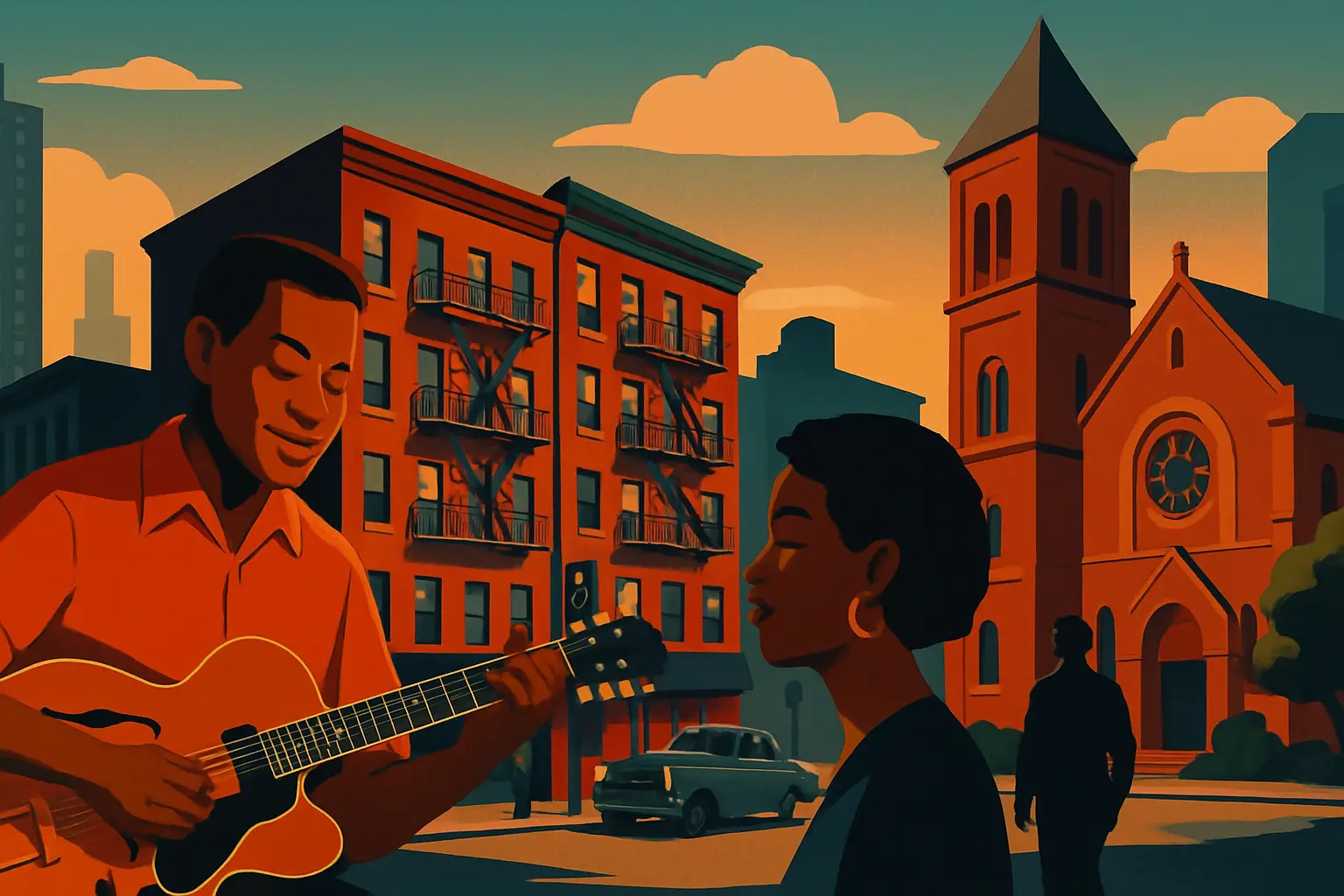
Bronzeville sits on Chicago's Near South Side, roughly between 26th and 51st Streets, between the Dan Ryan Expressway and the lakefront. Most visitors to Chicago's South Side stop at Hyde Park for the University of Chicago or the Obama Presidential Center and never turn north into the blocks that constituted one of the most significant communities in 20th-century America.
Between roughly 1910 and 1960, this neighborhood was called the Black Metropolis — a name formalized by sociologists St. Clair Drake and Horace Cayton in their landmark 1945 study of the same name, which mapped every block, barbershop, church, and nightclub with the precision of anthropologists documenting a civilization. The name was not rhetorical. Within the narrow boundaries set by restrictive real estate covenants — which legally barred Black residents from buying or renting property in most of Chicago — a community of hundreds of thousands built parallel institutions: independent banks, insurance companies, hospitals, newspapers, and a cultural scene that produced gospel music, the electric blues, and literature that reshaped American fiction.
The covenants were struck down by the Supreme Court in Shelley v. Kraemer in 1948. By then, the Great Migration that built Bronzeville had been running for nearly 40 years.
The First Great Migration (1910–1940) brought an estimated 500,000 Black Americans from the South to Chicago. The migration had real pull factors — industrial wages, the right to vote, escape from Jim Crow violence — but it was accelerated more than anything else by a single newspaper.
The Chicago Defender was founded in 1905 at a kitchen table on State Street by Robert S. Abbott, a Georgia-born printer who arrived in Chicago with almost no money. Within a decade it became the most influential Black-owned publication in American history — remarkable because two-thirds of its readership lived outside Chicago. The paper was shipped south on Pullman railroad cars by Black porters who distributed it along their routes, in defiance of Southern postmasters and police who tried to ban it. In towns where it was banned outright, copies passed hand to hand.
Starting in 1916, the Defender ran explicit front-page campaigns calling Black Southerners to move north — publishing wage comparisons, letters from readers who had already made the trip, and editorials comparing freedom from lynching in Chicago to the reality of Jim Crow in Alabama and Mississippi. The Defender's original 1905 office no longer stands, but the building at 3435 S. Indiana Ave. — where the paper operated for decades — still does. The paper is now online-only, but the building is visible from the street.
Get short, interactive stories that make each place easier to remember while you travel.
In the 1920s and 1930s, 35th Street between State Street and South Parkway (now King Drive) was called the Stroll — the entertainment spine of Black Chicago and one of the most important blocks in American music history. It served the same function as 125th Street in Harlem or Beale Street in Memphis: a concentrated ecosystem of jazz clubs, cabarets, barbershops, tailors, and policy houses that formed a street-level economy entirely outside the white commercial world.
Louis Armstrong arrived on the Stroll in 1922, summoned from New Orleans by cornetist Joe 'King' Oliver to play the Royal Gardens at 459 E. 31st Street. Earl 'Fatha' Hines played the Sunset Cafe at 35th and Calumet. Jelly Roll Morton, Dinah Washington, and Lionel Hampton worked the clubs. The Grand Terrace Ballroom broadcast the Earl Hines Orchestra nationally on NBC Radio throughout the 1930s, carrying the Stroll's sound across the country.
The clubs are gone — most demolished or burned, others replaced by postwar housing that was itself demolished in the 2000s. But the corner of 35th and King Drive still anchors the neighborhood's identity, and the Red Line station name — 35th-Bronzeville-IIT — inscribes that history into the transit system. Stand at that corner and look east: the grid of a jazz-age entertainment district is still readable in the streets.
Thomas A. Dorsey arrived in Chicago from Georgia in the 1910s and spent a decade playing the blues under the name 'Georgia Tom,' most notably accompanying Ma Rainey. After the death of his wife and infant son in 1932, he turned to sacred music and wrote the hymn 'Take My Hand, Precious Lord' — one of the most recorded pieces of American music — in a single sitting while grieving. He developed gospel music at Pilgrim Baptist Church (4301 S. Indiana Ave.), where he served as music director for nearly 50 years. A fire in 2006 gutted the church's interior; the building stands, with restoration ongoing.
Gwendolyn Brooks grew up at 4332 S. Champlain Ave. and spent most of her life in Bronzeville. In 1950 she became the first African American to win the Pulitzer Prize, for Annie Allen (1949) — a poetry collection set explicitly in the neighborhood's streets and rooftops. Richard Wright published Native Son in 1940 while living in Bronzeville, setting the novel in the neighborhood's kitchenette apartments. Both writers lived within blocks of each other in a neighborhood that also housed Muddy Waters, who arrived from Mississippi in 1943 and developed the amplified Chicago blues style in the South Side clubs — a direct influence on rock and roll.
A cluster of commercial buildings on South State Street represents the business infrastructure of the Black Metropolis. The Overton Hygienic Building (3619 S. State St., built 1923) was constructed by Anthony Overton, who ran a cosmetics company and bank at a time no white-owned Chicago bank would serve Black depositors. The Chicago Bee Building (3647 S. State St.) housed the Chicago Bee newspaper and is now a Chicago Public Library branch — one of the most accessible historic buildings to actually enter. The Supreme Life Building (3501 S. King Drive) was headquarters to an insurance company that became one of the largest Black-owned financial institutions in mid-20th-century America.
Three blocks west, the main campus of the Illinois Institute of Technology — designed by Ludwig Mies van der Rohe and built between 1942 and 1958 — occupies a large portion of what was once densely populated residential neighborhood. Crown Hall (3360 S. State St.) is considered one of the defining works of American modernist architecture: a single-story glass-and-steel pavilion housing IIT's College of Architecture. The campus is open to walk, with access from 31st or 35th Street.
The Bronzeville Walk of Fame runs along King Drive from 25th to 51st Street, with bronze plaques honoring neighborhood figures including Ida B. Wells, Louis Armstrong, Gwendolyn Brooks, Jesse Binga, and dozens more. Allow 30 minutes to walk the central stretch between 35th and 47th Street.
Bronzeville is mid-transformation. The Chicago Housing Authority demolished the high-rise public housing towers — including the Robert Taylor Homes and Stateway Gardens, which lined the Dan Ryan corridor for decades — as part of its early-2000s Plan for Transformation. The cleared land is filling slowly with mixed-income developments and new construction, leaving the neighborhood a patchwork of rebuilt blocks and quieter stretches.
For food: Pearl's Place (3901 S. Michigan Ave.) is a neighborhood landmark for soul food — fried chicken, catfish, candied yams, and a dining room that has not changed in decades. Cash preferred, portions generous, open since 1981. Bronzeville Winery (4956 S. Cottage Grove Ave.) serves comfort food alongside locally produced wine, with a patio and regular live music nights — a newer institution in the neighborhood's revitalization story. Harold's Chicken — the South Side institution — has multiple independently owned locations across the area; each operates under the shared menu of chicken fried in lard, served in a paper bag with hot sauce and mild sauce.
The DuSable Black History Museum and Education Center (740 E. 56th Place, in Washington Park) sits just south of Bronzeville, named for Jean Baptiste Point DuSable, the Haitian trader who established the first non-Indigenous settlement at the mouth of the Chicago River in the 1780s. Allow 90 minutes. Combine it with a visit to the Hyde Park neighborhood, which begins half a mile east.
Getting there: The Red Line to 35th-Bronzeville-IIT Station is the fastest route from the Loop — about 10 minutes, $2.50. The Green Line's 43rd, 47th, and 51st Street stops on Cottage Grove cover the neighborhood's south end. Bronzeville is 4 miles south of Millennium Park — close by train, too far to walk from downtown.
How long: A walking tour of the historic corridor — the 3400–3600 blocks of S. State St., the IIT campus, Crown Hall, the Walk of Fame from 35th to 47th Street, and Pilgrim Baptist Church on Indiana Ave. — takes 2–3 hours at a moderate pace. Add 90 minutes for the DuSable Museum. A full day covers everything including lunch.
Best time to visit: Spring and early fall (April–May, September–October) offer the most comfortable walking weather. August brings the Bud Billiken Parade on the second Saturday — more than a million spectators on King Drive; book accommodation weeks in advance. The historic buildings, museum, and library branch are open year-round.
Safety: The tourist-facing corridor — King Drive, the State Street historic buildings, the IIT campus, the DuSable Museum — is actively visited during the day. Use the CTA, stay on the main streets, and visit in daylight hours.