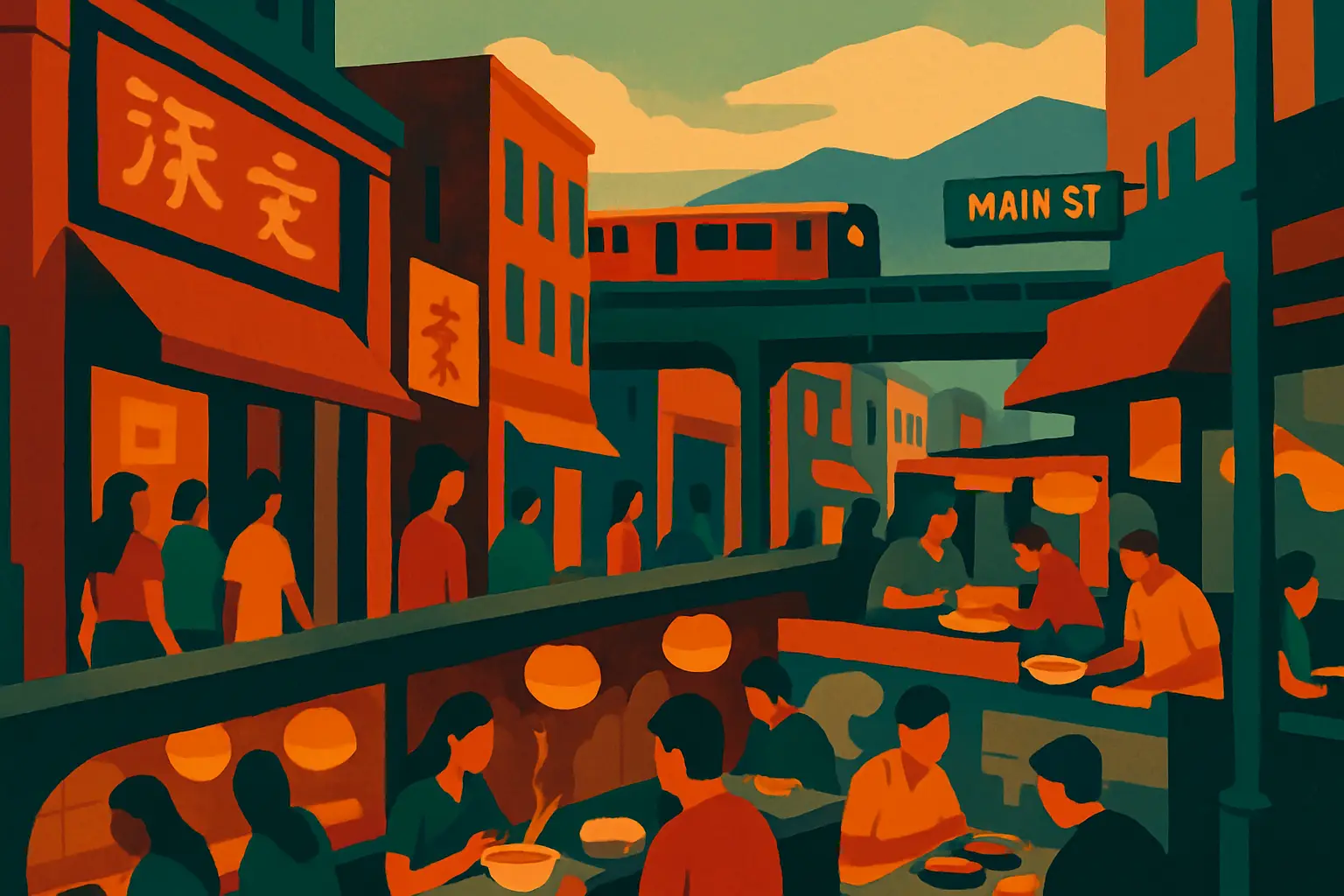
Manhattan's Chinatown, centered on Canal Street, has roughly 50,000 residents and is shrinking. Rents have risen, longtime residents have moved to Queens and Brooklyn, and the neighborhood's commercial core is increasingly tourist-facing — bubble tea shops and roast duck restaurants calibrated for visitors rather than for the community they once served.
Flushing is the opposite. Home to roughly 75,000 Chinese residents — the largest Chinese-American population of any US neighborhood — Flushing's Main Street and Roosevelt Avenue have continued to grow as the neighborhood absorbs new immigrants from mainland China's interior provinces. The result is a food scene that tracks directly with China's own regional restaurant explosion: Sichuan, Hunan, Yunnan, Xi'an, Fujian, Cantonese — not as generic 'Chinese restaurants,' but as restaurants whose menus reflect a specific place and a specific cooking tradition.
The immigration wave that built Flushing began in the 1980s, when changes to US immigration law opened doors to Taiwanese professionals and Hong Kong residents. A second, larger wave from mainland China arrived in the 1990s and 2000s. Today the neighborhood's commercial center — roughly bounded by Main Street, Roosevelt Avenue, and Northern Boulevard — is one of the busiest street-level retail corridors in all five boroughs, most of it conducted in Mandarin and Cantonese.
The Korean immigration story is slightly earlier: the 1970s, when the neighborhood was cheaper than Manhattan's Koreatown on 32nd Street. The Korean business district centered on Union Street — where signs are in hangul and the main language is Korean — operates largely in parallel to the Chinese commercial district, just two blocks away.
The basement level of New World Mall (136-20 Roosevelt Avenue) is the entry point for most visitors to Flushing's food scene — and, for many, the only destination they need. More than 40 stalls line a tiled corridor beneath the mall, each specializing in a specific dish or regional tradition. The air smells of soy sauce, charcoal, and sesame oil, and the room is loud with cooking and the three languages spoken simultaneously.
The stalls work like a hawker center: walk the corridor, point at what you want, pay at that station, eat at communal tables. No service, no English menus at most stalls (photos help), and cash is strongly preferred.
Highlights by section: scallion pancakes and sesame cold noodles near the entrance, cooked on open griddles with a crowd watching. Xinjiang-style lamb skewers — cumin-heavy, charcoal-grilled — one of the few authentic preparations in New York City. Taiwanese shaved ice and tang yuan (rice dumplings in sweet soup) in the back corner. Hand-pulled noodles: watch the cook stretch long ropes of dough before your order hits the wok.
The court is busiest from noon to 1:30 p.m. on weekends. Coming on a weekday morning — stalls open around 10:30 a.m. — is the way to get everything at its freshest and without the crowd.
New World Mall Food Court: 136-20 Roosevelt Ave, B1 level; open daily approximately 10 a.m.-9 p.m.
Cash preferred at most stalls; photos on the menu boards substitute for English descriptions
A full meal for two runs $25-$40 depending on how many dishes you order
Get short, interactive stories that make each place easier to remember while you travel.
Two blocks from New World Mall, the Golden Shopping Mall (41-28 Main Street, basement) is older and more chaotic — a network of tight corridors with stalls that have operated for decades. This is where Xi'an Famous Foods opened before its Manhattan expansion: the biangbiang noodles (broad, hand-torn noodles with chili oil and cumin-spiced lamb) and spicy lamb face salad that became famous on food television were refined in this basement. Xi'an's original Flushing stall is gone, but the stalls that replaced it carry the same tradition — hand-torn noodles from Shaanxi province, a cuisine from China's interior that most American diners have never encountered.
Main Street itself functions as a continuous open-air food market from the subway exit to Northern Boulevard. Vendor carts sell jianbing (Chinese crepes, egg-wrapped with scallion and hoisin), skewered meats and tofu glazed with sauce and grilled on portable charcoal units, fresh-cut dragonfruit and longan, and pineapple cake from Taiwanese bakeries along the block.
Taipan Bakery (135-26 Roosevelt Ave) sells Hong Kong-style egg tarts, cocktail buns, and pineapple buns that make a strong argument for starting the day in Flushing rather than ending it. The egg tarts — flaky pastry shell, silky egg custard — cost about $1.50 each and are best eaten warm on the sidewalk outside.
Xiao long bao — Shanghai soup dumplings — became a New York food obsession after Joe's Shanghai opened in Manhattan's Chinatown in 1995. But Joe's Shanghai's original location was in Flushing (136-21 37th Avenue), and the Queens neighbors who inspired it have been making soup dumplings longer.
Nan Xiang Xiao Long Bao (38-12 Prince Street, second floor) is the standard-setter. The dumplings here are smaller and more delicate than most American versions — thin skins, precisely pleated folds, an interior that holds hot broth and a meatball of seasoned pork, or pork and crab in the premium basket. The crab and pork version ($12-$15 per basket of 8) is the reason to visit. The second-floor dining room is basic and bright; no reservations, so expect a wait on weekends.
The technique matters: use the spoon provided, bite the top corner, tip the dumpling to release the broth into the spoon, sip, then eat with a dab of the ginger-black vinegar dipping sauce. Eating them whole — in one bite — is the fastest way to scald your mouth and identify yourself as a first-timer simultaneously.
Din Tai Fung (second floor of New World Mall) is the Taiwanese chain that standardized the soup dumpling for global export. Its Flushing location serves a more polished product in a more polished room — consistent and excellent if the Nan Xiang queue is discouraging.
Two blocks north of the Chinese commercial district, Union Street between Northern Boulevard and 35th Avenue is the heart of Flushing's Korean business district — grocery stores, karaoke bars, and Korean BBQ restaurants dense enough that the block smells of grilling meat from the sidewalk.
Kang Ho Dong Baekjeong (162-23 Northern Blvd) is named after a Korean wrestling celebrity who opened the original in Seoul. The Flushing location is consistently ranked among the best Korean BBQ in New York — tableside charcoal grills, high-quality cuts (short rib, brisket, pork belly, sliced tongue), and banchan (small shared side dishes) that arrive in waves before and during the meal. Plan 90 minutes here for a full meal; weekend evening waits can reach an hour.
BCD Tofu House (on 35th Avenue nearby) specializes in soondubu jjigae — silken tofu stew, served in a stone pot that keeps the broth boiling at the table. Order it with a level of spice that feels slightly beyond comfortable; it cools down fast. The dolsot bibimbap (stone pot rice bowl) is equally good.
H Mart (136-19 Roosevelt Ave) is the Korean grocery anchor — a large-format store with a prepared foods section and banchan counter that work as a quick meal. The fishcake, kimchi pancakes, and soy-glazed potato banchan from the hot counter run $3-$6 per container.
Kang Ho Dong Baekjeong: 162-23 Northern Blvd; reservations strongly recommended for weekend dinners
H Mart: 136-19 Roosevelt Ave — prepared foods counter, banchan, produce, Korean pantry staples
Norebang (private-room karaoke) venues on Union Street run from late evening past midnight; most charge by the hour
Flushing's restaurant district sits at the edge of Flushing Meadows-Corona Park, the 897-acre park that hosted the 1939 and 1964 World's Fairs — the second-largest park in New York after Pelham Bay, and one of the most overlooked.
The Unisphere, a 140-foot stainless steel globe at the park's center, was installed for the 1964 World's Fair by US Steel as a symbol of global unity and the Space Age. Three orbital rings encircle it, representing the paths of the first human in space (Yuri Gagarin), the first American in space (John Glenn), and the first communications satellite (Telstar). It has never been moved and remains the largest globe structure in the world.
The Queens Museum (inside the park, in a building also used for the 1964 Fair) holds the Panorama of the City of New York — a 9,335-square-foot scale model of all five boroughs, with 895,000 individual structures modeled at 1:1,200 scale. Standing over it is one of the stranger and more affecting experiences available in New York.
Citi Field, home of the New York Mets, sits directly adjacent to the park. A September afternoon baseball game followed by a post-game dumpling dinner in Flushing is one of New York's most satisfying off-itinerary days.
Is Flushing easy to navigate? The food district is compact — the main action runs along Roosevelt Avenue and Main Street for about six blocks, with Union Street's Korean block two blocks north. A half-day is enough to cover it; a full day lets you add the park and a baseball game.
Is Flushing safe? Completely. The main commercial streets are among the busiest in Queens — well-lit, high foot traffic, heavily commercial. Standard urban awareness applies (watch bags in crowds), but there is no specific concern in the food district or park.
When is the best time to go? September and October are ideal: comfortable temperatures, less tourist competition than summer, and the park at its best before winter. Summer weekends are peak-busy at the food courts; arrive early or after 2 p.m. The Chinese New Year celebration in late January or early February is Flushing's biggest annual event and worth a separate trip if you're in New York at that time.
How does this connect to other Queens neighborhoods? The 7 train passes through Jackson Heights on the way from Midtown — a worthwhile stop for South Asian and Latin American food on the same trip. See our guide to Jackson Heights. Astoria, accessible via the N/W train, is the other major Queens food and culture destination — covered in our Astoria neighborhood guide.