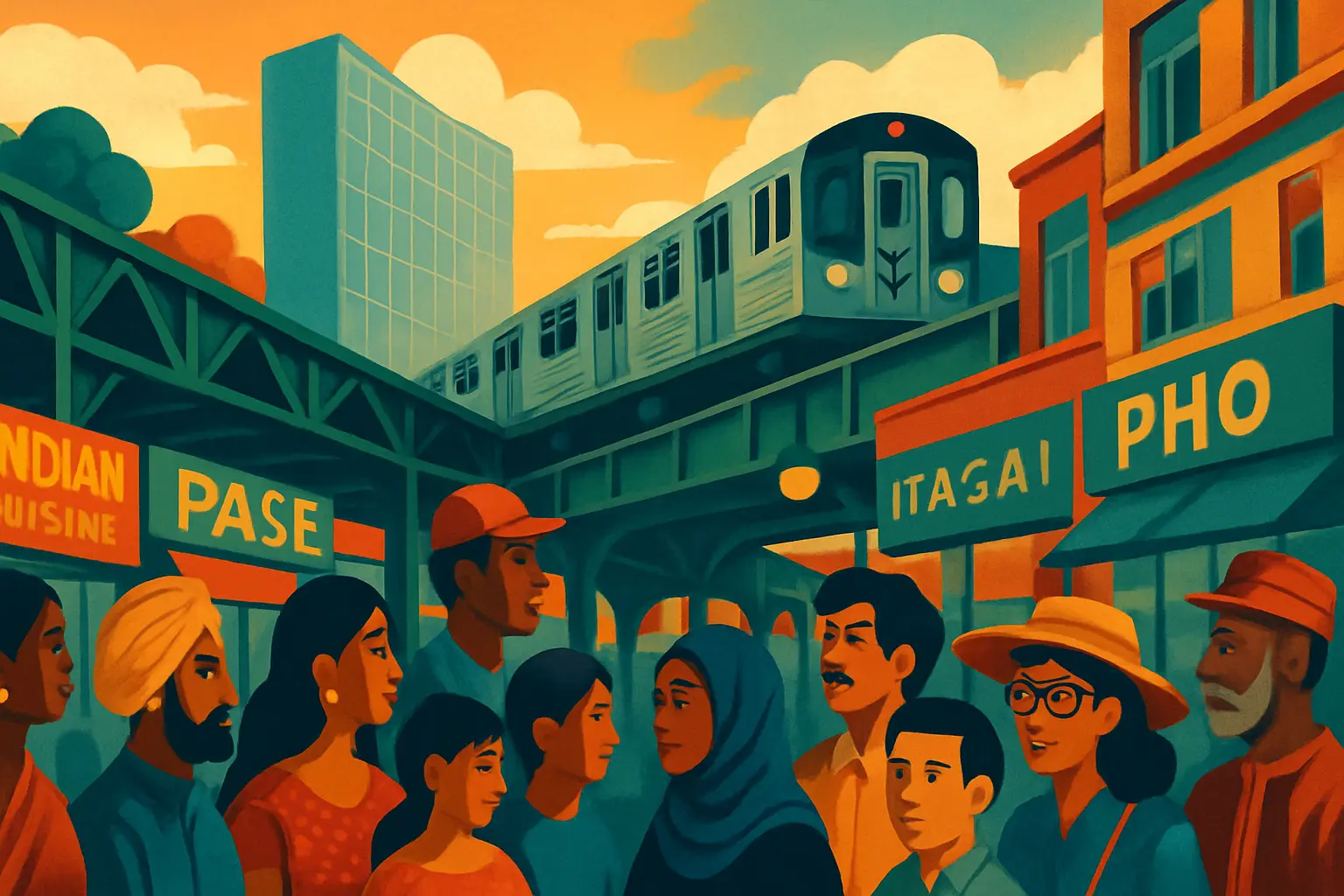
A 2012 study by Daniel Kaufman at Queens College documented more than 160 languages spoken within a two-mile radius of the 74th Street subway station. Subsequent surveys have pushed that number higher. The finding placed Jackson Heights above any other documented location on earth for linguistic diversity — a designation that is both a statistical fact and a lived experience on any given afternoon on Roosevelt Avenue.
Jackson Heights sits in north-central Queens, about four miles east of Midtown Manhattan via the 7 train. Its character comes from immigrant communities that have layered on top of each other since the 1960s, when the Immigration and Nationality Act of 1965 opened U.S. borders to Asian and Latin American immigrants for the first time since 1924. A large South Asian community — Indian, Bangladeshi, Pakistani — built one of the largest Little India corridors in New York along 74th Street. Along Roosevelt Avenue, Colombian, Ecuadorian, Uruguayan, and Mexican communities developed a parallel food and retail economy. Tibetan, Nepali, Afghan, Filipino, and dozens of other communities filled the space between and around them.
For visitors, this density is the proposition. Jackson Heights is the most efficient food tour in New York City. Unlike the planned 'diversity' of a food hall, it's organic — every storefront is there because a community needed it, not because a developer thought tourists would like it. That distinction shows in the food.
Before the immigrants arrived, Jackson Heights was a real estate experiment. The Queensboro Corporation began developing the area in 1909, with construction accelerating through the 1910s and 1920s. Their model was unusual for New York: large cooperative apartment blocks with shared interior courtyards, modeled loosely on English garden apartment design. The goal was to give middle-class Manhattan commuters something the city couldn't offer — private shared gardens, air circulation on all sides, and direct subway access to Midtown.
The result is a residential grid with a hidden layer. Behind the brick facades on the blocks between 76th and 88th Streets are a series of semi-private courtyard gardens that most visitors never see. Buildings like the Chateau (80th Street between 34th and 35th Avenues, completed 1922) and the Cambridge Court (around Northern Boulevard at 82nd Street) still have their original gardens, sometimes visible through arched passageways from the street.
The Jackson Heights Historic District, designated by the city in 1993, preserves roughly 2,200 buildings from this period. Walking through it — specifically along 35th Avenue between 80th and 86th Streets — is like stepping into a different version of New York: Tudor revival brickwork, iron gates, mature trees, and none of the street-level noise that defines Roosevelt Avenue two blocks south.
That contrast is the neighborhood's defining quality. Jackson Heights was planned as a quiet escape from Manhattan density, then became one of the most densely multicultural neighborhoods in the world. Both realities coexist, separated by two blocks.
Get short, interactive stories that make each place easier to remember while you travel.
Roosevelt Avenue runs east-west under the elevated tracks of the 7 train, which shadows the sidewalk and creates a street that is perpetually loud, slightly dark, and absolutely alive with food. The el blocks direct sunlight through much of the day, which keeps the sidewalk cooler than the surrounding blocks and enables a street-vending culture that runs from midmorning into the evening.
The main draw is Colombian. Empanada vendors line Roosevelt Avenue between 74th and 82nd Streets, selling thick Colombian-style empanadas filled with beef, chicken, or potato-and-egg combinations for $2–$3 each, fried fresh to order. The Arepa Lady — one of the most documented street food figures in New York — started here decades ago with a late-night cart near 79th Street before opening a permanent restaurant at 84-11 Roosevelt Ave. She serves arepas de choclo, the sweet corn cakes stuffed with cheese that bear no resemblance to the dry Mexican tortilla-adjacent arepas most American diners know. The line outside the restaurant version reaches the sidewalk on weekend evenings.
La Gran Uruguay (90-01 Roosevelt Ave) is the anchor of a small but serious Uruguayan restaurant cluster and one of the few Uruguayan restaurants in the entire United States. The chivito al pan — a Uruguayan steak sandwich layered with ham, mozzarella, fried egg, and olives — is what to order. Taqueria Coatzingo (76-05 Roosevelt Ave) represents the Mexican end of the strip: the pastor tacos and huaraches are the benchmark for what Roosevelt Avenue cooking produces at its best.
Arepa Lady restaurant: 84-11 Roosevelt Ave; open Tue–Sun from 5 p.m.; the original late-night cart near 79th St is still the neighborhood legend
La Gran Uruguay: 90-01 Roosevelt Ave; lunch and dinner daily, cash preferred
Taqueria Coatzingo: 76-05 Roosevelt Ave; open daily 7 a.m.–11 p.m.
The commercial district anchored by 74th Street and the surrounding blocks is one of the largest South Asian retail corridors in New York City — built by Indian, Bangladeshi, and Pakistani immigrants who arrived in large numbers after 1965 and found that Queens offered rents and community density that Manhattan could not.
Patel Brothers (37-27 74th St) is the anchor: a large South Asian grocery carrying spices, lentils, fresh produce, specialty snacks, and products that simply do not exist in any mainstream grocery chain. The original Patel Brothers was opened in Chicago in 1974 by two brothers from Gujarat; the Jackson Heights location became one of the chain's busiest. The samosa counter near the entrance — $1.50 for a fried potato-and-pea samosa — is the best $1.50 in Queens.
Diversity Plaza (74th St at 37th Ave), converted from a parking lot to a pedestrian plaza in 2011, is the neighborhood's open-air living room. On weekends, vendors sell chaat, jalebi, grilled corn, and cold drinks from umbrella carts. The crowd — South Asian families, Colombian workers on lunch break, tourists doing exactly what you're doing — is itself the destination.
For sit-down food, Kabab Palace (74-16 37th Ave) has been serving Pakistani-style grilled meats since 1983. The seekh kebabs and chicken boti arrive with naan and mint chutney. Rajbhog Sweets (72-27 37th Ave) makes the area's best mithai — barfi, gulab jamun, peda — and sells savory snacks through the afternoon. Arrive before 2 p.m. when the gulab jamun is still warm.
Patel Brothers: 37-27 74th St; open daily 9 a.m.–9 p.m.; the $1.50 samosa near the entrance is the neighborhood's best quick bite
Diversity Plaza: 74th St at 37th Ave; most active weekends 11 a.m.–5 p.m., free
Rajbhog Sweets: 72-27 37th Ave; closed Tuesdays, all other days 10 a.m.–8 p.m.
In 1993, Jackson Heights hosted one of the first openly gay pride marches in Queens, organized primarily by Latino LGBTQ+ residents at a time when visible queerness inside immigrant communities was rare and often dangerous. The Queens Pride Parade, now held annually every June along 37th Avenue through the neighborhood's commercial district, is one of the most diverse LGBTQ+ events in New York — not because of scale, but because of who marches in it. South Asian, Latin American, African, and Asian LGBTQ+ communities march under the same flags, which is genuinely unusual when Pride celebrations in American cities often remain stratified along lines of race and income.
The neighborhood developed a visible gay commercial district along 74th Street and 37th Avenue in the 1980s, when affordable rents drew LGBTQ+ residents priced out of Chelsea and the West Village. Many of the bars that defined that era are gone, but the neighborhood retains a significant LGBTQ+ presence — particularly within the Latin American community — and Queens Pride remains one of the most genuinely community-rooted events in the city's annual calendar.
For travelers, this history is a useful frame for understanding Jackson Heights as a whole: it is a neighborhood that has absorbed wave after wave of communities and found a way for them to coexist that most American cities have never managed. The LGBTQ+ Latino community and the South Asian Orthodox families and the Colombian food vendors and the Tibetan monks use the same 7 train home.
How do I get to Jackson Heights from Manhattan? The 7 train (Flushing Local) to 74th Street-Broadway/Jackson Heights/Roosevelt Avenue is the only route worth taking — about 25 minutes from Times Square-42nd Street and a direct shot from Grand Central at 42nd Street. The ride itself is worth noting: the 7 passes through Woodside, Elmhurst, and Corona before reaching Jackson Heights, and the demographic shift in each car is visible. The MTA used to call it the 'International Express.'
Is it easy to walk around? The commercial area is compact and very walkable. Roosevelt Avenue and 37th Avenue are the two parallel east-west spines; 74th Street and 82nd Street are the main north-south connectors. The entire food circuit — Roosevelt Ave vendors, Diversity Plaza, Kabab Palace, Rajbhog Sweets — fits in a 15-minute walk.
How does it connect to other Queens destinations? The 7 train continues east from Jackson Heights to Flushing Meadows-Corona Park (site of the 1964 World's Fair, and the park where the U.S. Open is held at the USTA Billie Jean King National Tennis Center) and Flushing itself, which has one of the largest Chinatowns outside of mainland China. A full day covering Jackson Heights, Flushing Meadows, and Flushing's food scene is a legitimate and excellent Queens itinerary.
Is Jackson Heights safe? The Historic District residential blocks are quiet and safe at any hour. Roosevelt Avenue during the day and early evening is busy urban street — take normal city precautions. The South Asian commercial district around 74th Street is safe throughout business hours. Violent crime rates are among the lowest in Queens.
For more on exploring outer-borough New York, see the Williamsburg guide — a different borough, a different kind of diversity, equally worth the subway ride.