Catalonia has a food culture that predates modern Spain by several centuries. When cookbooks were still rare in most of Europe, the Llibre de Sent Soví (1324) — one of the oldest surviving culinary texts on the continent — was already documenting Catalan techniques for sauces, picades (ground nut-and-herb pastes), and the use of dried fruit and spice combinations in savory dishes. The result is a culinary tradition that feels simultaneously Mediterranean and Alpine, recognizably Spanish in some ingredients but wholly distinct in approach.
The foundational difference is in the building blocks. Catalan cooking is structured around four mother sauces — sofregit (onion and tomato slowly cooked in olive oil until almost jammy), picada (a paste of ground almonds, garlic, herbs, and sometimes stale bread, used to finish stews and thicken braises), romesco (toasted peppers, almonds, and garlic, served with spring onions, fish, or vegetables), and alioli (garlic and olive oil, emulsified without egg into a thick white paste that is entirely different from French aioli). These four elements appear in nearly every classic dish, often in combination.
When you sit down at a serious Catalan restaurant and see a stew thickened with something nutty and dense, a sauce beside the fish that smells of charred pepper, or a bread spread that has no butter anywhere near it, you are tasting a tradition that was not influenced by the French court cooking that reshaped most of Western European gastronomy in the 17th and 18th centuries. Catalonia was doing its own thing.
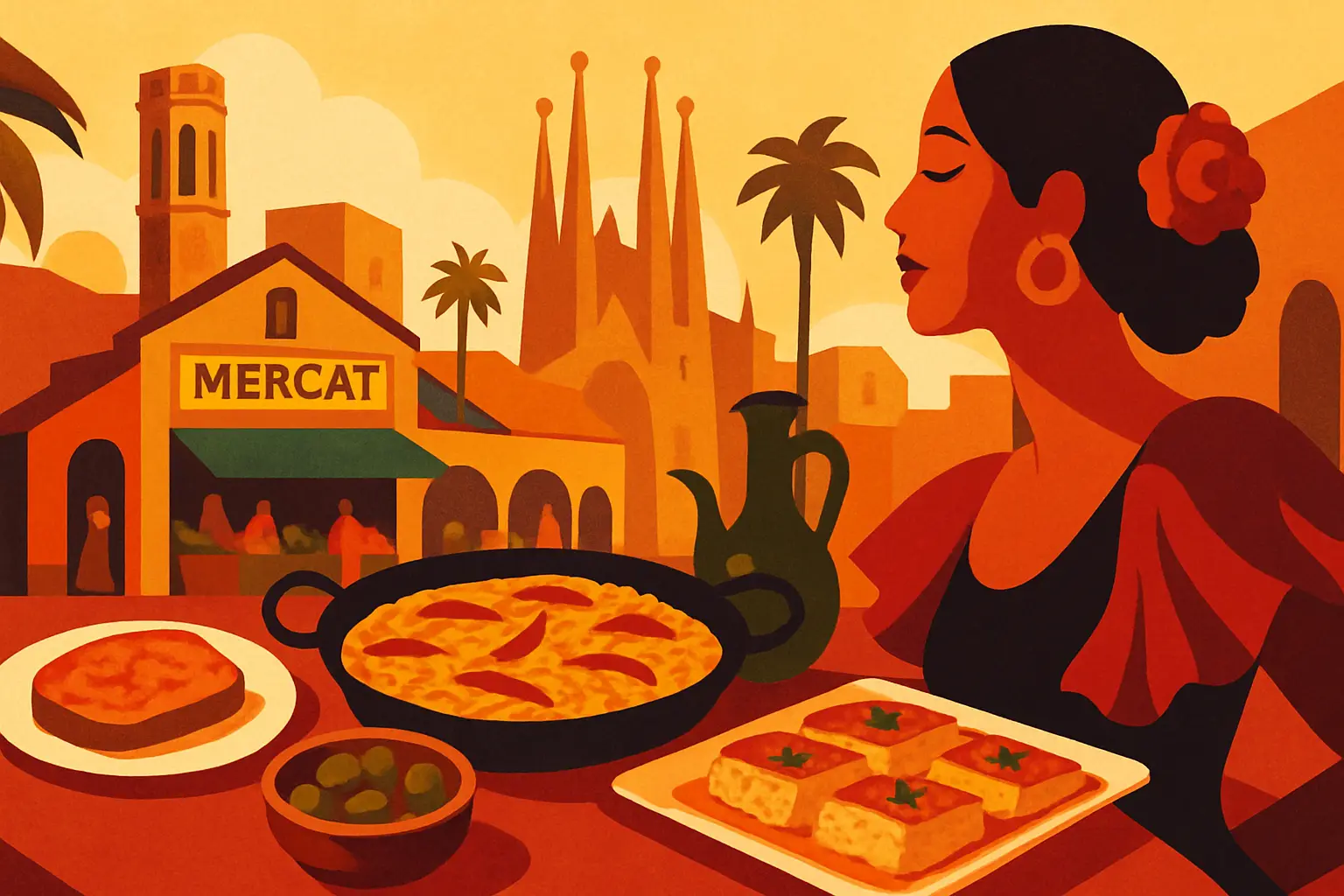
Pa amb tomàquet (bread with tomato) is so fundamental to Catalan food that it constitutes a complete daily ritual, not just a side dish. The process is specific and unremarkable in its simplicity: take a thick slice of pa de pagès (a round, slightly chewy Catalan country bread), rub a ripe tomato directly into the cut surface until the bread is soaked red, drizzle with good olive oil, add a pinch of flaky salt. That is it. No butter, no toppings beyond optional jamón or cheese, no further preparation.
The quality depends entirely on three things: the bread (it must have enough structure to absorb the tomato without collapsing), the tomato (overripe and deeply flavored — the variety used is the tomàquet de penjar, a small, intensely flavored type hung in clusters to dry and ripen), and the olive oil (Catalan, ideally from the Siurana or Les Garrigues denominations). At any serious restaurant in the city you will find bread prepared this way arriving at the table before anything else — sometimes already rubbed, sometimes with the tomato and oil brought separately for you to apply. This is not a starter. It is breakfast, lunch, and the base of every meal.
For the best version in the city, the bakery Forn Baluard (Carrer del Baluard, 38 in Barceloneta) bakes pa de pagès that is specifically designed for tomàquet rubbing — an open crumb that absorbs correctly without turning to mush. The bread is sold whole or by the slice; buy a loaf, take it to any corner shop with ripe tomatoes and olive oil, and make it yourself. The city's best pa amb tomàquet is almost always the one you assemble.
Get short, interactive stories that make each place easier to remember while you travel.
Barcelona's relationship with the sea has always been mediated by its port, and the Barceloneta neighborhood — built in the mid-18th century to house families displaced by the military expansion of the Ciutadella — retains the strongest expression of this seafood culture.
Fideuà is the dish most people associate with Barcelona's seafood tradition, even though it originated in Gandia, a coastal city south of Valencia. The preparation is essentially paella made with short, thin noodles (fideos) instead of rice, cooked dry in a wide shallow pan with cuttlefish, prawns, and a seafood broth. Unlike paella, a properly cooked fideuà develops a socarrat — a slightly caramelized crust of noodles at the base of the pan — that is considered the prize. It is served with alioli on the side. At La Mar Salada (Passeig de Joan de Borbó, 58 in Barceloneta), fideuà is one of the best preparations in the city and served with an understanding of timing — the pan arrives still sizzling, the noodles catching as you eat. Book ahead.
Esqueixada de bacallà is a cold salt-cod salad dressed with olive oil and vinegar, with tomato, black olives, and onion, sometimes with boiled egg and red pepper. It is a summer staple — specific to Catalonia in a way that is easy to underestimate. The bacallà must be desalted overnight in cold water (changed three times) before shredding by hand, which is where the name comes from: esqueixar means to tear or shred. At Bar Bodega Can Cisa (Carrer de la Princesa, 14 in El Born) the esqueixada is house-made from scratch and arrives dressed with a brightness that distinguishes it from perfunctory versions made from over-salted pre-prepared cod.
Cargols a la llauna — snails roasted in a metal tin with garlic, lard, and paprika — appear on traditional Catalan menus and are worth ordering at least once. The snails are small, the flavor earthy and specific. Restaurant La Pepita (Carrer de Muntaner, 86 in Eixample) keeps a traditional Catalan menu and consistently prepares them properly.
Barcelona's vermut culture has undergone a full revival in the past decade after a generation in which it was seen as an old-man ritual. The result is that the city now has two parallel vermut scenes: the genuinely old bars where it never stopped, and a newer generation of bottles-on-a-shelf establishments that have rediscovered it as a lifestyle signifier. Both are worth visiting, for different reasons.
The original, unchanged version lives at Quimet i Quimet (Carrer del Poeta Cabanyes, 25) in Poble Sec — a bar the size of a walk-in wardrobe that somehow fits 30 people standing while one member of the Quimet family prepares montaditos (small open sandwiches on tinned fish, canned vegetables, and condiments) from the extraordinary wall of preserved goods behind the bar. Open only at lunch; closed summers; always packed by 1:30 PM on weekends. The vermut is house-poured and excellent; the montadito with anchovy, roasted pepper, and cream cheese is the canonical order.
In El Born, El Xampanyet at Carrer de Montcada, 22 is the neighborhood's cava institution — house cava semi-sec at €2 a glass, with Cantabrian anchovies and pickles on the bar. Bar del Pla at Carrer de la Montcada, 2 is the reliable year-round alternative when El Xampanyet is on summer closure.
In Sant Antoni — the neighborhood south of Eixample that has become Barcelona's most consistently interesting food area — Bar Calders (Carrer del Parlament, 25) and Bar Bodega Sepúlveda (Carrer de Sepúlveda, 173) run a Saturday and Sunday vermut hour that begins at 1 PM and reaches standing room by 1:30 PM. Vermouth at around €3 a glass, patatas bravas, and the specific kind of afternoon ease that Barcelona does better than almost anywhere.
Barcelona's food scene has shifted significantly in the past five years, with some neighborhoods maintaining authentic culture while others have been reshaped by tourism and rising rents.
**Sant Antoni**: The most interesting neighborhood for food right now. The Mercat de Sant Antoni (Ronda de Sant Antoni, 74) anchors a Saturday morning second-hand book and music market that fills the surrounding streets, while the interior market itself — fully renovated in 2015 after 40 years of closures — is now the best market for produce and fresh fish outside Barceloneta. The blocks south of the market, around Carrer del Parlament and Carrer de Tamarit, have a concentration of good bars and small restaurants with no tourist infrastructure and decent prices.
**Barceloneta**: Still the anchor for seafood, though the beachfront Passeig Marítim restaurants are largely tourist-oriented. Walk one block inland toward Carrer del Baluard for a completely different version — La Cova Fumada, Forn Baluard for bread, and a handful of unfussy fish bars that still serve working-neighborhood prices.
**[Poble Sec](/es/blog/barcelona-el-raval-neighborhood-guide)** (adjacent to El Raval): Carrer de Blai hosts Barcelona's most famous street of pintxos bars — not Basque by origin but a Barcelona interpretation, with oven-grilled bread rounds topped with anchovies, tortilla, and cured meats. Arrive after 7 PM when the pintxos are freshest; skip any bar with a laminated photo menu.
**[El Born](/es/blog/barcelona-el-born-neighborhood-guide)**: Higher prices and more tourist traffic than five years ago, but the core institutions (El Xampanyet, Bar del Pla, La Vinya del Senyor) remain worth visiting. The Mercat de Santa Caterina nearby is the best market alternative to La Boqueria.
**[Gràcia](/es/blog/barcelona-gracia-neighborhood-guide)**: The most genuinely neighborhood-feeling part of Barcelona for eating. Plaça de la Vila de Gràcia and the streets radiating from it have a collection of small restaurants, vermouth bars, and neighbourhood cafés that feel least shaped by tourism. Vermouth at Bar Lluna (Carrer de Verdi, 5) on a Sunday morning is a reliable pleasure.
Crema catalana is, famously, the original from which French crème brûlée derived. The Catalan version predates the French by at least a century — a custard of egg yolk, milk, sugar, lemon zest, and cinnamon, caramelized on top with a hot iron disk (not a blowtorch, traditionally, though both are used now). The texture is softer than crème brûlée, with a less eggy flavor and a more pronounced citrus note. It is eaten cold, just-caramelized, and is available at nearly every traditional Catalan restaurant in the city.
Panellets are small marzipan cookies eaten in Catalonia specifically on La Castanyada — November 1, All Saints' Day — alongside roasted chestnuts (castanyes) and sweet moscatell wine. The classic version is rolled in pine nuts and has an almond-paste interior; variations include coffee, coconut, and chocolate. They appear in bakeries from late September onward and are specific enough to Catalan food culture that finding them outside of the region is genuinely difficult. If you are in Barcelona in September or October, bakeries across the city begin displaying them — Forn de Sant Jaume (Rambla de Catalunya, 50) is one of the best for the pine-nut version.
For bread and pastry more broadly, Catalan breakfasts lean on croissants de mantequilla (butter croissants, made properly with Catalan butter rather than margarine) and ensaïmada — a Mallorcan spiral pastry that has been adopted across Catalonia and appears in every bakery. The croissant at Forn Baluard (Carrer del Baluard, 38) in Barceloneta and at Turris (Carrer de Muntaner, 109) in Eixample are both worth the detour.
Barcelona is more expensive than Madrid but significantly cheaper than Paris or Amsterdam for equivalent quality. The price gap between tourist-facing and local establishments is wider here than in almost any other European city — knowing which side to eat on matters more than in most places.
Café amb llet (café con leche) at a neighborhood bar: €1.80–€2.50 standing at the bar; €3–€4 at a table
Pa amb tomàquet with jamón: €5–€8 at a normal bar; €12–€18 at tourist-facing establishments near La Rambla
Menú del día (3 courses, wine, water, bread), Monday–Friday lunch: €13–€18
Bomba at La Cova Fumada: €2.50 each
Glass of house vermut at a neighborhood bar: €2.50–€3.50
Cava glass at El Xampanyet: around €2
Fideuà for two (as a shared main): €22–€32 depending on restaurant
Fresh seafood tasting menu at a serious Barceloneta restaurant: €55–€90 per person
Fruit cup at La Boqueria: €5–€8. Same fruit at Mercat de Santa Caterina: €1.50–€2.50. This captures the full spread.
Pintxos on Carrer de Blai: €1.50–€2.50 per piece; dinner for two with drinks €18–€28
The comparison is a category error — Barcelona and Madrid have entirely different food identities and are not competing on the same terms. Madrid is a landlocked city built around a royal court that pulled the best of every region toward it; its food is comfort-focused, hearty, and specific to Castile in a way that is easy to overlook. Barcelona is a Mediterranean port city with a Catalan culinary tradition that predates Spain as a political entity; its food is more varied in technique, more influenced by the sea, and more shaped by a market culture that still functions as the city's daily infrastructure.
If you can only go to one, the decision depends on what you want to eat. For stewed meat, offal, fried squid, and the ritual of Sunday cocido, Madrid wins without question. For raw and cured seafood, vermut culture as a daily institution, market produce, and a dessert tradition that includes genuine crema catalana, Barcelona is the stronger option. For wine at the table, both cities are well served — Madrid by the Ribera del Duero and Rioja producers that dominate the capital's wine lists; Barcelona by the Penedès, Priorat, and Terra Alta denominations that feel more integrated into the city's daily life.
The sharpest practical difference is price transparency: in Barcelona, the tourist tax on food in the wrong restaurant is steeper. A place with menus in four languages within 100 meters of La Rambla will charge three to four times what a place two blocks further into the El Raval or El Born side streets charges for equivalent quality. The distance is rarely more than five minutes on foot.