El Raval sits on the western side of Las Ramblas, directly across from the Gothic Quarter. The name Barrio Chino was coined in 1925 by a journalist named Francesc Madrid who needed a shorthand for the neighborhood's density and marginal reputation. He borrowed the term from San Francisco, where 'Chinatown' already carried connotations of a crowded, vice-adjacent district. There were no Chinese residents in El Raval. The name took hold anyway — appearing in guidebooks, newspaper columns, and tourist literature for the next seven decades.
The neighborhood was genuinely rough by the standards of most eras: overcrowded tenements in streets that hadn't been widened since the medieval period, an active sex work industry, bars operating as fronts for other businesses, and a population of migrants, sailors, day laborers, and artists who lived here because rent was low and oversight was minimal. George Orwell stayed somewhere in these streets during the Spanish Civil War while writing what became Homage to Catalonia (1938). He described them as the densest slum he had ever encountered — and also described the anarchist political culture he found there with something close to admiration.
The transformation began in the 1990s as part of Barcelona's pre-Olympics renovation. The city demolished a section of the medieval street grid to create Rambla del Raval, a wide pedestrian boulevard where tenements had stood. It invested heavily in cultural institutions, restored key buildings, and began referring to the neighborhood by its older name. Raval comes from the Arabic word for suburb — a reminder that this land sat outside the city's medieval walls before the 14th century, when the new defensive perimeter finally enclosed it. The Arabic name had been the neighborhood's real name all along.
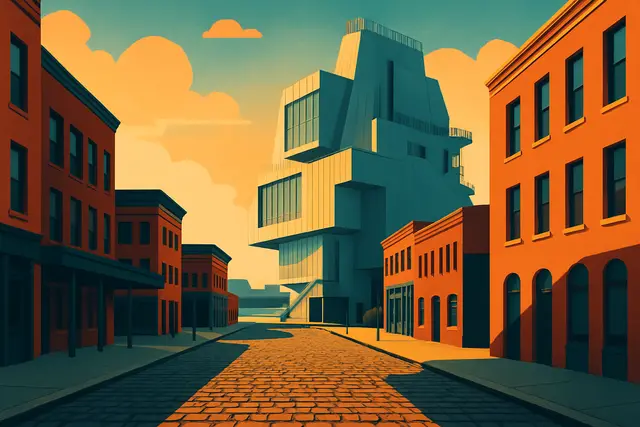
When the American architect Richard Meier's design for the Museu d'Art Contemporani de Barcelona (MACBA) opened in 1995 at Plaça dels Àngels, 1, it created something physically unusual in El Raval: a large, flat, open square in a neighborhood that had none. The building is deliberately white — a contrast to the stone-colored streets around it — and Meier designed it to read as an institution arriving in the neighborhood rather than growing organically from it.
The MACBA collection covers art from the 1950s to the present, with particular depth in Spanish and Catalan work from the late Franco period through the democratic transition. This is art that was politically charged in its own moment and remains underrepresented in international museums. The building's long ramp and glass galleries allow natural light to shift across the ground floor throughout the day.
Directly adjacent, the Centre de Cultura Contemporània de Barcelona (CCCB) occupies a converted 19th-century poorhouse — the Casa de la Caritat — with a glass wall added in 1994 that reflects the Gothic Quarter rooftops across its courtyard. The CCCB runs exhibitions, film programs, and performing arts events year-round; September marks the opening of the autumn cultural season and typically features the institution's most ambitious programming. Together, MACBA and the CCCB created a de facto arts district around Plaça dels Àngels that is the primary reason visitors come to El Raval at all. The long flat marble expanse in front of MACBA has been one of Europe's most recognized street skating spots since the day the building opened.
Get short, interactive stories that make each place easier to remember while you travel.
Most visitors to Barcelona go to the Sagrada Família or Park Güell. Far fewer visit Palau Güell at Carrer Nou de la Rambla, 3–5, which is where Gaudí's relationship with his primary patron Eusebi Güell actually began — and where you can see what Gaudí was doing before he had the freedom to do whatever he wanted.
Güell commissioned the building as his private residence in 1886, when Gaudí was 34 and already experimenting with parabolic arches and the structural innovations that would define his later work. The facade on Carrer Nou de la Rambla is restrained — wrought iron gates, dressed stone, Venetian Gothic details. The interior opens into a six-story central hall topped by a parabolic dome perforated with small circular windows. During the day, light enters through those openings and moves across the dome as the sun shifts. The effect draws from Moorish architecture, which Gaudí had studied directly in southern Spain and which runs as an influence through most of his early buildings.
The rooftop terrace is the building's most unexpected space: 20 chimneys, each individually clad in broken ceramic mosaic (trencadís), the technique Gaudí later developed extensively at Park Güell and Casa Batlló. Standing on the rooftop, you are looking at an early prototype of one of the most visually distinctive ideas in Spanish architecture, assembled above the same streets that were described as unredeemably bleak 40 years later. Palau Güell was declared a UNESCO World Heritage Site in 1984, grouped with Gaudí's other major works across the city.
At Carrer de Sant Pau, 101, the church of Sant Pau del Camp is one of the oldest surviving buildings in Barcelona. The main structure dates to the 12th century — Romanesque arches, a small cloister with carved Visigothic-influenced capitals, and stonework that predates the Gothic Quarter by several hundred years. It functions as a working parish church and is open to visitors. The name means 'Saint Paul of the Field,' because when it was built, there was nothing else here — just farmland outside the city wall.
At Carrer de l'Hospital, 56, the Antic Hospital de la Santa Creu served as Barcelona's main hospital from 1401 until 1930, when the new Hospital de Sant Pau (designed by Lluís Domènech i Montaner, Gaudí's most prominent rival) finally replaced it. The Gothic halls and garden courtyard now house the National Library of Catalonia and a public garden that operates as one of El Raval's quieter spaces. Antoni Gaudí died inside this complex on June 10, 1926, after being struck by a tram on the Gran Via — he was brought here unrecognized, his worn clothing leading staff to assume he was a poor laborer. His identity was confirmed only later.
El Raval's food options span a wider range than almost any other neighborhood in Barcelona, reflecting its layered demographic history. The blocks around Carrer de Joaquín Costa carry the neighborhood's bar culture — low-lit spaces, cheap vermouth and craft beer, a mix of older Catalan residents and the younger creative community that moved in around the cultural institutions. This street activates from around 7pm and stays busy into the early hours.
Rambla del Raval, the wide boulevard built by demolishing the old Barrio Chino blocks in 2000, is anchored at its southern end by a large bronze cat by the Colombian sculptor Fernando Botero — one of the rotund, inflated figures that appear in his work worldwide. The boulevard is lined with café terraces and considerably more local in feel than the nearby Ramblas. The surrounding streets hold a concentration of Pakistani, South Asian, and North African restaurants representing communities who moved into the neighborhood during the 1990s and made it a permanent part of El Raval's identity.
For a specific lunch stop: Bar Cañete at Carrer de la Unió, 17 opened in 2011 and serves high-quality traditional Catalan cooking — salt cod with honey and pine nuts, botifarra sausage with white beans, pa amb tomàquet — in a long dining room that still functions as a neighborhood bar rather than a tourist destination. Book ahead; it fills quickly every weekday.
La Boqueria at Rambla, 91 has operated as a market in various forms since the 13th century, which makes it a genuine historical institution. It also receives up to 50,000 visitors per day in peak season, which has made it functionally unusable as a food market for the people it was originally built to serve.
Barcelona addressed this in 2016 by banning guided tours from entering the market and capping the percentage of stalls that can be tourist-oriented. The measures helped somewhat. The market is still best understood as two separate operations: the tourist-facing front section near the Rambla entrance, where prepared fruit cups, fresh seafood displays, and candy stalls capture walk-by traffic at high margins; and the operational back of the market, where fish counters, charcuterie vendors, and produce stalls sell at prices that make sense for restaurants and local residents.
For visitors staying nearby — in El Born or the Gothic Quarter — La Boqueria remains a useful grocery resource if you arrive early on a weekday. As a standalone sightseeing attraction, it rewards visitors who move past the entrance display and spend time with the working stalls at the back, where the actual market is still operating.
Yes — with the same situational awareness you'd use in any dense urban neighborhood. El Raval has a higher rate of petty theft than Barcelona's residential neighborhoods: pickpocketing and phone snatching happen most frequently around La Boqueria and the Ramblas border. Keep your phone in a front pocket, use a bag with a zip closure, and pay attention around ATMs. The streets around MACBA, Palau Güell, and the museum district are active during the day and safe. Carrer de Joaquín Costa at night is well-trafficked and safe by any reasonable standard. The blocks immediately adjacent to the Ramblas on El Raval's eastern edge are the highest-density tourist zones and therefore the most active for opportunistic theft. El Raval is not a neighborhood to avoid — it is a neighborhood to walk through with standard urban attention rather than tourist inattention.
September and October are the strongest months for El Raval. The summer crowds thin significantly after La Mercè (Barcelona's largest city festival, late September — see the full guide), temperatures drop into a comfortable range for walking, and the cultural programming at MACBA and the CCCB shifts into its autumn season — typically the most ambitious of the year. Spring (March–May) is the other strong window. August is the most crowded month in the city overall and the least comfortable for extended street walking.
The nearest metro stop is Liceu (L3, green line), which deposits you on the Ramblas at El Raval's eastern edge — two minutes on foot to MACBA and five minutes to Palau Güell. The Sant Antoni stop (L2, purple line) covers the western side of the neighborhood. Both are on the T-Casual 10-trip metro card, which is the standard way to use Barcelona's metro.
Best months: September–November and March–May.
Liceu (L3) for MACBA, CCCB, and La Boqueria. Sant Antoni (L2) for Rambla del Raval and the western neighborhood.
MACBA and CCCB closed Mondays. Palau Güell closed Mondays. La Boqueria open Monday–Saturday, closed Sundays.
El Raval is 10–15 minutes on foot from El Born and the Gothic Quarter — walkable across the Ramblas without any transit.